TL;DR: When an illegally parked delivery vehicle blocks your path, slow down, check behind you, and signal before moving into the roadway if needed. Pass only when safe, leaving space for doors, mirrors, cargo, and workers. Do not squeeze between the vehicle and the curb or use the sidewalk. If you cannot pass safely, stop and wait. Liability may apply if illegal parking contributes to injuries.
Highlights:
- Brake early and cover your levers to avoid last-second swerves.
- Scan for reverse lights, turning wheels, opening doors, and active unloading.
- Pick your pass route well before the truck blocks your sightlines.
- Start merging left before the rear bumper, in one smooth line.
- Use the mirror test – if you cannot see the driver, assume unseen.
- Hold a steady lane position past the whole obstruction, not truck-by-truck.
- Re-enter the right side only after clearing the front and unloading area.
Tip: If a crash or near-miss happens, photograph the truck, plates, company markings, and curb signs, get witness contacts, and stick to observable facts when reporting.
Table of Contents
Cyclists can safely navigate around illegally parked delivery vehicles by slowing down, checking traffic, signaling, and moving left only when a safe gap is available. Leave enough clearance for doors, mirrors, cargo, workers, and sudden vehicle movement.
Do not squeeze between the vehicle and the curb or pass through an active loading area. If you cannot pass safely, stop and wait behind the vehicle.
Treat every stopped delivery vehicle as an active hazard. Watch for blind spots, opening doors, reversing, turning, or pulling into traffic.
Where Can Illegally Parked Delivery Vehicles Block Cyclists?
Delivery vehicles can obstruct cyclists in several parts of the roadway, not only in designated bike lanes. Whether a particular stop is illegal may depend on posted signs, curb markings, local ordinances, and the surrounding road conditions. Common examples include:
- Inside a bike lane: A truck may block a marked bike lane where parking or stopping is prohibited, forcing cyclists into the travel lane.
- Beside another parked vehicle: A double-parked truck can leave cyclists with no safe space along the right side of the road.
- On a shoulder or curbside riding area: A truck may block the portion of a road that cyclists normally use, particularly where signs or curb markings prohibit parking.
- Near an intersection or crosswalk: A vehicle parked illegally near a corner can block a cyclist’s path and limit visibility between cyclists, drivers, and pedestrians.
- Across a driveway or curb ramp: A delivery stop may force cyclists to move abruptly around the truck while vehicles or pedestrians enter and leave the area.
- At a bus stop or restricted loading zone: A truck stopped where it is not authorized may push cyclists, passengers, or other pedestrians into buses or moving traffic.
- On a sidewalk, bicycle path, or separated bikeway: A vehicle that extends into these spaces may force cyclists toward pedestrians, fixed barriers, or the roadway.
Each situation creates different hazards. Cyclists should identify the truck’s position, watch for moving traffic and unloading activity, and pass only when there is enough room to do so safely.
How To Safely Bypass A Delivery Truck That Is Parked Illegally
An illegally parked delivery truck may block a bike lane, shoulder, curbside riding area, shared lane, or part of the travel lane. Safely passing it may require you to move farther into the roadway. Do not wait until you are directly behind the truck to react. Slow down early, identify the hazards around it, and move only when the surrounding traffic gives you enough time and space.
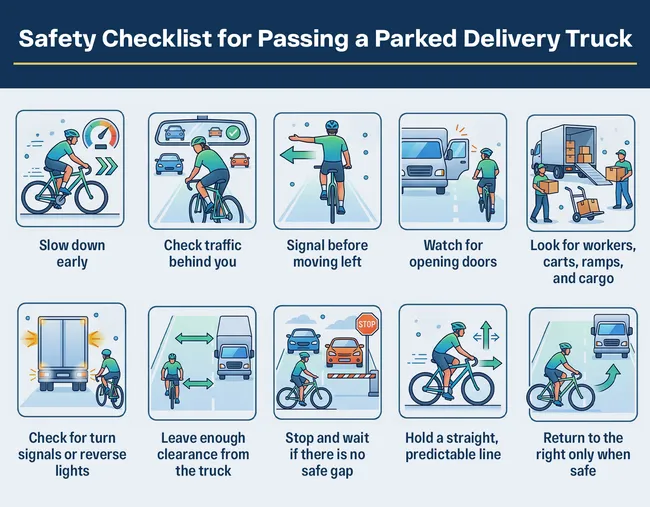
Use the following steps to bypass the truck safely:
-
Slow Down Before Reaching The Truck
Reduce your speed as soon as you notice the obstruction. Slowing early gives you more time to check traffic, identify an escape route, and stop if passing is unsafe. Keep your hands near the brake levers and avoid approaching so quickly that you must swerve at the last second.
-
Look For Signs That The Truck May Move
Treat the truck as an active hazard, even if it appears parked. Watch for:
- Turn signals, brake lights, or reverse lights.
- Wheels beginning to turn.
- A driver entering or leaving the cab.
- Side or rear doors opening.
- Workers unloading packages, carts, ramps, or equipment.
- Pedestrians stepping around the truck.
- Cargo, mirrors, or liftgates extending into your path.
If the truck begins to pull away, reverse, or turn, remain behind it until its direction is clear.
-
Identify Where You Will Ride Around It
Your safest route depends on where the truck is parked. A truck blocking a bike lane or shoulder may require you to merge into the adjacent travel lane. A double-parked truck may require you to move farther left or wait for traffic to clear. Near an intersection or crosswalk, the truck may block your view of turning vehicles and pedestrians.
Choose your route before beginning the maneuver. Do not enter an intersection, crosswalk, or opposing traffic lane unless you can clearly see that the path is safe.
-
Check Traffic Behind And Beside You
Look over your left shoulder for approaching vehicles, motorcycles, and other cyclists. Check more than once if necessary, but keep your bicycle moving in a straight line while looking back.
Do not assume that a driver will slow down or allow you to merge. Wait for a gap that gives you enough room to move over gradually without forcing another road user to brake or swerve.
-
Signal Before Moving Left
Signal your intention if another vehicle may be affected. In California, a left-hand signal is made by extending your left arm horizontally. Signaling tells drivers what you plan to do, but it does not give you the right of way. Check again before moving.
The California Vehicle Code requires a cyclist leaving a bike lane to ensure the movement can be made with reasonable safety and to signal when another vehicle may be affected. CVC §§22107 and 22111 also govern safe roadway movements and hand signals.
-
Move Into The Roadway Gradually
Begin moving left before you reach the back of the truck. Merge in one smooth, gradual line rather than swerving sharply around the vehicle.
Move far enough into the roadway to avoid the truck’s doors, mirrors, cargo, workers, and unloading equipment. California law does not establish a universal minimum distance for cyclists passing a parked truck, so use enough clearance to remain outside the reach of its doors and equipment.
-
Stay Visible While Passing
Avoid riding directly beside the truck for longer than necessary. The driver may not see cyclists located near the truck’s front, rear, or sides. If you cannot see the driver in the truck’s mirror, assume the driver may not see you.
Keep your speed controlled and continue watching the truck’s wheels, lights, doors, and cab. Be prepared to brake if the vehicle starts moving or someone steps into your path.
-
Do Not Squeeze Between The Truck And The Curb
Never pass on the right by riding through a narrow gap between the truck and the curb. The driver may open a door, begin unloading, pull toward the curb, or turn right. Workers, packages, ramps, and delivery carts may also block the space.
Do not ride onto the sidewalk simply to avoid the truck. Sidewalk riding may be restricted by local law and can put pedestrians at risk.
-
Maintain A Straight And Predictable Path
Once you move into the travel lane, hold a steady line. Do not weave back toward the curb between closely parked vehicles or multiple delivery trucks. Drivers may not expect you to disappear behind one vehicle and suddenly re-enter traffic around the next.
If another obstruction is visible ahead, remain in a safe roadway position until you have passed the entire blocked area.
-
Return To The Right Only When Safe
Do not move back immediately after passing the truck. First, clear the front bumper, doors, mirrors, cargo, and unloading area. Check over your right shoulder for cyclists, vehicles, and pedestrians. Signal if another road user may be affected, then move back gradually.
If you were riding in a bike lane, return only after confirming that the lane is clear and that another parked vehicle will not force you to merge again immediately.
-
Stop And Wait If You Cannot Pass Safely
You do not have to force your way around the truck. If traffic is too heavy, visibility is blocked, or workers are actively unloading, slow or stop in a safe position behind the vehicle. Wait until the truck moves or a safe gap becomes available.
A delayed trip is safer than entering traffic without enough room to complete the maneuver.
When California Law Allows Cyclists To Move Left
CVC §21208 permits a cyclist to leave a bike lane when reasonably necessary to pass another vehicle or avoid debris and hazardous conditions. The cyclist must wait until the movement can be made with reasonable safety and signal if another vehicle may be affected.
On roads without bike lanes, CVC §21202 permits cyclists to move farther from the right edge when reasonably necessary to avoid vehicles, fixed objects, pedestrians, surface hazards, and lanes too narrow for a bicycle and vehicle to travel side by side safely. This rule may allow a cyclist to move farther into the travel lane to maintain safe clearance from an illegally parked delivery truck.
The Hidden Dangers Of Passing A Parked Delivery Vehicle
An illegally parked delivery vehicle can create hazards wherever it blocks a cyclist’s path. These obstructions can contribute to common bike accidents, including dooring, sideswipe, and sudden-swerve crashes. A truck may force a cyclist out of a bike lane, away from the shoulder or curb, farther into a shared travel lane, or around an active loading area. It may also block the cyclist’s view of traffic, pedestrians, driveways, crosswalks, and intersections.
Opening Doors And Active Loading Areas
A delivery driver or worker may open a cab, side, or rear door without seeing an approaching cyclist. Workers may also step into the cyclist’s path or place packages, carts, ramps, liftgates, and other equipment beside the vehicle.
California Vehicle Code §22517 prohibits opening a vehicle door on the traffic side unless it is reasonably safe and can be done without interfering with moving traffic. However, cyclists should not assume that a driver or worker has checked before opening a door.
There is no universal four-foot clearance requirement for a cyclist passing a parked vehicle. Leave enough space to remain outside the reach of opening doors, extended mirrors, liftgates, cargo, and workers. The necessary distance depends on the vehicle and the surrounding conditions.
Blind Spots Around Delivery Trucks
Large delivery trucks have significant blind spots along their sides, immediately behind them, and near the front of the cab. Mirrors reduce these blind spots but do not eliminate them.
If you cannot see the driver’s face in the truck’s side mirror, assume the driver cannot see you. Avoid lingering beside the truck, but do not rush past it. Pass at a controlled speed only when you can maintain visibility, clearance, and a safe route away from the vehicle.
Sudden Vehicle Movement
A delivery vehicle that appears parked may begin moving without warning. Watch for:
- Brake lights, turn signals, and reverse lights.
- Wheels beginning to turn.
- A driver entering the cab.
- Closing doors or workers finishing a delivery.
- Engine noise or movement away from the curb.
- Signs that the truck may reverse, turn, or pull into traffic.
If the vehicle begins moving, remain behind it until its direction is clear. Never squeeze between a delivery truck and the curb when the truck may turn right or move toward the curb.
Blocked Sightlines
A delivery truck may prevent cyclists and drivers from seeing each other. This is especially dangerous near intersections, crosswalks, driveways, alleys, bus stops, and parking-lot entrances.
Slow down before passing the truck and look for vehicles or pedestrians emerging from behind it. Do not enter an intersection or opposing lane unless you can clearly see that your route is open.
Dooring, sideswipe, turning, and sudden-swerve crashes can cause head injuries, fractures, spinal injuries, and other serious harm. If unsafe parking or failure to check for cyclists contributes to a crash, responsibility depends on each person’s conduct and the available evidence.
In California, 35 percent of fatal bicycle crashes occurred on principal arterials. This figure describes where fatal crashes occurred and does not establish that every principal arterial presents the same level of risk.
Data Transparency Note: This article uses SafeTREC’s 2025 “Traffic Safety Facts: Bicycle Safety,” released in October 2025. The roadway-location figure is based on the data identified in that report. We update this content when newer, more reliable information becomes available.
Who Is Liable When An Illegally Parked Delivery Vehicle Causes A Crash?
Liability depends on where the delivery vehicle was parked, which law or restriction applied, how the parking created a hazard, and whether that hazard contributed to the cyclist’s injuries. Potentially responsible parties may include the driver, the driver’s employer, a delivery contractor, the vehicle owner, or another business involved in the delivery.
Liability Of The Delivery Driver
A delivery driver may be negligent for stopping or parking where stopping or parking is prohibited or unsafe. Depending on the location, the driver may have violated:
- A posted no-parking or no-stopping restriction.
- A red curb or other curb restriction.
- A rule against double parking.
- A prohibition on blocking a sidewalk, crosswalk, intersection, or driveway.
- A local rule governing loading zones or commercial deliveries.
- A law governing driving or stopping in a bikeway.
A parking violation does not automatically establish complete liability. The injured cyclist must still show that the driver’s conduct contributed to the crash and caused compensable harm.
A statutory or ordinance violation may support a rebuttable presumption that the driver failed to exercise due care when the requirements of California Evidence Code §669 are satisfied. Negligence per se is a doctrine used within a negligence claim, not a separate claim by itself.
Liability Of An Employer Or Delivery Company
An employer may be vicariously liable when an employee causes a crash while acting within the scope of employment. For example, the employer may share responsibility when its employee creates an unsafe obstruction while making an assigned delivery.
However, the company named on the package or truck may not necessarily be the driver’s employer. The driver may work for a contractor, delivery partner, franchisee, or another business. Employment records, delivery agreements, vehicle ownership documents, dispatch records, and evidence of control may help identify the responsible entity.
A company could also face direct negligence allegations arising from its own conduct, such as unsafe delivery policies, inadequate training, or instructions that encourage drivers to stop at prohibited locations. Whether such a claim applies depends on the evidence.
Other Potentially Responsible Parties
Depending on the circumstances, responsibility may also involve:
- A contractor who employed or supervised the driver.
- The owner of the delivery vehicle.
- A business that directed the driver to use an unsafe unloading location.
- A property owner whose loading arrangements created an unreasonable hazard.
- Another driver whose conduct contributed to the collision.
Comparative Negligence
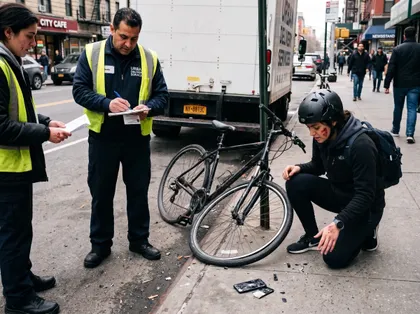
California follows pure comparative negligence. The cyclist’s percentage of fault may reduce a cyclist’s compensation, but partial fault does not automatically prevent recovery.
For example, if a cyclist sustained $100,000 in damages and were found 20% responsible, the cyclist’s recovery would generally be reduced to $80,000. The actual allocation of fault depends on the evidence and circumstances.
Commercial insurance carriers fight these claims hard. Attorneys who handle complex commercial cases can make a real difference. Many cyclists ask a bicycle accident lawyer for free advice. They do this before talking to the delivery company’s adjuster. This helps them understand their options.
Frequently Asked Questions About Illegally Parked Delivery Vehicles
Illegally parked delivery vehicles can obstruct cyclists in bike lanes, on shoulders, in shared travel lanes, at curbside, and elsewhere on the roadway. These answers explain how California cyclists may navigate common obstructions and what may happen when unsafe parking contributes to a crash.
Can I Move Farther Into The Roadway To Pass A Parked Delivery Vehicle?
California law may permit a cyclist to move farther into the roadway when reasonably necessary to avoid a parked vehicle, obstruction, opening door, pedestrian, surface hazard, or lane that is too narrow to share safely.
When leaving a bike lane, CVC §21208 requires the cyclist to wait until the movement can be made safely and to signal if another vehicle may be affected. On a road without a bike lane, CVC §21202 allows cyclists to move away from the right edge when reasonably necessary to avoid parked vehicles and other unsafe conditions.
What Should I Do If There Is No Safe Gap To Pass?
Slow down or stop in a safe position behind the delivery vehicle. Do not force your way into moving traffic, squeeze between the vehicle and the curb, or use the sidewalk to bypass it. Wait until the vehicle moves or a safe gap becomes available.
Is It Legal To Leave A Bike Lane To Pass A Parked Delivery Vehicle?
Yes. CVC §21208 allows a cyclist to leave a bike lane when reasonably necessary to pass another vehicle or avoid debris and hazardous conditions. Before leaving the lane, make sure the movement can be completed safely. Signal if another vehicle may be affected.
What If The Delivery Vehicle Blocks A Shoulder Or Road Without A Bike Lane?
Slow down, check traffic behind and beside you, and determine whether you can move farther left safely. CVC §21202 permits cyclists to move away from the right edge when reasonably necessary to avoid parked vehicles, opening doors, pedestrians, fixed objects, and other unsafe conditions.
Can A Delivery Company Be Responsible If Its Driver Parked Illegally?
Possibly. An employer may be responsible when its employee causes a crash while acting within the scope of employment. However, the responsible business may be a contractor, delivery partner, vehicle owner, or another company rather than the brand displayed on the vehicle or package.
What Happens If A Delivery Driver Opens A Door Into My Path?
CVC §22517 prohibits opening a vehicle door on the side available to moving traffic unless doing so is reasonably safe and does not interfere with traffic. The person who opened the door may be liable if the action contributed to the crash. An employer may also be responsible when the person was an employee acting within the scope of employment.
Fault still depends on matters such as visibility, the cyclist’s position and speed, available clearance, and the evidence from the scene.
Do Lawyers Only Get Paid If They Win A Bicycle Accident Case?
Many personal injury lawyers handle bicycle accident cases on a contingency-fee basis. In this setup, the lawyer usually receives a fixed percentage only when the client secures a settlement or judgment. Responsibility for court costs and other case expenses depends on the written fee agreement.
Contact A California Bicycle Accident Lawyer
Delivery-company GPS data, dispatch records, delivery timestamps, electronic logs, employment records, photographs, and vehicle video may help establish where the truck stopped, how long it remained there, and which business controlled the delivery. Nearby businesses, homes, buses, and traffic systems may also have relevant video. Because records may be overwritten or deleted under company-specific retention policies, prompt preservation requests can be important.
Although we can’t guarantee you an outcome for your case, these are the results from some cases that can show you how we can fight for your case:
- $3,500,000: Our client was a 6-year-old boy who was riding his bike across the middle of the street when he was struck by a pickup truck and run over. As a result, the child suffered a traumatic brain injury. The defendant attempted to blame the child for riding his bicycle across the middle of the street. We presented evidence and witness testimony. This led the driver to admit he was distracted. As a result, we secured compensation for our client.
- $1,150,000: A large delivery truck rear-ended our client on the highway. Our client was a middle-aged woman who suffered neck and back injuries. The defense tried to blame her injuries on her weight and preexisting health conditions. We were able to resolve the matter through mediation before it went to trial.
- $1,250,000: The insurance company claimed that our client, a 5-year-old boy, suddenly ran into the street and that the accident was unavoidable. However, we were able to prove it could have been prevented, thanks to an expert accident reconstruction. Justice was served, and we secured the maximum payout under the policy.
If you find yourself thinking I need a personal injury lawyer, call Arash Law now at (888) 488-1391 for a free, no-obligation case review. Every personal injury case is handled on a contingency fee basis, meaning you pay nothing unless we win.