TL;DR: ATVs generally lack protective enclosures, roll cages, and occupant restraints. They can roll over on uneven terrain and cause severe head, spinal, and crush injuries. Riding without a helmet or other protective gear further increases the danger.
Highlights:
- Wear a helmet and complete ATV safety training before riding. California law requires helmets on public lands and sets additional training rules for minors.
- Check brakes, tires, and controls before each ride to catch mechanical defects early.
- Avoid speeding, stunts, and overloading the vehicle, which are major causes of rollovers.
- Know that riders under 18 on public lands must meet California ATV certification, training, or supervision rules.
- Identify all available insurance policies—homeowners and off-road coverage may apply to your crash.
- File a personal injury lawsuit within two years, generally in most cases under California law.
- Contact an attorney early after a crash, as evidence can be lost quickly.
Tip: You generally have two years from the date of injury to file a personal injury lawsuit in California, but shorter deadlines may apply.
Table of Contents
What are the dangers of all-terrain vehicles (ATVs)? They have no protective frame, tip over easily, and travel across rough terrain. An outdoor ride can turn serious in seconds.
ATVs can look easy to handle, but they can throw riders off balance without warning. When a crash happens on a trail or hillside, serious injuries follow quickly because riders have nothing between them and the ground.
These vehicles require skill and maturity to operate safely. ATVs are open, unstable, and powerful, and that mix makes crashes very harmful. Those design factors explain why ATV injuries can be so severe.
Why Are All-Terrain Vehicles So Dangerous For Riders?
An ATV’s stability depends on its wheel width, center-of-gravity height, speed, load, terrain, and rider movement, and standard straddle-seat models have no enclosed cab or roll cage to protect against rollover. Side-by-sides (UTVs) add seats, seat belts, and roll bars, but their size, weight, and top-heavy design still leave riders little time to recover when the ground shifts or the vehicle takes a sharp turn.
These structural risks don’t cause crashes on their own, but the numbers show how often they lead to crashes. The Insurance Institute for Highway Safety (IIHS) reports that among ATV riders killed in single-vehicle crashes on public roads in 2024, 68% were killed in crashes involving an ATV rollover.
Data Transparency Note: This statistic comes from IIHS’s analysis of 2024 federal fatal-crash data and covers ATV rider deaths on public roads. It does not include every fatal ATV crash on trails, farms, or private property.
Here’s what makes ATVs so dangerous:
A High Center of Gravity Makes Tipping Easy
ATVs sit riders up high, above a narrow wheelbase. This design helps the vehicle clear rocks, logs, and uneven ground, but it also means the vehicle’s weight sits well above its wheels. On a flat, paved surface, this isn’t a problem. On a hillside, in a rut, or on a side slope, that raised weight shifts the balance point quickly. A slope that a car would handle easily can be enough to tip an ATV onto its side or roof. Riders often don’t feel the tipping point until they’ve already crossed it.
No Enclosed Cab Or Roll Cage On Standard ATVs
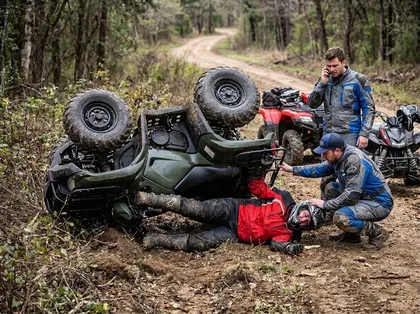
Unlike cars or UTVs, a straddle-seat ATV has nothing around the rider. There’s no roof, no door, no cage to catch the vehicle’s weight if it rolls. If the ATV tips over, the rider’s body is what absorbs the impact, or the rider gets pinned underneath the vehicle. This is why helmets and other protective gear matter so much on ATVs specifically, since the vehicle itself offers no structural protection at all.
Riders Must Shift Their Weight To Stay Balanced
ATVs are designed with the expectation that the rider will actively lean and shift their weight through turns and rough terrain, similar to a bicycle or motorcycle. This means the vehicle’s stability partly depends on the rider’s skill and reaction time, not just the machine. A new or fatigued rider who doesn’t shift correctly or who freezes up on a sudden obstacle can tip the vehicle over, even at low speeds. Passengers make this worse, since standard ATVs aren’t designed to carry a second rider’s added, unpredictable weight.
Unpredictable Terrain Multiplies Every Other Risk
ATVs are built for inherently unstable surfaces like loose gravel, mud, sand, hills, and rocky trails. Any one of these can suddenly change how the vehicle handles. A wheel dropping into a hidden rut, a patch of loose dirt on a turn, or a hidden rock can all upset the vehicle’s balance in an instant. Because riders often can’t see these hazards coming, they have very little time to adjust their speed or body position before the vehicle reacts.
Higher Speeds Leave No Room For Error
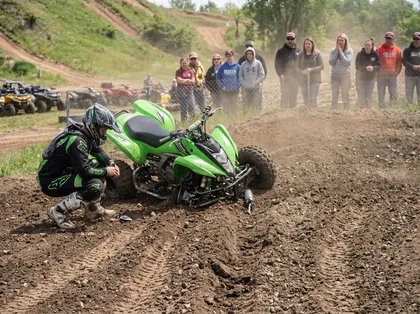
The faster an ATV travels, the less time a rider has to notice a hazard and respond to it. Off-road, hazards tend to appear with little warning, so speed and unpredictability compound each other. A rollover that might be a minor tip-over at low speed can become a violent, high-energy crash at higher speeds, throwing the rider clear of the vehicle or trapping them beneath it as it continues to roll.
Mechanical Issues And Overloading Add Further Risk
Worn tires, poor suspension maintenance, or overloaded cargo racks all change how an ATV handles, often without obvious warning signs. Adding extra weight, whether cargo or a passenger, raises the center of gravity even further and changes how the vehicle responds to turns and slopes. A machine that handles safely under normal conditions can become unstable once it’s improperly loaded or poorly maintained.
What Are The Main Causes Of California ATV Accidents?
ATV accidents can result from rider error, overloading, unsafe terrain, poor maintenance, or a mechanical defect. Each one can be enough to cause a serious crash.
Each cause points to a different type of responsibility:
- Rider Error: Speeding, reckless driving, and driving under the influence can increase the risk of a serious ATV crash. An impaired or reckless rider cannot react fast enough on rough terrain. Common examples include:
- Taking a blind turn too fast
- Riding after drinking
- Ignoring posted trail warnings
In a civil injury claim, a DUI can establish that the rider was negligent, meaning they failed to exercise reasonable care.
- Paved-Road Operation: ATV tires and handling systems are designed primarily for off-road surfaces. On pavement, an ATV may become harder to control or overturn during a turn. Public road riding also exposes ATV riders to collisions with larger, faster vehicles.
- Overloading: Carrying too much cargo or too many passengers changes how the ATV handles. That imbalance raises the risk of a rollover on uneven ground. This often looks like:
- Two riders on a single-rider ATV
- Cargo racks loaded past their weight limit
- Gear strapped high on the frame
- Mechanical Defects: Faulty brakes or a broken steering system can cause a rider to lose control without warning. These failures may result from:
- A manufacturing defect in the part itself
- Poor or delayed maintenance
- An improper repair job
Rider errors, such as speeding or overloading, may place responsibility on the operator. If a defect caused the crash, a manufacturer, seller, repair shop, owner, or another party may be responsible. ATV rollover accident lawyers can investigate the cause and identify potentially liable parties. In either case, ATVs offer riders far less protection than a car, and a rider’s body absorbs the full force of any impact.
Severe Injuries Frequently Caused By ATV Crashes
ATV crashes can cause severe, life-altering injuries. These include traumatic brain injuries (TBIs), spinal cord damage, and crushed or severed limbs. Injuries like these can change how you move, work, and live for the rest of your life. ATV crashes can also be fatal. During a rollover, a rider may be thrown from the vehicle or pinned underneath it, causing severe crush injuries, internal trauma, or suffocation.
Most of these injuries share a common thread: long recoveries with lasting consequences that affect everyday life.
- Traumatic Brain Injury (TBI): A blow to the head can cause brain bruising, swelling, and nerve damage. Without prompt treatment, these effects can last for years.
- Spinal Cord Damage: Damage to the spinal cord can lead to partial or complete paralysis.
- Severe Lacerations: Deep cuts can damage nerves and muscle, causing permanent loss of function.
- Broken Bones: Breaks range from minor cracks to open fractures that need surgery. A broken femur can cause long-term problems with how you walk.
- Crushed or Severed Limbs: ATV riders have no barrier around their limbs, so arms, legs, hands, and feet can be crushed, fractured, or severed in a crash.
Victims may need multidisciplinary care from trauma physicians, neurologists or neurosurgeons, orthopedic surgeons, rehabilitation physicians, and physical or occupational therapists. The appropriate specialists and length of recovery depend on the injuries involved.
Following California’s ATV safety rules can help lower the risk of many life-altering injuries.
Basic Safety Measures And California ATV Laws
California law requires all ATV riders to wear a helmet on public lands under CVC § 38505. CVC § 38503 and § 38504 set age rules for young riders.
UTVs and other side-by-side vehicles fall under separate state rules, including their own age and equipment requirements. Together, these rules and safe riding habits lower your risk of a serious crash.
California’s ATV rules include:
- Take a Training Course: Complete a recognized ATV safety course before riding.
- Inspect Before You Ride: Check brakes, tires, and controls before each ride.
- Wear a Helmet: CVC § 38505 requires all riders to wear a helmet on public lands.
- Stay Off Paved Roads: ATVs are not built for paved roads. Avoid paved roads unless California law and posted local rules specifically allow ATV operation.
- No Stunts: Avoid jumps or risky moves that raise crash risk.
- Use an Age-Appropriate ATV: Riders under 16 should operate only youth models designed for their age and size, not adult-sized ATVs. A machine that is too large or powerful may exceed a young rider’s strength, reach, and ability to control it.
- Age Rules: On California public lands, riders under 18 need one of these:
- An ATV safety certificate.
- Direct supervision from an adult who holds one.
- Enrollment in a safety course with a certified instructor.
Riders under 14 must also be directly supervised by a parent, guardian, or another adult authorized by the parent or guardian.
Gear helps reduce injury on trails, just as it does when avoiding motorcycle crashes on other surfaces. Following these laws and wearing gear are the best ways to stay safer on the trail. Even careful riders can be hurt by a defective part or a reckless driver. In those cases, someone else may be legally responsible for your injuries.
Who Is Liable For An ATV Accident In California?
In an ATV accident in California, more than one party can be liable. A negligent driver, an owner who failed to keep the ATV in good condition, or a maker who sold a faulty ATV may each share the blame. The facts of your crash will show who is at fault.
A personal auto policy may not cover an ATV unless the vehicle meets the policy’s coverage terms. If that coverage is denied, you may still have options. A separate off-road or homeowners policy may provide coverage, depending on its terms, exclusions, and the location of the crash. Many people do not know that homeowners insurance can also cover ATV crashes. It is worth checking all available policies before assuming you have no coverage.
People who search for free advice from an ATV rollover accident lawyer often find that a formal consultation is the best way to identify who is liable. Arash Law can look into your crash, find out which policies apply, and help you decide on next steps.
Frequently Asked Questions About ATV Accidents
ATV accidents come with many legal questions. The answers below cover the most common concerns riders and passengers have after a crash. If your situation is more complex, a personal injury attorney can help.
Can You Drive An ATV On Public Roads In California?
California doesn’t allow off-highway vehicles on public highways in most cases. There’s one exception: crossing a two-lane highway. A registered off-highway vehicle can cross if it goes straight across (about 90 degrees) and does so quickly and safely.
Highways with more than two lanes or limited access are different. Vehicles can only cross these at a designated crossing point.
There’s one more exception. Under CVC § 38026, certain authorities can open short stretches of highway for combined use (both regular traffic and off-highway vehicles). This is only allowed if specific legal rules are met.
Can A Rental Waiver Stop Me From Suing After An ATV Crash?
Rental companies often ask you to sign a liability waiver before you ride. A clear, well-written waiver can block some ordinary negligence claims. But California generally won’t enforce a waiver that tries to excuse gross negligence.
You may still have a claim if the evidence shows one of these:
- Gross negligence.
- A product defect.
- Conduct outside what the waiver covers.
- Another duty that legally can’t be waived.
Who Is At Fault If I Were A Passenger On A Crashed ATV?
Fault depends on the facts. The driver, another motorist, or a defective-part manufacturer could each be liable. Most ATVs are not built to carry passengers on public land under CVC § 38506. Carrying a passenger anyway may affect how fault gets shared, but you may still have a valid claim.
How Long Do I Have To File A Claim After An ATV Accident In California?
Many California personal injury lawsuits are subject to a two-year limitation period under CCP § 335.1. However, accrual and tolling rules can change the deadline. If a California public entity may be responsible, a government claim generally must be presented within six months under Government Code § 911.2.
Can I Seek Compensation If A Mechanical Defect Caused My Crash?
Yes, if a defective ATV or part contributed to the crash, you may be able to seek compensation through a product liability claim. A manufacturer, distributor, or retailer may face a product-liability claim if a defective ATV or component caused the injuries. A repair shop may instead be liable for negligent repair if its work contributed to the crash, while an owner may be liable for negligent maintenance or entrustment.
How Are ATV Accident Lawyers Compensated?
Many ATV accident attorneys work on a contingency fee basis, so you pay nothing up front. People often wonder, do lawyers only get paid if they win with contingency fees? The answer is yes. You owe no attorney fees unless your case results in a recovery.
Every ATV accident case is different. Contact a personal injury attorney to discuss the facts of your situation.
Injured In An ATV Crash? We Can Help
ATV accidents can leave you with serious, lasting injuries. If you are thinking, “I need a personal injury lawyer,” you do not have to face this alone. AK Law’s legal team has handled severe off-road vehicle accident cases and understands the challenges these claims present. These cases often involve product defects, operator error, and evidence that can be quickly lost after a crash.
The case results below reflect Arash Law’s experience handling serious injury claims involving ATVs, vehicle rollovers, and other small, open vehicles. Each case involved different facts, injuries, and legal issues:
- $6,750,000 ATV Accident Recovery: Our client, a farm worker, fell off the back of an ATV and down a cliff while working. He suffered a traumatic brain injury and other trauma requiring long-term assisted living care. A workers’ compensation judge approved a $6.75 million settlement on his behalf.
- $5,500,000 Rollover Accident Recovery: Our client suffered a spinal cord injury and a mild traumatic brain injury when his work vehicle rolled over. We secured a $5.5 million settlement on his behalf.
- $3,000,000 Golf Car Accident Recovery: We secured a $3 million settlement in a golf car accident and premises-liability case.
Every case is different, and past results do not guarantee a similar outcome. Results depend on the facts, injuries, available insurance, applicable law, and other circumstances.
Our team is committed to keeping every client’s needs front and center. Call us at (888) 488-1391 to schedule your free consultation. Reaching out early gives you the best chance to protect your rights.