TL;DR: In California, the driver who dropped unsecured cargo, their employer, or a government agency that failed to clear debris may be liable for your damages. You generally have two years to sue for personal injuries and three years to sue for property damage. If a public entity may be responsible, you generally must present a government claim within six months before filing a lawsuit.
Highlights:
- Identify the vehicle, company, contractor, property owner, or agency involved.
- Preserve evidence showing where the debris came from.
- Call 911 for injuries or hazards; otherwise report to CHP/local police.
- Record any plate, company name, trailer number, and USDOT number you see.
- Collect witness names and contact details, plus what they saw and when.
- If a public agency may be responsible, file a government claim within 6 months.
Tip: Keep the damaged parts and repair estimates, and stick to observable facts when describing how the debris appeared.
Table of Contents
Responsibility for road debris damage in California depends on how the debris reached the roadway and who failed to prevent or remove the hazard. A driver who dropped an unsecured load, a trucking company, a construction contractor, a property owner, or a public entity may be legally responsible, depending on the facts of the accident.
Road debris can appear without warning and cause serious crashes or property damage. Common hazards include tire treads, unsecured cargo, construction materials, fallen tree branches, and vehicle parts. More than one party may share liability for the same accident.
The facts of the accident determine who may be legally responsible. They also affect the evidence you need and the type of claim you may pursue.
Who May Be Liable For Road Debris Damage?
More than one party may be legally responsible for damage or injuries caused by road debris. Liability depends on how the debris reached the roadway, who had a duty to prevent the hazard, and whether that party failed to use reasonable care.
Road debris remains a significant traffic safety issue. The American Automobile Association (AAA) Foundation for Traffic Safety estimated that road debris was a factor in about 319,724 crashes, 32,802 injuries, and 433 deaths in the United States from 2018 through 2023.
The facts of the accident determine which parties may be included in an insurance claim or lawsuit. When several parties share fault, California generally allows recovery of economic damages from jointly responsible defendants, while each defendant is usually responsible only for its percentage of non-economic damages.
The Driver Who Failed To Secure The Load
A driver may be responsible when cargo, tools, furniture, building materials, or other objects fall from the driver’s vehicle.
California Vehicle Code Section 23114 generally prohibits driving a vehicle unless it is constructed, covered, or loaded to prevent its contents from dropping, leaking, blowing, spilling, or otherwise escaping. California Vehicle Code Section 24002 also prohibits operating a vehicle that is unsafely loaded and presents an immediate safety hazard.
Examples may include:
- Unsecured furniture in a pickup truck.
- Gravel spilling from a trailer.
- Tools left unsecured in a work vehicle.
- Tree branches extending from an overloaded truck.
- Household items left unsecured during a move.
- Scrap metal that is transported without proper securement.
A traffic citation may support a claim, but a citation is not always required to establish negligence.
A Trucking Company Or Driver’s Employer
A trucking company or another employer may be liable for a road debris accident if its worker acted negligently within the scope of employment. The company may also be liable for its own negligent acts or omissions, such as:
- Failing to inspect the truck or trailer.
- Providing defective cargo restraints.
- Allowing an overloaded or unsafe vehicle onto the road.
- Failing to train drivers on load securement.
- Ignoring earlier reports of damaged equipment.
- Pressuring a driver to operate an unsafe vehicle.
A trucking company’s records may show who loaded the cargo, when the vehicle was inspected, and whether the company knew about a safety problem.
Commercial motor carriers and drivers operating in California may also be subject to federal cargo-securement regulations under 49 CFR §§ 393.100–393.136. These rules generally require cargo to be contained, immobilized, or secured with appropriate equipment. It may include tiedowns, dunnage, or bracing to prevent it from leaking, spilling, blowing, shifting, or falling from the vehicle.
The Vehicle Or Trailer Owner
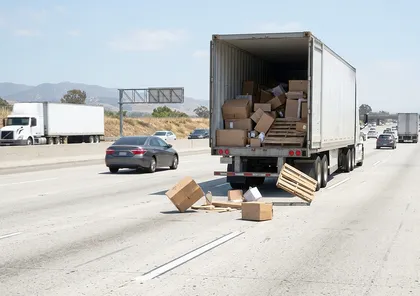
The person or business that owns the truck, trailer, or other vehicle may share responsibility if poor maintenance contributed to debris falling onto the roadway.
For example, liability may arise when a worn latch opens, a defective tailgate fails, or a damaged trailer component allows cargo to escape. Ownership alone does not automatically establish liability. However, maintenance records and inspection reports may show whether the owner failed to correct a known hazard.
California law may make a vehicle owner liable when another person negligently operates the vehicle with the owner’s express or implied permission. This statutory liability can apply even if the owner did not personally drive the vehicle, load, or secure the cargo. Still, the owner’s liability under this law is subject to statutory limits.
Those limits may not apply when the owner is independently negligent, such as by knowingly allowing an unsafe vehicle to be used, or when the driver was acting as the owner’s employee or agent.
A Cargo-Loading Company
Some commercial shipments are loaded by a separate warehouse, shipper, or loading contractor. That company may be responsible if it improperly stacked, balanced, tied down, or secured the cargo.
Determining liability may require reviewing:
- Bills of lading.
- Loading instructions.
- Cargo photographs.
- Weight records.
- Inspection checklists.
- Shipping agreements.
- Surveillance footage from the loading location.
Several companies may dispute who controlled the load. Preserving these records early can help establish each party’s role.
A Construction Company Or Road Contractor
Construction materials and equipment can create dangerous road debris when contractors fail to secure a work zone or clean the roadway.
A contractor or subcontractor may be liable for debris such as:
- Loose gravel.
- Metal pieces.
- Lumber.
- Cones or barriers.
- Broken tools.
- Construction signs.
- Materials left in an open traffic lane.
Responsibility may depend on who controlled the work area, who was required to inspect it, and whether the contractor had enough time to remove the hazard. A dangerous road conditions attorney can investigate the work zone, identify the responsible parties, and determine whether the contractor, subcontractor, or another entity may be liable.
An Adjacent Property Owner Or Business
A person or business that owns or controls property next to a roadway may be responsible when a dangerous condition on that property causes debris to enter the road. Examples of potential debris entering the road include:
- A branch dropping from a visibly damaged tree.
- Landscaping materials that wash onto the pavement.
- Objects left near the roadway that get blown into traffic.
Liability generally depends on whether the property owner created the hazard or knew, or reasonably should have known, about it and failed to act. A property owner is not automatically liable merely because an object came from the property.
A Vehicle Or Parts Manufacturer
A manufacturer may be responsible when a defective vehicle component separates and becomes road debris. Examples may include a tire tread separating, a wheel detaching, or a trailer component breaking because of a design or manufacturing defect.
A product liability claim may involve the manufacturer, distributor, retailer, or another company in the product’s supply chain. The damaged part should be preserved whenever possible because experts may need to inspect it.
Caltrans, A City, Or A County
Under California Government Code Section 835, a public entity may be liable for an injury caused by a dangerous condition of public property when the claimant proves that:
- The property was in a dangerous condition.
- The dangerous condition caused the injury or damage.
- The condition created a reasonably foreseeable risk of that type of harm.
- A negligent or wrongful act or omission by a public employee acting within the scope of employment created the condition, or the agency had actual or constructive notice of it with enough time to take protective measures.
What if a roadway defect caused my accident? You may have a claim against the responsible public entity if the roadway defect or debris created a dangerous condition and the agency knew or should have known about it but failed to address it within a reasonable time.
For example, a claim may be possible if an agency received repeated reports about a large object blocking a traffic lane but failed to respond within a reasonable period.
However, an agency may not have sufficient notice when debris falls onto the road only moments before a collision.
Caltrans generally controls state highways, while cities, counties, or other entities may control local roads. The responsible agency must be identified based on who owned, controlled, or maintained the roadway where the debris was located. Present the claim to the public entity responsible for the roadway because filing only with a different agency generally will not satisfy the claim requirement for the correct entity.
What If The Debris Came From An Unknown Vehicle?
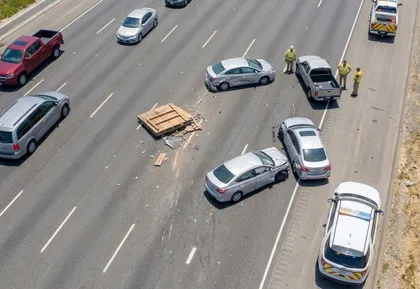
It is common for a driver to discover debris without seeing the vehicle that dropped it. The responsible driver may have left the area or may not know that the load came loose.
Possible sources of recovery may include:
- Collision coverage if you struck debris already lying in the roadway.
- Comprehensive coverage if falling or flying debris strikes your vehicle, depending on the policy.
- Uninsured motorist bodily-injury coverage if debris from an unidentified vehicle caused injuries, and California’s physical-contact and reporting requirements are satisfied.
- Uninsured motorist property-damage coverage may apply only if there was direct physical contact with the uninsured vehicle and its owner, operator, or license number can be identified. It generally does not cover property damage caused by debris from a completely unidentified vehicle.
- A claim against a driver, business, or public entity identified through later investigation.
If your insurer pays for the loss and a responsible party is later identified, the insurer may pursue that party through subrogation. Ask how any recovery may affect your deductible and whether the insurer will seek to recover it for you.
Coverage depends on the wording of the policy and how the incident occurred. For example, an insurer may treat striking an object already lying in the road differently from being struck by an object still falling from another vehicle.
The driver should report the incident promptly and ask the insurer which coverage applies. Policy deductibles, exclusions, limits, and reporting requirements may affect the claim.
What If I Swerved To Avoid Road Debris?
A driver who swerves to avoid debris may collide with another vehicle, barrier, cyclist, pedestrian, or roadside object. Liability does not necessarily fall entirely on the swerving driver.
Investigators may consider:
- How suddenly the debris appeared.
- Whether a reasonable driver could have avoided it.
- The driver’s speed.
- Following distance.
- Visibility and weather conditions.
- Whether the driver was distracted.
- Whether another driver contributed to the crash.
How Do You Establish Liability After A Road Debris Accident?
To establish liability after a road debris accident, you generally must show that another party’s actions or failure to act caused the crash and your losses. Depending on the facts of your case, you may need to establish the following:
- Duty of Care: The responsible party had a legal duty to use reasonable care. For example, drivers must secure their loads, contractors must use reasonable care when their work creates or controls a roadway hazard, and public agencies may be responsible for dangerous road conditions under applicable California law.
- Breach of Duty: The party failed to meet that duty. Examples include failing to secure cargo, leaving debris in the roadway, or failing to remove a known hazard within a reasonable time.
- Causation: The breach was a substantial factor in causing the road debris accident and your injuries or property damage.
- Damages: You suffered actual losses, such as vehicle repair costs, medical expenses, lost income, or pain and suffering.
Establishing liability depends on the evidence available. The stronger the evidence, the easier it may be to identify the responsible party and show how the road debris caused your injuries or other losses.
Types Of Evidence That Can Help Establish Liability
Road debris can disappear quickly after a crash. Other vehicles may move it, road crews may remove it, or weather may change the scene. Gathering evidence as soon as it is safe to do so can help establish how the accident occurred, identify the responsible parties, and support your compensation claim.
| Evidence | How It May Help |
|---|---|
| Photos and Videos | Document the scene by taking photos or videos of:
Do not enter an active traffic lane to collect evidence. |
| Dashcam Footage | May show debris falling from a vehicle or identify a license plate, company logo, trailer number, or cargo. It can also capture how the collision occurred. Save the original recording immediately before it is overwritten. |
| Witness Information | Witnesses may identify where the debris came from, how long it remained in the roadway, or how the crash occurred. Obtain each witness’s name, phone number, email address, and a brief description of what they observed. |
| Police or CHP Report | A report may document road conditions, witness statements, the vehicles involved, citations, and the responding officer’s observations. Call 911 if the debris creates an immediate hazard, causes injuries, blocks traffic, or results in a serious collision. |
| Commercial Vehicle & Cargo Records | Commercial vehicle and business records may help determine whether a commercial carrier or cargo handler failed to secure the load properly. Relevant records may include:
|
| Government Maintenance & Complaint Records | When a public agency shares responsibility, relevant records may include:
These records help establish whether the agency knew or should have known about the hazard and had enough time to address it. |
Some evidence may not last long. A lawyer can send preservation letters requesting that important records, videos, electronic data, and other evidence be retained.
What Compensation May Be Available After A Road Debris Accident?
The compensation available after a road debris accident depends on the type of losses you suffered and the facts of your case. If another party caused the accident, you may seek compensation for damage to your property. In addition to property damage, if you suffered injuries, you may recover additional damages through a personal injury claim.
If the accident damaged your vehicle or other personal property, you may pursue compensation for:
- Towing expenses.
- Storage fees.
- Vehicle repair costs.
- The vehicle’s pre-accident actual cash value if it is declared a total loss.
- Rental vehicle or other transportation expenses.
- Damage to personal property inside your vehicle.
- Loss of use while your vehicle is being repaired or replaced.
If you sustained injuries, you may also seek compensation for reasonable medical expenses, lost income, and loss of future earning capacity. You may also recover non-economic damages for the effects of your injuries, including:
- Physical pain.
- Emotional distress.
- Disfigurement or scarring.
- Permanent disability.
- Loss of enjoyment of life.
Workers injured on the job may also qualify for workers’ compensation benefits. An attorney can determine whether you also have a separate claim against a negligent third party.
The compensation available in your case depends on several factors, including the severity of your losses, the available evidence, insurance coverage, policy limits, and each party’s share of fault.
How California’s Comparative Negligence Affects Your Claim
Shared fault does not end your claim in California. You may still recover compensation even if you were partly to blame for the crash. California follows the pure comparative negligence rule.
Under this rule, your percentage of fault reduces your compensation. You can still recover damages (money for your injuries and losses) as long as you are not found fully responsible. If you are found 30% at fault, you keep 70% of your total damages.
Say you swerved to avoid a tree branch in the road, struck another car, and were assigned 25% of the blame. You may be eligible to recover 75% of your proven losses.
The hazard’s location, visibility, and suddenness can affect how fault is apportioned between the driver and any parties that created it or failed to address it. A lawyer can review that evidence and push back if an insurer assigns you too much of the fault.
How Long Do I Have To File A Lawsuit After A Road Debris Accident In California?

The deadline to file a claim or lawsuit depends on the type of damages you seek and the party responsible for the accident.
Here are the deadlines that commonly apply in California:
- Personal Injury Lawsuit: California Code of Civil Procedure Section 335.1 generally gives you two years after the injury claim accrues, which is usually the accident date, to file a lawsuit.
- Property Damage Lawsuit: CCP §338(c)(1) generally gives you three years from the date of the accident to file a lawsuit for damage to your vehicle or other personal property.
-
Claims Involving Government Entities: California Government Code Section 911.2 generally requires you to present an administrative claim to the responsible public entity within six months after the cause for the claim arises, which is usually the accident date.
The public entity generally has 45 days after the claim is presented to act on it, unless the response period is extended by written agreement.
- If the public entity sends a proper written rejection notice, California Government Code Section 945.6 generally gives you six months from the date it personally delivers or mails the notice to file a lawsuit.
- If the public entity does not send a legally sufficient rejection notice, you generally have two years from the date of the injury, death, or property damage to file a lawsuit.
In some cases, you may apply for permission to present a late claim within one year after the injury, death, or property damage. The public entity does not have to approve the application.
A traffic accident attorney can identify the deadlines that apply to your case. They can then prepare and file the required documents and help protect your right to pursue compensation before those deadlines expire.
What To Do If Debris Hits Your Vehicle
The steps you take after a road debris accident can affect your safety, your insurance claim, and any future legal action. Take these steps as soon as it is safe to do so:
- Put Your Safety First: Move your vehicle to a safe location if possible. Turn on your hazard lights and stay away from moving traffic. Do not try to remove debris from an active roadway.
- Report the Accident: Call 911 if anyone is injured or the debris creates an immediate hazard. Otherwise, report the incident to the California Highway Patrol (CHP) or the appropriate local law enforcement agency.
- Document the Scene: Take photos or videos of your vehicle, the roadway, the debris, if you can do so safely, skid marks, traffic signs, and other relevant conditions. If another vehicle dropped the debris, record its license plate, company name, trailer number, and U.S. Department of Transportation (USDOT) number, if applicable.
- Collect Witness Information: Ask witnesses for their names and contact information. Their observations may help identify where the debris came from and how the accident occurred.
- Seek Medical Attention: Seek prompt medical attention if you are injured, develop symptoms, or have concerns about your condition. Medical records can also document injuries connected to the crash.
- Notify Your Insurance Company: Report the accident promptly. Before giving a recorded statement to another party’s insurer or accepting a settlement offer, make sure you understand your legal rights.
- Consult a Personal Injury Lawyer: An attorney can help preserve evidence, identify the responsible parties, communicate with insurers, and explain your legal options.
How A California Lawyer Can Help After A Road Debris Accident
Road debris cases often require more than proving that debris caused the crash. You may also need to identify who created the hazard and preserve evidence before it disappears. A personal injury lawyer can help by:
- Investigating how the debris reached the roadway.
- Identifying all potentially liable parties.
- Sending preservation letters to trucking companies, businesses, or public agencies to preserve records, videos, and electronic data.
- Obtaining police reports, witness statements, surveillance footage, and other evidence.
- Working with accident reconstruction experts when necessary.
- Handling communications and negotiations with insurance companies.
- Calculating your current and future damages.
- Filing a lawsuit and meeting all legal deadlines if settlement efforts fail.
Early legal representation may help preserve critical evidence and strengthen your case before important information becomes unavailable.
Although the following cases did not involve road debris accidents, they illustrate how our attorneys approached complex liability cases involving dangerous roadway conditions or hazards.
| Recovery | How Our Lawyers Helped |
|---|---|
| $1,750,000 | We pursued a claim against the city after an uninsured driver struck our client at a hazardous intersection. During our investigation, we uncovered a history of accidents at that location that supported the case. |
| $1,450,000 | We pursued claims against the construction contractors and the city after our client suffered injuries from uneven pavement in a construction zone. The case settled after the first day of trial, following their denial of liability. |
| $1,003,000 | We refocused our liability strategy after an uninsured driver caused the crash and pursued compensation based on an overgrown bush that obstructed the driver’s view. |
| Important Note: Every case presents different facts and legal issues. Past results do not guarantee a similar outcome in any future case. | |
Frequently Asked Questions About Road Debris Accidents In California
Road debris accidents can create uncertainty about your next steps. The following answers address common questions based on California law.
Who Pays For Windshield Damage From A Rock On The Freeway?
If another vehicle throws a loose rock into the air and it strikes your windshield, comprehensive coverage may apply, subject to your policy terms and deductible. When a driver fails to secure a load, and the rock falls directly from that vehicle, the driver or the driver’s insurer may be responsible for the damage. If you can identify the responsible vehicle, you may also pursue a claim against that party.
How Do I Prove Which Truck Dropped The Cargo?
You can identify the truck through evidence collected after the accident. Helpful evidence may include:
- Dashcam footage.
- Surveillance videos.
- Witness statements.
- Police reports.
- Photos of the truck or the accident scene.
If you cannot identify the truck, an attorney may help obtain additional evidence, such as nearby surveillance footage or business records, to determine who dropped the cargo.
What If The Driver Who Dropped The Debris Drives Away?
Uninsured motorist (UM) coverage may still apply, but only in limited circumstances. Under California case law, Pham v. Allstate Ins. Co. (1988) 206 Cal.App.3d 1193, California’s “physical contact” requirement can be satisfied when an object falls from an unidentified vehicle and strikes you or your car in a single uninterrupted chain of events. Coverage is less likely if the debris had already come to rest or couldn’t be tied to another vehicle.
For a bodily-injury UM claim, California law generally requires reporting the accident to law enforcement within 24 hours and submitting a sworn statement to your insurer within 30 days, along with meeting the physical-contact requirement and your policy’s other conditions.
Contact Arash Law After A Road Debris Accident
Arash Law, also known as AK Law, offers a free case review for people injured or whose property was damaged in a road debris accident. If you were involved in a traffic accident, our traffic accident attorneys can evaluate your case at no cost. We can identify the parties who may be legally responsible, explain your legal options, and answer your questions.
California law limits the time you have to file certain claims and lawsuits. Acting quickly also gives your attorney more time to preserve important evidence. This evidence may include surveillance footage, dashcam recordings, vehicle data, witness statements, and records from trucking companies or public agencies. Some evidence may disappear or become unavailable if no one takes steps to preserve it.
Call (888) 488-1391 today to schedule your free consultation.