TL;DR: Yes. Being cut out with the Jaws of Life generates EMS records, fire logs, and incident reports documenting crash severity. Those records do not automatically prove the crash caused your specific injuries, so you still need medical evidence linking the collision to your diagnosis. Preserve your vehicle, EMS reports, hospital records, and scene photographs immediately.
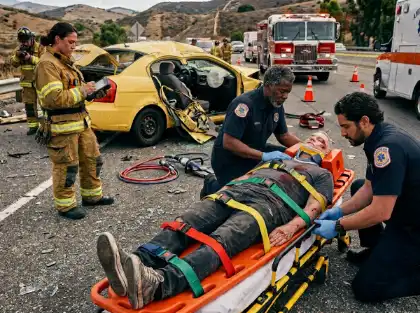
If rescue workers had to cut you out of your car using the Jaws of Life following a crash, that can matter in a California injury claim. The rescue itself may generate important evidence about the circumstances and severity of the crash. Fire department incident reports, Emergency Medical Services (EMS) records, ambulance run sheets, and trauma records can document that you were trapped, how responders removed you, your condition at the scene, and the treatment you needed immediately afterward.
That evidence can help counter attempts to minimize the collision and may also support claims involving pain, fear, emotional distress, and physical suffering associated with being trapped. Under California negligence law, the fact that emergency extrication was necessary can help document the circumstances of the crash. However, you still need evidence showing that the crash caused the injuries and losses you are claiming.
Table of Contents

Emergency Responders Had to Cut Me Out of My Vehicle With the Jaws of Life After a Crash. Can the Extrication, Ambulance, and Trauma Records Matter When Documenting the Severity of My Injury Claim?
Yes. Extrication, ambulance, and trauma records can provide important contemporaneous evidence about the circumstances of the crash, your condition at the scene, and the medical care you required immediately afterward. These records may exist after firefighters use hydraulic rescue tools to remove you. They may also document your vital signs, symptoms, mechanism of injury, transport condition, emergency room findings, imaging, and initial diagnoses.
These records can help show that the collision involved serious circumstances and establish a medical timeline beginning shortly after the crash. However, the fact that firefighters had to cut you from the vehicle does not by itself prove the severity or cause of a particular injury. Your claim still needs medical evidence connecting the collision to the injuries and losses for which you are seeking compensation.
Preserving these records can therefore be critical when an insurer disputes how the crash occurred, argues that an injury was pre-existing, or questions whether your symptoms are related to the collision.
Key Facts About Jaws of Life Claims in California
- The baseline evidence chain begins at the scene. A Patient Care Report (PCR) logs vital signs, including blood pressure, heart rate, and alertness, before hospital treatment begins. Fire incident reports and ambulance run sheets each capture pre-treatment conditions, and no one can recreate them once care begins.
- Vehicle physical evidence disappears fast. Do not let anyone sell the vehicle for scrap or crush it before your case resolves.
- Causation is a separate legal standard from crash severity. Under California Civil Jury Instructions (CACI) 400, you must prove that the defendant was negligent, that you were harmed, and that the defendant’s negligence was a substantial factor in causing your diagnosed injury, not just that a violent crash occurred.
- The rescue itself can sometimes add to the harm. If emergency extrication causes a new injury or worsens an existing one, that additional harm may still be part of the claim when the rescue was reasonably necessary because of the crash.
Why Crash Severity Does Not Automatically Prove Medical Causation
When pursuing an injury claim in California, you have to go beyond simply showing that the crash was severe enough to require the use of the Jaws of Life. You also have to demonstrate that it directly caused your injuries and losses.
Under CACI 400, the instruction setting out the essential elements of a California negligence claim, you must establish three things:
- Negligence: The other party failed to use reasonable care.
- Harm: You suffered real, measurable harm.
- Causation: Their negligence was a substantial factor in causing your diagnosed injury.
Causation, the third element, is the one insurers and defense lawyers most often contest in high-impact crash claims. A defense team may concede the crash was serious but argue that your specific injury came from a pre-existing condition rather than the collision itself.
Emergency extrication records can support a serious car accident claim by documenting the severity of the circumstances, including entrapment, vehicle deformation, and the rescue required. Still, they do not, on their own, establish the force of impact or medical causation.
A pre-existing condition does not by itself defeat your claim. Under California law, you may recover damages to the extent the crash aggravated a prior condition. A defendant is responsible for the full harm their negligence caused, even if a pre-existing condition made you more susceptible to injury than an average person would have been. What you cannot recover for is the condition as it already existed before the collision, which is why pre-crash medical records matter.
Essential Fire, EMS, and Hospital Records to Preserve
 Records created during your rescue can be among the most important objective evidence in your case. They capture your condition before hospital treatment begins, and no other document can recreate that window. When building a claim, prioritize getting copies of the following:
- Fire and EMS PCRs log your vital signs during extrication. Paramedics record blood pressure, heart rate, and alertness at the scene. That data establishes your baseline condition at the moment of injury.
- Ambulance run sheets track what paramedics observed during transport and show whether your condition stabilized or deteriorated before you reached the hospital.
- Emergency room trauma records and triage notes document your condition on arrival. X-rays and CT scans taken at that point provide imaging that can help link your injuries to the crash. Insurers have a hard time arguing against this kind of objective evidence.
These documents matter because they show your condition at the moment of injury, before the effects of treatment make it harder to separate what the crash caused from what treatment changed. The crash scene and the vehicle itself hold the other half of the physical evidence your case may need.
Fire incident reports and other nonmedical agency records may be available through the agency’s public records process. PCRs and other EMS medical records contain protected health information. Generally, you must request them through the responding agency’s medical records procedure, with patient authorization or other legally sufficient authority when required by law.
A car accident lawyer can send a written preservation demand to the responding agency to keep it from purging those records under its routine retention schedule.
Photographs, Vehicle Damage, and Other Evidence to Preserve
Your vehicle can serve as important physical evidence of how the crash occurred. Crush patterns, airbag deployment, and structural deformation may help document the severity of the collision in ways that medical records alone cannot. They do not by themselves establish impact force or prove that the crash caused a particular injury. However, the information they provide can get lost if the vehicle is scrapped before your case is resolved.
Follow these steps to protect your vehicle as evidence:
- Do not sign a vehicle release form without first having an attorney review it.
- Do not let anyone sell the vehicle for scrap or crush it before your case resolves.
- Contact the tow yard directly to confirm where it is storing the vehicle and that it will not move or sell the vehicle without notifying you.
- Have someone photograph the interior, including seat belts, airbags, and any interior crush damage, as soon as you can access it.
- Ask your attorney to send a spoliation letter, a formal written demand requesting all parties to preserve evidence, before anyone files a lawsuit.
Act on these steps quickly. A total-loss vehicle can reach a salvage auction within days to weeks of the crash, depending on the insurer and tow yard. Once it’s gone, no one can recover that physical evidence.
The official traffic accident report created by law enforcement can also help confirm the facts of your case. The agency you need to obtain a copy from depends on where your crash occurred.
- In freeway crashes, the California Highway Patrol (CHP) typically investigates and may document the scene using a CHP 555 Traffic Collision Report. This document includes officer observations, scene measurements, witness statements, contributing factors, and party information. You can request a copy using the CHP 190 form.
- In crashes that a city or county police agency investigates, that department will have its own collision report. Request it directly from that agency.
Common Injuries and Recoverable Damages After Emergency Extrication
Crashes requiring emergency extrication can involve severe trauma, entrapment, or prolonged compression. Injuries associated with the collision and entrapment may be part of an injury claim when the crash caused them and medical evidence supports them. California Civil Code §§ 3281 and 3283 establish that a person who suffers harm through another’s wrongful conduct has a right to seek compensation for that harm.
Injuries associated with serious crashes and vehicle entrapment may include:
- Orthopedic Fractures: Broken bones in the spine, pelvis, or limbs caused by the force of impact and the vehicle structure collapsing around the occupant.
- Crush Syndrome: Sustained pressure on muscle tissue can release toxins into the bloodstream, potentially causing kidney damage or, in severe cases, requiring amputation.
- Nerve and Soft Tissue Damage: Deep injuries that may require surgery and extended rehabilitation.
If the emergency rescue itself causes a new injury or makes an existing injury worse, that harm may still be part of your claim against the person who caused the crash. California law generally allows recovery for additional harm caused by medical treatment or other reasonable aid made necessary by the original injury.
Being trapped inside a wrecked vehicle while waiting for rescue can also cause lasting psychological harm. Many survivors develop post-traumatic stress disorder (PTSD), severe anxiety, or depression. Under California law, emotional distress damages are recoverable as part of a personal injury claim. They are not secondary to physical injuries, and they deserve the same documentation effort.
Section 3283 also extends recovery to future damages that are reasonably certain to occur, meaning a well-documented claim can include costs not yet incurred at the time of filing. For example:
- Specialist care.
- Pain management.
- Ongoing physical or mental health treatment.
- Lost wages if your injuries limit your ability to work.
How thoroughly you document those losses from the start directly shapes the strength of your claim. Our car accident lawyers at Arash Law build that record systematically, covering physical, mental, and financial losses together, because the defense may exploit any gap in the documentation.
How Future Treatment and Work Limitations Can Affect Your Injury Claim
Serious crash injuries may continue affecting you long after the emergency rescue ends. If your doctors expect you to need future surgery, rehabilitation, physical therapy, pain management, or mental health treatment, those expected needs may be considered as part of your injury claim when they are supported by medical evidence.
Your injuries may also affect your ability to work. Time missed for treatment, reduced hours, work restrictions, or a reduced ability to earn income in the future may be relevant when you can document them.
Future losses should not be based on guesswork. Medical records, treatment plans, work restrictions, wage records, and other supporting evidence can help show how the crash may continue affecting your health and ability to work.
How Insurance Adjusters Scrutinize Claims for Crashes Involving Emergency Extrication
Insurance adjusters work for the insurance company, not for you. They may closely examine your medical history, vehicle damage, and injury timeline for reasons to dispute or reduce the claim, especially when rescue tools such as the Jaws of Life were used after the crash.
These are common insurance tactics:
- Pointing to minor vehicle damage or arguing that the crash photos do not show enough force to cause your reported injuries, even when extrication records clearly document that responders needed rescue tools.
- Combing through your pre-crash medical records looking for any documented condition they can characterize as pre-existing, then using it to argue that your injury predates the collision and to deny or reduce your payout.
A clear, well-documented medical history from before the crash can help you address disputes like these. It tells your attorney exactly what existed before the collision and what the crash caused. That distinction makes it far harder for an adjuster to call your injuries pre-existing.
Ready to find out what your accident claim may be worth? The lawyers who deal with car accidents at Arash Law can request key evidence to help document the severity of your injuries. They can also take over all contact with the insurer on your behalf, removing you from that pressure entirely. Call (888) 488-1391 for a free case evaluation.
Deadlines That May Affect a Jaws of Life Injury Claim in California
Under California Code of Civil Procedure (CCP) § 335.1, the standard statute of limitations for a California personal injury lawsuit against a private party is two years from the date of injury. Missing that deadline can permanently bar you from pursuing compensation in court.
Damage to your vehicle, including damage associated with the crash and emergency extrication when legally attributable to the collision, can also be part of your case. In California, a lawsuit for damage to personal property generally must be filed within three years under CCP § 338(c)(1).
However, if the injured person is a minor, the two-year clock generally does not start running until they turn 18 (CCP § 352). That exception does not apply to government claims.
If a public entity, such as Caltrans, a city, or a county, may have contributed to the crash through a dangerous road condition, a separate and shorter deadline applies. Under Government Code (GOV) § 911.2, you must file a written claim with the responsible public entity within six months of the incident:
- For many claims against California state entities, the Department of General Services’ Office of Risk and Insurance Management (DGS/ORIM) administers the Government Claims Program.
- If you are filing a death, personal injury, or personal property claim against Caltrans for $12,500 or less, you need to submit it directly to the appropriate Caltrans District Claims Office. Claims over $12,500 go through the Government Claims Program.
The six-month time limit for filing a government claim is not the last deadline you may face. Claim presentation is a prerequisite to a lawsuit (GOV § 945.4).
- If the public entity sends a compliant written rejection, you generally have six months from the date it personally delivers or mails the notice to file a lawsuit.
- If the entity never gives written notice of rejection, the lawsuit deadline is usually two years from the date of the claim’s accrual, typically the date of your injury.
If you miss the initial six-month government claim deadline, California law may allow you to apply for permission to file a late claim. You typically must make that application within a reasonable time, and no later than one year after the claim accrues. If the entity denies the application, you may still be able to ask a court for relief.
FAQs About Jaws of Life Extrication and Injury Claims in California
Does Being Trapped in a Vehicle Prove an Injury Is Severe?
No. Being trapped does not, by itself, prove your injuries are severe. However, it does document that you were trapped and that your situation required emergency extrication. You still need physician diagnoses and imaging results to confirm what injuries you sustained. Those are the objective pieces of evidence that establish severity and link the mechanism of injury to your specific condition.
How Do Ambulance and Trauma Records Support Your Compensation Claim?
Ambulance and trauma records can fit into damages documentation by capturing your condition in the immediate aftermath of the crash, before treatment begins, and before any subsequent injury can cloud the picture. This matters because insurers may argue that you sustained your injuries after the collision rather than during it. Scene and transport records provide contemporaneous evidence of your condition from the minutes immediately after the crash onward, making that argument much harder to sustain.
Are Psychological Injuries From Being Trapped Compensable in California?
Yes. California law allows recovery for emotional distress and mental trauma as part of a personal injury claim. If being trapped inside a wrecked vehicle left you with anxiety, post-traumatic stress disorder (PTSD), or sleep disruption, those injuries may be recoverable depending on the specific facts of your case. Documentation from a treating physician or licensed therapist showing your symptoms and course of treatment can help support that part of your claim.
Do Lawyers Only Get Paid If They Win?
Generally, yes. Most California personal injury attorneys handle car accident cases on a contingency fee basis. You pay no legal fees upfront. Your attorney takes a percentage of your recovery only if your case ends in a settlement or a court award in your favor. If there’s no recovery, you owe no attorney’s fees. This arrangement allows injured people to obtain legal representation without paying out of pocket while they are still recovering.
What Arash Law Has Recovered in High-Stakes Crash Cases
Serious crash cases can involve substantial medical expenses, long-term treatment, lost income, and lasting physical or emotional harm. The case results below show how Arash Law has handled high-value collision cases involving significant injuries and losses, and illustrate that each recovery depends on the specific facts, evidence, liability issues, and damages involved:
$6 million — Car Accident: The firm obtained this recovery for a client who was driving with his wife and son on a two-lane highway when an intoxicated driver crossed the double yellow lines and caused a head-on collision. The crash killed the client’s wife.
Past results do not guarantee future outcomes. Every case is different, and results depend on the specific facts and evidence involved.
Get the Help You Need for Your Car Crash Claim. Call Arash Law
If rescuers had to cut you out of your vehicle using the Jaws of Life, that could complicate any resulting injury claim in California. The evidence your claim depends on can disappear within days of the crash. An early legal review can help you identify what you need to obtain and preserve as soon as possible.
Arash Law has recovered over $1 billion for injured clients across California. Call us at (888) 488-1391 for a free case evaluation. No legal fees unless we win or settle your case.
Sources
- California Legislative Information: Code of Civil Procedure § 335.1 (two-year personal injury statute of limitations). https://leginfo.legislature.ca.gov/faces/codes_displaySection.xhtml?sectionNum=335.1&lawCode=CCP
- California Legislative Information: Code of Civil Procedure § 338 (three-year statute of limitations for property damage lawsuits). https://leginfo.legislature.ca.gov/faces/codes_displaySection.xhtml?sectionNum=338&lawCode=CCP
- California Legislative Information: Code of Civil Procedure § 352(a) (tolling of certain limitation periods while the injured person is under the age of majority). https://leginfo.legislature.ca.gov/faces/codes_displaySection.xhtml?sectionNum=352&lawCode=CCP
- California Legislative Information: Government Code § 911.2 (six-month claim-presentation deadline for certain claims against public entities). https://leginfo.legislature.ca.gov/faces/codes_displaySection.xhtml?sectionNum=911.2&lawCode=GOV
- California Legislative Information: Government Code § 911.4 (application to present a late claim after the initial claim-presentation deadline). https://leginfo.legislature.ca.gov/faces/codes_displaySection.xhtml?sectionNum=911.4&lawCode=GOV
- California Legislative Information: Government Code § 945.4 (claim-presentation requirement before filing certain lawsuits against public entities). https://leginfo.legislature.ca.gov/faces/codes_displaySection.xhtml?sectionNum=945.4&lawCode=GOV
- California Legislative Information: Government Code § 945.6 (deadline to file suit after rejection of a government claim and the two-year period when no qualifying written rejection notice is given). https://leginfo.legislature.ca.gov/faces/codes_displaySection.xhtml?sectionNum=945.6&lawCode=GOV
- California Legislative Information: Government Code § 946.6 (petition for court relief after denial of an application to present a late claim). https://leginfo.legislature.ca.gov/faces/codes_displaySection.xhtml?sectionNum=946.6&lawCode=GOV
- California Legislative Information: Civil Code § 3281 (right to recover damages for harm caused by another). https://leginfo.legislature.ca.gov/faces/codes_displaySection.xhtml?sectionNum=3281&lawCode=CIV
- California Legislative Information: Civil Code § 3283 (future damages that are certain to result). https://leginfo.legislature.ca.gov/faces/codes_displaySection.xhtml?sectionNum=3283&lawCode=CIV
- California Highway Patrol: Collision Report CHP 190 (instructions for requesting a CHP traffic collision report). https://www.chp.ca.gov/notify-chp/collision-report-chp-190/
- California Department of General Services, Office of Risk and Insurance Management: Government Claims Program (claims involving California state agencies and certain Caltrans claims). https://www.dgs.ca.gov/ORIM/Services/Page-Content/Office-of-Risk-and-Insurance-Management-Services-List-Folder/File-a-Government-Claim
- Judicial Council of California: CACI No. 400, Negligence, Essential Factual Elements (negligence, harm, and substantial-factor causation). https://courts.ca.gov/system/files/file/judicial_council_of_california_civil_jury_instructions_2026.pdf
- Judicial Council of California: CACI No. 3927, Aggravation of Pre-existing Condition or Disability (damages when a defendant’s conduct worsens a condition that already existed). https://courts.ca.gov/system/files/file/judicial_council_of_california_civil_jury_instructions_2026.pdf
- Judicial Council of California: CACI No. 3928, Unusually Susceptible Plaintiff (a defendant may remain responsible even when a person was more susceptible to injury than a normally healthy person). https://courts.ca.gov/system/files/file/judicial_council_of_california_civil_jury_instructions_2026.pdf
- Judicial Council of California: CACI No. 3929, Subsequent Medical Treatment or Aid (additional harm resulting from medical treatment or other aid reasonably required by the original injury). https://courts.ca.gov/system/files/file/judicial_council_of_california_civil_jury_instructions_2026.pdf
- Arash Law: Past Case Results (published firm case results referenced in the article). https://arashlaw.com/case-results/
Disclaimer
Past results do not guarantee future outcomes. Every case is different. The information on this page is for general educational purposes and does not constitute legal advice. Reading or relying on this content does not form an attorney-client relationship. If you suffered an injury, consult a licensed California personal injury attorney about your specific situation.