TL;DR: Many personal injury cases settle after discovery, when both sides review shared evidence like medical records, depositions, and expert reports. Once the facts are clear, defendants and insurers can accurately assess trial risk. They often prefer to settle rather than face a jury, especially when damaging evidence or strong expert testimony emerges during discovery.
Highlights:
- Track and gather key proof early: records, photos, video, bills, and wage loss.
- Answer interrogatories and document requests carefully, completely, and on time.
- Prepare thoroughly for your deposition and keep testimony consistent with records.
- Calendar discovery cutoffs: 30 days before trial, motions 15 days before.
- Plan for expert exchange and expert discovery deadlines if a demand is served.
- Review any defense physical exam demand for proper time, place, scope, and doctor.
- Preserve and disclose relevant evidence properly to avoid CCP § 2023.030 penalties.
Tip: Keep a dated file of symptoms, appointments, and insurer communications, and stick to facts rather than guessing.
Table of Contents
Many personal injury cases that reach litigation settle during or after discovery, although there is no guarantee that a case will resolve at that stage. Discovery is the formal exchange of evidence between the parties. As medical records, documents, testimony, and expert opinions become available, the parties may have a clearer basis for evaluating a settlement instead of proceeding to trial.
This applies to cases already in a lawsuit. Many injury claims settle earlier, through direct talks with the insurance company, and never reach formal discovery at all.
There is no reliable statewide statistic showing that most California personal injury cases settle specifically after discovery. Discovery often creates an important settlement opportunity because it gives the parties more information about liability, damages, credibility, and trial risk. However, a case may settle before discovery, during it, after it, or later in the litigation process.
Litigation, the process of taking a legal dispute through the court system, can feel deeply unpredictable and stressful. You may not know what evidence the other side is holding, what your case is worth, or how a jury might rule. That uncertainty can make it almost impossible to reach an early agreement. Once the facts are formally laid out through discovery, that picture becomes much clearer.
Discovery is the formal process that changes this dynamic. Through formal discovery requests, depositions, subpoenas, examinations, and expert exchanges, each side may obtain relevant, non-privileged evidence, subject to valid objections and court-imposed limits.
As the parties obtain more information through discovery, they may be able to assess settlement options more fully. Discovery can encourage settlement, but it does not guarantee that all disputed facts will become clear or that the case will be resolved.
What Is The Discovery Process In A California Personal Injury Case?
Discovery is the formal evidence-sharing process both sides use once a California personal injury lawsuit is filed. Both sides must follow the California Civil Discovery Act (CCP § 2016.010 et seq.), which governs the exchange of facts, documents, and testimony before trial.
Both sides use specific legal tools to gather that evidence:
- Interrogatories: Written questions sent to another party, who must respond in writing with answers under oath, applicable objections, or another response permitted by California law.
- Requests for Production: Demands for documents like medical records, accident reports, and insurance records. For example, discovery in truck accident cases may involve driver logs, maintenance records, company policies, and electronic vehicle data.
- Requests for Admission: Written statements that the other side must admit or deny, which help narrow what is truly in dispute.
Depositions are also a key part of this phase. In a deposition, a party or witness answers questions under oath in front of a court reporter. Those answers are on the record and can be used at trial.
Physical Examination: In a personal injury case, a defendant may generally demand one nonintrusive physical examination of the plaintiff without first obtaining court permission. The demand must identify the examination’s time, place, scope, conditions, and examining physician. Other or more intrusive examinations may require a court order.
After the initial trial date is set, any party may serve a timely demand for a simultaneous exchange of expert trial witness information. If a demand is served, the parties must exchange their expert lists and any required declarations by the applicable deadline.
That shared knowledge can change how the parties assess their chances at trial and may create stronger reasons to discuss settlement.
Why Most Cases Settle After Discovery Concludes
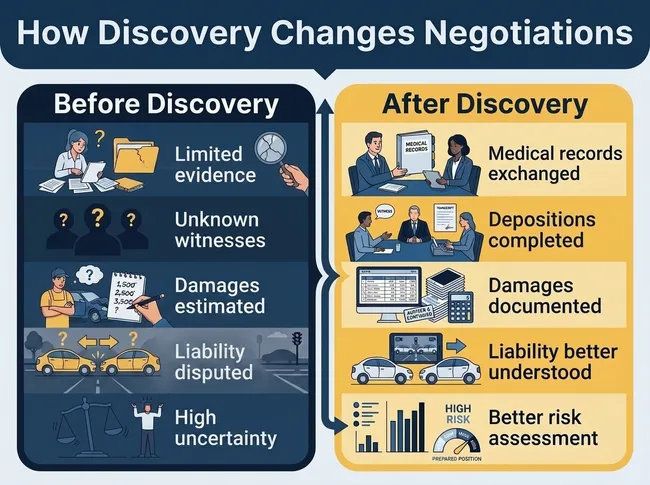
Before the discovery process ends, both sides are working from gaps in the evidence. Settlement may become more likely when discovery gives both sides enough information to assess the strengths, weaknesses, and possible outcomes of the case. However, no reliable statewide data show that most California personal injury cases settle specifically after discovery concludes.
For insurance companies, a jury verdict is an unknown they cannot price, while a negotiated settlement is a number they help control. Adjusters and defense attorneys treat settlement as a cost decision, not a justice one, and once discovery ends, they lose the cover of factual uncertainty.
As discovery moves forward, documents and witness accounts that were once unavailable may become part of the record. Evidence that weakens one side’s position can increase pressure to settle, although disputes may still arise over missing information, objections, privileges, or incomplete responses.
Going to trial is also expensive for both sides. Defense attorneys bill by the hour, expert witnesses charge large fees, and court costs add up. When the evidence is already on the table, going to trial is hard to justify.
Discovery may also lead to a motion for summary judgment or summary adjudication. A court may grant summary judgment when there is no triable issue of material fact and the moving party is entitled to judgment as a matter of law. A ruling on these motions can end the case, narrow the issues for trial, or substantially change each side’s settlement position.
If you are at this stage thinking, “I need a personal injury lawyer to sort through this evidence,” trust that instinct. Working with injury attorneys who understand how insurers assess risk can make the difference between a low offer and a fair one.
The side whose disclosures are more damaging to the other tends to hold more leverage in negotiations. Not all evidence carries the same weight, and knowing which types carry the most weight shapes how far a settlement number can move.
5 Key Factors That Push A Case Toward Settlement
Risk alone does not force a settlement. Evidence found during discovery is what most often drives the defense toward a real offer.
- Strength of Evidence: Clear proof of fault leaves little room for dispute. Surveillance video, dashcam footage, and liability records are hard to argue against.
- Deposition Testimony: How each side testifies under oath may affect settlement evaluation. Clear, consistent testimony can strengthen a party’s position, while material contradictions or evasive answers may create credibility concerns. The effect depends on the testimony and the other evidence in the case.
- Expert Reports: After the trial date is set, either side may request an exchange of information about the expert witnesses each party may call at trial. When your side names a strong medical expert, settlement pressure may increase. A treating chiropractor’s role as a witness depends on whether they were retained for litigation or simply treated your injuries.
- Insurance Company Risk Assessment: Insurers and defense attorneys use discovery evidence to estimate possible verdicts, defense costs, and policy exposure. When the potential exposure is much higher than a settlement offer, resolving the case becomes the safer choice.
- Cost of Litigation: Trials are costly for the defense, too. Expert fees, court costs, and attorney time add up fast. Settling before trial cuts those costs for the defense.
For clients who retain the firm, the attorneys at Arash Law build a clear picture of these factors for the insurer. They lay out the evidence, expert disclosures, and cost data so the insurer can see what a jury would likely decide. Which factor carries the most weight depends on what the discovery produced. Many clients also have questions about how long the process takes and what the trial really involves.
Frequently Asked Questions About Settlements And Discovery
The transition from discovery to settlement talks can feel like a long waiting game, and it is normal to have questions. Many people look online for free advice from an injury attorney, but every case has its own facts and timeline. Getting clear answers to those questions makes the process far less daunting.
How Long Does The Discovery Phase Take In California?

California law does not set one fixed length for discovery. Under CCP § 2024.020, most discovery must finish 30 days before trial, and related motions must be heard by day 15. Expert discovery follows separate deadlines. Because trial dates vary, discovery can take a few months or well over a year.
General discovery ordinarily must be completed 30 days before the date initially set for trial, and related discovery motions must be heard at least 15 days before that date. Expert witness discovery generally has later cutoffs: it must be completed 15 days before the initial trial date, and related motions must be heard 10 days before it. A court may modify or reopen these deadlines in appropriate circumstances.
Can A Personal Injury Case Settle During Discovery?
Yes. A personal injury case may settle before discovery begins, while discovery is underway, after discovery ends, during pretrial proceedings, or even after trial begins. The timing depends on when the parties obtain enough information to reach an agreement.
What Happens If We Cannot Reach A Settlement After Discovery?
If you cannot settle, the court may set one or more mandatory settlement conferences, often closer to the trial date. This is a court-ordered meeting where the parties try to resolve the matter.
Mediation is a separate process that can happen at different points in a case. It may occur by agreement, through a court program, or by court order, with a neutral third party helping both sides negotiate. If these efforts do not produce a settlement, the case may proceed toward trial unless it is resolved through summary judgment, dismissal, arbitration, or another procedure.
Will I Have To Go To Trial If I Do Not Settle?
You may have to go to trial if the case is not settled or otherwise resolved through a motion, dismissal, arbitration, or another procedure. Settlement can still occur as the trial approaches or even after the trial begins.
What Happens If Discovery Uncovers Evidence That Hurts My Case?
Discovery works both ways, so your side must also share relevant evidence, even facts that do not help your claim. Hiding or destroying that evidence can trigger serious penalties under CCP § 2023.030, including sanctions or a loss of the case. A good attorney addresses weak points directly instead of ignoring them.
How Does Deposition Testimony Impact My Settlement Value?
Your deposition is the sworn, out-of-court testimony you give before trial. It directly affects how the defense values your case. A credible, consistent plaintiff raises the case’s perceived value because the defense sees greater trial risk. Inconsistencies in your testimony can give the other side a reason to offer less.
Facing Discovery? Make Sure It Works For You, Not Against You
Discovery works both ways. It can strengthen your case, but it also lets the defense review your medical history, prior injuries, and other records. An attorney who understands California’s discovery rules can protect your privileged information and use the evidence to support a fair settlement. When the other side knows your attorney can expose weaknesses in their case, the dynamics of your claim shift.
The following case results show how depositions, expert testimony, and other evidence developed during litigation contributed to settlement outcomes:
- $9,000,000 Discovery-Driven Recovery: Other firms turned this case away, calling it a simple workers’ comp claim. Our aggressive discovery and depositions uncovered a separate personal injury claim against a third party. The insurer’s offer went from zero to full policy limits in just three weeks.
- $8,800,000 Deposition-Driven Settlement: A speeding company van driver caused our client’s severe injuries. Multiple key depositions during discovery shifted the entire direction of the case. That shift led to a life-changing settlement for our client.
- $1,250,000 Expert Deposition Recovery: The at-fault driver accepted liability but disputed the severity of our client’s injuries. Two years of litigation pushed the offer from $150,000 to the full settlement. The case resolved right after expert depositions began, three weeks before trial.
Case Results Disclaimer: Every case is different, and past results do not guarantee a similar outcome. Results depend on the facts, injuries, available insurance, applicable law, and other circumstances.
A strong discovery strategy changes how the other side weighs your case. That pressure can help move a case toward a fair settlement and may keep you out of the courtroom. Arash Law handles personal injury cases on a contingency fee basis. The firm is also known as AK Law. Attorney’s fees are charged only if the firm obtains a recovery, subject to the written fee agreement.
Call (888) 488-1391 to schedule your free consultation. Speak with attorneys who know how to use California law to push your case toward a fair result.