TL;DR: Cleaning up after an earlier ceiling collapse does not automatically prevent you from pursuing an injury claim in California. A lawyer can investigate the two incidents, your landlord’s knowledge of the ceiling hazard, warnings about further collapse, and the landlord’s response before your injury. Your actions may affect comparative fault, but the available evidence determines whether you may be able to pursue compensation.
Yes. You may still have a valid injury claim if a ceiling collapse or falling debris injured you while you were cleaning up an earlier collapse. Your decision to clean up does not automatically make you responsible for your injuries.
California law allows injured tenants to pursue claims when a landlord’s negligence causes harm. However, the state’s pure comparative fault rules may reduce compensation if the tenant’s actions contributed to the collapse and the resulting injury.
A lawyer can review what the landlord knew about the ceiling hazard, any warnings about further collapse, and how the landlord responded before you were injured.
Table of Contents

Part of My Rental’s Ceiling Had Already Fallen, and More Fell While I was Cleaning Up. What Would a Lawyer Investigate Before Deciding Whether I Have a Claim?
A lawyer would investigate both ceiling collapses, the landlord’s knowledge of the hazard, and the circumstances of your injury. They would also examine whether the landlord or another responsible party had an opportunity to address the danger.
The investigation would focus on several questions:
- The Ceiling’s Condition: Were there visible signs of damage, such as cracks, sagging, or water stains, before either collapse?
- Earlier Warnings: Did you or someone else report the problem to the landlord or property manager?
- The First Collapse: When did it happen, and what part of the ceiling fell?
- The Safety Response: Did anyone inspect the damage, arrange repairs, issue warnings, or restrict access afterward?
- Your Cleanup Activities: Why were you cleaning up, what did you know about the remaining danger, and had anyone given you instructions?
- The Second Collapse: What fell, when did it happen, and how did it injure you?
The answers to these questions can help an attorney determine whether the landlord or another party had a legal duty to act. They can also help establish whether a failure to fulfill that duty contributed to your injuries.
The first collapse may indicate a hazardous condition. However, it does not automatically prove the landlord was negligent or knew another section would fall.
Key Facts About Secondary Ceiling Collapse Injury Claims in California
- A landlord’s prior knowledge of an unsafe ceiling condition may affect liability. Under Judicial Council of California Civil Jury Instructions (CACI) No. 1006, knowledge of an unsafe ceiling condition may affect responsibility for injuries from a later collapse.
- The first collapse may provide notice of a continuing hazard. The initial collapse may alert the landlord to remaining dangers, depending on when and how they learned about it.
- The landlord’s response to the first collapse may affect liability for the second collapse. Failure to take reasonable precautions after learning of a ceiling hazard may support an injury claim.
- Cleaning up debris does not automatically mean you were negligent. Your actions must have been negligent and contributed to your injury for comparative fault to apply (CACI No. 405).
- The second collapse must be linked to the claimed injuries. You must establish that the defendant’s negligence substantially contributed to the injury (CACI No. 1000).
Reviewing the Timeline of the First and Second Ceiling Collapses
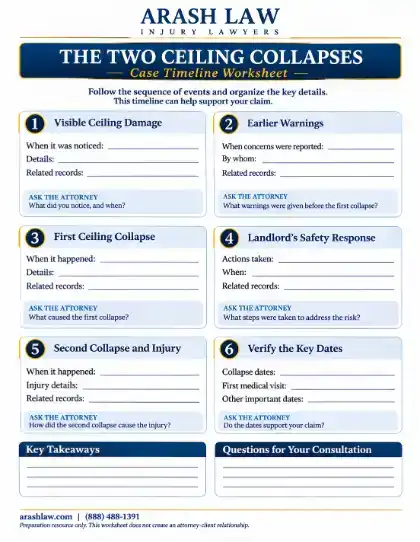 The timeline below outlines six key stages, from the first signs of ceiling damage to the second collapse that caused your reported injury. It shows how earlier warnings, the first collapse, and the landlord’s response may help establish when the unsafe condition became known and whether reasonable precautions were taken before the second incident.
A lawyer can use existing photos, messages, maintenance records, witness accounts, and medical documents to piece together what happened without requiring you to return to the damaged area. Comparing these records can also help clarify the dates of both collapses, identify unanswered questions, and confirm when the injury occurred for purposes of evaluating legal deadlines.
How Can a Lawyer Determine Whether the Landlord Knew About the Danger?
A lawyer can review complaints, inspection records, repair requests, and communications about the first collapse to determine what your landlord knew before your injury. They can trace who received each report, when they received it, and how the landlord responded.
The lawyer can also examine who was responsible for the damaged ceiling. Under CACI No. 1006, the applicable rule depends on that control:
- Landlord-Controlled Areas: For areas such as shared lobbies and hallways, a lawyer would investigate whether the landlord knew or reasonably should have known about the hazard.
- Tenant-Controlled Areas: For areas under a tenant’s control, a lawyer would look for the landlord’s actual knowledge and right and ability to correct the condition. A ceiling inside your apartment may still involve structural components under the landlord’s control.
These findings help the lawyer assess whether your landlord had the required knowledge and a reasonable opportunity to take precautions before the second collapse.
What Evidence Can Help a Lawyer Review Both Collapses?
Existing photographs, communications, medical records, and maintenance documents can help a lawyer understand the two ceiling collapses. The goal is to establish the sequence without asking you to recreate the incident.
Useful records may include:
- Existing Photos or Videos: Images already taken before or after either collapse. You do not need to return to the damaged room and move unstable materials to take new photos or collect potentially dangerous debris for an attorney to begin reviewing your situation.
- Landlord Communications: Messages between landlords and tenants regarding the ceiling, warnings, repairs, or cleanup.
- Maintenance Records: Work orders, inspection reports, and repair histories already available. A lawyer may also seek relevant documentation held by the landlord or property management company.
- Witness Information: Names of people who observed either incident or heard relevant conversations.
- Medical Documentation: Treatment records identifying reported symptoms, examination findings, and diagnosed injuries. They can help clarify what injuries occurred and how they relate to the incident. These documents will be especially important if you were injured because ceiling material struck your head.
- Incident Reports: Existing reports describing the injury and when it occurred.
Earlier complaints, messages, inspection reports, and repair records may help establish what your landlord knew about the ceiling before your injury. Witnesses may also confirm when someone reported the danger and who received that report.
The first collapse itself may have alerted your landlord to a continuing hazard. A lawyer would investigate when the landlord or property manager learned about it and whether there was a reasonable opportunity to take precautions before the second collapse.
What Should the Landlord Have Done After the First Collapse?
After learning about the first collapse, the landlord should have taken reasonable precautions to protect tenants from further falling material. Depending on the circumstances, those precautions could have included inspecting the ceiling, arranging repairs, warning tenants, or restricting access.
California Civil Code (CIV) § 1941 addresses a residential landlord’s obligation to maintain habitable premises and repair conditions that render them unfit for occupancy. CACI No. 1001 also explains the general duty to use reasonable care concerning unsafe property conditions.
To assess whether the response was reasonable, a lawyer may ask:
- When did the landlord learn about the first collapse?
- Did a qualified person inspect the ceiling for remaining hazards?
- Did the landlord arrange repairs, warn tenants, or restrict access?
- Who controlled repairs and had authority to address the danger?
- How much time did the landlord have to act before your injury?
Not every delay in addressing a reported ceiling hazard establishes landlord negligence. Landlord liability lawyers would consider the ceiling’s condition, what the landlord knew, the available precautions, and the time between the two collapses.
The investigation should also establish who controlled repairs. Depending on the property, other parties may have relevant responsibilities.
Does Cleaning Up After the First Collapse Affect Your Injury Claim?
Cleaning up debris after the first ceiling collapse does not automatically prevent you from pursuing compensation for an injury from a second collapse. However, your actions may affect your claim if they contributed to your injury.
That matters because California follows a pure comparative fault system (Li v. Yellow Cab Co. (1975), 13 Cal.3d 804). It allows injured parties to continue pursuing claims, even if they were partly responsible for the harm they suffered. However, their percentage of fault can reduce the compensation available to them.
For example, suppose you have $100,000 in damages, but a court finds you 20% at fault. You can then only recover $80,000.
However, comparative fault does not automatically apply simply because you were cleaning up after the first ceiling collapse. Under CACI No. 405, a defendant alleging comparative fault (such as your landlord) must first show that your negligence substantially contributed to your injury.
What would a lawyer examine about your cleanup decision?
- Your Reason for Cleaning: Were you removing debris from your living space, following instructions, or responding to another immediate concern?
- Your Knowledge: Did you understand that additional ceiling material might fall?
- The Warnings You Received: Did anyone specifically advise you not to enter the area?
- The Visible Condition: Could you reasonably recognize the remaining danger?
- The Landlord’s Response: Had the landlord inspected, repaired, or restricted access to the damaged area?
- The Available Alternatives: What other reasonable options existed under the circumstances?
For example, a tenant who received a clear warning to avoid an unstable ceiling may face different fault questions than a tenant who didn’t.
However, a warning does not automatically eliminate a landlord’s legal responsibility. Likewise, the absence of a warning does not automatically establish liability.
The attorney must examine the conduct of everyone involved and determine whether it contributed to the injury.
Wondering how your decision to clean up an earlier collapse might affect a claim? Call (888) 488-1391 and book a free initial consultation with Arash Law. Our California falling object injury lawyers can handle injury claims arising from ceiling fixtures or materials, and they’re ready to review your situation.
What Happens If the Landlord Disputes Responsibility?
If the landlord disputes responsibility, an attorney can compare the parties’ accounts against the available timeline and evidence.
The dispute might involve whether the landlord received notice, whether the ceiling condition was foreseeable, or whether reasonable precautions were available. Additionally, the landlord may argue that the tenant acted unreasonably by cleaning up after the first collapse.
The following disputes can raise separate questions that affect your claim:
| Disputed Issue | How It May Affect Your Injury Claim | What a Lawyer May Review |
|---|---|---|
| The landlord didn’t know about the ceiling hazard. | Lack of knowledge may impact whether the landlord had a duty to address the danger. | Earlier complaints, maintenance requests, inspection records, and notices after the first collapse. |
| The landlord had no opportunity to respond. | Limited time to act may affect whether the landlord failed to take reasonable precautions. | The time between collapses and how fast the landlord addressed hazards. |
| The tenant should not have cleaned up. | The tenant’s actions may reduce compensation if they were negligent and contributed to the injury. | Warnings, visible hazards, cleanup instructions, and the tenant’s reasons for cleaning. |
| The second collapse could not have been prevented. | This may influence whether the landlord’s actions or inaction contributed to the injury. | Inspection findings, prior damage, available precautions, and the cause of the collapse. |
| The reported injury was unrelated to the collapse. | If the second collapse did not cause the reported injury, the tenant may not recover compensation for that injury. | Medical records, treatment history, and circumstances of the second collapse. |
A premises liability injury attorney can assess these questions before deciding whether the available evidence supports a claim. If it does, they can assess whether you can pursue compensation for the losses you sustained from the second collapse, such as medical expenses, lost income, future medical care, and pain and suffering.
Frequently Asked Questions About Injuries From a Second Ceiling Collapse

Does Reporting the Ceiling Problem to My Property Manager Count as Notifying My Landlord?
Yes, it may. Under California law, reporting a ceiling hazard to a property manager, building superintendent, or a management company employee may constitute notifying the landlord.
A lawyer can review who received your complaint and their role in managing the property to determine whether the landlord had notice before the second collapse.
Can My Landlord Blame Me for Cleaning Up After the First Collapse?
Yes. Your landlord may argue that cleaning up after the first collapse contributed to your injury. However, that would not automatically prevent you from pursuing compensation.
Under California’s comparative fault rules, the landlord must establish that your conduct was negligent and substantially contributed to your harm for you actually to share fault.
A lawyer can examine what you knew, whether you received warnings, and whether the landlord took reasonable precautions. The evidence determines whether any percentage of fault should be assigned to you.
What If My Landlord Warned Me About the Ceiling Before I Was Injured?
A prior warning may affect your injury claim. However, it does not automatically eliminate the landlord’s responsibility. An attorney would examine:
- What the warning said.
- When you received it.
- Whether it adequately addressed the danger.
They would also determine whether the landlord had an obligation and reasonable opportunity to take additional precautions.
The warning could be relevant to both the landlord’s conduct and the reasonableness of your decision to remain in the area.
Can I Have a Claim If the Landlord Did Not Know About the First Collapse?
Possibly. A lawyer would investigate whether the landlord knew about an unsafe condition before the collapse or, in areas the landlord controls, reasonably should have discovered it.
The analysis depends on who controlled the affected area and whether the landlord had the right and ability to address the hazard.
The attorney would also examine when the landlord learned about the first collapse and whether any opportunity existed to prevent the second incident.
Without those facts, the absence of an earlier report does not resolve liability.
What If Both Ceiling Collapses Happened on the Same Day?
You may still have an injury claim even if both ceiling collapses happened on the same day.
The time between events matters because it may affect whether the landlord had notice and a reasonable opportunity to respond.
An attorney can compare messages, photographs, incident reports, and medical records to establish the sequence of events.
A short interval does not automatically excuse negligence or prove that the landlord could have prevented the second collapse. The circumstances require individual review.
What If I Suffered a Head Injury From the Falling Ceiling?
You may be able to pursue compensation for a head injury if another party’s negligence caused it.
A lawyer can review medical records, reported symptoms, examination findings, and treatment history to evaluate the injury claim.
Being struck on the head does not automatically establish a concussion or traumatic brain injury. Those conditions require appropriate medical assessment.
If you develop concerning symptoms after a head impact, seek prompt medical attention rather than waiting for the legal investigation.
Can I Still File a Claim If the Landlord Already Removed the Debris?
Yes. Removing the debris does not automatically prevent you from pursuing an injury claim. Whether you can sue a landlord as a tenant depends on the landlord’s negligence and how it contributed to your injury.
A lawyer may review existing photographs, witness accounts, maintenance records, inspection documents, and medical reports to investigate what happened.
They may also request relevant records from the landlord or other parties and consider whether additional evidence needs to be preserved.
You do not need to retrieve dangerous materials or reconstruct the collapse yourself.
How Long Do I Have to File a California Ceiling Collapse Injury Claim?
You generally have two years from the date of your injury to file a California ceiling collapse injury lawsuit against a private landlord. This deadline applies to most California personal injury lawsuits against private parties (Code of Civil Procedure § 335.1).
You may have to meet a different deadline if an exception applies, if you sue for other losses, such as damaged personal property, or if another entity (such as a government agency) may be responsible.
The injury date is particularly important when two separate ceiling collapses occurred. A lawyer can compare existing records to determine which date applies and whether any exceptions affect the deadline.
For this reason, it’s ideal to seek legal guidance as soon as possible. Learning about your rights and options, and pursuing an insurance claim, do not pause legal filing deadlines in California.
Get Help Reviewing Your Ceiling Collapse Timeline
The landlord’s knowledge, response to the first collapse, and your cleanup activities may all affect your injury claim. Arash Law can review these details, investigate potential responsibility, and help you pursue compensation if the evidence supports your case.
Our attorneys can review your existing records and identify what needs further investigation. You do not need to return to the damaged area or recover unsafe debris.
Call (888) 488-1391 for a free case evaluation. Arash Law handles qualifying personal injury cases on a contingency fee basis, so you pay no attorney’s fees unless we win or settle your case.
Sources
- California Code of Civil Procedure § 335.1: Establishes the general two-year deadline for filing personal injury lawsuits.
https://leginfo.legislature.ca.gov/faces/codes_displaySection.xhtml?sectionNum=335.1.&lawCode=CCP- California Civil Code § 1941: Establishes residential landlords’ obligations to maintain habitable rental premises and repair conditions that make them unfit for occupancy.
https://leginfo.legislature.ca.gov/faces/codes_displaySection.xhtml?sectionNum=1941.&lawCode=CIV- Judicial Council of California Civil Jury Instructions (CACI), 2026 Edition: CACI No. 1000 addresses premises liability elements; No. 1001 covers the basic duty of care; No. 1006 explains landlords’ duties; and No. 405 addresses comparative fault.
https://courts.ca.gov/system/files/file/judicial_council_of_california_civil_jury_instructions_2026.pdf- Li v. Yellow Cab Co., 13 Cal.3d 804 (1975): California Supreme Court decision establishing pure comparative fault, under which a plaintiff’s recovery is reduced by their fault percentage but not eliminated solely because of comparative negligence.
https://scholarlycommons.pacific.edu/cgi/viewcontent.cgi?article=2458&context=mlrDisclaimer
The information on this page is for general educational purposes and does not constitute legal advice. No attorney-client relationship is formed by reading or relying on this content. If you were injured, consult a licensed California personal injury attorney about your specific situation. Arash Law — (888) 488-1391.