TL;DR: Yes, even if you’re from another state, you can schedule a consultation, organize records, and coordinate logistics for a relative injured in California. However, your family relationship alone does not authorize you to hire an attorney, access confidential records, or accept a settlement on their behalf. Unless you have the appropriate legal authority, those decisions generally still belong to your injured relative. California filing deadlines may continue running while your relative receives treatment, so prompt coordination matters.
You can help arrange a California injury consultation for an injured relative if you’re from another state, but limit yourself to handling practical tasks. Ask what assistance your relative wants, organize available information, and confirm how they would prefer to communicate with the attorney.
However, your relative generally retains the right to make their own legal decisions. You would need the necessary legal authority to make those decisions on their behalf.
If your relative cannot travel, you can contact the firm to ask about available phone or video consultations, electronic document handling, and the option for an authorized family member to participate. Confirm the arrangements before the appointment.
Key Facts About Helping a Relative With a California Injury Consultation From Another State
- Family relationships do not automatically grant legal authority. An injured adult generally controls decisions about representation, records, and settlement unless an authorized representative may act.
- Contingency fee agreements must be written. California Business and Professions Code § 6147 requires the attorney and the client (or the client’s authorized guardian or representative) to sign any written contingency fee agreement.
- California injury claims have filing deadlines. Personal injury lawsuits generally have a two-year deadline, while property damage claims generally have a three-year deadline.
- Government claims may require earlier action. California Government Code § 911.2 generally requires that a written personal injury claim be filed within six months when a covered public entity is responsible.
- Consultation privacy matters. California Evidence Code § 952 protects qualifying confidential attorney-client communications, including certain communications involving people whose participation helps the client obtain legal advice.
Table of Contents

My Relative Was Injured in California, But I Live in Another State. How Can I Help Arrange a Consultation While Respecting Their Decisions and Privacy?
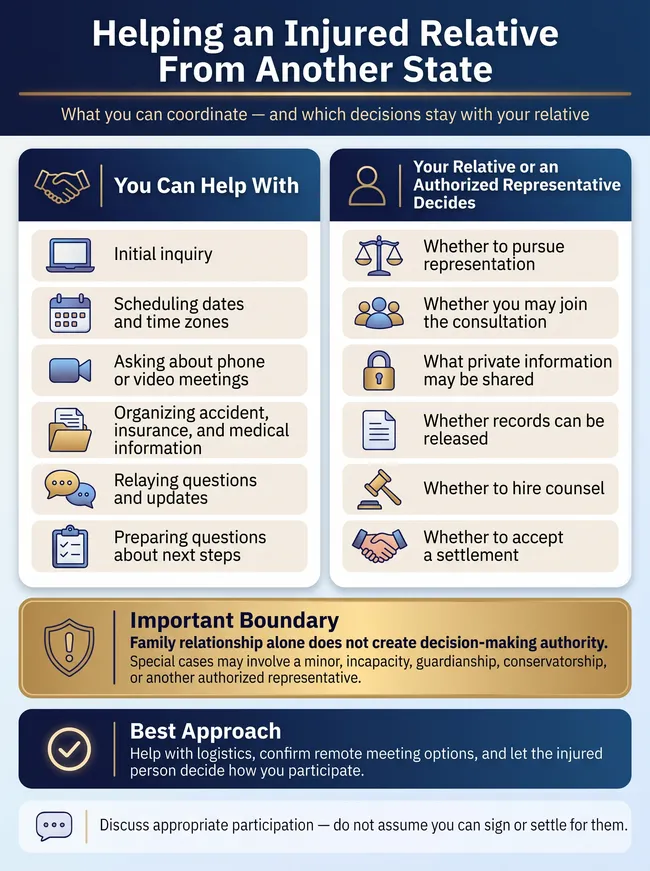
Even if you live in another state, you can help a relative who was injured in California arrange a consultation by coordinating schedules, preparing available information, and helping them communicate with a law firm. However, assisting with these tasks does not automatically give you authority to hire counsel, authorize disclosure of confidential records, or settle the claim.
If your relative is an adult who can make their own decisions, begin by asking what help they want. They may prefer to speak privately with an attorney, have you join part of the consultation, or authorize you to receive scheduling updates.
Which Tasks Can You Handle, and Which Decisions Belong to Your Relative?
The following table distinguishes between practical assistance and decisions that require the injured person’s consent or appropriate legal authority.
| Task | How You Can Help | Who Authorizes or Decides |
|---|---|---|
| Initial inquiry | Contact the firm to ask about consultation procedures. | The injured person generally decides whether to pursue representation. |
| Scheduling | Coordinate dates, time zones, and contact details. | The injured person chooses when and how to participate. |
| Remote meetings | Ask whether phone or video consultations are available. | The injured person decides whether you may participate, subject to the firm’s procedures. |
| Document preparation | Help identify accident reports, photographs, insurance information, and medical records. | The injured person or an authorized representative must approve restricted access or disclosure. |
| Attorney communication | Relay questions and scheduling information. | The injured person controls what confidential information may be shared with you. |
| Hiring counsel | Help organize questions about the proposed representation agreement. | The injured person or a legally authorized representative makes the decision. |
| Settlement offers | Help your relative prepare questions about a proposed resolution. | The injured person or an authorized representative decides, subject to applicable court-approval requirements. |
What If Your Relative Is a Minor or Cannot Make Decisions?
If your relative is a minor or cannot make legal decisions, you may need to confirm who has authority to act on their behalf before arranging a California injury consultation:
- Adult With Decision-Making Capacity: Your relative generally decides whether to hire counsel, authorize records, and accept a settlement. Being their parent, spouse, or sibling does not automatically transfer those rights.
- Minor Under 18: A parent or legal guardian may have authority to act on behalf of a child. Litigation may require a guardian ad litem, a person appointed to protect the child’s interests in court. Certain settlements also require court approval.
- Adult With Impaired Decision-Making Capacity: Serious injuries or hospitalization do not automatically establish legal incapacity. An attorney may need to evaluate whether the person can make the relevant decisions or requires legal representation through an authorized person.
- Court-Appointed Conservator: A conservator’s authority depends on the court appointment and applicable orders. A conservatorship does not necessarily grant unlimited authority over every legal or financial decision.
A valid power of attorney may authorize certain actions, depending on its terms and the applicable law. Do not assume that one exists or that your family relationship creates this authority.
If your relative cannot communicate or make decisions, explain the circumstances when contacting a California law firm from another state. For example, if they suffered serious injuries in a pedestrian collision and became temporarily incapacitated, Arash Law’s pedestrian accident lawyers can discuss how to arrange an initial consultation and what authorization may be needed for your participation.
How Can You Prepare for the Consultation From Another State?
Use this checklist to organize practical assistance without taking over your relative’s decisions.
- Confirm permission. Ask whether your relative wants legal assistance and what role they would like you to have.
- Discuss preferences. Find out whether they prefer private calls, shared conversations, or your involvement only in scheduling.
- Organize available information. Prepare accident details, known insurance information, treating-provider names, and questions without accessing restricted records.
- Confirm remote arrangements. Ask whether telephone or video meetings are available, how documents may be exchanged, and whether family members can participate.
- Clarify authorization requirements. Ask what consent, identification, or legal documents the firm needs before sharing confidential information with you.
How Can You Gather Records Without Exceeding Your Authority?
You can help organize information your relative already has or authorizes you to access. Medical providers, insurers, and attorneys may require additional permission before releasing confidential information.
Records Worth Organizing
- Accident Documentation: Obtain available photographs and witness information. Identify the responding agency, such as the California Highway Patrol or local police department, and ask about the requirements for obtaining a collision report on your relative’s behalf.
- Medical Information: List treating hospitals, physicians, specialists, and rehabilitation providers, including those outside California.
- Insurance Documents: Organize available policy information, claim numbers, correspondence, and insurance contacts.
- Financial Records: Collect available medical bills, receipts, and documentation of missed work or other injury-related expenses.
- Evidence: Identify potential surveillance footage, photographs, and electronic records that may need preservation.
Your relative may need to authorize the release of medical or insurance records. Do not sign a release or request restricted information in their name without appropriate authority.
Evidence may disappear before a legal filing deadline expires. For example, surveillance systems may overwrite footage according to their retention settings. An attorney can advise whether a preservation request is appropriate.
Can Your Relative Sign Documents Electronically?
California’s Uniform Electronic Transactions Act generally recognizes electronic signatures when the applicable legal requirements are satisfied, and the parties agree to conduct the transaction electronically.
However, not every document or procedure necessarily qualifies for electronic handling. Ask the firm which documents can be signed remotely and whether identification, additional consent, or another signing procedure is required.
A valid electronic signature does not eliminate the need for proper signing authority.
Can Joining an Attorney Consultation Affect Confidentiality?
Yes. A family member’s participation can affect attorney-client confidentiality, depending on the circumstances and the purpose of their involvement.
California Evidence Code § 952 recognizes that certain third parties may participate in confidential communications when doing so furthers the client’s interests in obtaining legal advice or is reasonably necessary.
For example, your participation may help if your relative needs assistance with communication due to an injury. However, simply being a family member does not automatically establish that your presence is appropriate.
Before joining a consultation:
- Ask your relative whether they want you involved.
- Tell the attorney why your assistance may be helpful.
- Follow the attorney’s instructions about confidentiality.
- Allow your relative to speak privately when requested.
Prior written attorney approval is not an automatic statutory requirement for every family member who joins a consultation. Whether a communication remains privileged depends on the applicable legal circumstances.
The attorney can help determine how to involve you without unnecessarily exposing private information.
Why Do California Rules and Filing Deadlines Matter?
When an injury occurs in California, California law will often govern the resulting personal injury claim. However, jurisdiction and choice-of-law questions can depend on additional facts.
The complications of arranging an injury consultation while living in another state do not automatically pause California filing deadlines.
What Are the Main California Injury Claim Deadlines?
| Claim Type | General Deadline | What It Means |
|---|---|---|
| Personal injury | Two years | A lawsuit generally must be filed within two years of the injury. |
| Property damage | Three years | A lawsuit for property damage generally must be filed within three years. |
| Government entity injury claim | Six months | A written administrative claim generally must be presented to the responsible public entity within six months. |
Legal basis: California Code of Civil Procedure (CCP) §§ 335.1 and 338; California Government Code § 911.2.
Missing an applicable statute of limitations for personal injuries or a government claim deadline may bar the claim entirely. Exceptions, extensions, and different procedural requirements may apply.
For example, certain filing deadlines may be tolled while the injured person is a minor. Government claims and specialized injury cases may follow different rules.
What If a Government Entity May Be Responsible?
If an injury involves a public vehicle, dangerous public property, or another potentially responsible government entity, the claim may require earlier action.
For covered claims against California state agencies, the California Department of General Services (DGS), through its Office of Risk and Insurance Management (ORIM), administers the Government Claims Program.
Claims involving cities and counties generally require presentation to the appropriate local public entity.
The process may also involve additional requirements after the public entity responds or fails to act.
For more information, see Arash Law’s resources on public-entity claim deadlines.
Do Reporting Requirements and Evidence Deadlines Work the Same Way?
No. Legal filing deadlines, reporting duties, and evidence preservation have different consequences.
- Filing Deadlines: These determine when a lawsuit must be filed or a government claim presented to preserve potential legal remedies.
- Reporting Duties: Missing an applicable accident-reporting requirement may create administrative problems or weaken available evidence.
- Evidence Preservation: Delaying the collection of photographs, surveillance footage, or records can affect the strength of the proof.
If your relative remains hospitalized, has returned home, or cannot communicate, an attorney can evaluate which deadlines apply and whether an exception is available.
Talk to Arash Law About Your Relative’s California Claim
If your relative was injured in California, you can contact an injury attorney without assuming responsibility for your relative’s legal decisions.
Call Arash Law at (888) 488-1391 for a free case evaluation. You can discuss available consultation arrangements, what information to prepare, and whether your relative wants you involved.
If your relative cannot communicate or may require a legal representative, explain the situation so the firm can discuss the appropriate next steps.
Case Results Involving Serious California Injury Claims
Arash Law has handled serious injury cases involving disputed liability, extensive medical evidence, and government entities. These results illustrate the types of claims the firm has handled, although they do not establish that either case involved out-of-state family coordination.
The following results are from Arash Law’s published case results.
$17.9 Million — Auto Injury Verdict
Our attorneys secured a unanimous $17.9 million verdict against the County of Los Angeles after years of litigation. One client suffered a fractured tibia and permanent mild brain injury, while the other sustained a sprained knee requiring physical therapy. The jury reached its verdict in just 90 minutes.
$12 Million — Auto vs. Pedestrian Result
Our firm secured a $12 million resolution for a 74-year-old pedestrian who suffered severe injuries requiring extensive medical care after being struck while crossing the street. The case resolved on the courthouse steps just before jury selection began.
Past results do not guarantee future outcomes. Every case is different, and results depend on the specific facts and evidence involved.
Frequently Asked Questions About Helping an Injured Relative with a California Claim

If My Relative is Out of State, Do They Have to Travel to California for the Consultation?
Not necessarily. Ask Arash Law whether a phone or video consultation is available for your relative’s circumstances. Travel requirements for later stages of a case depend on the proceedings and cannot be ruled out in advance.
Can I Pay the Legal Costs for My Injured Relative’s Attorney?
Potentially, yes. California’s professional conduct rules permit certain third-party payments when the required conditions are satisfied, including the client’s informed written consent, protection of confidentiality, and the attorney’s independent professional judgment.
However, paying legal costs does not give you control over the attorney’s decisions or your relative’s case.
Do California Personal Injury Lawyers Charge Upfront Fees?
Many of them don’t. Instead, they may offer contingency fee arrangements, meaning the attorney’s fees depend on a recovery.
California Business and Professions Code § 6147 requires that the written agreement explain the agreed-upon fee percentage and how costs and expenses affect the client’s recovery.
Ask the attorney to clarify whether any case costs may remain payable if there is no recovery.
Will Out-of-State Medical Bills Be Included in the California Claim?
Medical expenses for reasonable and necessary treatment outside California may be recoverable when they result from the injury and are supported by evidence.
Help your relative identify treating providers and organize available bills and records. The attorney can evaluate which expenses are recoverable.
Can I Sign a Representation Agreement for My Adult Relative?
Generally, no, unless you have appropriate legal authority.
An adult with decision-making capacity ordinarily signs their own agreement. California law also recognizes signatures by authorized guardians or representatives in appropriate circumstances.
A parent-child relationship alone does not authorize you to sign for an adult child.
What Happens If a Deadline Arrives While My Relative Is Hospitalized?
Hospitalization does not automatically extend California filing deadlines. However, certain legal exceptions or tolling provisions may apply.
An attorney should promptly review the circumstances, particularly when a government entity may be involved.
Can I Accept a Settlement Offer for My Injured Relative?
You could, but not merely because you are a family member.
The injured adult generally controls settlement decisions unless a legally authorized representative may act on their behalf. Certain settlements involving minors or people who lack legal capacity also require court approval.
You can help organize questions about an offer without accepting or rejecting it on your relative’s behalf.
Arrange a California Injury Consultation While Respecting Your Relative’s Choices
You do not need to manage every legal decision to provide meaningful support. Scheduling an appointment, identifying records, and helping your relative communicate their preferences can make the process easier.
Arash Law can discuss how you may participate, what permissions are needed, and which decisions must remain with your relative or an authorized representative.
Call (888) 488-1391 for a free case evaluation. Ask about available remote consultations, authorization requirements, and the next practical steps. Arash Law offers contingency fee arrangements for qualifying cases, with fees and costs explained in the written agreement.
Sources
- California Code of Civil Procedure § 335.1. General two-year filing deadline for personal injury actions. California Legislative Information. https://leginfo.legislature.ca.gov/faces/codes_displaySection.xhtml?sectionNum=335.1.&lawCode=CCP
- California Code of Civil Procedure § 338. General three-year limitations period for property damage claims. California Legislative Information. https://leginfo.legislature.ca.gov/faces/codes_displaySection.xhtml?sectionNum=338.&lawCode=CCP
- California Government Code § 911.2. Time limits for presenting certain claims against public entities. California Legislative Information. https://leginfo.legislature.ca.gov/faces/codes_displaySection.xhtml?sectionNum=911.2.&lawCode=GOV
- California Evidence Code § 952. Confidential attorney-client communications and qualifying third-party participation. California Legislative Information. https://leginfo.legislature.ca.gov/faces/codes_displaySection.xhtml?sectionNum=952.&lawCode=EVID
- California Business and Professions Code § 6147. Written contingency fee agreement requirements. California Legislative Information. https://leginfo.legislature.ca.gov/faces/codes_displaySection.xhtml?sectionNum=6147.&lawCode=BPC
- California Code of Civil Procedure § 372. Representation and settlement approval involving minors and people lacking legal capacity. California Legislative Information. https://leginfo.legislature.ca.gov/faces/codes_displaySection.xhtml?sectionNum=372.&lawCode=CCP
- California Civil Code § 1633.7. Legal recognition of electronic records and signatures under applicable conditions. California Legislative Information. https://leginfo.legislature.ca.gov/faces/codes_displaySection.xhtml?sectionNum=1633.7.&lawCode=CIV
- California State Bar. California Rules of Professional Conduct, Rule 1.8.6, Compensation from One Other Than Client. https://www.calbar.ca.gov/Portals/0/documents/rules/Rule_1.8.6-Exec_Summary-Redline.pdf
- California Department of General Services. Office of Risk and Insurance Management, File a Government Claim. https://www.dgs.ca.gov/ORIM/File-A-Claim
- Arash Law. Published Case Results. https://arashlaw.com/case-results/
Disclaimer
Past results do not guarantee future outcomes. Every case is different. The information on this page is for general educational purposes and does not constitute legal advice. Reading this content or contacting the firm does not, by itself, create an attorney-client relationship. Consult a licensed California attorney about the facts, deadlines, and legal authority applicable to your situation. Arash Law — (888) 488-1391.