TL;DR: Health insurance covers motorcycle accident injuries, including emergency care, surgeries, and rehabilitation, but you still owe deductibles, co-pays, and out-of-pocket costs. It does not pay for property damage, lost wages, or pain and suffering, leaving you exposed to substantial financial losses unless you pursue a claim against the at-fault driver within 2 years.
Highlights:
- Use health insurance immediately for emergency motorcycle accident care.
- Ask providers to bill health insurance before signing any lien agreements.
- Check MedPay coverage to reduce deductibles and immediate out-of-pocket costs.
- Review UM/UIM coverage if the at-fault driver lacks sufficient insurance.
- Challenge claim denials by requesting an appeal with your insurer or filing a grievance with the California DMHC.
- File a personal injury lawsuit within 2 years of your injury date, or an administrative claim within 6 months if a government entity caused the crash.
Tip: Gather and preserve all medical records, insurance documents, and accident details immediately, as this documentation protects both your claim and your settlement negotiations.
Table of Contents
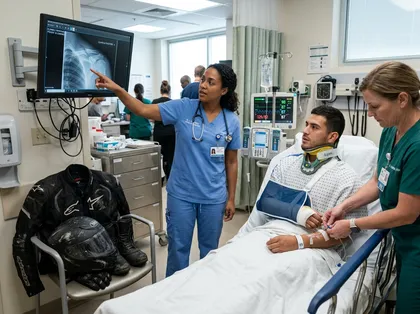
Health insurance does cover injuries from motorcycle accidents. Your health plan is usually the first source of coverage for emergency medical treatment after a crash. It helps pay for emergency care and other covered medical expenses.
Even so, health insurance does not cover everything. Deductibles, co-pays, coinsurance, out-of-network charges, and noncovered services can still leave you with high out-of-pocket costs. It also does not pay for the non-medical losses you sustained in the crash.
California law provides additional ways to recover those losses. Understanding your coverage and legal options after a motorcycle accident helps you manage medical bills and protect your right to seek compensation.
How Health Insurance Applies After A Motorcycle Accident
If you have health insurance, your plan generally covers treatment for motorcycle accident injuries regardless of who caused the crash. Your insurer cannot delay or deny emergency medical care simply because fault has not yet been determined.
Here are important things to know about health insurance after a motorcycle crash:
- California law and federal EMTALA require hospitals to screen and stabilize emergency patients regardless of insurance or ability to pay. Most health plans must also cover emergency care under a “prudent layperson” rule, which uses a patient’s symptoms, not the final diagnosis, to decide coverage. As a result, insurers generally cannot deny emergency claims just because the condition later turns out to be less serious.
- The federal No Surprises Act protects you if a motorcycle accident sends you to an out-of-network hospital. This law limits what patients can be charged beyond in-network cost-sharing amounts.
Your health plan also covers a wide range of treatments after a motorcycle crash. Depending on your plan, covered treatments may include:
- Hospital Care:
- Emergency room treatment.
- Inpatient care.
- Hospital room charges during your recovery.
- Surgical Care:
- Surgery for broken bones.
- Procedures to treat internal injuries.
- Other operations you need after traumatic injuries.
- Rehabilitation Services:
- Physical therapy.
- Chiropractic care.
- Other treatments that restore strength, mobility, and function.
- Prescription Medications:
- Pain medication.
- Antibiotics.
What Medical Costs Are Not Covered By Health Insurance?
Health insurance only pays its agreed rate for covered medical care, so you may still have out-of-pocket costs after a motorcycle accident. These costs are part of your plan’s cost-sharing requirements rather than additional covered benefits. They include:
- Deductibles: The amount you pay before your health plan starts covering eligible expenses.
- Copayments: A fixed amount you pay for each covered medical service.
- Coinsurance: Your share of covered medical costs after you meet your deductible.
You can pursue these losses through a personal injury claim against the at-fault driver or a lawsuit if the law allows. Certain coverages on your own motorcycle or auto insurance policies may also help pay for urgent medical expenses.
How Other Insurance Coverage Helps Cover Your Losses
Check your motorcycle or auto insurance policy before assuming health insurance is your only option. You may already have Medical Payments (MedPay) or Uninsured/Underinsured Motorist (UM/UIM) coverage. These may reduce your out-of-pocket costs after a motorcycle accident. Reviewing your insurance coverage early helps you identify every available source of compensation after a crash.
MedPay generally helps pay covered accident-related medical expenses regardless of fault, often without a deductible or co-pay, but only up to your policy limit.
Meanwhile, UM/UIM coverage helps when the driver who caused the crash has no insurance or insufficient coverage for your losses. That can be beneficial, as a study from the Insurance Research Council (IRC) reports that in 2023, 20.4% of California drivers were uninsured. Additionally, though § 11580.1(b) of the California Insurance Code requires all drivers to carry a minimum bodily injury liability limit of $30,000 per person. Serious motorcycle injuries can exceed that limit, leaving injured riders dependent on additional insurance or a personal injury claim.
However, note that under § 11580.2 of the Insurance Code, insurance companies include UM/UIM coverage in bodily injury liability policies by default unless you reject it in writing. That said, check whether it’s included in your policy first.
How Health Insurance Subrogation Works After A Motorcycle Accident
Subrogation is your health plan’s legal right to recover the money it paid for your medical bills. That right applies to any settlement you receive from the at-fault driver. If your insurer pays your medical bills after the accident, it can place a lien, which is a legal claim against your settlement. It can then seek repayment after your case resolves.
California Civil Code § 3040, the state’s Health Care Liens law, may limit health-plan and insurer reimbursement liens. The insurer may recover the lesser of its actual costs or a percentage of your settlement:
- If You Have a Lawyer: The insurer’s recovery is generally capped at one-third of your settlement or final judgment.
- If You Don’t Have a Lawyer: The insurer’s recovery is generally capped at one-half of your settlement or final judgment.
California law also requires the insurer to share the attorney’s fees incurred in obtaining the settlement. This rule reflects the common fund doctrine. Under it, a health plan that benefits from your attorney’s work must help pay for it. If you think, “I need a personal injury lawyer,” hiring one may reduce the amount your private health plan can recover from your settlement.
Government health programs follow different rules:
- Medicare: Medicare must reduce its recovery by a share of your attorney fees under the Medicare Secondary Payer rules.
- Medi-Cal: Medi-Cal’s recovery is generally limited to the portion of a settlement properly allocated to medical expenses it pays on your behalf under federal and California law.
If Medicare or Medi-Cal paid for your medical care, you must generally address those claims before you receive your settlement funds. Many injured riders face another concern at the same time. They want to know what happens if their health insurance refuses to pay their medical bills after a motorcycle accident.
How Motorcycle Accident Medical Bills Are Paid
After a motorcycle crash, several types of coverage may apply, but they do not all pay at the same time. Instead, they generally pay in a set order determined by your policy terms and coordination-of-benefits rules, including which coverage is primary and which is secondary. Because these coverages may overlap, it is important to review all available policies early to avoid paying more than necessary out of pocket.
Depending on your coverage, policy language, and the outcome of your motorcycle injury claim, the following sources may help pay or reimburse medical bills:
- Your health insurance covers medically necessary treatment in accordance with your plan benefits.
- MedPay coverage, if available, can help pay for out-of-pocket costs like deductibles and co-pays that health insurance does not fully cover.
- UM/UIM coverage applies if the at-fault driver has no insurance or not enough insurance to cover your injuries.
- A personal injury settlement or court award may be used to reimburse certain medical costs and resolve outstanding liens from providers or insurers.
The way insurance coverage applies after a motorcycle accident can also depend on how serious your injuries are:
- For minor injuries, such as sprains or soft tissue damage, treatment is usually limited to emergency care, follow-up visits, and short-term physical therapy. These claims are typically handled quickly through health insurance and, if applicable, MedPay.
- For moderate injuries, such as fractures or surgical procedures, coverage often includes hospitalization, imaging tests, surgery, and longer rehabilitation. These cases are more likely to involve coordination between health insurance, MedPay, and potential lien negotiations.
- For severe injuries, including traumatic brain injuries, spinal cord damage, or long-term disability, medical care may continue for months or years. In these cases, multiple insurance layers may apply at once, and medical liens or subrogation claims are more likely to play a significant role in the final settlement.
These coverages do not always pay in a fixed order. Your health plan, MedPay, Medicare/Medi-Cal, UM/UIM, provider liens, and any settlement may interact differently depending on policy language, coordination-of-benefits rules, and public-program reimbursement laws.
Why Some Insurers Deny Claims And How To Fight Back
Health plans deny claims by citing policy exclusions or arguing that the treatment was not medically necessary. If your health insurer sends a denial letter after a motorcycle accident, that decision is not final. You can respond with evidence and use the appeals process to challenge it.
Most denials fall into a few common categories. Each reason comes from specific policy language:
| Common Reason | Why Your Claim May Be Denied |
|---|---|
| Out-of-Network Care Without Authorization | An HMO may deny or limit coverage for non-emergency care received from an out-of-network provider without prior authorization, since most HMO plans require in-network care, referrals, or prior approval for non-emergency services. Emergency care is generally covered regardless of network status under state and federal law. |
| Racing Or Track Day Exclusions | Some health plans exclude injuries that occur during races, speed contests, or organized track events. |
| Lapsed Or Unpaid Premiums | The insurer may deny your claim if your coverage was no longer active when the motorcycle accident occurred. |
California law gives health plan members the right to appeal a denial directly to their insurer. Members can also file a grievance with the California Department of Managed Health Care (DMHC) or the California Department of Insurance (CDI), depending on the plan type. The health plan generally has 30 days to respond to the grievance.
If the dispute involves whether your treatment was medically necessary, you can request an Independent Medical Review (IMR). Independent doctors not tied to your health plan can review the denial. They decide if your treatment qualifies for coverage.
Recovering Losses That Health Insurance Does Not Cover
Health insurance often covers necessary medical treatments, but it does not pay for every loss you incur from a motorcycle accident. You may pursue a personal injury claim against the at-fault driver to recover losses that health insurance does not pay, such as:
- Property Damage: Costs related to repairing or replacing your motorcycle or other damaged property.
- Lost Income: The wages or income you lose while you recover.
- Non-Economic Damages: Personal, intangible losses. Examples include:
- Pain and suffering.
- Emotional distress.
- Loss of enjoyment of life.
- Loss of companionship.
To have a valid personal injury claim, you must show that the person or entity who caused the accident owed you a legal duty of care to prevent harm under § 1714 of the state’s Civil Code. However, they failed to do so, acting carelessly and directly causing your injuries and losses. For example, you may have a claim against a car driver who ran a red light and T-boned your motorcycle at an intersection.
Several California laws affect how much compensation you can pursue and how long you have to take legal action:
- Comparative Fault: California follows the pure comparative negligence rule. You may recover compensation even if you were partly at fault for the crash. However, your share of fault reduces your recovery. For example, if you are 20% at fault, you will receive 20% less compensation.
- Limits on Non-Economic Damages: Proposition 213 (Civil Code § 3333.4) limits the amount uninsured motorists may recover. If you ride without motorcycle insurance, you may not be able to claim pain and suffering, although certain exceptions may apply depending on the circumstances of the accident. That is true even if the other driver caused the accident. You can still seek compensation for medical bills, lost wages, and other financial losses.
- Filing Deadlines: § 335.1 of the state’s Code of Civil Procedure, as well as § 911.2 of its Government Code, set different deadlines depending on who caused the crash:
- Most Motorcycle Accidents: Unless an exception applies, you have two years from the date of the crash to file a personal injury lawsuit.
- Government Entities: You generally must file an administrative claim within six months before you can sue.
Missing a filing deadline can permanently prevent you from recovering compensation. Motorcycle accident lawyers can evaluate your claim, explain how these laws apply to your case, outline your available legal options, and help protect your right to seek damages before time runs out.
Frequently Asked Questions About Health Insurance And Motorcycle Accidents
Navigating health insurance after a motorcycle crash can be confusing. You may wonder who pays your medical bills, what happens if your claim is denied, or whether your settlement affects your health coverage. As a result, you may be seeking free advice from a motorcycle accident lawyer online.
The answers below explain how California law applies and what you need to know before making important decisions. If you need more specific insights for your situation, consider consulting an attorney directly.
Can Doctors Refuse To Bill My Health Insurance If The Injury Resulted From A Motorcycle Crash?
Possibly, yes. In some cases, medical providers may prefer to treat motorcycle accident patients on a lien basis rather than billing health insurance, particularly if they regularly work with personal injury claims. However, this depends on the provider and whether they are in-network or contractually required to bill insurance. In-network providers typically bill your health insurance first, while others may offer treatment on a lien agreement tied to a future settlement.
Some providers prefer liens because they may collect more than what a health plan would pay. That said, before signing a lien, ask whether the provider is in-network and whether it will bill your health insurance first. That may protect you from inflated costs and help preserve more of any settlement you may receive.
If Someone Else Caused My Motorcycle Accident, Do I Still Need To Use My Health Insurance?

Yes. Even when another driver is at fault, their insurance does not pay your bills right away. A settlement can take months to resolve. Your health insurance pays immediately, so you can get care without waiting and without falling behind on bills.
If you later recover compensation through a settlement, your health insurer may seek reimbursement for amounts it paid on your behalf through subrogation or other repayment provisions in your policy. These repayment rights are usually addressed during the settlement process rather than paid out-of-pocket at the beginning of your case.
What Happens If My Medical Bills Go Unpaid During My Case?
Health insurance may process claims, but co-pays, deductibles, and disputed charges can still lead to outstanding balances. If these bills are not managed, providers may send accounts to collections. However, that does not mean you are personally responsible for paying everything immediately while your case is pending.
In many personal injury cases, attorneys help manage these balances by communicating with medical providers, delaying collection efforts, and negotiating reductions from medical liens at the time of settlement. This process helps reduce the risk of collections while your claim is still being resolved, but outcomes depend on the provider and the facts of the case.
Does Not Wearing A Helmet Affect My Health Insurance Claim?
Most health insurers cover necessary treatment, no matter how the injury happened. That includes crashes where no helmet was worn. Coverage rules can vary by plan type, so check your policy if you have questions.
That said, if your personal injury case goes to court, the other side may argue your head injuries were worse because you had no helmet. California follows pure comparative negligence. Under it, a court could reduce any compensation you might recover in a lawsuit based on your share of fault. That affects your lawsuit outcome, not your right to use your health insurance for treatment.
Questions About Health Insurance After A Motorcycle Accident? Contact Arash Law
Protect your settlement before medical liens reduce your recovery. After a motorcycle accident, health insurers and medical providers may assert liens against your compensation. Without legal help, those claims could significantly reduce your settlement. The attorneys at Arash Law review liens, negotiate reductions when possible, and work to help you keep more of your recovery.
Our team at Arash Law has experience handling motorcycle accident cases and can help with yours. Here are some of the settlements and court awards we’ve obtained for clients who were injured in similar crashes:
- $5,000,000: A truck driver violated his training and the company’s policy by making a dangerous turn, resulting in a collision with our client. Our team proved that, had the turn been made safely, the motorcycle accident wouldn’t have occurred.
- $1,550,000: We settled after our client sustained spinal and wrist injuries in a motorcycle crash with a rideshare vehicle.
- $1,450,000: Our client suffered head trauma after hitting an uneven pavement near a construction site. After initially denying liability, the contractors and the city agreed to pay the requested amount of compensation after the first day of trial.
However, each case is different, and outcomes can vary. A free case review can help our lawyers assess whether you have a claim and what you may be able to recover after a motorcycle crash.
Many injured riders worry about the cost of hiring an attorney. Some wonder, “Do lawyers only get paid if they win?” At Arash Law, the answer is yes. Our lawyers at AK Law work on a contingency fee basis. You pay no attorney’s fees unless we recover compensation for you.
Call (888) 488-1391 today for a free initial consultation.