TL;DR: Black box data can prove fault in a California truck accident by showing speed, braking, and steering in the seconds before impact. Injured drivers or passengers can lose this evidence if it is overwritten, weakening claims for medical bills or lost wages.
Highlights:
- Get medical care promptly, and keep records tying injuries to the crash.
- Ask a lawyer to send a preservation letter immediately.
- Request that the truck be kept out of repair shops or salvage until data is downloaded.
- Document the scene: photos, vehicle positions, skid marks, and visible damage.
- Collect witness names and contact info while memories are still fresh.
- Preserve any dashcam footage and your phone records from the time of the wreck.
- Be prepared for shared-fault arguments under California comparative negligence rules.
Tip: When giving statements, stick to observable facts and save details like speed estimates for the data and experts.
Table of Contents
Black box data can help establish fault in a California truck accident when it shows unsafe or reckless driving. It records objective facts such as speed, braking, and steering right before impact. While it does not directly assign legal fault, it provides clear evidence of what the truck did. That can strongly support a finding of who caused the crash.
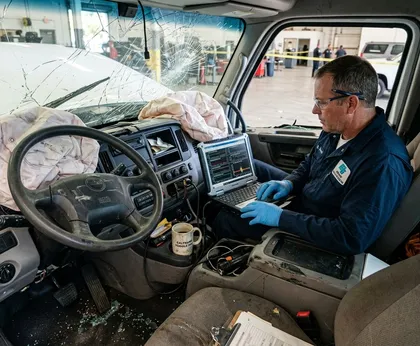
“Black box” data is typically associated with Event Data Recorders (EDRs). However, in many trucks, EDR functionality is integrated into or linked with the Electronic Control Modules (ECMs). Together with Electronic Logging Devices (ELDs), these onboard computers provide unbiased digital information in the case of a truck accident.
Unlike what a witness remembers, this data does not change over time. It records exactly what the truck was doing in the moments before impact. The challenge is that this data does not last forever. Trucking companies may overwrite or delete it quickly. Understanding what the device captures and how long it retains that data is what makes timing critical.
What Is A Commercial Truck Black Box?
A “black box” in a commercial truck is an informal term for an electronic system that records vehicle data. That can include electronic control modules (ECMs) and event data recorders (EDRs). Each device serves a different purpose, such as tracking engine performance or recording data during a crash.
The more important question is, what specific data does each device record? The answer can help explain what happened in the seconds before a crash. In truck accidents, EDR data is especially useful because it captures key information during sudden events like hard braking or a collision.
What Information Do EDRs Capture?
EDRs capture objective digital data from the seconds leading up to a crash. Unlike eyewitness accounts, this data is machine-recorded and not influenced by human perception. EDR data provides an objective digital record, which can help support the reconstruction of how the crash occurred.
EDRs measure several key metrics, each tied to a specific driver behavior:
- Speed and Braking: Shows how fast the vehicle was moving and whether the driver slowed down before impact.
- Engine and Throttle Data: Indicates whether the driver was accelerating at the moment of impact.
- Steering Wheel Angle: Captures sudden turns in the final seconds before the crash.
- Safety Systems: Records seatbelt use and airbag deployment.
At-fault drivers may claim they were not speeding or that they tried to brake. Truck accident lawyers may use EDR data to challenge those unsupported claims. These records can show exactly what the truck was doing.
What Information Do ECMs And ELDs Capture?
Electronic Control Module (ECM) data can help demonstrate whether the trucking company ignored safety defects or failed to repair the truck. The ECM continuously monitors engine performance and may store diagnostic trouble codes and limited snapshot data related to certain operating conditions.
- Quick-Deceleration Event Logs: Some systems may record event-triggered or freeze-frame data during rapid deceleration or fault conditions. The amount of pre- and post-event data varies by manufacturer and configuration. This data may indicate hard braking before impact, but it must be interpreted alongside physical evidence and other crash reconstruction data.
- Historical Diagnostic Trouble Codes (DTCs): The ECM may log mechanical failures, sensor errors, and system faults the truck experienced before the crash. If a trucking company claims the crash was caused by an “unavoidable sudden mechanical failure,” but the DTC logs show that an ABS sensor or a low air pressure warning fault had been flashing on the dashboard for the past three weeks, it can support a claim of negligent maintenance.
The Electronic Logging Device (ELD), on the other hand, can show Hours-of-Service violations, which may help show that the truck driver was fatigued.
- RODS (Record of Duty Status) Logs: These logs are the driver’s official duty status record. It records a driver’s duty status throughout the day in four categories:
- Off-Duty
- Sleeper Berth
- Driving
- On-Duty (Not Driving)
- The ELD Malfunction & Data Diagnostic Logs: ELD systems generate diagnostic and malfunction records, including power loss, signal disruption, or disconnection events, depending on system configuration.
- Unassigned Driving Time Reports: If a driver is not properly logged into the ELD, vehicle movement may still appear in system records as unassigned driving time. This data may indicate periods when vehicle movement is not matched to a logged driver, which may warrant further investigation into Hours-of-Service compliance.

How Black Box Evidence Proves Fault Under California Law
Black box data from ECM and EDR systems plays an important role in proving fault in truck accidents. It provides objective, time-stamped information about what the truck was doing before and during a crash, which helps establish whether a driver failed to use reasonable care.
California law requires everyone to use ordinary care to avoid harming others. In truck accident cases, black box data from ECM and EDR systems can help show whether a driver failed to meet that duty of care. This data can reveal key details about how the truck was operated before and during the crash. For instance:
- If the truck slowed down or showed no deceleration before impact, this may indicate the driver failed to react in time.
- If the driver was accelerating at the moment of impact, this can suggest inattention or unsafe driving behavior.
- Steering input shows if the driver attempted to turn or correct course to avoid the collision.
- Seatbelt use and deployment of airbags or other safety systems help indicate the severity of the crash and the occupant’s response.
Liability may depend on the EDR data. While this information may prove fault, it may also show whether the truck driver tried to stop or prevent the collision. In such cases, shared fault may be possible.
California follows a pure comparative negligence rule. That means you may still recover compensation even if you share some of the blame. For example, if a court or insurer finds 20% at fault, you may still be eligible to recover 80% of your damages.
Shared fault in big rig crashes can be complex. Some victims often seek free advice from a truck accident lawyer to understand their position when there is partial liability.
Additionally, it’s important to understand that your truck accident case should not only focus on truck data. Medical records also build your case. Visiting a doctor or chiropractor after the crash ties your injuries to the collision in writing. Together, the EDR data and your medical records give you objective, documented proof of what happened and what it cost you.
Why You Must Act Quickly To Preserve Truck Data
The trucking company often controls access to vehicle data, making early preservation efforts important before the information gets overwritten or lost. A person other than the registered owner can retrieve it only with the owner’s consent, a court order, or another legal exception. Without quick legal action after a crash, important electronic evidence can disappear and weaken your case.
A lawyer can move quickly so that the evidence crucial for proving fault does not get lost. That proactive strategy matters because:
- New information can quickly overwrite old crash data. Near-deployment data is typically cleared after 250 ignition cycles, which is about 60 days of driving.
- If the truck gets repaired, reset, or sent to salvage before the data is downloaded, key crash information may be permanently erased.
- Trucking companies are not required to store this data indefinitely, which creates a limited window to preserve it after a collision.
A spoliation letter from a truck accident attorney can demand that the company preserve black box data and other crash evidence before it is lost. Once the company is notified of a crash, it may have a legal duty to preserve that information.
This spoliation of evidence affects truck accident cases by helping formally establish that obligation. If a trucking company erases black box data despite receiving a preservation request, a court may impose sanctions for destroying evidence.
Thinking, “I need a personal injury lawyer” after a truck accident is completely understandable. A lawyer can help protect your rights and preserve crucial evidence, especially when your injuries make it difficult for you to handle these steps on your own.
Frequently Asked Questions About Truck Accident Evidence
After a truck accident, data stored in the truck often becomes key evidence in the case. These vehicles use onboard devices to log speed, braking, and driver hours. Several systems can each store different parts of that data. Knowing who holds this data and how fast it can disappear shows why quick action after a crash matters.
How Accurate Is A Black Box In A Vehicle?
Black box data is generally reliable. Specifically, for trucks equipped with EDRs, federal standards set the accuracy requirements all makers must follow. If you suspect irregularities, truck accident lawyers can work with subject-matter experts to evaluate whether the data is accurate.
Can A Black Box Prove Exactly Who Is At Fault?
A black box records data such as speed, braking, and steering inputs. However, it does not determine fault on its own. Black box data can help prove fault by showing actions like speeding, delayed braking, or failure to react in time. At the same time, it can also support the truck driver’s defense if the data shows they slowed down, applied the brakes, or tried to avoid the crash before impact.
Ultimately, evidence from a black box helps lawyers, insurers, and courts understand what happened. It may point to negligence in some cases or to reasonable efforts to prevent a collision in others.
Can A Trucking Company Legally Destroy Black Box Data?
Yes. Without a legal notice, a trucking company can overwrite the data. Some devices can do this in as little as 30 days, depending on the carrier. A spoliation letter, which formally demands the preservation of evidence, aims to stop this by requesting that the company preserve the data. Destroying it after that notice can lead to court penalties.
Do All Commercial Trucks Have Black Boxes?
Most commercial trucks today have some form of electronic data recording. The Federal Motor Carrier Safety Administration requires electronic logging devices on most active commercial trucks. Some older vehicles are exempt from this rule.
Who Controls Black Box Data After A Crash?
The trucking company typically controls the truck data, and a truck accident attorney can send a formal demand quickly to secure it before records are lost.
Arash Law Can Handle Your California Truck Accident Case
Black box data can be overwritten over time, which may weaken or even destroy important evidence for your claim. Preserving this data as soon as possible is critical to protecting your case. AK Law has the resources and experience to act fast for you.
Our truck accident lawyers can send a spoliation letter right away, formally telling the trucking company to preserve all electronic records before that data is lost. We can also work with qualified experts to gather and review crash data that supports your case. That evidence can help show what the at-fault driver did and who is responsible for your injuries.
If you’re concerned about how much it would cost for us to handle your case, you may be wondering, “Do lawyers only get paid if they win?” The answer is yes at our firm, as we work on a contingency-fee basis. That means you pay nothing up front, and your lawyer only gets paid if they secure compensation for you.
Call (888) 488-1391 for a free initial consultation and take that first step today.