Alhambra dog-bite reporting starts with a local procedural detail many people miss: the City contracts animal services through the Los Angeles County Department of Animal Care and Control. Bite reports route to DACC’s Downey Animal Care Center, not to a city office on Main Street. Rabies and bite-reporting protocols are handled by LA County Public Health’s Veterinary Public Health division. Police involvement comes through the Alhambra Police Department. If the bite occurs at Alhambra Park or another city-owned property AND the City allegedly contributed to the conditions, a six-month government claim deadline may apply in addition to the standard two-year statute of limitations.
A California personal injury attorney has reviewed this guide. Arash Law has recovered over $1 billion for injury clients across California.
Call our Alhambra dog bite attorneys at (626) 899-9820 for a free, no-pressure consultation. No fee unless we recover for you. House, hospital, and virtual visits are available across LA County.
Five Things That Actually Matter When Choosing a Dog Bite Lawyer in Alhambra
Most guides tell you to verify a lawyer’s State Bar status and ask about fees. Those steps matter, but they are not what separates a strong Alhambra dog bite case from a weak one. These five do.
- Bite reports route to LA County DACC in Downey, not a City of Alhambra office. The City of Alhambra contracts with the LA County Department of Animal Care and Control. Bite reports, quarantine determinations, vicious-dog declarations, and follow-up investigations all route to the Downey Animal Care Center at 11258 S Garfield Avenue, (562) 940-6898. A lawyer who does not know this can lose valuable time at the start of a case.
- California is a strict-liability state under Civil Code §3342 for actual bites. The owner is liable for damages from a bite if the victim was in a public place or lawfully on private property. The owner’s prior knowledge of the dog’s viciousness is irrelevant under §3342. The statute applies to actual bites only. If a dog knocks someone down without biting, the claim may require a negligence theory or another basis to establish liability. Ask any lawyer you interview to walk you through how §3342 differs from common-law negligence and from §3342.5, the duty of an owner after a dog bite incident.
- A bite on city property does not automatically create a claim against the City. Alhambra Park, Almansor Park, Burke Heritage Park, Garfield Park, and Barnes Park are all city-owned. A bite at any of these does not by itself create city liability. A separate claim against the City of Alhambra under Government Code §911.2 may apply only if the City allegedly contributed — for example, through a dangerous condition, prior notice of a recurring dog problem, defective fencing, leash-enforcement failure after known complaints, or other public-entity conduct. The government claim deadline is six months from the date of the bite, not two years.
- The dog owner’s homeowner’s or renter’s insurance is usually what actually pays. Most California dog bite recoveries come from the owner’s HO-3 homeowner’s or HO-4 renter’s liability policy, not from the owner’s personal assets. Some policies exclude specific breeds or named dogs with prior bite history. A lawyer who understands how to issue a policy-limits demand and how to identify excess coverage matters more than one who is simply willing to file a lawsuit.
- Evidence after a dog bite degrades fast — preserve photos and records within days. Wound photos from the first 48 hours establish severity and scarring trajectory. The dog’s veterinarian and DACC maintain vaccination and quarantine records. Witness contact information disappears as bystanders move on. The strongest dog bite cases are built in the first week.
Table of Contents

Why Choosing a Dog Bite Lawyer in Alhambra Is Different
California’s dog bite law is the same statewide. Civil Code §3342 imposes strict liability on the owner for actual bites. What changes city to city is the procedural landscape: which agency takes the bite report, which courthouse hears the case, what local ordinances control leash and household-dog rules, and which residential and commercial settings are most likely to produce a claim. In Alhambra, four procedural facts shape the case.
1. Alhambra contracts its animal services to LA County DACC
The City of Alhambra does not maintain its own animal control agency. According to the City’s official Animal Control page, Alhambra partners with the Los Angeles County Department of Animal Care and Control. DACC serves Alhambra residents from the Downey Animal Care Center at 11258 South Garfield Avenue, Downey, CA 90242. The DACC Communication Center is staffed 24 hours a day, 7 days a week at (562) 940-6898.
Some nearby cities use different animal-control systems, but Alhambra routes animal-control services through LA County DACC. Pasadena handles bites through Pasadena Humane Society at (626) 792-7151. Long Beach handles bites through Long Beach Animal Care Services at (562) 570-7387. A lawyer working on an Alhambra case who is in the habit of calling Pasadena Humane will lose days. Bite reports, quarantine compliance, vicious-dog declarations, and follow-up investigations all flow through DACC’s Downey location.
2. Rabies and bite reporting go through LA County Public Health
Separately from animal control’s role, the medical and public health reporting for a dog bite in Alhambra is handled by the LA County Department of Public Health’s Veterinary Public Health program. VPH can be reached at (213) 288-7060 or through their online Animal Bite Reporting portal. VPH’s job is to determine whether the biting dog is current on rabies vaccination, whether a 10-day observation period applies, and whether post-exposure rabies prophylaxis is necessary for the victim. The VPH report may help document the dog, the owner, the dog’s vaccination status, and the timeline. It can be a useful piece of evidence in a civil claim alongside the DACC bite report and medical records.
3. Alhambra has its own municipal code on dogs
Alhambra Municipal Code Section 14.04.030 requires dogs in any city park to be on a leash no longer than six feet and under the owner’s control at all times. AMC 7.20.158 prohibits dogs from running at large on public streets, parks, or other public areas. AMC 7.20.120 limits households to a maximum of two dogs. AMC 7.20.150 addresses loud barking. Violating a local leash or running-at-large ordinance may support a negligence claim in a civil case, but it does not automatically prove every issue. Liability still depends on the facts of the bite, the causal connection between the violation and the bite, and the strength of the supporting evidence.
4. Civil Code §3342 applies to actual dog bites only
California’s strict liability statute is the dog BITE statute. §3342 applies when a dog actually bites. If a dog knocks someone down, jumps on them, or scares them into falling without an actual bite, §3342 strict liability does not apply. The claim may still proceed under a negligence theory — for example, the owner failed to control a dog known to jump on people. Or it may proceed under premises liability or other theories. The streamlined strict-liability framework of §3342 requires an actual bite. Distinguishing these scenarios early in case workup matters. The legal theory determines what evidence is needed and what defenses apply.
What the Local Data Shows on Dog Bites in Alhambra
Dog bite statistics in California are not published with the same city-by-city granularity that the Office of Traffic Safety publishes for vehicle crashes. The California Department of Public Health publishes aggregated statewide rabies and bite reports. LA County DACC publishes annual reports at the county level. City-disaggregated dog bite counts are typically not publicly available. What we have for Alhambra specifically is the procedural footprint, the local ordinance framework, and documented incident reporting.
That procedural footprint matters. Alhambra has a population of approximately 78,223 and is located in the western San Gabriel Valley. The city sends its bite reports to DACC’s Downey facility, which is a large county animal-control agency serving unincorporated areas and contracted cities across Los Angeles County. DACC’s Downey Animal Care Center handled animal control responsibilities for the City of Alhambra continuously through the most recent published intake and services data. Local reporting has covered off-leash dog concerns at Alhambra Park, including resident requests for stronger code enforcement and increased police patrols during the park’s evening hours. For broader analysis of dog bite injury patterns and statewide trends, see our coverage of annual dog bite statistics.
On the geographic side, the city’s residential mix produces different bite scenarios. Downtown Alhambra, Alhambra Hills, Sierra Vista, Madison Heights, and the Valley Boulevard corridor combine high-density multifamily housing with single-family residential streets. In high-density apartment contexts, landlord liability questions arise regarding dangerous dogs in common areas and failure to enforce pet policies. In the single-family context, the central claim is standard §3342 strict liability against the dog’s owner.
Speak with an Alhambra Dog Bite Lawyer Today — (626) 899-9820. Local Alhambra line: (626) 899-9820 · Main 24-hour California line: (888) 488-1391
Where Your Case Gets Filed and Which Local Agency Handles It
A single Alhambra dog bite case can involve up to four separate procedural tracks. Knowing which path applies — and which is the dominant track for case value — is the difference between a strong claim and a stalled one.
| Procedural track | Where it goes | Deadline and key authority |
|---|---|---|
| Civil personal injury claim against the dog owner — the primary case | LA County Superior Court. Filing venue depends on the case type, the amount in controversy, and the Superior Court assignment rules. The Alhambra Courthouse at 150 W Commonwealth is one of the LA Superior Court locations that hears civil PI matters. Depending on the case posture, other LA Superior Court venues such as the Stanley Mosk Courthouse may apply. Verify the correct filing venue through the LA Superior Court before filing. | 2 years from date of bite — CCP §335.1. Strict liability under Civil Code §3342 for bite-caused injuries. |
| Animal control bite report and dog quarantine | LA County DACC, Downey Animal Care Center, 11258 S Garfield Ave, Downey 90242, (562) 940-6898 | Report promptly. DACC may investigate the bite, locate the dog and owner, verify rabies vaccination status, and coordinate quarantine or observation requirements with public-health authorities. |
| Rabies and public-health bite report | LA County Department of Public Health, Veterinary Public Health, (213) 288-7060, or the online Animal Bite Reporting portal | Report promptly — California Code of Regulations Title 17 §2606 requires animal bites to be reported to the local health officer. Standard dog/cat rabies observation commonly follows public health guidance. |
| Government claim — only if the City allegedly contributed | City of Alhambra City Clerk, 111 S First Street, Alhambra 91801 — for claims alleging the City contributed through a dangerous condition, prior notice, defective fencing, leash-enforcement failure, city-program involvement, or other public-entity conduct. | 6 months from date of bite — Gov. Code §911.2. Presentation required before suit — Gov. Code §945.4. |
| Criminal report and police involvement — severe attacks | Alhambra Police Department non-emergency line, or 911 for emergencies | Report as soon as practical. The APD report number becomes part of the civil case evidence package. |
A lawyer who handles an Alhambra dog bite as if it were a single-track civil lawsuit will miss two of the three time-sensitive evidentiary tracks. Of the four, the DACC bite report is the most often missed by general personal injury lawyers. It is often one of the core documents in a strict-liability case.
Representative Results from Arash Law’s California Practice
The results below are representative California personal injury results from Arash Law’s practice across multiple injury types. None are Alhambra cases. Some are settlements, and some involve trial or trial-preparation posture. They illustrate the types of catastrophic injury claims the firm has handled, including the lead $2.3 million dog bite case, where the firm secured policy-limits recovery from the owner’s homeowner’s insurance for an elderly victim’s traumatic brain injury caused by an unleashed dog attack.
$6,100,000 — Pedestrian case involving a 6-year-old child. Included for the severity-of-child-injury context. Not a dog bite. Catastrophic injuries to a young child trigger similar damages categories: future medical care, scarring, emotional impact, and lost earning capacity from age 18.
$3,500,000 — Bicyclist vs. auto involving a 6-year-old child with traumatic brain injury. Included for context on how the firm has overcome defense comparative-fault arguments against young child plaintiffs. The same defense strategy is common in child dog bite cases.
Past results do not guarantee future outcomes. Every case depends on its own facts, evidence, injuries, insurance, venue, and liability issues. Two of the three results above are not dog bite cases. They are listed only to illustrate the firm’s experience with catastrophic child injuries and head trauma. The $2.3M dog bite case involved a traumatic brain injury caused by the fall from the dog attack, which substantially increased the case value beyond the bite injury alone. Contacting Arash Law does not create an attorney-client relationship. An attorney-client relationship is formed only when both parties sign a written fee agreement.
In our experience, what separates a serious Alhambra dog bite case from a thin one is the early identification of the homeowner’s or renter’s insurance policy that will fund the recovery — and the early preservation of wound photos, the DACC bite report, and vaccination records. The dog-bite case the firm resolved for $2.3 million was won through careful TBI documentation and a policy-limits demand structured around the owner’s homeowner’s insurance policy.
Red Flags When Choosing an Alhambra Dog Bite Lawyer
Dog bite work is a niche within personal injury. The lawyer-selection question is not simply whether a firm handles injury cases. Watch for the following signals.
- The firm pitches itself as a general personal injury practice, and it cannot name LA County DACC, the Downey Animal Care Center, or LA County Veterinary Public Health’s rabies-reporting role. These three are table stakes for Alhambra dog bite work.
- The firm is unfamiliar with the distinction between Civil Code §3342, which imposes strict liability for the bite itself, and §3342.5, which imposes a separate duty of the owner after a known bite. Conflating the two is a basic precision error that surfaces fast in settlement negotiations.
- The firm proposes filing the civil case before identifying the dog owner’s homeowner’s or renter’s insurance policy. Most recoveries come from policy proceeds, not personal assets. Identifying the policy and any excess layers is upstream of filing.
- Aggressive television-style branding without a single named, verifiable result on the firm’s website. A firm that cannot point to a specific recovered result for a specific injury category is one whose case handling is hard to evaluate.
- The firm tells you the case is obvious because California is a strict-liability state. Strict liability simplifies the liability question. It does not by itself determine case value. Value is built through medical documentation, scarring photos, and demonstration of impact on the victim’s life.
- The firm wants a recorded statement to the dog owner’s insurance carrier before your medical workup is complete. Insurance adjusters are trained to extract statements that minimize injury severity before the full picture is documented.
How to Verify a Dog Bite Lawyer’s Actual Track Record
Most lawyer-selection guidance is aspirational. “Choose someone with experience” is not verifiable. Here is what you can actually verify in 15 minutes.
1. California State Bar Attorney Search
The California State Bar maintains a public attorney-search tool at apps.calbar.ca.gov/attorney/LicenseeSearch/QuickSearch. Look up any attorney by name to confirm active status, license number, year of admission, public-record disciplinary history, if any, and current bar address. Inactive or suspended attorneys cannot represent you. A discipline notation does not automatically disqualify, but it warrants a direct conversation.
2. LA County Superior Court case-search portal
LA Superior Court’s public case-access portal at lacourt.org allows civil-case searches by attorney name. A lawyer who claims regular LA County or Northeast District civil PI experience may appear in public civil filings. Public docket searches are not perfect. Some cases settle before filing. Some records list associated counsel or firm names differently. The venue can vary. Treat the portal as a useful cross-check, not a complete proof of experience.
3. Three direct questions to ask in consultation
- How many dog bite cases have you taken to verdict, settlement, or trial-prepared resolution in the last three years? Ask for a specific number, not a generality.
- Walk me through how you would identify the dog owner’s homeowner’s or renter’s policy in my case. What’s the first letter you send? A lawyer who cannot answer specifically does not handle this work routinely.
- If the bite happened on city property, how would you evaluate whether a government claim is needed? The right answer should identify the six-month Government Code §911.2 deadline and explain that a City claim depends on whether the City allegedly contributed through a dangerous condition, prior notice, defective fencing, leash-enforcement failure, city-program involvement, or other public-entity conduct.
Common Alhambra Dog Bite Scenarios
Most Alhambra dog bite claims fall into one of six scenarios. Each carries its own evidence pattern, defendant identification challenge, and insurance pathway.
1. Bite at Alhambra Park or another city park
Alhambra Park at 500 N Palm Avenue, Almansor Park, Burke Heritage Park, Garfield Park, and Barnes Park are all city-owned. Dogs are permitted on a six-foot leash under AMC 14.04.030. A person who allows a dog to be off-leash violates the ordinance. A bite on city park property typically involves the standard Civil Code §3342 strict liability claim against the dog’s owner. A separate government claim against the City of Alhambra under Government Code §911.2 may also apply IF the City allegedly contributed — for example, through a dangerous condition the City had notice of, defective fencing, inadequate signage, or failure to enforce known dangerous-dog activity at the park. The mere fact that a bite occurred on city property does not by itself create city liability. Ask how the lawyer evaluates whether a city-property bite supports a parallel government claim, and how they handle the parallel filing of the §3342 civil claim and the §911.2 government claim.
2. Bite at an apartment complex or multi-family residential property
Alhambra’s high-density residential corridors — Downtown Alhambra, the Valley Boulevard corridor, and the Garfield Avenue area — produce frequent apartment-complex bite claims. Liability here can extend beyond the dog’s owner to the landlord, property manager, or HOA. This rule applies especially if the property knew of prior aggressive incidents and failed to enforce its own pet policies or lease restrictions. Critical evidence includes the lease pet rider, prior-complaint records, and property-management incident logs. Prior complaints typically require a document subpoena once litigation begins. Ask how the lawyer handles a multi-defendant case with both the dog owner and the landlord.
3. Child bite — facial scarring case
Dog bites to children present specific damages categories: future plastic surgery often staged over multiple procedures into adulthood, psychological treatment, and scarring evaluation by qualified surgeons. Child cases also implicate minor-tolling under CCP §352(a). The SOL is tolled until the child turns 18, but DACC reporting and evidence preservation cannot wait. Photographs of the wound at first medical treatment, at each follow-up, and at scarring-stabilization points, typically at 12-18 months, are essential. Ask which plastic surgeons the lawyer works with for pediatric scarring evaluations.
4. Postal worker, delivery driver, or utility worker bite
People legally on private property in the performance of a job — postal workers, delivery drivers, meter readers, utility crews — are within §3342’s protected class. The owner cannot defend on “trespasser” grounds. These cases often involve workers’ compensation as the primary recovery vehicle, with a parallel third-party civil claim against the dog’s owner under Labor Code §3852 and following. The workers’ comp carrier will have a lien on the third-party recovery. For the workplace injury side of these cases, ask how the lawyer coordinates the workers’ comp and third-party civil tracks.
5. Veterinarian’s rule and the assumption-of-risk defense
California courts apply an assumption-of-risk doctrine to certain occupations that knowingly accept the risk of being bitten. Veterinarians, kennel workers, dog groomers, and similar paid-with-dogs roles cannot recover under §3342 strict liability for injuries from dogs in their professional care. These victims must instead pursue common-law negligence — proof that the owner knew or should have known of a specific dangerous propensity beyond ordinary risk. Ask whether the lawyer has handled an assumption-of-risk-defended dog bite case, and how they framed the negligence theory.
6. Police dog, military dog, and government-agency working dog
Civil Code §3342 has explicit exceptions for governmental agencies using dogs in military or police work performed in their assigned duties. A bite by an Alhambra Police K-9 deployed to apprehend a suspect, for example, does not create strict liability under § 3342 against the agency. A separate civil rights claim under 42 U.S.C. §1983 may apply if the deployment violated constitutional standards. These cases require both PI experience and familiarity with federal civil rights.
Alhambra Dog Bite Evidence Map — What to Preserve and Who Controls It
Each Alhambra dog bite claim type has a different evidence preservation calendar and a different custodian. The first 7 to 30 days are often decisive, which is why the immediate steps after a dog bite in Alhambra matter so much. A lawyer who knows the local landscape can send the right preservation letters to the right parties before evidence is overwritten, destroyed, or simply forgotten.
| Scenario | Time-sensitive evidence | Custodian |
|---|---|---|
| Standard residential bite at the owner’s home or yard | DACC bite report, owner identification, dog license and microchip records, vaccination records, homeowner’s policy declarations, wound photos with dates | LA County DACC · veterinarian · owner directly · claimant |
| Apartment or HOA common area bite | Lease pet rider, HOA pet policy, prior-complaint records, property-management incident logs, surveillance from common areas. Surveillance overwrites in 7-30 days. | Property manager · HOA board · landlord · dog owner · LA County DACC |
| City park bite at Alhambra Park, Almansor, or other city park | DACC bite report, park surveillance if any, witness statements from other park-goers, prior-incident records for that park via CPRA request, potential city government claim within 6 months if the City allegedly contributed | LA County DACC · City of Alhambra Community Services · Alhambra PD · witnesses |
| Commercial property bite at a store, restaurant, or pet business | Commercial general liability policy declarations, business surveillance footage, employee training records on dog-handling, incident report, OSHA reports if employee was bitten | Business owner · CGL carrier · employer if employee victim |
| Child facial bite — scarring case | Medical records from Alhambra Hospital ED or other initial-treatment facility, plastic-surgery referral records, dated photographs at each treatment milestone, school nurse and incident records if at school | Alhambra Hospital Medical Center at 100 S Raymond Ave · pediatric plastic surgeons · school district · claimant family |
| Postal worker or delivery driver bite | Workers’ comp claim file, employer accident report, USPS/FedEx/UPS incident report, route records confirming legitimate presence, homeowner’s policy of the property owner | Employer · workers’ comp carrier · property owner’s HO policy · LA County DACC |
Preservation letters to each custodian above should be among the first letters out the door in any Alhambra dog bite case. Surveillance overwrite cycles at apartment complexes and commercial properties typically range from 7 to 30 days. A delay of 2 weeks can mean the difference between a video-documented attack and a case dependent on witness memory.
Speak with an Alhambra Dog Bite Lawyer Today — (626) 899-9820. Local Alhambra line: (626) 899-9820 · Main 24-hour California line: (888) 488-1391
Filing Deadlines for an Alhambra Dog Bite Case
Three separate deadlines apply to most Alhambra dog bite cases. Missing anyone can extinguish a track of recovery.
Two years to file the civil lawsuit
California Code of Civil Procedure §335.1 sets a two-year statute of limitations for personal injury actions, including dog bite claims. The clock starts on the date of the bite. If the bite victim is a minor, the deadline is tolled under CCP §352(a) until the minor turns 18. Evidence-preservation activities cannot wait — DACC report, photos, medical records, and witness statements all need to be captured early.
Six months to file any government claim
If the bite occurred at Alhambra Park or another city-owned location AND the claim alleges that the City contributed to the injury, a written government claim may need to be presented to the City of Alhambra within six months under Government Code §911.2. Examples may include a dangerous condition, prior notice of a recurring dog problem, defective fencing, leash-enforcement failure after known complaints, city-program involvement, a city employee, or a city-owned animal. Claim presentation must precede any lawsuit under Government Code §945.4.
After the government claim is filed: split deadline for the resulting lawsuit
Once a government claim is filed, the lawsuit deadline splits depending on how the claim is resolved. If the city DENIES the claim in writing, the lawsuit must be filed within 6 months of the rejection date under Gov. Code §945.6(a)(1). If the city takes NO ACTION within the 45-day investigation window per Gov. Code §912.4, the claimant has up to 2 years from the date of injury to file suit. The longer window only applies when the city is silent, not when it denies.
Prompt public-health reporting after a bite
California regulations require bites from mammals to be reported to the local health officer. In Alhambra, animal-bite reporting can involve LA County Public Health Veterinary Public Health at (213) 288-7060 or the online Animal Bite Reporting portal. This public health reporting requirement under California Code of Regulations Title 17 §2606 is not the same as the civil lawsuit deadline. The resulting public-health record can also be a useful piece of evidence in a civil claim.
How to File a Bite Report with LA County DACC
Because Alhambra contracts with LA County for animal control, all bite reports go through the LA County Department of Animal Care and Control rather than to a city office. The procedural details:
| Field | Detail |
|---|---|
| Filing office | Downey Animal Care Center, 11258 South Garfield Avenue, Downey, CA 90242 |
| 24-hour Communication Center phone | (562) 940-6898 — staffed 24/7 |
| Online reporting | Available through animalcare.lacounty.gov. Verify the current portal URL before filing. |
| What DACC does after the report | Investigates the bite, locates the dog and owner, verifies rabies vaccination status, orders standard 10-day rabies observation period — typically at the owner’s home if compliance is reasonable. DACC may proceed to vicious-dog or potentially-dangerous-dog declarations under the LA County Code in cases of repeat or severe bites. |
| Why the bite report matters in your civil case | The DACC report identifies the dog, the dog’s owner, the dog’s vaccination status, and the incident timeline as documented by an independent agency. This is foundational evidence in any Civil Code §3342 strict-liability claim. |
Verify current DACC contact procedures at the City of Alhambra’s official Animal Control page at alhambraca.gov before relying on these details, in case service contracts or county procedures have been updated.
How to File a Rabies and Bite Report with LA County Public Health
Separately from animal control’s role, the medical and public health side of bite reporting in LA County is handled by the LA County Department of Public Health’s Veterinary Public Health program. This report is the document that triggers rabies-exposure determination and any necessary post-exposure prophylaxis.
| Field | Detail |
|---|---|
| Phone reporting | (213) 288-7060 during business hours, Monday-Friday, 8 a.m. to 5 p.m. |
| Online reporting | Animal Bite Reporting form at publichealth.lacounty.gov/vet. Verify the current URL before filing. |
| Statutory authority | California Code of Regulations Title 17 §2606 — animal bites must be reported to the local health officer |
| After-hours and emergency reporting | If the bite occurs outside VPH business hours, an emergency report can be initiated through Alhambra PD or LA County Sheriff dispatch. Dispatch will connect to an on-call animal control officer. |
How to File a Government Claim Against the City of Alhambra
If the dog bite occurred on city-owned property — Alhambra Park, Almansor Park, Burke Heritage Park, Garfield Park, Barnes Park, public sidewalks, the city pool, or other Alhambra municipal property — and you allege any contributing role by the city, you may have a separate claim against the City of Alhambra. The City’s contributing role might be failure to enforce leash laws despite known violations, defective fencing, inadequate signage, or similar. The California Government Claims Act governs that claim.
| Field | Detail |
|---|---|
| Filing deadline | 6 months from the date of the bite — Government Code §911.2. Late claims require a separate petition under Gov. Code §911.4 with statutory excuse grounds. |
| Statutory authority | Government Code §§910 through 915.2. Presentation required before suit under §945.4. |
| Where to file | City of Alhambra City Clerk, 111 South First Street, Alhambra, CA 91801. For property and community-services questions: (626) 570-5044. Verify current claim-filing procedures and the appropriate office at cityofalhambra.org before submitting. |
| City’s investigation window | 45 days under Gov. Code §912.4 for the city to act. The city may approve, deny, or take no action. |
| After the city responds — lawsuit deadline | If the city DENIES: 6 months from the rejection notice — Gov. Code §945.6(a)(1). If the city takes NO ACTION within 45 days: up to 2 years from the date of injury — Gov. Code §945.6(a)(2). |
The City of Alhambra does NOT accept claims on behalf of LA County, the Alhambra Unified School District, the LA County Sheriff’s Department, or any other separate public entity. If the bite occurred at a county-owned facility, a school district property, or in connection with another public entity, the claim must be filed with that specific entity. Each entity has its own claim procedure and a 6-month deadline.
How Lawyer Fees Work in an Alhambra Dog Bite Case
Most California personal injury lawyers, including Alhambra dog bite lawyers, work on a contingency fee basis. That means no fee unless and until the lawyer recovers money for you.
Two California rules govern contingency fee agreements:
- California Business and Professions Code §6147 requires contingency fee agreements to be in writing and signed by both lawyer and client. A copy must be provided to the client. §6147 also requires specific disclosures: the fee is negotiable, fees are not set by law, and a statement of the percentage and its calculation.
- California Rule of Professional Conduct 1.5 separately prohibits unconscionable or illegal fees, regardless of whether the agreement is in writing. Rule 1.5 lists factors used to determine reasonableness.
Some contingency agreements use different percentages depending on whether the case resolves before litigation, after a lawsuit is filed, or at trial or appeal. Case costs include expert witnesses, court filing fees, medical record copying, and deposition transcripts. Costs are typically handled separately from the contingency percentage and may be advanced by the lawyer with reimbursement at the time of recovery. The exact percentage, cost responsibility, and calculation method must be stated in the written fee agreement before representation begins. Review the fee agreement carefully, including how costs are handled if there is no recovery.
What to Bring to Your Free Consultation
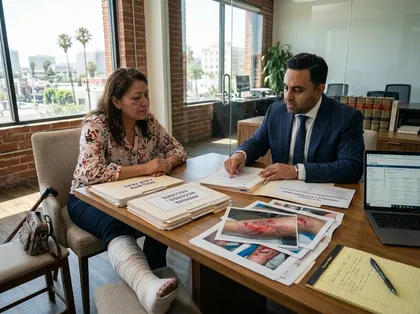 A productive first meeting depends on assembling the documents most likely to anchor the case. For an Alhambra dog bite case, bring whatever of the following you have:
- Photos of the wound — at first treatment, at each follow-up, and at any scarring milestones. Date-stamp where possible.
- Medical records and bills from any treating providers — Alhambra Hospital ED if used, follow-up primary care, plastic surgery consult, mental health if applicable.
- LA County DACC bite report number if you’ve already filed.
- LA County Public Health VPH report number or online portal confirmation, if applicable.
- Alhambra Police Department incident report number, if you reported to the police.
- Names, phone numbers, and addresses of any witnesses.
- The dog owner’s name, address, and any insurance information you have, including homeowner’s, renter’s, or commercial policy details.
- Any text messages, photos, or letters between you, the dog owner, and any insurance adjuster who has contacted you.
- Information about prior bites or aggressive incidents involving the same dog, if known.
- For an apartment or HOA case: the property’s name, the property manager’s contact, your lease pet rider if you are a fellow tenant, and any prior complaints you’ve filed with the property.
If you don’t have all of these, bring what you have. The lawyer can subpoena, request, or pursue the rest as part of the case workup.
Frequently Asked Questions
How much does it cost to hire an Alhambra dog bite lawyer?
Most Alhambra dog bite cases are handled on contingency. No fee unless we recover for you. The fee agreement will be in writing, specify the percentage, and explain whether you may owe case costs if there is no recovery. California Business and Professions Code §6147 requires contingency fee agreements to be in writing and signed before representation begins.
Does California follow a one-bite rule?
No. California is a strict-liability state under Civil Code §3342. The dog owner is liable for damages from a bite if the victim was in a public place or lawfully on private property. This rule applies regardless of whether the dog has ever bitten anyone before. The owner’s lack of prior knowledge of the dog’s viciousness is not a defense under §3342.
What if the dog owner does not have insurance?
You can still file a claim directly against the owner. Strict liability applies regardless of insurance. But practical recovery depends on what the owner can pay. Other parties may also share liability depending on the facts: a landlord or property manager who knew of the dog’s aggression and failed to act, a business that allowed the dog on premises, a dog walker or kennel that lost control of the dog, or a public entity if the bite happened on government property and the entity allegedly contributed. Identifying every potentially liable party is upstream of filing a single-defendant lawsuit.
Should I give the insurance adjuster a recorded statement?
Speak with an attorney first. Insurance adjusters are trained to elicit statements that minimize injury severity or shift liability. They often call before the victim’s full medical workup is complete. There is generally no obligation to provide a recorded statement to the dog owner’s insurance carrier before consulting counsel.
What evidence do I need for a dog bite claim in Alhambra?
The strongest Alhambra dog bite cases are built on seven categories of evidence. Wound photos at multiple time-points. The LA County DACC bite report. The LA County VPH rabies/bite report. Medical records documenting treatment and any planned future care — especially scarring or plastic surgery for facial bites. Witness contact information. The dog owner’s identity and any insurance information. If at an apartment or commercial property, the property’s prior-complaint records and any surveillance footage. Surveillance overwrites fast. Send preservation letters within days, not weeks.
Is it worth suing for a dog bite?
It depends on the severity of injuries, the available insurance, the strength of the liability evidence, and the impact on your life. Minor bites with quick healing and no scarring typically resolve through the dog owner’s homeowner’s or renter’s insurance without litigation. Catastrophic bites — TBI from a fall during the attack, facial scarring on a child, large dog attacks with multiple wounds — frequently involve policy-limits demands. When the policy is inadequate to the damages, a deeper investigation into excess coverage and personal-asset recovery follows. A free consultation will tell you which category your case falls under.
How is Alhambra different from nearby cities for dog bite reporting?
Dog-bite reporting can vary across LA-area cities. Some nearby cities use separate animal-control systems, while Alhambra routes animal-control services through LA County DACC in Downey at (562) 940-6898. Do not assume the reporting path is the same just because another bite happened elsewhere in Los Angeles County.
Other Injury Matters in Alhambra
A dog bite is one type of injury claim that arises in Alhambra. Other claims — car accidents, truck collisions, premises injuries, and pedestrian incidents — have their own procedural and evidentiary patterns. For broader help with any injury claim in the city, see our Alhambra injury law firm overview. If your case involves a dog bite specifically, our dedicated Alhambra dog bite lawyers page has more details on what to expect from a consultation and how the firm handles dog bite intake.
Let Arash Law Help With Your Alhambra Dog Bite Case. Local Alhambra line: (626) 899-9820 · Main 24-hour California line: (888) 488-1391 · Free, no-pressure consultation. No fee unless we recover for you. House, hospital, and virtual visits across LA County.
A dog bite can leave you with medical bills, missed work, scarring, and lasting emotional impact. Whether the bite happened at Alhambra Park, in a Downtown Alhambra apartment complex, on a residential sidewalk in Alhambra Hills, near the Valley Boulevard corridor, or anywhere else in the city, our Alhambra dog bite lawyers can help you understand your options under California Civil Code §3342, identify the right insurance pathways, and build the case on the right evidence calendar.
Call (626) 899-9820 — our local Alhambra number — for a free initial consultation. Our main 24-hour California line is (888) 488-1391. We offer virtual, home, and hospital visits so you can speak with us from wherever you are.
About This Guide
This guide applies the California dog bite law to Alhambra-specific procedural facts. Sources include the City of Alhambra Animal Control page at alhambraca.gov/170/Animal-Control, the LA County Department of Animal Care and Control, the LA County Department of Public Health Veterinary Public Health program, the Los Angeles Superior Court at lacourt.ca.gov, the California State Bar attorney search, the California Office of Legislative Information for statutory text including Civil Code §§3342 and 3342.5, CCP §335.1, Gov. Code §§911.2 and 945.4, and the California Judicial Council CACI 463 dog bite jury instruction. A California personal injury attorney reviewed it for accuracy.
Sources
- City of Alhambra — Animal Control page, alhambraca.gov/170/Animal-Control (confirming Alhambra contracts with LA County DACC; verified)
- LA County Department of Animal Care and Control — Downey Animal Care Center, 11258 S Garfield Ave, Downey, CA 90242, (562) 940-6898
- LA County Department of Public Health — Veterinary Public Health, (213) 288-7060 (rabies and bite reporting)
- California Civil Code §3342 (dog owner strict liability for actual bites) — leginfo.legislature.ca.gov
- California Civil Code §3342.5 (subsequent bite owner duty)
- California Code of Civil Procedure §335.1 (2-year SOL for personal injury)
- California Code of Civil Procedure §352(a) (minor tolling)
- California Government Code §§911.2, 945.4, 945.6 (government claim deadlines and lawsuit windows)
- California Code of Regulations Title 17 §2606 — animal-bite reporting to the local health officer
- California Business and Professions Code §6147 (written contingency fee agreement requirement)
- California Rules of Professional Conduct, Rule 1.5 (prohibition on unconscionable or illegal fees)
- California Judicial Council Civil Jury Instructions, CACI No. 463 (dog bite statute, essential factual elements)
- Alhambra Municipal Code 14.04.030 (6-foot leash requirement in city parks)
- Alhambra Municipal Code 7.20.120 (2-dog household maximum), 7.20.150 (loud barking), 7.20.158 (no running at large)
- Los Angeles Superior Court — Alhambra Courthouse, 150 W Commonwealth, Alhambra, CA 91801, (626) 293-2100 (lacourt.ca.gov)
- California State Bar Attorney Search — apps.calbar.ca.gov/attorney/LicenseeSearch/QuickSearch
- Alhambra Hospital Medical Center — 100 S Raymond Ave, (626) 570-1606