TL;DR: Property damage is physical harm to your belongings or property, such as a vehicle, home, fence, or business, and you may seek compensation for repairs, replacement, or loss in value. California generally gives you 3 years to file a property damage lawsuit. Report the loss to your insurer promptly. Late reporting alone usually won’t kill your claim, but some coverages (like auto UMPD) have strict short deadlines.
Highlights:
- Separate your property damage claim from personal injury claims so repairs can start sooner while your injury case continues.
- Document all damaged items in your car, including phones, laptops, and tools, since personal item coverage varies by policy.
- Understand California’s minimum liability limits – $15,000 for property damage – may not cover your car’s full value.
- Review your own insurance policy early to identify coverage gaps and UMPD limits before you need them.
- Know the deadline: report damage to your insurer within days of the accident, and file a lawsuit within three years.
- You can choose your own repair shop under California law; the insurer cannot force you to use their preferred network.
- Read release forms carefully before signing, and ask an attorney to review any language mentioning ‘all claims’ or ‘any injuries’.
Tip: Stick to factual details when reporting your claim – document the accident with photos, police reports, and witness information rather than speculating about what happened.
Table of Contents
Property damage refers to physical harm to tangible property. This includes vehicles, electronics, furniture, tools, homes, and more. These items can often be repaired, replaced, or given a monetary value.
The property owner may seek compensation based on the situation. This can cover reasonable repair costs, replacement costs, or the value of property that can’t be restored. A claim might also include related losses, like debris removal, temporary security measures, emergency repairs, or reasonable loss-of-use expenses.
Motor vehicle accidents are among the most common causes of property damage. In those cases, the claim may cover damage to the vehicles, their contents, and property outside the roadway. Property damage and bodily injury are different categories of loss. In many cases, repairs or replacement can be addressed before an injury claim is fully resolved. However, any release should be carefully reviewed to ensure that resolving the property-damage portion does not unintentionally waive other claims.
What Is Considered Property Damage After An Accident?
Property damage after an accident is not limited to a damaged vehicle. It can include almost any tangible property harmed by someone else’s conduct, depending on fault, insurance coverage, and the type of incident.
Common examples include:
- Vehicles: This covers reasonable repair costs, fair market value if it’s a total loss, and any proven decrease in resale value after repairs.
- Personal Belongings: Items like phones, laptops, car seats, tools, furniture, and clothing may be included if they were damaged in the accident. Coverage depends on your policy terms.
- Homes and Residential Structures: Accidents can damage walls, roofs, windows, garage doors, fences, gates, and other parts of your property.
- Landscaping: Damage may include trees, shrubs, lawns, and irrigation systems. The value depends on repair or replacement costs and any decrease in the property’s overall value.
- Commercial Property: Claims may include storefronts, signs, equipment, inventory, and parking structures.
- Public or Utility Property: Accidents can harm guardrails, traffic signs, utility boxes, streetlights, and other government or utility property.
The owner of damaged property may file a claim against the responsible party or the applicable liability insurer. Homeowners, commercial property, collision, or other insurance may also apply, depending on the circumstances of the accident and the policy terms.
You have two ways to file a claim: against the other driver’s insurance or against your own insurance, if you have the right coverage.
If you go through your own insurer using collision coverage, you’ll have to pay your deductible first.
Here’s the good part: if your insurer pays your claim, it can then go after the at-fault driver to recover its costs. This is called “subrogation.” And when it does, it also has to recover your deductible for you so you can get that money back.
Consider the following actions to support your claim:
- Photograph the damage before repairs or removal.
- Save estimates and receipts.
- Document emergency expenses such as boarding up a wall, securing a broken gate, or removing hazardous debris.
Necessary safety work should not be delayed, but as much evidence as reasonably possible should be preserved.
Property Damage After A California Traffic Accident
These general property damage rules apply mainly to traffic accidents. California’s collision databases focus on crashes with injuries or deaths. They don’t give a full count of accidents with only property damage. Minor crashes often go unreported, making it hard to estimate the total property damage.
Property damage is a common result of traffic collisions. A crash can harm the vehicles and their contents. It can also damage nearby property, such as:
- Fences
- Garage doors
- Storefronts
- Landscaping
- Road signs
- Utility equipment
The claims process depends on who owns the damaged property and which insurance coverage applies. A driver’s property damage liability coverage may pay for damage caused to another person’s vehicle or property. Accident lawyers also consider collision, homeowners, renters, commercial property, or other insurance, depending on the circumstances and policy terms.
How California Handles Repairs, Total Loss, And Diminished Value
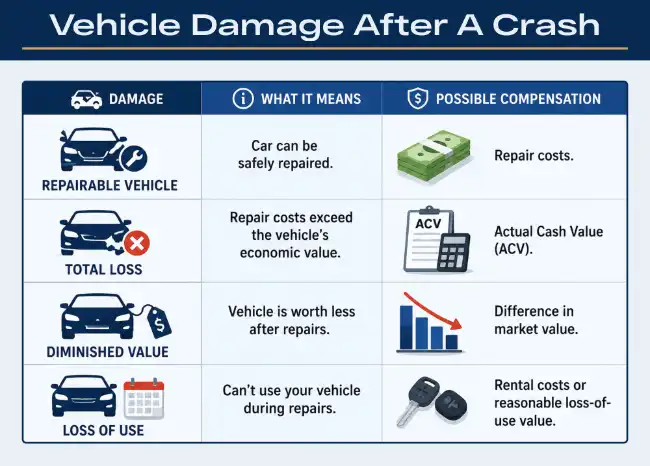 When another driver damages your car, California law may allow you to seek compensation to cover your losses. Depending on the facts of your case, you may be able to recover repair costs, your car’s lost value if it is totaled, any drop in resale value after repairs, and rental costs while you wait. These are separate avenues of compensation that you may be able to pursue depending on the coverage and facts involved.
- Total Loss: California doesn’t set one fixed rule for when a car is “totaled.” Insurers generally total a car when repairs cost more than it’s reasonably worth — in practice, that’s often 70–80% of the car’s actual cash value (ACV), though this varies by insurer. ACV refers to the vehicle’s fair market value immediately before the accident. What you’re paid depends on your policy (for your own claim) or the other driver’s fault and coverage limits (for a third-party claim).
-
Diminished Value: Repairs may not fully restore the car’s pre-crash market value. If evidence shows the repaired vehicle is worth less due to its accident history or repair quality, you can claim the difference. Diminished value isn’t automatic so that you may need:
- Sales prices for similar cars
- Dealer opinions
- Repair records
- A professional appraisal
-
Repair Costs: If the vehicle can be repaired, a claim may include the reasonable cost of:
- Labor
- Replacement parts
- Paint
- Testing and inspections
- Other accident-related repairs
Keep the repair estimate, final invoice, photographs, and records of any supplemental damage discovered after the shop begins work.
- Rental Costs and Loss of Use: You might recover transportation expenses while your car is being repaired or while resolving a total-loss claim. This can include rental charges or compensation for not being able to use your vehicle. In a California third-party claim, you can seek loss-of-use damages even if you didn’t rent a vehicle or pay rental costs. The amount may be based on the reasonable rental value of a similar vehicle for the time needed to repair or replace yours. Recovery depends on the facts and evidence, and on whether the claimed time was reasonable.
- Towing, Storage, Taxes, and Fees: Your claim may also cover reasonable towing and storage costs incurred as a result of the accident. For covered first-party total losses, the settlement can include sales tax and some fees. These fees may cover registration, licensing, or transfers. These amounts should be backed by the insurer’s valuation and settlement documents, not seen as automatic reimbursement for every expense.
How much you ultimately recover depends on fault, available insurance limits, the applicable policy, and the evidence supporting the vehicle’s repair cost and pre-crash value.
How Insurance Limits And Uninsured Drivers Affect Your Claim
Two things may determine how much you actually receive: whether you can prove fault and whether the at-fault driver carries enough coverage. Even when the fault is clear, the other driver’s policy may not be large enough to pay for everything you lost. That gap between the required minimum and the real-world value of vehicles is where claims run into trouble.
- Policy Limits: California requires drivers to carry at least $15,000 in property damage liability coverage. The $15,000 minimum is a per-accident limit, not a separate $15,000 limit for each vehicle, property owner, or damaged item. If a single crash damages several vehicles or structures, the available insurance may need to be divided among multiple claims.
This coverage pays for damage a driver causes to another person’s vehicle or property. However, California’s $15,000 minimum may not fully cover major repairs or the total-loss value of a newer or more expensive vehicle.
- Uninsured Driver: If an identified uninsured driver damages your vehicle, optional Uninsured Motorist Property Damage (UMPD) coverage may apply. Collision coverage or a collision-deductible waiver may provide different protection, depending on the policy.
California’s UMPD (uninsured motorist property damage) coverage comes with some strict rules:
-
-
- Physical contact required. The other vehicle must have actually hit yours.
- The driver must be identified. You need to know who hit you (or their license plate/vehicle info).
- Report within 10 business days. You must tell your insurer quickly.
-
What it pays for:
-
-
- If you don’t have collision coverage, UMPD only covers your vehicle itself, not personal items inside it or rental car costs. You’re paid the lesser of your car’s actual value or $3,500.
- If you do have collision coverage, UMPD instead covers your collision deductible, up to $3,500.
-
One more catch: if the other driver has at least California’s minimum required property damage coverage, they’re not considered “uninsured,” even if their coverage isn’t enough to fully pay for your damage.
- Shared Fault: This situation does not automatically disqualify your claim, either. California follows pure comparative fault, a rule established in Li v. Yellow Cab Co. (1975). Under this rule, any potential compensation may be reduced by your share of fault.
That means you may still be able to recover damages even if you played some part in the crash. If you are found 20% at fault, for example, any compensation you may be eligible to receive would be reduced by 20%.
Many victims learn the full extent of that coverage gap only after they file a claim. Accident attorneys can review your own policy early to give you a clearer picture of what you can actually recover. California law sets strict deadlines for filing property damage claims, and missing them means losing your right to seek compensation.
Deadlines To File A Property Damage Lawsuit In California
You generally have 3 years to sue for property damage:
- Vehicles (car, truck, etc.): 3 years under Code of Civil Procedure § 338(c)
- Real property (home, fence, storefront, landscaping): 3 years under Code of Civil Procedure § 338(b)
Keep in mind: the exact deadline can shift depending on when the claim is considered to “start” (accrue) and whether any exceptions apply to your situation.
If a government entity or employee is at fault, the deadline is much shorter:
- File a formal written claim within 6 months of the accident (Gov. Code § 911.2).
- If the agency properly rejects your claim in writing, you then have 6 months from that notice to file a lawsuit (Gov. Code § 945.6).
- If they don’t send a proper rejection, you get 2 years from the date of the accident instead.
Report to your insurer quickly, even though you have years to sue:
- Most policies require prompt notice of an accident.
- Waiting too long to report could hurt your claim, especially if the insurer can show the delay made it harder for them to investigate.
Frequently Asked Questions About Property Damage Claims
Handling insurance claims after an accident is confusing, and it is easy to feel uncertain about the next steps. These answers address common procedural worries, from choosing a repair shop to signing release forms. Your practical concerns are real, and these answers are here to help you move forward clearly.

Can I Settle My Property Damage Claim Before My Personal Injury Claim?
Yes. Property damage and personal injury are separate claims. They run on different timelines, and property damage settles faster because the repair costs are easier to estimate.
Personal injury takes longer, and that window matters when it comes to signing anything. Your doctor needs time to understand the scope of your injuries. That includes whether you will need ongoing care such as physical therapy or chiropractic care. Be careful before you sign anything.
Some release forms cover only property damage, which is fine. Others use broad language, such as phrases like “all claims” or “any injuries,” that can cancel your right to pursue a bodily injury claim. Read every release closely. If you see that kind of language, ask an attorney to review it before you sign.
Do I Have To Use The Auto Body Repair Shop The Insurance Company Recommends?
No. California law (Insurance Code § 758.5) lets you pick your own repair shop. The insurer can only recommend a specific shop if you ask for a suggestion, or if they’ve already told you in writing that you have the right to choose. They can also share honest info about a shop’s services.
If you use your own shop, the insurer can question charges it thinks are too high — but it can’t cut your payout just because its preferred shop would’ve charged less.
How Do I Make A Property Damage Claim If I Didn’t Get The Driver’s Insurance At The Scene?
You can still get the information you need. If law enforcement responded, contact the responding agency to ask whether it prepared a:
- Collision report
- Incident record
- Information-exchange document
The report may include the other driver’s identifying and insurance information. Still, it may be incomplete or require separate verification.
If the California Highway Patrol (CHP) handled the scene, request the report through the Online Crash Portal at crashes.chp.ca.gov or submit a CHP 190 form to the nearest CHP office. Your own insurer can also request the report directly on your behalf.
Accident Lawyers Can Help With Property Damage Claims
Dealing with insurance adjusters, repair shops, and lowball offers after a crash takes a real toll. You are trying to recover while juggling phone calls, paperwork, and pressure from people who do not have your best interests in mind. You should not have to handle all of that alone.
Accident lawyers can take that weight off your shoulders. When you have legal help, the back-and-forth with insurers shifts to your attorney, not to you. Your attorney can handle claims, push back on unfair offers, and protect your rights at every step. That means you can focus on getting better instead of handling the legal process on your own.
In addition to property damage, accident victims can also sustain injuries. If you find yourself thinking, “I need a personal injury lawyer,” Arash Law is here to help. AK Law handles personal injury cases on a contingency fee basis. This means you pay no attorney’s fees unless we recover compensation for you. Call (888) 488-1391 to schedule a free initial consultation.