TL;DR: Yes, you can still get an injury assessment. Although a new insurance policy cannot retroactively cover an earlier crash, you may still have a personal injury claim against a responsible driver or another liable party. A lawyer can examine fault, medical records, and potential limits on recoverable damages.
You can still request an assessment of your injuries, even if you bought auto insurance after the accident. A doctor can evaluate your injuries, while a personal injury lawyer can review your insurance documents, investigate who caused the crash, and assess your legal options. Just keep in mind that your new policy does not retroactively cover the accident.
Your current insurance card does not establish whether you were covered when the accident occurred. A lawyer must separately review the application date, the actual coverage start time, and any earlier applicable insurance. Even if you had no qualifying coverage at the time, you may still pursue certain damages from a responsible party.
However, if you were uninsured at the time of the accident, California law may limit the types of compensation you can recover. A legal assessment can help you understand these limitations and explore your options for pursuing compensation despite them.
Table of Contents

I Bought an Insurance Policy After the Accident. What Should a Lawyer Review Before Determining Whether I Can File a Claim for My Injuries?
A lawyer should review your insurance records, the accident timeline, and evidence of your injuries before assessing a potential injury claim. The review generally focuses on three areas:
- Insurance Coverage: The lawyer compares the time of the accident with your application, payment records, and the policy effective date. They also check whether another policy covered you or the vehicle.
- Liability for the Accident: Police reports, witness statements, photographs, and other evidence can help establish whether another driver or party caused the accident.
- Potential Compensation: Medical records, treatment bills, proof of lost wages, and documentation of other losses help the lawyer assess potential damages. Your insurance status may affect certain damages, but it does not automatically determine the outcome.
Key Facts About Post-Accident Insurance and California Injury Claims
- You can still request an injury assessment. Buying insurance after an accident does not prevent you from seeking medical care or consulting a lawyer about a potential injury claim.
- New insurance does not cover an earlier crash. A lawyer must compare the accident’s date and time with the policy’s effective date and time.
- Your current insurance card is not enough. Application records, payment confirmations, and other applicable policies can help establish whether coverage existed at the time of the crash.
- You may still pursue compensation. If another party caused the accident, you may have an injury claim. However, California Civil Code § 3333.4 (Proposition 213) may limit pain and suffering damages for certain uninsured drivers.
- Filing deadlines still apply. You can request an assessment of your injuries after buying insurance, but you still need to consider the deadlines for pursuing compensation. State law generally allows two years to file a personal injury lawsuit and six months to present government claims.
What Should a Lawyer Verify If I Bought Insurance After an Accident?
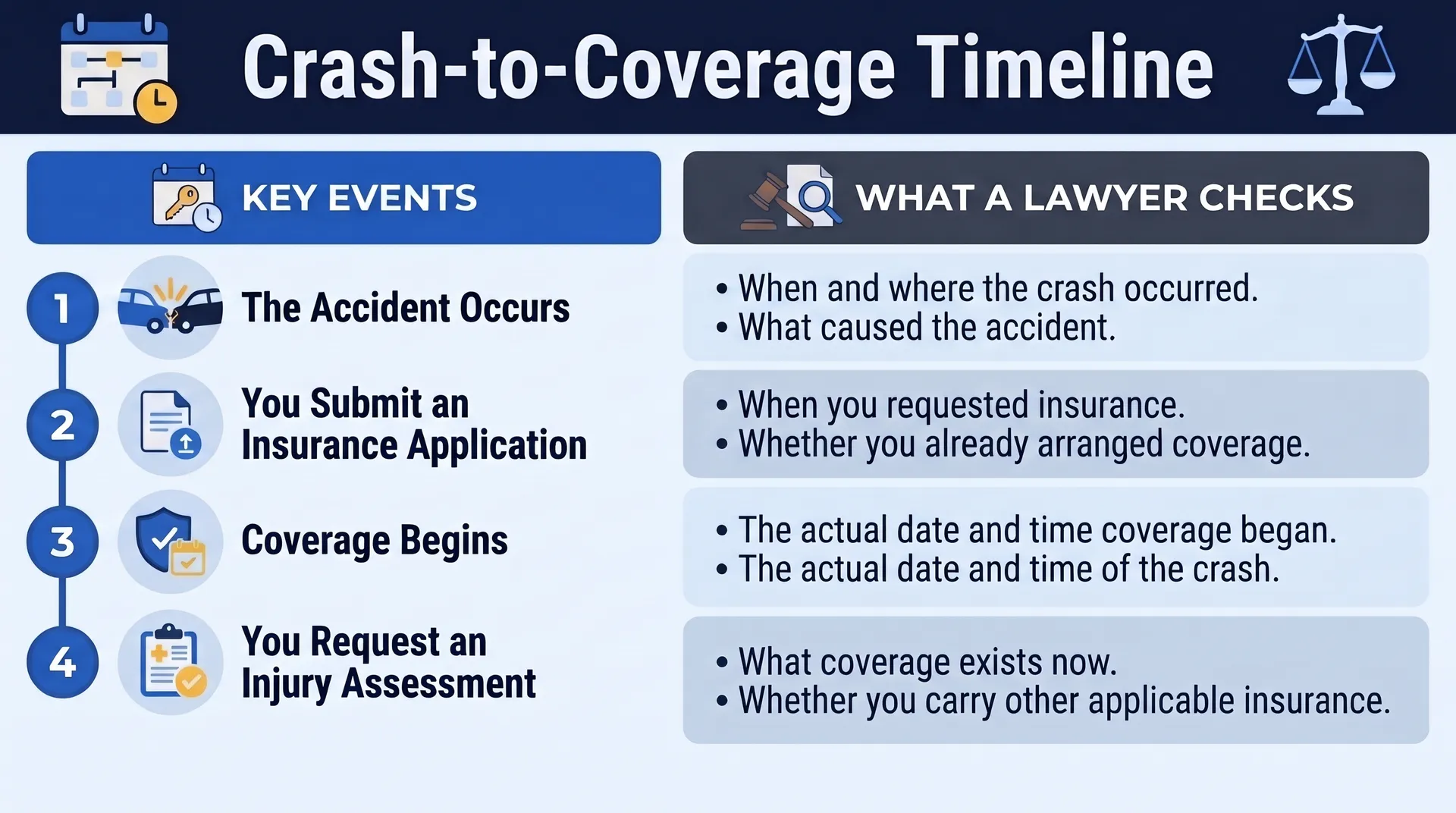
A lawyer should verify whether you had applicable insurance at the time of the accident and assess your options for pursuing an injury claim. The timeline below outlines the key steps in that review.
A legal review of this timeline can help the attorney answer these two key questions.
Question 1: Was Insurance in Effect When the Accident Occurred?
A lawyer must determine whether qualifying coverage existed at the time of the collision. A policy purchased afterward cannot retroactively insure a loss that occurred before coverage began. However, another applicable policy may have covered the driver or vehicle. To determine whether this is the case, the lawyer should review actual insurance records, such as:
- A copy of your insurance application.
- The application’s payment receipt.
- Emails or other communications with an insurer or agent that confirm the application.
- Your new policy’s declarations page.
- Temporary proof of insurance coverage (such as an insurance binder).
- Policy endorsements.
Question 2: Can I Hire a Lawyer and Pursue an Injury Claim?
Yes. If you purchased insurance after the accident, you can still consult a personal injury lawyer to assess your legal options. Hiring an attorney does not depend on your new policy covering the earlier crash. Whether you have a viable claim depends on liability, available sources of recovery, documented injuries, applicable legal restrictions, and filing deadlines.
If another driver caused the crash, you may still pursue an injury claim against that driver, even if you purchased insurance afterward. A lawyer will typically review the following evidence to assess who may be responsible:
- The police report.
- Photos of the accident scene.
- Witness statements.
Before hiring a lawyer to handle your injury claim, consider asking them the following questions:
- I didn’t have insurance when the accident occurred. Can you still help me pursue a claim against the at-fault driver’s insurer?
- How would my lack of insurance at the time of the crash affect your approach to handling my case?
- I don’t have proof of when my coverage started. Can you help me obtain the necessary insurance records?
The lawyer’s answers can help you understand what representation would involve, how they would address your insurance situation, and what steps they would take if you decide to hire them.
Why Doesn’t My Current Insurance Card Establish Coverage for an Earlier Accident?
Your current insurance card cannot establish coverage for an earlier accident because it only shows your present insurance information. It does not establish whether your policy was active at the time of the crash.
California Insurance Code § 460 addresses when insurance coverage begins. A policy may list an exact start time, and an insurance binder may provide temporary coverage before the insurer issues the final policy.
This distinction matters because submitting an application or making a payment does not necessarily mean coverage began immediately. A lawyer should check the insurer’s records to verify the actual coverage start time rather than rely solely on the date shown on your current insurance card.
A car accident lawyer can compare the documents and policy terms to determine whether coverage was active at the time of the accident.
How Lawyers Assess Liability for Third-Party Injury Claims
Lawyers assess liability by reviewing accident reports, witness statements, photographs, and other available evidence to determine who caused the crash. They then evaluate whether another party’s actions contributed to your injuries.
Your insurance status at the time of the accident does not automatically determine who was at fault. If another driver caused the crash, you may still pursue an injury claim against that driver’s insurer rather than seeking benefits from the policy you purchased after the crash. A lawyer can investigate whether the other driver’s negligence supports your claim.
Under California Civil Code § 1714, everyone must use reasonable care to avoid harming others. If a driver fails to exercise that care and causes an accident, they may be responsible for the resulting injuries and losses.
When more than one driver contributes to the crash, a lawyer must also consider how they share responsibility. California follows the pure comparative fault rule established in Li v. Yellow Cab Co., 13 Cal.3d 804 (1975). This means you may still recover compensation even if you were partly responsible for the crash.
For example, if you were 30% at fault, you would generally recover 30% less in damages. A lawyer can review the evidence to determine liability in a California car accident and assess each driver’s share of responsibility.
You may have more options than you think. Arash Law offers a free case evaluation for California accident victims, including those who were uninsured at the time of the crash. Call (888) 488-1391 to speak with a California traffic accident claims attorney at no cost.
How Could Proposition 213 Affect My Injury Claim?
California Civil Code § 3333.4, known as Proposition 213, may prevent certain uninsured drivers from recovering compensation for specific losses.
Generally, you can pursue two main types of compensation through a personal injury claim:
- Economic (Financial) Damages: Examples include medical bills and lost wages.
- Non-Economic (Personal) Damages: Examples include pain and suffering and emotional distress.
Proposition 213 can bar the recovery of non-economic damages if you owned an uninsured vehicle involved in the accident or drove without establishing the required financial responsibility. Buying insurance after an accident does not automatically prevent it from applying.
A lawyer must first determine whether the driver satisfied California’s financial responsibility requirements at the time of the collision. This review may include insurance covering a borrowed vehicle, applicable policies, and other qualifying forms of financial responsibility.
If Proposition 213 applies, you may still seek economic damages from a responsible party. In certain cases, you may also retain your right to recover non-economic damages. For example, an exception may apply if a court convicted the at-fault driver of driving under the influence.
A legal review can help identify which damages may be recoverable in a California car accident claim and whether Proposition 213 limits your compensation.
Should I Wait to Request an Injury Assessment After Buying Insurance?
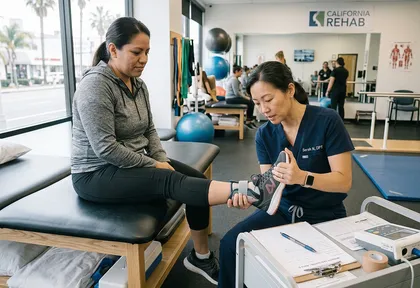
No. You can request an injury assessment without waiting for your new insurance policy to take effect. Seeking medical care and discussing your legal options promptly can also help you document your injuries and preserve evidence before it becomes unavailable.
California also sets deadlines for pursuing injury claims:
- Personal Injury Lawsuits: Under CCP § 335.1, you generally have two years from the injury date to file a lawsuit.
- Government Claims: Under Government Code § 911.2, you generally must present a personal injury claim against a public entity within six months.
These deadlines may vary depending on the circumstances. A lawyer can help you identify which deadlines apply while you gather medical records, accident reports, photographs, and other relevant evidence.
Frequently Asked Questions About Buying Insurance After an Accident in California
Is It Insurance Fraud to Request an Injury Assessment After Buying Insurance?
No. Requesting an injury assessment after purchasing insurance does not, by itself, constitute insurance fraud.
You can consult a lawyer about an earlier accident, even if your new policy does not cover it. However, knowingly providing false information or misrepresenting the time of the accident to obtain insurance benefits may constitute fraud under California Penal Code § 550.
Do I File a Claim With My New Insurance If Someone Hit Me?
No. A new policy covers only events that occur after coverage begins. If someone else caused the crash, your claim should go through the at-fault driver’s liability insurance, not your own new policy.
Can I Use My Health Insurance to Pay for My Car Accident Injuries?
Yes. If you have applicable health insurance, it may cover medical evaluations and treatment after a car accident, subject to your plan’s terms. Your health insurer may later seek reimbursement from a personal injury settlement. A lawyer can review any reimbursement obligations when evaluating your claim.
Do I Still Need to Report the Crash to the DMV If I Didn’t Have Auto Insurance?
Yes. You must file an SR-1 report with the DMV within 10 days if the crash caused an injury, a death, or more than $1,000 in property damage. That filing obligation applies regardless of your insurance status at the time of the crash.
If you were uninsured when the accident occurred, the DMV may suspend your driving privileges for at least one year. Buying insurance afterward does not prevent this consequence. Reinstatement generally requires maintaining proof of financial responsibility with the DMV for three years.
What Happens If the At-Fault Driver Doesn’t Have Insurance Either?
If the at-fault driver has no insurance, you may still pursue compensation, but collecting it can be more difficult. A lawyer can check whether uninsured motorist coverage or another insurance policy applies. You may also be able to sue the responsible driver directly, although recovering money depends on their available assets and other circumstances.
Does Proposition 213 Apply If I Was Driving Someone Else’s Insured Car?
Not necessarily. If you were driving someone else’s insured vehicle with permission, the owner’s policy may provide qualifying coverage. However, policy exclusions and other circumstances may affect whether Proposition 213 applies. A lawyer should review the insurance documents and your financial responsibility status at the time of the accident before determining whether your damages are limited.
How Do I Afford Legal Help If I Have No Money to Pay a Lawyer Up Front?
Look for California personal injury lawyers who handle cases on a contingency fee basis. This generally means you do not pay attorney fees unless compensation is recovered, so you don’t have to pay them up front. Under California Business and Professions Code § 6147, contingency fee agreements must be in writing and explain the attorney’s fees and how case costs will be handled.
Talk to Arash Law About Your California Injury Claim
If you purchased auto insurance after a collision, Arash Law can review your accident timeline, insurance application, policy effective date, evidence of liability, and medical records. Our attorneys can assess whether another applicable policy or a claim against a responsible party could provide a potential path to compensation.
Call (888) 488-1391 to schedule a free case evaluation. Our team can discuss the documents you should bring and the legal options that may apply to your circumstances.
Sources
- California Legislative Information. California Code of Civil Procedure § 335.1: two-year statute of limitations for most personal injury lawsuits. https://leginfo.legislature.ca.gov/faces/codes_displaySection.xhtml?sectionNum=335.1.&lawCode=CCP
- California Legislative Information. California Civil Code § 1714: duty of reasonable care and liability for injuries caused by negligence. https://leginfo.legislature.ca.gov/faces/codes_displaySection.xhtml?sectionNum=1714.&lawCode=CIV
- California Legislative Information. California Civil Code § 3333.4: Proposition 213, restrictions on non-economic damages for certain uninsured motorists and statutory exceptions. https://leginfo.legislature.ca.gov/faces/codes_displaySection.xhtml?sectionNum=3333.4.&lawCode=CIV
- California Legislative Information. California Insurance Code § 460: insurance policy effective times and coverage commencement. https://leginfo.legislature.ca.gov/faces/codes_displaySection.xhtml?sectionNum=460.&lawCode=INS
- California Legislative Information. California Insurance Code § 382.5: insurance binders and temporary proof of coverage. https://leginfo.legislature.ca.gov/faces/codes_displaySection.xhtml?sectionNum=382.5.&lawCode=INS
- California Legislative Information. California Penal Code § 550: fraudulent insurance claims and knowingly false statements to obtain insurance benefits. https://leginfo.legislature.ca.gov/faces/codes_displaySection.xhtml?sectionNum=550.&lawCode=PEN
- California Legislative Information. California Vehicle Code § 16000: accident reporting requirements and the 10-day reporting deadline. https://leginfo.legislature.ca.gov/faces/codes_displaySection.xhtml?sectionNum=16000.&lawCode=VEH
- California Legislative Information. California Vehicle Code §§ 16021 and 16054: acceptable forms of financial responsibility and qualifying insurance coverage at the time of an accident.
https://leginfo.legislature.ca.gov/faces/codes_displaySection.xhtml?sectionNum=16021.&lawCode=VEH
https://leginfo.legislature.ca.gov/faces/codes_displaySection.xhtml?sectionNum=16054.&lawCode=VEH- California Legislative Information. California Vehicle Code § 16070: driver’s license suspension for failure to establish financial responsibility at the time of a reportable accident.
https://leginfo.legislature.ca.gov/faces/codes_displaySection.xhtml?sectionNum=16070.&lawCode=VEH- California Legislative Information. California Government Code § 911.2: general six-month deadline for presenting personal injury claims against public entities. https://leginfo.legislature.ca.gov/faces/codes_displaySection.xhtml?sectionNum=911.2.&lawCode=GOV
- California Legislative Information. California Business and Professions Code § 6147: requirements for attorney contingency fee agreements. https://leginfo.legislature.ca.gov/faces/codes_displaySection.xhtml?sectionNum=6147.&lawCode=BPC
- California Department of Motor Vehicles. Report of Traffic Accident Occurring in California (SR-1): 10-day reporting requirement for accidents involving injuries, deaths, or property damage exceeding $1,000. https://www.dmv.ca.gov/portal/dmv-virtual-office/accident-reporting/
- California Department of Motor Vehicles. Financial Responsibility (Insurance): qualifying coverage at the time of an accident, potential license suspension, and hearing rights. https://www.dmv.ca.gov/portal/driver-education-and-safety/dmv-safety-guidelines-actions/financial-responsibility-insurance/
- California Courts. Ask a Government Agency to Pay You: administrative claim requirements, government claim deadlines, and procedures before filing a lawsuit. https://selfhelp.courts.ca.gov/civil-lawsuit/government-claim
- Li v. Yellow Cab Co., 13 Cal.3d 804 (1975). California Supreme Court decision establishing pure comparative fault in negligence claims.
https://scholarlycommons.pacific.edu/cgi/viewcontent.cgi?article=2458&context=mlrDisclaimer
Past results do not guarantee future outcomes. Every case is different. The information on this page is for general educational purposes and does not constitute legal advice. Reading or relying on this content does not create an attorney-client relationship. If you were injured, consult a licensed California personal injury attorney about your specific situation. Arash Law. (888) 488-1391.