TL;DR: A lawyer should review the owner’s complete policy, vehicle schedule, any newly acquired or replacement-vehicle clauses, purchase records, and proof of permission. The attorney must also confirm who was insured and which policy terms applied on the date of the crash. Insurance on another vehicle does not automatically extend to the borrowed motorcycle, but the absence of the motorcycle from the policy schedule does not necessarily preclude coverage.
A newly purchased borrowed motorcycle may raise insurance questions even when its owner already has coverage for another vehicle. A lawyer can investigate the purchase timeline, the borrowing arrangement, and the applicable policy terms to determine whether coverage may be available.
Table of Contents

I Was Injured While Riding a New Motorcycle That Was Lent to Me. They Say It Wasn’t Insured, But the Owner Has Another Policy. What Documents Should a Lawyer Review?
A lawyer should examine the owner’s insurance policy, motorcycle purchase records, vehicle schedule, and proof of permission. The review should establish who was insured, whether the motorcycle qualified as a covered vehicle, and which policy provisions applied on the date of the crash.
An unlisted motorcycle may qualify for coverage under certain policy provisions, but insurance on another vehicle does not automatically extend to it.
Key Facts About Borrowed Motorcycle Crashes and Insurance in California
- Coverage Under the Owner’s Existing Policy: Insurance on another vehicle does not automatically cover a newly purchased motorcycle. Coverage depends on the policy terms effective on the crash date.
- Motorcycle Ownership and Permission to Ride: Purchase records, registration, and communications can help establish who owned the motorcycle and whether the borrower had permission to use it.
- Coverage for a Newly Purchased Motorcycle: Vehicle schedules, insured-person definitions, and newly acquired or replacement-vehicle clauses help determine whether the motorcycle or injured rider qualifies for coverage.
- Insurance for Rider Injuries and Motorcycle Damage: Bodily injury and motorcycle damage may involve different insurance provisions, including liability, UM/UIM, MedPay, and physical damage coverage.
- Motorcycle Owner’s Liability for a Borrower’s Crash: California Vehicle Code §§ 17150–17151 address owner liability for negligent operation by a permissive rider and generally limit liability based solely on permissive use.
- Proposition 213 and Uninsured Motorcycle Riders: California Civil Code § 3333.4 may restrict pain and suffering damages when an owner or operator lacks the required financial responsibility.
- Deadlines for Borrowed Motorcycle Injury Claims: Most personal injury lawsuits have a two-year deadline under Code of Civil Procedure § 335.1. Claims against public entities generally require earlier claim presentation under Government Code § 911.2.
Insurance Policies and Documents a Lawyer Should Review
Motorcycle accident lawyers can investigate the relationships among the owner, the borrower, the motorcycle, and the available insurance policies. The following table identifies the documents needed to evaluate potential coverage.
| Review Area | What the Lawyer Must Verify | Documents to Review |
|---|---|---|
| Motorcycle owner | Who legally owned the motorcycle at the time of the crash? | Title, bill of sale, registration, and purchase agreement. |
| Borrowed rider | Who operated the motorcycle and whether they had permission. | Driver’s license, collision report, text messages, and owner statements. |
| Insured persons | Whether the rider qualified as a named insured, resident relative, or other covered person. | Policy definitions, declarations, household records, and endorsements. |
| Newly purchased motorcycle | When the owner acquired the motorcycle and whether it was eligible for coverage. | Purchase documents, VIN, registration, insurance applications, and any temporary insurance binder. |
| Other insured vehicle | Which vehicle was listed on the owner’s existing insurance policy. | Declarations page and vehicle schedule. |
| Existing insurance policy | Whether the contract covered motorcycles, included motorcycle-specific exclusions, or provided coverage for newly acquired or replacement vehicles. | Complete policy, vehicle classifications, and endorsements effective on the crash date. |
| Insurance communications | Whether and when the owner notified the insurer about the motorcycle and whether coverage was confirmed or changed. | Emails, messages, agent correspondence, and coverage confirmations. |
| Injury and motorcycle damage | Which insurance provisions, if any, could apply to bodily injuries or physical damage to the motorcycle. | Liability, UM/UIM, MedPay, collision, and comprehensive coverage provisions. |
These records help identify possible coverage, but they do not establish that the motorcycle or rider was insured.
How Insurance Records Affect Coverage
The owner’s existing policy and any insurance available to the borrower must be evaluated separately. A policy may cover one vehicle or person without extending the same benefits to another.
- The Owner’s Existing Policy: Coverage may extend to an unlisted motorcycle only if the contract’s terms and eligibility requirements allow it. Having another insured vehicle does not guarantee protection.
- The Borrower’s Own Policy: An existing auto or motorcycle policy may provide UM/UIM or MedPay benefits. Eligibility depends on definitions of insured persons, vehicle restrictions, and California law.
- Coverage for Injuries and Motorcycle Damage: Insurance that pays for bodily injuries does not necessarily cover motorcycle repairs. Each type of loss must be evaluated under the applicable coverage provisions.
How Ownership and Purchase Records Affect Coverage
The timing of the motorcycle purchase matters because certain policy provisions apply only when specific acquisition and notification requirements are met.
- Insurance Applications and Effective Dates: Coverage must be evaluated using the contract and endorsements applicable on the crash date, including any relevant provisions governing newly acquired vehicles.
- Newly Acquired and Replacement Vehicle Clauses: Some policies provide temporary coverage for qualifying vehicles, subject to eligibility conditions and notification deadlines. These provisions do not automatically apply to motorcycles.
- Temporary Insurance and Dealer Arrangements: A dealer-issued policy, a temporary binder, or a separate motorcycle policy may provide coverage if it was in effect when the crash occurred. A lender’s insurance requirement alone does not establish coverage.
How Permission Records Affect a Borrowed Motorcycle Accident Claim
Messages, statements, and previous borrowing arrangements can help determine whether the owner authorized the rider to use the motorcycle. A lawyer may consider:
- Communications and Prior Driving History: Messages, earlier borrowing arrangements, and the owner’s conduct may help establish express or implied permission.
- Owner and Witness Statements: Statements from people familiar with the arrangement may help confirm whether the borrower had authorization to ride.
- Traffic Collision Report: The report may identify the rider and owner, as well as the crash circumstances, but it does not necessarily establish permission.
Preserve relevant communications before they are lost or deleted. Permission may support owner liability under California Vehicle Code § 17150, but it does not independently establish insurance coverage. Similar coverage questions can arise when a driver is not listed on an insurance policy.
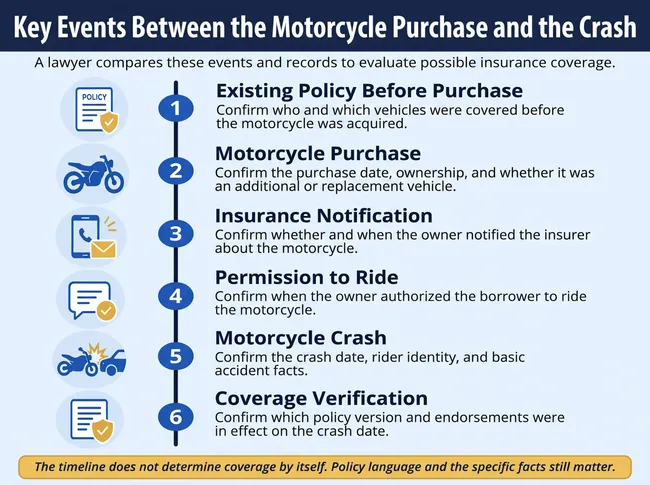
Key Events Between the Motorcycle Purchase and the Crash
The timeline shows six key events and review steps that may help determine whether insurance covered the motorcycle and its rider at the time of the crash.
It begins with the existing insurance policy to establish what coverage was in place before the motorcycle was purchased. Next, the purchase date helps determine whether provisions for newly acquired or replacement vehicles may apply.
The lawyer then checks when the insurer was notified and whether the owner gave the borrower permission to ride. These details are compared with the crash date to establish what happened before the accident.
Finally, the lawyer reviews the policy terms and endorsements in effect when the crash occurred to assess whether coverage may apply.
Insurance notification and permission to ride may happen in either order. The timeline helps organize these events, but coverage ultimately depends on the policy language, applicable law, and specific circumstances.
Permissive Use and Owner Liability Under California Law
Under California Vehicle Code § 17150, a motorcycle owner may be responsible for injuries or property damage caused by someone negligently operating the motorcycle with the owner’s express or implied permission.
Permission may be established through messages, previous borrowing arrangements, or the owner’s conduct. However, permission alone does not establish that the motorcycle or borrower was insured. A lawyer must separately verify whether the applicable policy covered the motorcycle and its permissive rider.
Vehicle Code § 17151 generally limits an owner’s liability arising solely from another person’s permissive use of the motorcycle. These limits do not necessarily apply when the owner is independently negligent or when liability arises through certain agency or employment relationships. If the owner knowingly entrusted the motorcycle to an unfit rider, negligent entrustment may support separate liability when the rider’s unfitness contributed to the harm. A lawyer should examine the rider’s licensing status, experience, and known safety concerns.
Who Is Actually at Fault for the Crash?
Borrowing a motorcycle does not automatically make the rider or owner responsible for a collision. A lawyer should investigate the circumstances of the crash to determine whether another driver, the borrower, or multiple parties contributed to the accident.
California follows a pure comparative fault rule. If the injured rider contributed to the collision, their compensation may be reduced according to their percentage of fault (Li v. Yellow Cab Co. (1975) 13 Cal.3d 804).
Witness statements, traffic camera footage, photographs, and collision reports can help establish responsibility.
Call Arash Law for a free case evaluation at (888) 488-1391. Our attorneys can review the coverage records, the evidence of fault, and what Proposition 213 means for your specific claim, and they can tell you what your options actually are.
Compensation Sources and What Proposition 213 Limits
Several insurance policies may be relevant after a crash involving a borrowed motorcycle. A lawyer should determine which benefits are available based on the responsible parties, the policy terms, and the coverage effective on the date of the accident.
- At-Fault Driver’s Liability Insurance: If another driver caused the crash, their liability policy may cover medical expenses, lost wages, property damage, and other recoverable losses, subject to liability findings, policy limits, and applicable legal restrictions.
- Uninsured/Underinsured Motorist (UM/UIM) Coverage: If another driver caused the crash and lacked sufficient insurance, UM/UIM benefits may be available under an applicable policy. Eligibility depends on the borrower’s insured status, motorcycle-related restrictions, and California Insurance Code § 11580.2.
- The Motorcycle Owner’s Policy: The owner’s liability coverage may protect a qualifying permissive rider against claims arising from injuries or damage the rider caused to others, if the policy covers the motorcycle. The policy may also provide MedPay or other applicable benefits, depending on its terms and exclusions.
Does Coverage for My Injuries Also Cover Damage to the Motorcycle?
Not necessarily. Bodily injury coverage and motorcycle damage coverage have different requirements. An at-fault driver’s liability policy may cover both injuries and property damage, subject to the applicable limits. UM/UIM bodily injury coverage and MedPay generally address qualifying injuries or medical expenses rather than motorcycle repairs.
Motorcycle repairs may instead fall under the at-fault driver’s property damage liability coverage or applicable collision or other physical damage insurance. A lawyer should evaluate these provisions separately.
Does Having No Motorcycle Insurance of My Own Mean Proposition 213 Applies?
No. Not automatically. A borrower may satisfy California’s financial responsibility requirements through an applicable policy or another qualifying arrangement covering the motorcycle involved in the crash. A lawyer should verify the policy terms, effective dates, and insured-person provisions before determining whether Proposition 213 applies.
Under California Civil Code § 3333.4, certain uninsured owners and operators generally cannot recover non-economic damages, such as pain and suffering. Economic losses, including medical expenses and lost wages, may remain recoverable even when this restriction applies.
A qualifying DUI conviction of the other driver may create an exception for certain uninsured vehicle owners under § 3333.4(c). The statutory exception does not expressly apply to an uninsured operator who does not own the motorcycle.
Frequently Asked Questions About Borrowed Motorcycle Crashes in California
Is It Worth Suing an At-Fault Driver Who Has No Insurance?
Suing an uninsured driver in California can be worth pursuing if the defendant has assets, but collectability is never guaranteed. Even if a judgment is obtained, collecting can take time and may require additional legal steps. Whether collection is realistic depends on the defendant’s assets and circumstances; a lawyer can assess collectability before you spend time and money on a lawsuit.
How Does Insurance Handle a Motorcycle Crash That Was Not My Fault?
If another driver caused the crash, their liability insurance may provide compensation for your injuries and motorcycle damage. A lawyer should also determine whether any UM/UIM, MedPay, or other benefits are available under applicable policies. Coverage depends on the policy terms and verified facts of the accident.
Can I Ride a Newly Purchased Motorcycle Home Without Insurance?
California generally requires motorcycle owners and operators to maintain qualifying financial responsibility. This may include liability insurance or another legally accepted form. Some policies provide temporary coverage for newly acquired vehicles, but these provisions do not automatically apply to motorcycles. Verify that the motorcycle is covered before riding, and do not assume the owner’s existing auto policy provides protection.
What If the At-Fault Driver Offers to Pay Me Directly?
Signing any release before you know the full extent of your injuries is a serious risk. Signing a release can waive or severely limit your ability to seek additional compensation later, even if your injuries turn out to be more severe than they appeared at the scene, even if surgery or long-term treatment becomes necessary. Do not sign anything until you have been fully evaluated medically and consulted with an attorney.
Can I Recover Pain and Suffering if I Had No Insurance in California?
Possibly. Having no personal motorcycle policy does not automatically trigger Proposition 213. A lawyer must determine whether an applicable policy or another qualifying form of financial responsibility covered you for the motorcycle involved in the crash. If the restriction applies, non-economic damages, including pain and suffering, are generally unavailable unless a statutory exception applies.
How Long Do I Have to File These Claims in California?
Most California personal injury lawsuits must be filed within two years of the crash under Code of Civil Procedure § 335.1. However, other deadlines may apply:
- Government Entity Claims — 6 Months: If a dangerous road condition involving Caltrans, a city, or another public entity contributed to the crash, you generally must present a written claim within six months under Government Code § 911.2. State claims typically go through DGS/ORIM, while city and county claims go to the appropriate local entity. Separate deadlines apply to filing a lawsuit after the claim process.
- DMV Accident Reporting — 10 Days: You generally must file an SR-1 report if anyone was injured or killed, or property damage exceeds $1,000. This applies regardless of fault, and a police report does not replace the SR-1. Failure to report may result in license suspension (Vehicle Code § 16000).
- Insurance Notice Requirements: Your policy may require you to report the crash or submit a claim sooner than the legal filing deadline.
Some exceptions, including tolling for minors and special rules for certain claims, may affect these deadlines. A motorcycle accident lawyer can help identify the applicable requirements and filing dates.
Talk to Arash Law About Your California Borrowed-Bike Claim
If you were injured while riding a newly purchased borrowed motorcycle, questions about insurance coverage may make it difficult to know where to turn for compensation. Arash Law can investigate whether the owner’s existing policy or another available policy may provide coverage, even if the motorcycle was not listed. Our attorneys can also assess how the crash occurred and whether California’s Proposition 213 may affect your recovery.
Arash Law handles personal injury cases on a contingency-fee basis. You pay no attorney’s fees unless there is a recovery in your case. Call (888) 488-1391 for a free case evaluation to discuss your injuries, the available insurance information, and your legal options.
Sources
- California Legislative Information. California Insurance Code § 11580.1: Automobile liability insurance requirements, covered vehicles, permissive users, and applicable exclusions.
https://leginfo.legislature.ca.gov/faces/codes_displaySection.xhtml?sectionNum=11580.1.&lawCode=INS- California Legislative Information. California Insurance Code § 11580.2: Uninsured and underinsured motorist coverage, insured-person definitions, exclusions, and UIM requirements.
https://leginfo.legislature.ca.gov/faces/codes_displaySection.xhtml?sectionNum=11580.2.&lawCode=INS- California Department of Insurance. So You’ve Had an Accident, What’s Next? Guidance on newly acquired and replacement vehicles, automatic coverage provisions, and insurer notification requirements.
https://www.insurance.ca.gov/01-consumers/105-type/95-guides/01-auto/hadaccident.cfm- California Legislative Information. California Vehicle Code § 17150: Owner liability for negligent operation of a motor vehicle with express or implied permission.
https://leginfo.legislature.ca.gov/faces/codes_displaySection.xhtml?sectionNum=17150.&lawCode=VEH- California Legislative Information. California Vehicle Code § 17151: Statutory limits on motor vehicle owner liability arising under § 17150.
https://leginfo.legislature.ca.gov/faces/codes_displaySection.xhtml?sectionNum=17151.&lawCode=VEH- Judicial Council of California. California Civil Jury Instructions (CACI), 2026 Edition, CACI No. 724, Negligent Entrustment of Motor Vehicle: Requirements for establishing negligent entrustment, including knowledge of the driver’s unfitness and resulting harm. https://courts.ca.gov/system/files/file/judicial_council_of_california_civil_jury_instructions_2026.pdf
- California Legislative Information. California Civil Code § 3333.4: Proposition 213 restrictions on non-economic damages for certain uninsured owners and operators, including the DUI-conviction exception.
https://leginfo.legislature.ca.gov/faces/codes_displaySection.xhtml?sectionNum=3333.4.&lawCode=CIV- California Legislative Information. California Vehicle Code §§ 16020–16021: Financial responsibility requirements and qualifying forms of financial responsibility.
https://leginfo.legislature.ca.gov/faces/codes_displaySection.xhtml?sectionNum=16020.&lawCode=VEH
https://leginfo.legislature.ca.gov/faces/codes_displaySection.xhtml?sectionNum=16021.&lawCode=VEH- California Legislative Information. California Vehicle Code § 16056: Minimum motor vehicle liability coverage limits.
https://leginfo.legislature.ca.gov/faces/codes_displaySection.xhtml?sectionNum=16056.&lawCode=VEH- California Department of Motor Vehicles (DMV). Auto Insurance Requirements: Acceptable forms of financial responsibility and California’s minimum liability insurance requirements.
https://www.dmv.ca.gov/portal/vehicle-registration/insurance-requirements/- California Supreme Court. Li v. Yellow Cab Co. (1975) 13 Cal.3d 804: California’s pure comparative negligence rule.
https://scholarlycommons.pacific.edu/cgi/viewcontent.cgi?article=2458&context=mlr- California Legislative Information. California Code of Civil Procedure § 335.1: Two-year statute of limitations for most personal injury lawsuits.
https://leginfo.legislature.ca.gov/faces/codes_displaySection.xhtml?sectionNum=335.1.&lawCode=CCP- California Legislative Information. California Government Code § 911.2: Six-month claim-presentation deadline for personal injury claims against public entities.
https://leginfo.legislature.ca.gov/faces/codes_displaySection.xhtml?sectionNum=911.2.&lawCode=GOV- California Legislative Information. California Vehicle Code § 16000: Accident reporting requirements for injuries, deaths, and qualifying property damage.
https://leginfo.legislature.ca.gov/faces/codes_displaySection.xhtml?sectionNum=16000.&lawCode=VEH- California Legislative Information. California Vehicle Code § 16004: Suspension of driving privileges for failure to submit a required accident report.
https://leginfo.legislature.ca.gov/faces/codes_displaySection.xhtml?sectionNum=16004.&lawCode=VEH- California Department of Motor Vehicles (DMV). Report of Traffic Accident Occurring in California (SR-1): Ten-day reporting requirement and reporting instructions.
https://www.dmv.ca.gov/portal/dmv-virtual-office/accident-reporting/- California Highway Patrol (CHP). Request a Crash Report: Procedures for obtaining CHP collision reports.
https://www.chp.ca.gov/traffic/request-a-crash-report/- California Department of General Services (DGS), Office of Risk and Insurance Management (ORIM). File a Government Claim: Procedures for presenting qualifying claims against California state agencies.
https://www.dgs.ca.gov/ORIM/File-A-ClaimDisclaimer
Past results do not guarantee future outcomes. Every case is different. The information on this page is for general educational purposes and does not constitute legal advice. Reading or relying on this content does not create an attorney-client relationship. If you were injured, consult a licensed California personal injury attorney about your specific situation.