TL;DR: Depending on the circumstances, compensation may come from personal insurance, platform coverage, another driver’s insurer, or qualifying work-injury benefits. Your app status, policy terms, and the purpose of your trip help determine which coverage applies. Preserve your app logs and GPS data right away, as those records can help show what policy may cover your accident.
Your personal auto insurance, the delivery platform’s commercial coverage, or another at-fault driver’s liability insurance may cover a crash after deliveries. California’s Proposition 22 may also provide occupational accident benefits if you qualify.
Which coverage applies depends on your app status, policy terms, work arrangement, and who caused the crash. Finishing deliveries does not automatically mean you logged off or lost coverage. Reconstructing your activities between the final delivery and the collision can help identify which claims may apply.
Table of Contents

I Had Already Finished My Deliveries and Was Driving Home When I Got Into an Accident. What Information Helps Determine Which Insurance or Claim Might Apply?
The information that matters includes your delivery app status, the time of your last completed order, and whether you accepted another request. Your route, reason for driving home, insurance policies, work arrangement, and who caused the crash also help determine which claims may apply.
Finishing deliveries does not automatically mean you logged off or lost coverage. Reconstructing the timeline between your last delivery and the collision can help identify whether personal auto insurance, platform coverage, another driver’s liability insurance, or work-related injury benefits deserve review.
Key Facts About Delivery Driver Insurance in California
- App status helps identify potential coverage. Delivery completion, online availability, and acceptance of another order can affect which insurance applies. Finishing deliveries does not automatically mean you are logged off.
- Personal policies may exclude delivery use. Your own auto insurance may not cover a delivery accident if you use the insured vehicle for commercial or delivery purposes. This exclusion may apply even if the app was offline at the time of the crash.
- Another at-fault driver may owe compensation. California negligence law allows injured drivers to pursue applicable claims regardless of delivery-app status. Available compensation depends on fault and documented losses.
- Work classification affects injury benefits. California Business and Professions Code § 7455 establishes occupational accident benefits for qualifying app-based drivers. Eligible employees may instead have workers’ compensation coverage.
- App records help reconstruct the crash timeline. Delivery completion timestamps, online status, accepted orders, and GPS records help identify potentially applicable coverage periods. Preserve available records promptly.
- Filing deadlines can affect recovery. California Code of Civil Procedure § 335.1 generally provides 2 years to bring a personal injury lawsuit. Government Code § 911.2 generally requires that injury claims against public entities be filed within six months.
What App Status Means at the Moment of Impact
Your app status at the exact moment of the car accident determines whether the delivery platform’s commercial coverage or only your personal auto policy may apply. Completing a delivery can end the platform’s active-delivery liability coverage.
If you completed your final delivery, logged off, and began driving home for personal reasons, start with your personal auto policy. It may cover the crash under its applicable terms.
If you stayed online, other benefits may remain available. Your app status and policy terms determine which protections apply.
Three scenarios capture how your app status can affect your insurance options in practice:
- Offline: You logged out of the delivery app before the crash. The platform’s active-delivery liability coverage does not apply. Your personal auto policy would typically be the first source of coverage. Review any delivery-related exclusions, especially if you were driving home after completing an order.
- Online With No Active Order: You remained logged into the delivery app but had not accepted an order. During this period, platform liability coverage may differ. For example, DoorDash directs Dashers to their personal auto insurance during this time. Coverage depends on the policy’s terms and any applicable exclusions.
- Newly Accepted Order: You accepted a delivery request before the crash. Under California Business and Professions Code § 7463(j), active delivery periods generally begin when a driver accepts a delivery request. The platform’s applicable commercial liability coverage may then protect against qualifying third-party claims.
However, your app status does not determine another driver’s liability. If another driver caused the crash, that driver’s insurance may provide compensation regardless of whether you were logged on. Review any delivery-related exclusion before assuming a coverage gap exists.
The brief window between your last drop-off and the moment you either log off or accept the next order is when coverage disputes usually arise. Identifying which scenario describes your crash is the first task in building a claim.
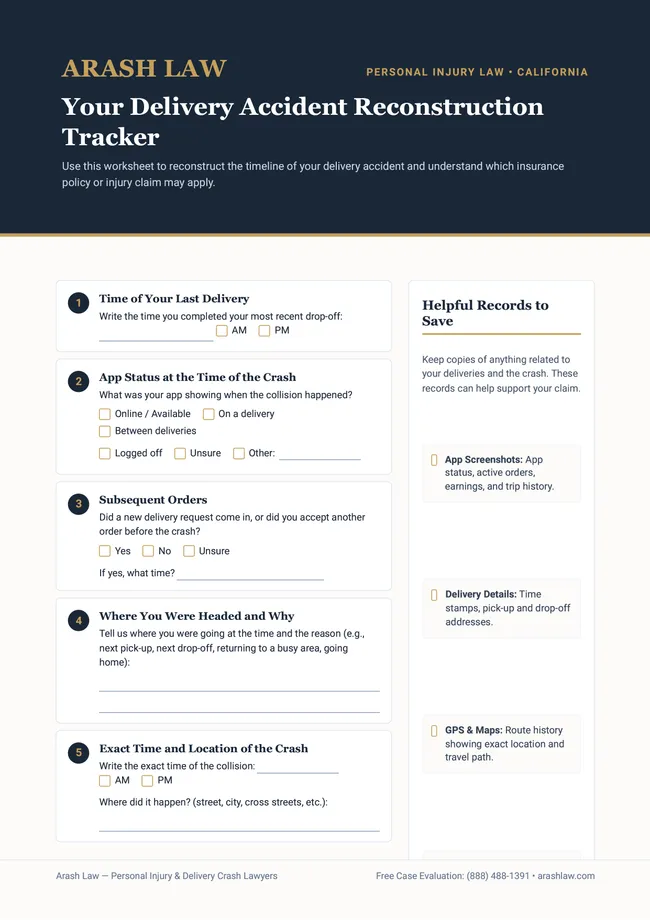
Reconstructing the Timeline of Your Delivery Accident
What happened between the completion of your last delivery and the time the crash occurred may determine which insurance policy applies. To reconstruct the timeline, gather every record that captures the sequence:
- Last Delivery Completion: When the app marked the prior order complete.
- App Status: Whether you were offline, online with no order, or had accepted a new order.
- Subsequent Orders: Whether you accepted a new order before the crash.
- Route Purpose: Where you were heading and why at the time of impact.
- Time of Crash: The exact timestamp of the collision.
- Vehicle Ownership: Personal or commercial vehicle.
- Work Arrangement: Employee or independent contractor.
- Policies in Effect: Which insurance policies were active at the time.
Platform records can help establish your app status, delivery history, and location at the time of the crash. Retention practices vary by company and record type. Preserve any records you can access and request preservation of relevant platform data as soon as possible.
The Four Coverage Tracks: Which One Applies to You?
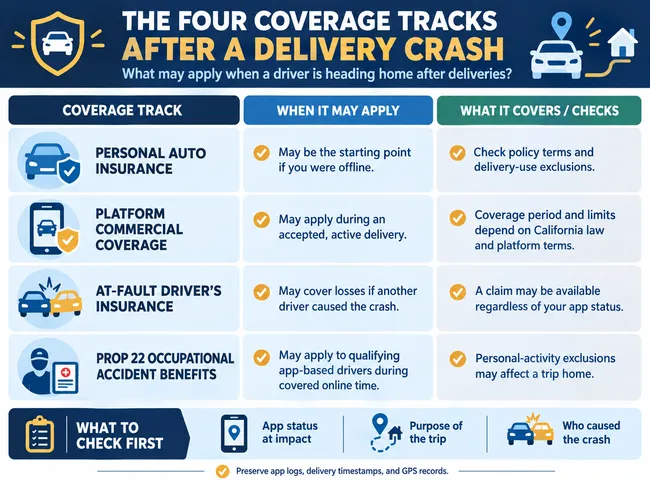
Your app status and the cause of the crash help identify potential coverage. Policy terms, trip purpose, and work classification also affect which insurance or injury benefits may apply.
Your personal auto policy, the platform’s commercial coverage, a third-party liability claim, and occupational accident benefits are four legally distinct tracks. Your situation may involve one, some, or all of them. None of them automatically covers every loss.
The same coverage distinctions apply when determining what to do after an accident involving a delivery driver, particularly when identifying the responsible insurer.
Track 1: Personal Auto Insurance
Your personal auto policy is the starting point when the app is offline. However, your insurer may exclude commercial delivery activities, including the transportation of goods for payment.
These exclusions depend on the policy’s language and the circumstances of the crash. For this reason, delivery app platforms such as DoorDash advise drivers to confirm whether their personal insurance covers delivery work.
A delivery-related exclusion does not automatically apply simply because you completed deliveries earlier that day. Your insurer must evaluate the crash under your policy’s specific terms.
Your app status and the purpose of your trip can help determine whether the exclusion applies. Reading your policy’s exclusion endorsements, or having an attorney review them, is the most reliable way to know for sure.
If you logged off before the crash, and you have Medical Payments (Med Pay) and collision coverage as part of your auto policy, they may help pay for medical expenses and damage to your vehicle regardless of fault. Coverage still depends on your policy’s terms and applicable exclusions.
Track 2: Platform Commercial Coverage
California law requires qualifying delivery network companies to maintain third-party auto liability coverage while engaged in business. Under Business and Professions Code § 7455(f), this coverage must provide at least $1 million per occurrence when no other qualifying policy covers the vehicle.
For example, DoorDash maintains commercial auto liability coverage for qualifying accidents during active deliveries in California. Its U.S. insurance guidance distinguishes delivery-related coverage from other driving activities.
In California and several other states, DoorDash further defines the delivery-service period as beginning when a driver accepts an order. It ends when the order is delivered, canceled, or unassigned. A driver completing their final delivery for the day may therefore end that platform’s active-delivery liability coverage, even if the driver remains online and gets involved in a crash on the way home.
Finally, DoorDash explains that its liability coverage does not pay for damage to the Dasher’s own vehicle. Drivers must review their personal auto policies for physical damage protection and potential delivery-related exclusions.
This example shows why a driver’s app activity and the platform’s coverage rules matter when identifying potentially applicable commercial insurance.
Track 3: Third-Party Liability Against the At-Fault Driver
If another driver caused the crash, you may have a personal injury claim against that driver regardless of your app status at the time. California follows a fault-based liability system: the at-fault driver may be liable for the losses they cause, including medical bills, lost earnings, and property damage. However, you must demonstrate that the other driver caused the accident by failing to act with reasonable care.
You may be able to pursue this claim separately from the other three tracks.
Notably, if you contributed to the crash, you can still pursue this claim. However, your percentage of fault could reduce your potential recovery under California’s comparative fault rule (Li v. Yellow Cab Co. (1975) 13 Cal.3d 804).
Acting early can help protect your claim. If the other driver’s insurer refuses to offer fair compensation, you may have to file suit. California Code of Civil Procedure § 335.1 generally gives injured drivers two years to file a personal injury lawsuit. Government Code § 911.2 generally requires you to present an administrative claim within six months when a public entity faces potential liability. For example, this deadline may apply if the driver of a government vehicle caused the crash.
Deadlines or exceptions may apply, and evidence of your accident can disappear long before filing windows close. Acting promptly helps preserve crash evidence, identify available insurance, and protect your right to pursue compensation.
Track 4: Occupational Accident Benefits Under Proposition 22
Proposition 22 classifies qualifying app-based delivery drivers as independent contractors rather than employees. The California Supreme Court upheld this classification in Castellanos v. State of California (2024) 16 Cal.5th 588. As a result, qualifying independent contractors generally cannot claim traditional workers’ compensation benefits.
Proposition 22 instead requires occupational accident benefits during qualifying online time, even without an active delivery. However, California Business and Professions Code § 7455 permits exclusions for personal activities outside engaged time.
Remaining online does not guarantee coverage during the trip home. Your app status, trip purpose, and applicable exclusions help determine eligibility. Completing your final delivery also does not automatically mean you logged off. Platform agreements and earnings records can help establish your work arrangement and activity.
Delivery-company employees may qualify for traditional workers’ compensation. California’s coming-and-going rule generally excludes ordinary commutes. However, workers’ compensation lawyers can identify whether exceptions may apply, such as when employees perform employer errands or use employer-provided transportation under qualifying circumstances.
What to Document and How to Report Accurately
To document and report a delivery accident accurately, preserve crash evidence and provide factual information to insurers, the delivery platform, and law enforcement. App logs, GPS data, and dashcam footage can help establish which coverage period applied and support your injury claim.
Preserve the following evidence:
- App Logs and GPS Data: Save timestamps, delivery history, and app activity records showing your status at the time of the crash.
- Police or CHP Collision Report: Request the investigating agency’s report to document crash details and the officer’s findings. Eligible parties can request CHP reports through the CHP’s online Crash Portal or Form CHP 190.
- Dashcam Footage: Save footage promptly before your camera’s recording system overwrites it.
- Video From Nearby Cameras: Identify businesses, traffic cameras, or other vehicles that may have captured the collision. Request preservation of relevant footage.
- Medical Records and Treatment Notes: Keep records of your injuries, treatment, and recovery to support your claim and document related medical expenses.
When reporting the accident:
- State the Facts: Describe what happened based on your observations. Avoid guessing about fault or details you cannot confirm.
- Disclose Your App Status: Report whether you were offline, remained online after your last delivery, or had accepted another order.
- Provide Accurate Times: Identify when you completed your last delivery and when the crash occurred. Check your records if needed.
- Explain Your Trip Purpose: Describe where you were heading and why, including whether you were driving home after deliveries.
- Correct Any Mistakes: Provide accurate information to insurers, the platform, and law enforcement. Correct errors promptly if you discover them.
When Is an Injury Case Review Helpful After a Delivery Accident?
A legal case review may help when insurers dispute coverage, your app records leave your delivery status unclear, or multiple policies could apply. It can also help if another driver is responsible, or if your injuries result in significant medical expenses or lost income.
A California injury attorney can review your crash timeline, identify potential claims, evaluate coverage disputes, and explain applicable filing deadlines. You do not need to establish which insurer is responsible or gather all relevant evidence of your accident before requesting a case evaluation.
If you need help determining which coverage applies after a delivery crash, contact Arash Law at (888) 488-1391 to schedule a free case evaluation with our car accident lawyers.
Frequently Asked Questions About Delivery Driver Insurance in California
Does My Personal Auto Insurance Cover a Crash on My Way Home After Delivering?
Your personal auto insurance may cover the crash, depending on your policy terms and whether a delivery-related exclusion applies. Logging off does not automatically resolve coverage questions. Your insurer may examine your app activity and trip purpose to determine whether the policy covers the accident.
What If My Delivery App Was Online but I Had No Active Order?
Your personal auto insurance may apply, subject to policy exclusions. For example, DoorDash identifies personal insurance as primary when drivers remain online without an accepted order. Its active-delivery liability coverage does not apply during that period.
Proposition 22 occupational accident benefits may still apply during qualifying online time, subject to exclusions for personal activities.
Can I Sue Another Driver If the Crash Happened During or After a Delivery Shift?
Yes. If another driver caused the crash, you may have a personal injury claim against them regardless of your work status at the time.
Does the Coming and Going Rule Block Occupational Accident Benefits Under Prop 22?
Not automatically. The coming-and-going rule generally excludes ordinary commutes from traditional workers’ compensation. Proposition 22 uses different eligibility requirements.
Qualifying online time may trigger occupational accident benefits, even without an active order. However, personal-activity exclusions may apply to your drive home. If you logged off, Proposition 22 generally does not require coverage for the subsequent trip.
Who Pays for Damage to My Vehicle After a Delivery Shift Crash?
Your personal auto policy or the at-fault driver’s liability insurance may cover vehicle damage. Which one applies depends on your app status, who caused the crash, and whether your policy excludes delivery use. Sorting out which policy responds first requires comparing each policy’s terms with the crash timeline.
How Can an Attorney Help When Multiple Insurance Policies Are Involved?
An attorney can review your app records, investigate applicable policies, and identify potential coverage gaps. They can also preserve evidence, address insurer disputes, and pursue available claims against responsible parties.
How Much Does It Cost to Hire a Lawyer for a Delivery Driver Accident?
Likely nothing up front. Many personal injury lawyers handle these cases on a contingency fee basis, which means you pay no legal fees unless the lawyer wins or settles your case. Case-related costs may still apply.
Get Help With Your California Delivery Accident Claim
Delivery accident cases are rarely simple. When a gig platform’s occupational accident policy, a personal auto exclusion, and a third-party liability claim against the driver who hit you are all in play at the same time, sorting out which coverage applies is difficult to do alone.
Our car accident lawyers can review your app logs, your policy, and the facts of your crash to identify the claims that may apply and help you pursue the compensation you may be entitled to.
Arash Law handles personal injury cases throughout California, including delivery driver accidents that involve more than one coverage track. We work under a contingency fee agreement, so you pay no legal fees unless we win or settle your case.
Case-related costs may still apply. Our attorneys have recovered over $1 billion for clients across the state.
For a free case evaluation, call Arash Law at (888) 488-1391.
Sources
- California Legislature: California Code of Civil Procedure § 335.1. Two-year statute of limitations for personal injury claims against private parties.
https://leginfo.legislature.ca.gov/faces/codes_displaySection.xhtml?sectionNum=335.1.&lawCode=CCP- California Legislature: Government Code § 911.2. Six-month written claim deadline before suing a public entity.
https://leginfo.legislature.ca.gov/faces/codes_displaySection.xhtml?sectionNum=911.2.&lawCode=GOV- California Legislature: Vehicle Code § 16056 (as amended by SB 1107). New minimum auto liability limits of $30,000/$60,000/$15,000, effective January 1, 2025.
https://leginfo.legislature.ca.gov/faces/codes_displaySection.xhtml?lawCode=VEH§ionNum=16056- California Legislature: Business and Professions Code § 7455. Occupational accident benefit obligations for platforms under Proposition 22.
https://leginfo.legislature.ca.gov/faces/codes_displaySection.xhtml?lawCode=BPC§ionNum=7455.- California Supreme Court: Castellanos v. State of California, No. S279622 (July 25, 2024). The Court upheld Proposition 22 against a constitutional challenge, ruling that Business and Professions Code § 7451 does not conflict with Article XIV, section 4 of the California Constitution. The decision preserved independent-contractor classification for qualifying app-based drivers.
https://supreme.courts.ca.gov/case/s279622-castellanos-v-state-california-protect-app-based-drivers-and-services- California Supreme Court — Li v. Yellow Cab Co. (1975) 13 Cal.3d 804. The draft relies on this case for comparative fault. The decision supports California’s pure comparative negligence doctrine.
https://scholarlycommons.pacific.edu/cgi/viewcontent.cgi?article=2458&context=mlr- DoorDash: Understanding Auto Insurance Maintained by DoorDash. Supports active-delivery liability coverage and the no-active-order distinction.
https://help.doordash.com/en-us/dashers/article/understanding-auto-insurance-maintained-by-doordash- DoorDash: Insurance Basics for Delivery Drivers. Explains delivery-related policy exclusions and personal auto insurance considerations.
https://dasher.doordash.com/en-us/support/insurance- California Business and Professions Code § 7463. Defines online time and engaged time under Proposition 22.
https://leginfo.legislature.ca.gov/faces/codes_displaySection.xhtml?lawCode=BPC§ionNum=7463Disclaimer
Past results do not guarantee future outcomes. Every case is different. The information on this page is for general educational purposes and does not constitute legal advice. Reading or relying on this content does not create an attorney-client relationship. If you were injured, consult a licensed California personal injury attorney about your specific situation. Arash Law — (888) 488-1391.