TL;DR: A lawyer should investigate the temporary cycling route, signs and barriers, driver movements, construction responsibilities, and the connection to your injury. Relevant evidence includes photographs, witnesses, traffic-control plans, permits, and inspection records. Public and private claims require separate legal analysis, including different deadlines. A construction closure alone does not establish fault.
Determining responsibility for your injury starts with reconstructing how cyclists moved through the construction area that day. Your lawyer should compare the planned route with the signs, barriers, vehicle movements, and work activities you actually encountered.
That review should identify who designed, installed, inspected, or changed the temporary route and whether the driver’s conduct contributed to your injury. Photographs, witness accounts, plans, and project records can help connect those actions to the people or organizations responsible.
A construction closure alone does not establish negligence or a valid government claim. The evidence must connect specific conduct or conditions to your injury. Your lawyer can then evaluate potential public and private claims and their separate deadlines.
Key Facts About Investigating a Bicycle Injury Near Construction
- A closure alone does not establish public agency liability. Government Code § 835 requires proof of a dangerous condition that caused the injury, a foreseeable risk, and either negligent employee creation or sufficient agency notice.
- Some bicycle lane closures warrant considering an alternative route. CA MUTCD Chapter 6P, Typical Application 47, recommends considering a separate facility or detour on roads posted at 35 mph or higher. This guidance applies when directing cyclists into a shared lane would be inappropriate.
- Drivers must exercise reasonable care around cyclists, including near construction zones. Civil Code § 1714(a) provides the general duty of care. A lawyer should investigate the driver’s attention, speed, turns, and passing movements.
- Claims against public agencies generally have an early deadline. Government Code § 911.2 generally requires that an injury claim be submitted within six months. A lawyer should promptly identify the correct agency and applicable deadline.
- Private injury and property claims have separate deadlines. California generally allows two years for personal injury lawsuits and three years for property damage lawsuits, subject to applicable exceptions.
Table of Contents

The Bike Path Was Closed Due to Construction When I Was Injured. How Do I Find a Lawyer Who Can Investigate the Traffic Signs, the Driver, and Those Responsible for the Construction Project?
Look for a California bicycle injury lawyer who handles investigations involving drivers, temporary cycling routes, and construction work. Ask how the lawyer would identify project participants, preserve evidence, and evaluate possible public and private claims.
Check the attorney’s license status and disciplinary history through the State Bar of California. During your consultation, ask questions that test the lawyer’s approach to your specific circumstances:
- Have you handled bicycle injuries involving temporary traffic routes or construction closures?
- How would you compare the traffic signs with the route cyclists actually encountered?
- What records could identify who installed, inspected, or moved the barriers?
- Would you investigate the driver separately from the construction project?
- How would you determine whether a government claim deadline applies?
If you prefer Spanish, ask who will conduct interviews, explain documents, and provide case updates in Spanish. Confirm how the firm will handle interpretation when your lawyer discusses legal decisions or reviews your account.
For example, suppose roadwork reportedly closed a bicycle lane, and a cyclist was injured while following the available route. The incident may raise questions about a possible government claim, but neither an unlawful closure, a defective traffic-control plan, public responsibility, nor the cause of the injury has been established.
A lawyer should investigate the temporary route, signs, barriers, driver conduct, and construction responsibilities before drawing conclusions about liability. Photographs, witness accounts, and project records may help clarify what happened and who controlled the relevant conditions.
How Did the Temporary Route, Traffic Signs, and Driver Conduct Contribute to the Injury?
Your lawyer should reconstruct the temporary route, signs, barriers, and driver movements to determine whether they contributed to your injury. The review should establish conditions on the incident date because the arrangement may change as construction progresses.
Start by identifying where the normal cycling route ended and what options remained available. Your lawyer should distinguish a separate bike path from a bicycle lane alongside traffic, then examine the following:
- Advance Warnings: Where did the first warning appear, and could approaching cyclists and drivers see it?
- Route Directions: Did signs direct cyclists into a shared lane, temporary path, or detour?
- Route Continuity: Did those directions remain clear through intersections and driveways?
- Available Space: Did barriers, equipment, gravel, or other surface conditions restrict the route?
- Worker Instructions: Did anyone direct you or nearby drivers?
- Vehicle Conflicts: Where did your route intersect with the driver’s movement?
Photographs and video may show blocked signs, narrow passages, or pavement markings that conflict with temporary directions. Witnesses may clarify worker instructions, moving equipment, and conditions that later photographs no longer capture.
Compare the Arrangement With Applicable Traffic-Control Rules
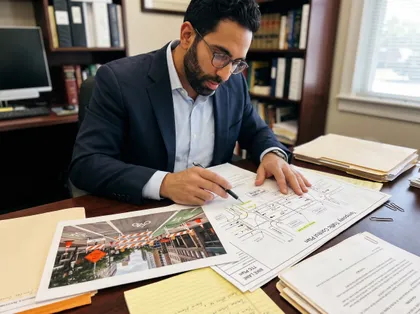
Your lawyer should compare the temporary arrangement with the traffic-control requirements applicable to the facility, conditions, and incident date. The review must distinguish mandatory standards from recommendations.
CA MUTCD Chapter 6P, Typical Application 47, recommends considering a separate bicycle facility or detour for certain bicycle lane closures. This guidance applies to roads posted at 35 mph or higher where directing cyclists into a shared lane would be inappropriate. It does not require a detour for every closure.
For a separate bike path, your lawyer should check whether the work could have been done while keeping the bikeway open through the work zone. If a detour was necessary, the lawyer should examine whether the selected route followed applicable guidance for a practical and clearly marked alternative. The relevant CA MUTCD provisions depend on the type of bicycle facility and the nature of the temporary arrangement.
Examine the Driver’s Conduct Within That Arrangement
Your lawyer should separately investigate whether the driver acted reasonably while approaching and passing through the temporary route. Relevant questions include:
- Was the driver attentive and traveling at an appropriate speed?
- How did the driver position the vehicle, pass, or turn near you?
- Did lighting, equipment, traffic queues, or sight lines affect visibility?
- What could the driver see, and how much time was available to respond?
- Was the driver performing work duties that could raise questions about an employer’s responsibility?
Witness accounts, dashcam footage, nearby video, and physical damage can help test each person’s explanation. Construction may help explain the encounter, but a driver’s statement blaming the work zone does not establish the cause or excuse the driver’s conduct.
Who Controlled the Construction Work, and Did Their Actions Contribute to Your Injury?
Your bicycle accident lawyer should identify who controlled the temporary cycling arrangement and whether their actions contributed to your injury. Different organizations may design, approve, install, inspect, or change the route, so the project owner’s name alone does not establish responsibility.
These parties may be involved:
- Project Owner: Contracts may identify who commissioned the work and retained authority over particular decisions.
- Public Agency: Permits and inspection files may explain the agency’s ownership, approval, or oversight role.
- General Contractor: Daily reports and work schedules may identify who coordinated activities near the route.
- Traffic-Control Contractor: Installation and inspection records may identify who placed and maintained signs, cones, and barriers.
- Utility Company or Subcontractor: Work orders may establish who controlled equipment, materials, or separate operations near the closure.
Your lawyer should compare the contracts with what workers actually did. Important questions include who could change the route, who inspected it, and who received reports about problems. The next step is connecting those responsibilities and actions to the sequence that caused your injury.
For example, a barrier might direct cyclists toward a shared traffic lane. The investigation should establish who placed the barrier, how you entered the lane, what the driver did, and how the injury occurred.
Medical records can help document the injuries, treatment, and reported incident history. Bicycle damage, helmet damage, photographs, and witness accounts may help explain how the injury occurred.
Your lawyer should also examine conflicting accounts and allegations that your own movements contributed to. Those questions require evidence rather than assumptions based on the construction closure.
Who to Investigate and Where to Find Records
Your lawyer can use scene observations to identify whose role needs investigation, who may hold relevant records, and which questions remain unanswered. The examples below guide the review without establishing responsibility in your case.
| Observed Arrangement | Responsible Role to Verify | Possible Record Holder | Unresolved Issue |
|---|---|---|---|
| A barrier blocked the usual cycling route. | Person or organization authorizing and installing the closure | Permitting agency, project owner, or contractor | What route did the plan provide for cyclists? |
| Signs directed cyclists toward vehicle traffic. | Designer and installer of the temporary route | Agency engineer, designer, or traffic-control contractor | Did the installed arrangement match the plan? |
| A sign faced away from approaching cyclists. | Person responsible for inspection and maintenance | Contractor or agency inspector | When did the sign’s position change? |
| A driver turned across the cyclist’s route. | Driver and any employer connected to the trip | Driver, employer, witnesses, or nearby businesses | What could the driver see before turning? |
| Equipment or gravel occupied the temporary route. | Person controlling the equipment or material | Contractor, subcontractor, or utility company | Who placed it there, and how long had it remained? |
| A worker directed cyclists near the closure. | Worker’s employer and supervisor | Contractor or subcontractor | What directions did the worker give? |
| A closure notice or detour instruction was issued before construction. | Agency or contractor responsible for notifying road users | Permitting agency, project manager, or contractor | What was communicated, when, and did it match the actual arrangement? |
Your lawyer should request plans, permits, logs, notices, and driver or employer records relevant to the incident’s location and date. Preserve original photographs, videos, and messages, including their dates and source information. Do not enter a closed worksite, move barriers, or recreate the incident to collect additional evidence.
Injured near a construction closure and unsure who was responsible? Call Arash Law at (888) 488-1391 for a free initial consultation about your bicycle injury. Share existing photographs, notices, witness details, and correspondence so the team can discuss questions that further investigation should address. You do not need to identify every contractor or agency before contacting the firm. Hablamos español.
When a Public Agency or Private Contractor May Bear Responsibility
A private contractor may be responsible for negligent work, while a public agency may be liable for a dangerous condition on public property. Your lawyer should evaluate each separately because different legal requirements, immunities, and deadlines apply to each.
- For a Private-Party Negligence Claim: The investigation generally must establish a duty, unreasonable conduct, causation, and resulting harm. A contractor’s specific responsibilities and actions may help determine whether those requirements apply.
- For a Dangerous-Condition Claim Against a Public Agency: Government Code § 835 requires a dangerous public-property condition that caused injury and created a reasonably foreseeable risk of that injury. The claim must also establish negligent creation by a public employee or sufficient agency notice and time to protect against the condition. Your lawyer must also evaluate applicable government immunities.
Government Code § 831.4 provides immunity for certain injuries caused by conditions of qualifying recreational trails and paths. Whether that immunity applies depends on the facility, the alleged cause of the injury, and the surrounding circumstances. A lawyer should not assume that every bicycle route is covered or that a closure automatically removes the immunity.
Public approval of construction does not automatically establish public agency liability. Likewise, a contractor’s presence does not establish that it controlled the condition that allegedly caused the injury.
Deadlines That Can Apply After a Bicycle Accident
California generally allows two years to sue a private party for personal injuries, but claims involving public agencies usually require action within six months. Your lawyer should identify each potential defendant and distinguish the government claim deadline from the later lawsuit deadline.
- Personal Injury Lawsuit: Code of Civil Procedure (CCP) § 335.1 generally allows a two-year period from the date of injury to sue a private driver, contractor, or other private party.
- Property Damage Lawsuit: CCP § 338 generally allows 3 years to bring a claim for damage to personal property, such as a bicycle. Different requirements may apply when a public entity is involved.
- Government Injury Claim: Government Code § 911.2 requires presenting a formal claim to the correct public entity within six months of the injury. A police report, hazard complaint, or public-records request does not replace this step. These requirements generally also apply to claims against drivers or workers acting within the scope of public employment. After claim presentation, separate lawsuit deadlines apply:
- With a Compliant Written Rejection: Generally, file suit within six months of the notice’s personal delivery or mailing, not when you read it (Government Code § 945.6(a)(1)).
- Without a Compliant Written Rejection: Generally, file suit within two years from when the legal claim arose, usually the injury date (Government Code § 945.6(a)(2)). This does not extend the initial six-month claim presentation deadline.
- If the Six-Month Claim Deadline Has Passed: Apply to the public entity as soon as possible. You generally have a reasonable time to apply, up to one year after the injury. If the agency denies your application or the law treats it as denied, you generally have six months to petition the court. Relief is not guaranteed. (Gov. Code §§ 911.4, 946.6)
Missing an applicable lawsuit or government claim deadline may bar that claim entirely. These are general periods, and exceptions or different rules may affect an individual’s situation.
Preserve evidence promptly. Construction signs, barriers, work schedules, and camera footage may change or disappear well before a filing deadline. Delays in preservation can affect the strength of your proof, even when the legal claim remains timely.
For a cyclist who primarily communicates in Spanish, the lawyer should explain the applicable deadlines in Spanish. Translation needs should be addressed promptly rather than assumed to change or extend a legal deadline.
Frequently Asked Questions About Bicycle Injuries Near Construction
Does a Closed Bike Path Prove Someone Was Negligent?
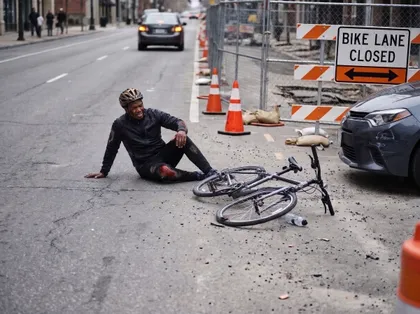
No, a closed bike path alone does not prove negligence. Your lawyer must investigate the actual arrangement, applicable duties, and connection between the alleged problem and your injury.
Can a Lawyer Investigate Without the Contractor’s Name?
Yes, a lawyer can investigate without knowing the contractor’s name at the first consultation. The location, incident date, photographs, and project notices can provide starting points. Permits and contracts may identify the participants. Your lawyer can then examine which organization controlled the activity or condition relevant to your injury.
Can a Lawyer Investigate If No Vehicle Hit Me?
Yes, a lawyer can investigate an injury without vehicle contact. The review may concern a sudden maneuver, a surface condition, a barrier, or a construction activity. Your lawyer must still determine what caused the injury and whether another party bears legal responsibility. The absence of contact does not answer those questions.
What If My Notes or Witness Messages Are in Spanish?
Keep your original Spanish notes and messages, and ask the firm how it will review them. Original wording can help preserve details about directions, sign descriptions, and the sequence of events.
Confirm who will interpret interviews and explain legal decisions in Spanish. Tell the lawyer whenever a translation fails to reflect what you meant.
Does a Construction Closure Mean I Have a Government Claim?
No, a construction closure does not automatically establish a government claim. A lawyer must identify whether a public entity controlled the relevant property or condition, whether a legal basis for liability exists, and whether any immunity applies. If a public entity may be involved, the lawyer should evaluate the shorter claim deadline without assuming the claim will succeed.
Let Arash Law Help You After a Bicycle Accident
If you suffered injuries near a construction closure, Arash Law can review your existing records and discuss whether further investigation may identify a responsible party. The review may involve the temporary cycling route, driver conduct, construction control records, and potential public or private claims. No government claim or contractor liability is presumed.
Share any photographs, notices, medical records, or agency correspondence you already have. You do not need to identify every contractor or public agency before reaching out.
Call (888) 488-1391 for a free initial consultation. Hablamos español.
Sources
- Caltrans: California traffic-control manual and applicable edition information.
https://dot.ca.gov/programs/safety-programs/camutcd- Caltrans: Bicycle lane closure guidance in Chapter 6P, including Typical Application 47.
https://dot.ca.gov/-/media/dot-media/programs/safety-programs/documents/ca-mutcd/2026/2026-camutcd-2026-6p-a11y.pdf- California Courts: Personal injury claims, evidence, and general filing periods.
https://www.selfhelp.courts.ca.gov/civil-lawsuit/personal-injury- California Courts: Government claim presentation and lawsuit procedures.
https://www.sucorte.ca.gov/civil-lawsuit/government-claim- California Government Code § 835: Requirements for dangerous-condition claims against public entities.
https://leginfo.legislature.ca.gov/faces/codes_displaySection.xhtml?lawCode=GOV§ionNum=835.- California Government Code § 911.2: Government claim presentation periods.
https://leginfo.legislature.ca.gov/faces/codes_displaySection.xhtml?lawCode=GOV§ionNum=911.2.- California Government Code § 945.6: Lawsuit deadlines following government claim presentation.
https://leginfo.legislature.ca.gov/faces/codes_displaySection.xhtml?lawCode=GOV§ionNum=945.6.- California Code of Civil Procedure § 335.1: General personal injury lawsuit deadline.
https://leginfo.legislature.ca.gov/faces/codes_displaySection.xhtml?lawCode=CCP§ionNum=335.1.Disclaimer
This article provides educational information and does not create an attorney-client relationship. Consult a licensed California attorney about your circumstances and deadlines. Past results do not guarantee future outcomes. Arash Law: (888) 488-1391.