TL;DR: Leaving the scene of an accident is a crime in California, and charges increase when a crash causes injury or death. Injured individuals can still pursue compensation, but prompt reporting and preserved evidence are crucial because insurers closely review hit-and-run claims.
Highlights:
- Document the scene with photos of damage, injuries, and debris.
- Collect witness contact details if available.
- Report the accident to law enforcement immediately.
- Seek medical care, even for minor injuries.
- Keep records of medical bills, missed work, and accident-related expenses.
- Notify your insurance company and ask about uninsured motorist coverage.
- Understand California’s two-year statute of limitations for personal injury claims.
Tip: Stick to facts when reporting the incident and avoid speculating about the other party’s involvement.
Table of Contents
In California, leaving the scene of an accident without stopping, sharing information, or reporting it is a crime under the Vehicle Code. The offense can be a misdemeanor or felony depending on whether the crash caused injury, death, or property damage. If you were hurt by a driver who fled, you may still seek compensation through insurance or a civil claim.
Is It A Crime To Leave An Accident Scene?
In California, the legal term for leaving the scene of an accident is a “hit-and-run.” This applies when a driver involved in a collision fails to stop and comply with required legal duties. Leaving the scene is a criminal offense and may be charged as:
- Property Damage Only — Misdemeanor
- Injury or Death — Misdemeanor or felony, depending on the circumstances
Hit-and-run accidents can happen anywhere, including intersections, parking lots, and private property. They can also occur even when the injured person is not inside a vehicle, such as pedestrians and cyclists.
A driver may be considered to have committed a hit-and-run by:
- Colliding with a stationary vehicle and leaving without providing contact details.
- Leaving the scene after causing injuries without waiting for the police or offering assistance.
- Damaging public or private property, such as a fence, sign, or mailbox, without reporting it.
- Failing to provide identifying information to the involved parties or law enforcement.
- Striking a pedestrian or cyclist and leaving without checking their condition.
What Is A Hit-and-Run in California?
A hit-and-run happens when a driver involved in a crash leaves without stopping to provide information, assist injured people, or report the accident as required by law.
Duty To Stop After An Accident In California
California law requires drivers involved in a crash to stop as close to the scene as safely possible. This duty applies even if the accident appears minor or involves only property damage.
Drivers must generally take the following steps:
- Provide identifying and contact information to the other driver or property owner.
- Render reasonable assistance if someone is injured, including contacting emergency services.
- Report the crash to law enforcement when injuries or death occur.
- File a report with the California Department of Motor Vehicles (DMV) when injuries, death, or qualifying property damage are involved.
If you were injured and the other driver failed to follow these requirements, you may have the right to pursue compensation for accident-related losses.
Additional Factors Affecting The Consequences Of Fleeing The Accident Scene
Hit-and-runs can involve both criminal and civil consequences. Understanding what a hit-and-run is can help clarify why these cases carry serious legal and financial implications. Criminal cases focus on punishment for violating the law, while civil claims seek to compensate injured people for their losses. Even if law enforcement does not immediately identify the driver, you may still be able to seek compensation through insurance, such as uninsured motorist coverage.
Other factors that may affect consequences include:
- Driving Under the Influence — Alcohol or drug involvement can lead to additional or more serious criminal charges.
- Distracted Driving — Texting, navigation use, or app use may support negligence claims.
- Driver Injuries — Leaving the scene due to personal injury does not eliminate legal duties.
What To Do After A Hit-And-Run In California
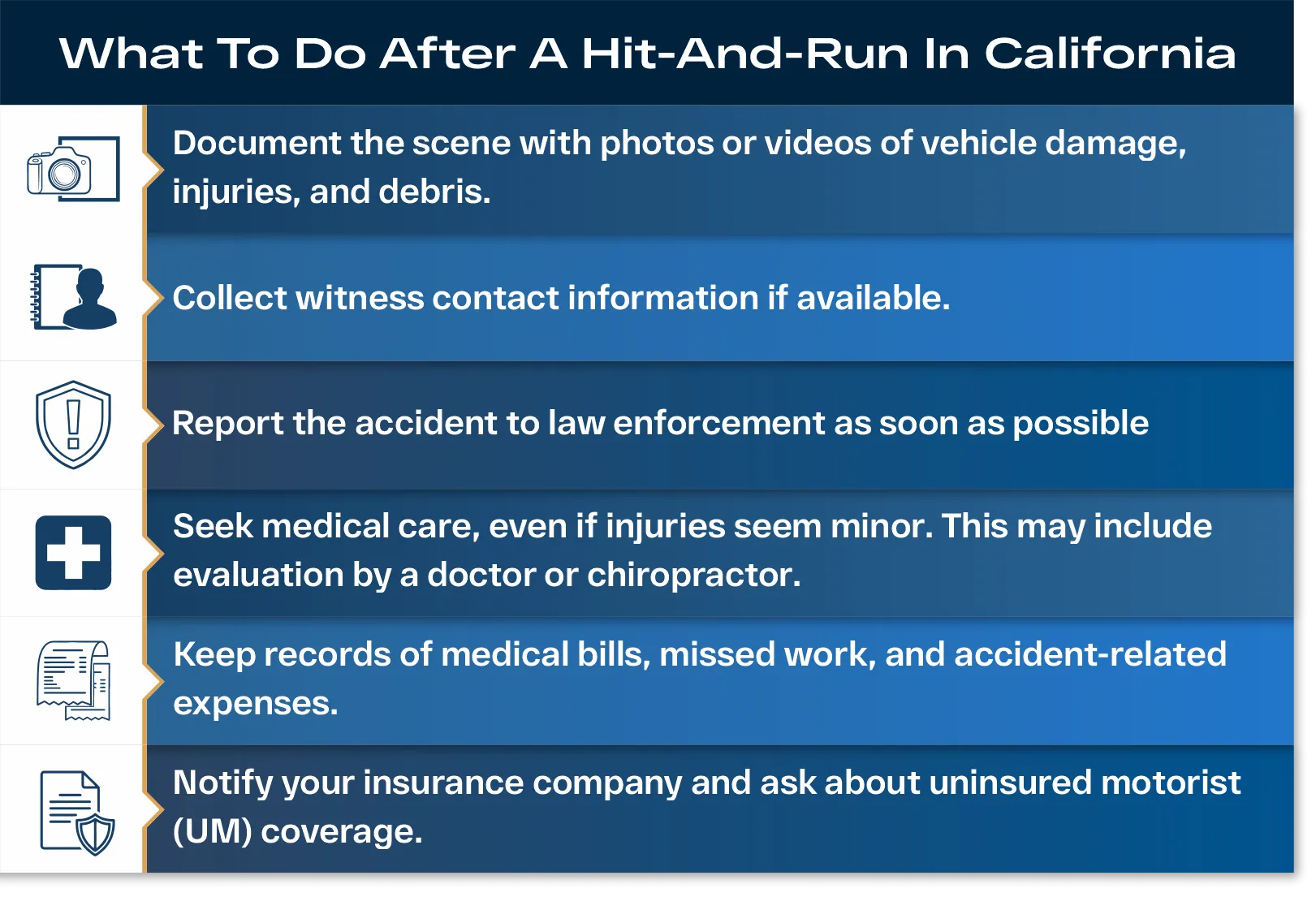 After a hit-and-run, taking prompt steps can protect your rights and support a future claim. If you feel unsure about the process, speaking with hit-and-run accident attorneys can help you understand your options. Consider the following steps to protect your rights:
- Document the scene with photos or videos of vehicle damage, injuries, and debris.
- Collect witness contact information if available.
- Report the accident to law enforcement as soon as possible.
- Seek medical care, even if injuries seem minor. This may include evaluation by a doctor or chiropractor.
- Keep records of medical bills, missed work, and accident-related expenses.
- Notify your insurance company and ask about uninsured motorist (UM) coverage.
Preserving physical evidence, such as damaged clothing or vehicle parts, may also help establish how the crash occurred.
Why Hit-And-Run Insurance Claims Can Be Complicated
Hit-and-run cases often involve insurance challenges because the at-fault driver is unknown. Without an identified driver, filing a third-party liability claim may not be possible.
Common issues include:
- Policy exclusions that limit hit-and-run coverage.
- Strict policy-based reporting deadlines.
- Requirements for police reports and sworn statements.
Most insurance policies require prompt notice, and some UM claims require reporting the accident to the police within a short time window. Review your policy carefully to avoid claim delays or denials.
Comparative fault can also affect a hit-and-run claim. California follows a pure comparative fault system, which means your percentage of responsibility for the crash may reduce compensation.
For example, if evidence shows you were speeding, making an unsafe turn, or not following traffic rules, an insurer may argue you share part of the blame. If you are found 40% at fault, your recoverable damages may be reduced by 40%. Because hit-and-run cases often rely on limited evidence, insurers sometimes scrutinize the injured person’s actions more closely when evaluating fault.
Statute Of Limitations For Hit-And-Run Cases In California
In most cases, you have two years from the date of the accident to file a personal injury claim. Missing this deadline may bar recovery.
Some exceptions may extend this deadline in a process known as tolling. These situations include the following:
- If the victim is a minor, the two-year period doesn’t start until they turn 18.
- If the hit-and-run driver leaves California, the time may pause until they return to the state.
- In some cases, the victim doesn’t notice their injuries until much later after the accident. The clock may start on the date that they discover the injuries.
How Hit-And-Run Accidents Get Investigated

Law enforcement uses various techniques to find a person who has fled after an accident. Below are several methods by which authorities can locate and apprehend at-fault individuals:
- Witness statements
- Traffic and surveillance cameras
- Dashcam footage
- Vehicle debris or paint transfer
- Automatic license plate recognition systems
- Public tips and media outreach
Occasionally, an at-fault driver may surrender due to guilt, remorse, or legal advice. Some drivers reveal involvement through statements or social media posts, which law enforcement may treat as admissions. Others get identified after bringing damaged vehicles to repair shops that notice signs of a recent collision.
In addition to police investigations, some injured people choose to consult firms like Arash Law to understand how evidence may support an insurance claim or civil case.
Frequently Asked Questions (FAQs) About Leaving The Scene Of An Accident
This section answers common questions about personal injury and hit-and-run accidents. The information is for general education only and should not be taken as legal guidance or free accident lawyer advice.
Can I File A Claim For My Hit-And-Run Accident Injuries?
Yes. You can seek compensation after a hit-and-run through insurance. If the driver is identified, you may file a claim with their insurer or pursue a case against them. If the driver is never found, you may still recover damages through your uninsured motorist (UM) coverage. If your claim is denied, you may proceed to sue for damages.
Does Getting Involved In A Hit-And-Run Accident Affect My Insurance Even If I Was Not At Fault?
If you are not at fault, a hit-and-run usually does not raise your premiums, but policies vary. Your uninsured motorist coverage may help pay for injuries or damage. Collision coverage may help repair your car, though deductibles often apply. Notifying your insurer promptly helps them review your claim.
Why Do Some Drivers Leave The Scene?
Drivers may flee because they fear arrest, lack insurance, are impaired, or panic after a crash. Leaving the scene does not remove legal responsibility and often makes the situation worse.
Should I Submit A Police Report Even For Minor Car Accidents In California?
Yes, it is generally wise to file a police report, even for minor crashes. A report creates official documentation that can support your insurance claim. It can also help resolve disputes about what happened. This record may become important if issues arise later.
How Soon After An Accident Must It Be Reported To Insurance In California?
California law does not set a strict deadline, but insurers usually expect prompt notice. Many policies recommend reporting within 24–72 hours. Early reporting helps protect your claim, especially if injuries appear later. Always check your specific policy for exact requirements.
Consult A Personal Injury Attorney If You Get Involved In A Hit-And-Run
Hit-and-run cases can be legally and procedurally complex. If you find yourself thinking, “I need a personal injury lawyer,” speaking with an attorney may help you understand your rights, deadlines, and insurance options.
Many people also ask, “Do lawyers only get paid if they win?” Many personal injury lawyers work on a contingency fee basis, meaning fees are tied to recovery and explained before representation begins.
You may also see references online offering free accident lawyer advice, but every case is different. A direct consultation can clarify how California law applies to your situation.
If you suffered injuries in a hit-and-run, you can contact AK Law to discuss your options and next steps.