TL;DR: Vehicle impoundment does not automatically prevent you from pursuing an injury claim. Vehicle release, insurance coverage, and bodily injury compensation involve separate decisions. However, signing a broad settlement release may affect your right to recover compensation.
Yes, you can still file a personal injury claim even if your car was towed to an impound lot after the accident. California law treats a property damage claim and a bodily injury claim as two distinct legal matters. Resolving the vehicle issue does not automatically end your right to seek injury compensation. However, carefully review settlement paperwork because a broad release may resolve both claims.
Key Facts: Impounded Vehicles and Injury Claims in California
- Vehicle Impoundment: A vehicle tow does not automatically prevent an injured person from filing a personal injury claim.
- Driver’s License: Check your license status through the California Department of Motor Vehicles (DMV). A license issue does not automatically mean you lack insurance.
- Insurance Coverage: Review your policy to determine whether towing, storage, collision damage, or other losses may be covered.
- Injury Evidence: Medical records, crash reports, photographs, and witness information may support an injury claim.
- Separate Processes: Retrieving your vehicle does not automatically resolve your injury claim. However, a broadly worded settlement release may affect both.
- Legal Deadlines: California Code of Civil Procedure (CCP) § 335.1 generally allows two years to file a personal injury lawsuit. CCP § 338 generally allows three years for property damage lawsuits, while Government Code § 911.2 generally requires a personal injury claim against a public entity to be presented within six months.
Table of Contents

After the Crash, My Car Was Towed, and I Have Questions About My Driver’s License. What Should I Check Separately Regarding the Vehicle, Insurance, and an Injury Claim?
Check four things separately: the impound notice, your driver’s license records, insurance coverage, and evidence of your injuries. Your vehicle’s release requirements do not automatically determine whether you can seek compensation for injuries caused by another party.
Start by identifying the agency that authorized the tow and the facility holding your vehicle. Then confirm your license status with the DMV and review your insurance documents. You should also preserve photographs, medical records, and other evidence that may support your injury claim.
These steps help you address the vehicle’s storage costs without overlooking your rights as an injured person. You may need to contact different agencies or companies because each handles a different part of the situation.
Use this checklist to identify the records you need and the appropriate contacts:
| Issue | What to Check | Who to Contact |
|---|---|---|
| Vehicle impoundment | Tow notice, grounds for impoundment, storage fees, and release requirements | Towing company and agency that authorized the tow |
| Driver’s license | Current license status, restrictions, and DMV records | California DMV |
| Auto insurance | Policy status on the accident date, covered drivers, collision coverage, towing benefits, and applicable liability coverage | Your insurance company or agent |
| Injury claim | Medical records, crash evidence, insurance communications, and legal deadlines | Medical provider, claims adjuster, or personal injury attorney |
Each contact handles a different issue. The towing agency determines the grounds for impoundment, the DMV maintains license records, and insurers evaluate coverage. Fault and injury compensation require a separate assessment.
If you prefer Spanish, ask whether the agency, towing facility, or insurer offers Spanish-language assistance. Request written explanations of charges and release requirements when needed.
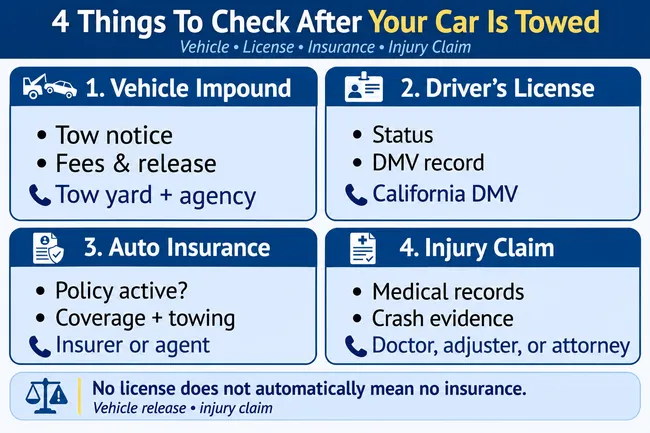
Four Things to Check When Your Car Is Towed After an Accident
If your car was towed after an accident, check the impound details, your driver’s license status, insurance coverage, and evidence of your injuries. Each issue involves different records, requirements, and contacts. Reviewing them separately can help you address towing and storage concerns while protecting your right to pursue an injury claim.
The following four steps explain what to check, who to contact, and which documents to keep:
1. Review the Impound Notice and Identify the Towing Agency
The impound notice can help you determine why your car was towed, where it is being stored, and which agency authorized the removal. These details matter because towing rules and vehicle release requirements depend on the circumstances.
Review the notice for the towing company’s name, storage address, and instructions. If you did not receive one, contact the responding police department or California Highway Patrol (CHP) office.
Once you locate your vehicle, ask the towing facility or authorizing agency about:
- The legal grounds for the tow and whether an administrative or investigative hold applies.
- A written breakdown of towing and storage charges.
- The documents required to request vehicle release.
- The facility’s business hours and payment methods.
- Any restrictions affecting access to the vehicle.
- The law or other authority used to justify the tow and whether the vehicle is subject to an administrative, investigative, or other legal hold.
California Vehicle Code (CVC) § 22651.07 provides certain consumer protections involving towing and storage. Depending on the circumstances covered by the law, these include rights concerning invoices, vehicle inspection, personal property, and payment methods.
A vehicle may be removed because it cannot be safely driven, obstructs traffic, or meets another legal ground for towing. Removal does not automatically establish a licensing violation.
There is no universal impound period that applies to every California accident. The reason for the tow, the applicable law, and any authorized hold can affect when the vehicle becomes eligible for release.
2. Verify Your Driver’s License Status Through the DMV
An accident or vehicle impoundment does not necessarily change your driver’s license status. Check your official record through the DMV’s online driver’s record service rather than assuming your license was suspended.
You may need to verify:
- Whether your license is currently valid.
- Whether the DMV has issued any suspension or restriction notices.
- Whether the collision resulted in a reporting requirement.
- Whether you must complete any administrative steps.
CVC § 14602.6 allows certain vehicle impounds involving specified license violations. A qualifying violation may result in a 30-day impound, subject to the statute’s requirements and exceptions.
That period does not apply to every accident-related tow. The statute also provides early-release provisions in qualifying circumstances, but release depends on satisfying the applicable requirements.
A license problem also does not automatically prove that the driver was uninsured. Insurance coverage depends on the policy’s terms, applicable law, and the facts of the collision.
If the accident caused an injury, death, or more than $1,000 in property damage, California generally requires a Report of Traffic Accident Occurring in California (SR-1) to be submitted to the DMV within 10 days. This requirement is separate from filing a police report or insurance claim. Failure to report may lead to administrative consequences, including potential license suspension.
3. Check Your Auto Insurance Policy and Coverage
Your auto insurance policy can help determine which towing, storage, and vehicle damage expenses may be covered. The answer depends on the coverage you purchased, the policy terms, and the circumstances of the crash.
Contact your insurer or insurance agent to confirm your coverage on the date of the accident. Request the policy documents, including effective dates, covered drivers, endorsements, exclusions, and any cancellation notices.
Review the following:
- Collision Coverage: May help pay for covered damage to your vehicle, subject to the policy terms and deductible.
- Towing or Roadside Assistance: May provide limited benefits for eligible towing expenses.
- Uninsured Motorist Property Damage (UMPD): May cover certain vehicle damage caused by an uninsured driver, subject to eligibility requirements and policy limits.
- Liability Coverage: Generally covers claims made against an insured for injuries or property damage to others.
- Medical Payments or Uninsured/Underinsured Motorist Coverage: May provide certain injury-related benefits when the policy and accident circumstances qualify.
Ask whether your insurer will pay eligible towing or storage expenses directly or reimburse you for them. A towing facility may still require payment before releasing the car, even when an insurance claim is pending.
If another driver caused your injuries, their liability insurer may also need to evaluate towing and storage fees after an accident. Reimbursement is not automatic and depends on liability, coverage, and the circumstances.
Request any coverage denial in writing. A driver’s license problem may raise coverage questions, but it does not automatically establish that no policy existed or that an injury claim is invalid.
4. Preserve Evidence of Vehicle Damage and Your Injuries
Your vehicle, medical records, and crash documentation can provide important evidence for a personal injury claim. Photograph the car as soon as you can safely access it, including damaged areas, impact points, and relevant interior damage.
You should also preserve:
- Photos or videos from the crash scene.
- Available police or collision reports.
- Witness names and contact information.
- Medical evaluations and treatment records.
- Receipts for towing, storage, and related expenses.
- Communications with insurers and towing companies.
- Copies of impound notices, vehicle release paperwork, and any written notices about a lien sale or disposal.
Request Preservation of the Vehicle
A written preservation request can help protect vehicle evidence that may support your injury claim. Ask the towing company to notify you before altering, transferring, selling, or destroying the car. Car accident lawyers may also send a formal preservation letter, sometimes called a spoliation letter.
Request access to inspect and photograph the car before repairs, transfer, or disposal. CVC § 22651.07 provides certain vehicle inspection rights in qualifying circumstances. Document any refusal and coordinate with your insurer or attorney when necessary.
California Evidence Code § 413 allows a court or jury to consider a party’s willful suppression of evidence when evaluating the case. However, a towing company’s loss of evidence does not automatically establish that a party suppressed it, and sending a preservation letter does not guarantee that the vehicle will be kept.
You can still pursue an injury claim even if your vehicle is sold, destroyed, or becomes inaccessible. Police reports, photographs, witness statements, and medical records may help establish fault and injuries. However, losing the vehicle could make it harder to prove your case.
Document Your Injuries
Medical records can help establish the nature, timing, and treatment of injuries after a collision. Seek appropriate medical care if you suffered an injury, even if you are primarily concerned about recovering your vehicle.
Some symptoms may become more noticeable after the accident. Tell your medical provider about your symptoms and follow recommended treatment instructions.
Keep copies of medical bills, treatment summaries, diagnostic reports, and work restrictions. These records may help document the physical and financial effects of your injuries.
If you receive medical or insurance documents in Spanish, preserve them with your other records. Ask for clarification or translation before agreeing to instructions or signing forms you do not understand.
How Can You File an Injury Claim if Your Car Is Still Impounded?
You can pursue an injury claim without waiting for the towing company to release your vehicle. Your eligibility generally depends on liability, your injuries, and the available evidence, not whether you have recovered the car.
Depending on the circumstances, your options may include:
- At-Fault Driver’s Insurance: You may pursue a bodily injury liability claim with the other driver’s insurer if that driver caused the collision.
- Your Own Insurance: Your policy may provide medical payments coverage or uninsured/underinsured motorist (UM/UIM) benefits, depending on your coverage and the circumstances.
- Personal Injury Lawsuit: You may file a lawsuit against a potentially responsible party if your claim cannot be resolved through insurance, subject to applicable legal deadlines.
The reason for the impoundment does not, by itself, establish who caused the crash. California’s comparative fault rules may affect compensation if more than one party contributed to the accident.
What Compensation Can You Seek if Your Car Was Impounded After an Accident?
You may seek compensation for injuries caused by another party’s negligence, even if your car remains impounded. The types and amounts of compensation depend on your injuries, financial losses, available evidence, and applicable law.
An injury claim may include:
- Medical Expenses: Costs of emergency treatment, hospital care, medication, rehabilitation, and other necessary medical services.
- Lost Wages: Income lost because your injuries prevented you from working.
- Reduced Earning Capacity: Loss of future earning ability if your injuries affect your ability to work.
- Future Medical Expenses: Reasonably anticipated treatment and ongoing care related to your injuries.
- Pain and Suffering: Physical pain, emotional distress, and other non-economic effects of the accident.
Vehicle damage, towing charges, and storage expenses are separate from bodily injury losses. You may also seek reimbursement for reasonable accident-related property losses when another party is legally responsible. Whether these expenses are recoverable depends on the circumstances.
An attorney can help evaluate your injuries and financial losses while keeping the vehicle damage and bodily injury components of your claim separate.
Can You Recover Your Car While an Injury Claim Is Pending?
You may be able to retrieve your vehicle while pursuing an injury claim, but release depends on the applicable towing and impound requirements. You generally don’t need to complete the personal injury claim before asking about the vehicle’s release.
Contact the towing facility and authorizing agency to confirm the following:
- Whether the vehicle is eligible for release or remains subject to a legal hold.
- Which identification, ownership, registration, or authorization documents are required.
- Whether agency approval or payment of applicable charges is necessary.
- Whether additional statutory conditions apply to the impound.
Vehicle release concerns possession and storage, while an injury claim concerns fault and accident-related losses. Neither process guarantees the outcome of the other.
Before signing any settlement paperwork, read its scope carefully. A document releasing only specified property damage claims differs from one that releases all claims arising from the accident.
If you are offered a document in English and are more comfortable reading Spanish, request an explanation or translation before signing. Confirm whether the document concerns vehicle possession, property damage, or a broader settlement of accident-related claims.
What If You Cannot Afford the Towing and Storage Fees?
You can ask the towing facility and the agency that authorized the impound about available payment, release, or fee-review procedures. Not every agency offers hardship relief or reduced charges, so availability must be confirmed.
To manage increasing storage costs:
- Request an itemized invoice and ask when additional charges will apply.
- Check whether your insurance covers eligible towing or storage expenses.
- Keep written records of your calls, payment requests, and attempts to retrieve the vehicle.
- Ask your insurer about inspecting the car if immediate retrieval is not possible.
California law allows qualifying towing and storage facilities to pursue lien-sale procedures when authorized charges remain unpaid. The requirements depend on the circumstances and applicable statutes.
If the facility issues a notice of sale or disposal, promptly review your options and preserve any available vehicle evidence. An attorney may help assess the legal issues affecting your injury claim.
How Long Do You Have to File an Injury Lawsuit in California?
California law sets filing deadlines for personal injury lawsuits, and the time limits depend on who may be responsible for the accident. Missing an applicable statute of limitations or government claim deadline may bar the claim entirely.
The following deadlines may apply:
- Personal Injury Lawsuits: You generally have two years from the date of the injury to file a lawsuit against a private party, such as a negligent driver. (CCP § 335.1)
- Property Damage Lawsuits: You generally have three years to file a lawsuit involving damage to your vehicle or other personal property. (CCP § 338)
- Government Claims: You generally must present a written personal injury claim to the appropriate public entity within six months. This requirement may apply if a city, county, or state agency is responsible for the accident. (Gov. Code § 911.2)
- Government Claim Review: A public entity generally has 45 days to act on a properly presented claim unless the review period is extended. If the entity does not act within the applicable period, the claim may be considered rejected. (Gov. Code § 912.4)
- Government Lawsuit Deadlines: If a public entity provides a qualifying written rejection notice, you generally have six months from the date the notice is personally delivered or mailed to file a lawsuit. If no qualifying written notice is provided, the deadline is generally two years from the date the claim arose. (Gov. Code § 945.6)
Vehicle impoundment does not automatically extend these filing deadlines. Vehicle damage, surveillance footage, and other evidence may become unavailable before the filing period ends.
DMV reporting duties are separate from lawsuit deadlines. Missing an administrative reporting requirement may cause licensing problems, rather than automatically barring an injury claim.
Car Impounded After an Accident? Arash Law Can Review Your Injury Claim
Arash Law can review the accident, available evidence, and insurance issues to help determine your options for pursuing injury compensation while the impound matter remains unresolved.
Hablamos español. If you prefer to discuss your accident and injury claim in Spanish, let our team know when you contact us.
Call (888) 488-1391 to discuss your potential injury claim.
Frequently Asked Questions About Impounded Cars and Injury Claims
Can I Still File an Injury Claim if I Signed a Vehicle Release?
You may still file an injury claim if the release only covers vehicle damage. However, a release covering all claims arising from the accident may also affect your right to seek compensation for injuries. An attorney can review the document to determine which claims, if any, you agreed to release.
Can I Challenge an Impound After an Accident?
You may request a post-storage hearing when your impound qualifies under CVC § 22852. Eligible owners generally have 10 days from the date on the storage notice to request a hearing, but certain types of vehicle removals are excluded.
Contact the authorizing agency for hearing instructions. A successful challenge may affect responsibility for towing and storage charges, but does not guarantee the immediate release of the vehicle.
Can I Retrieve Personal Belongings From My Impounded Car?
Yes, you generally have the right to retrieve personal belongings from your impounded vehicle without paying towing or storage fees. Contact the facility about business hours, identification, and authorization requirements before visiting. (CVC § 22651.07)
Can I File an Injury Claim if My Impounded Car Is Sold or Destroyed?
Yes, you may still pursue an injury claim even if your impounded vehicle is sold or destroyed. However, losing the car may limit evidence of the collision. Preserve available photographs, reports, and witness information, and seek legal guidance about any remaining evidence.
Does an Impounded Car Mean My Driver’s License Is Suspended?
No. An impounded car does not automatically mean your driver’s license is suspended. Check your DMV record for your current status and contact the authorizing agency to learn why your vehicle was removed.
Does Not Having a Valid Driver’s License Mean I Was Uninsured?
No. The absence of a valid driver’s license does not automatically mean there was no insurance policy. Ask your insurer to verify the policy’s effective dates and explain any applicable coverage restrictions.
Contact Arash Law About Your California Car Accident Claim
If you were injured in a crash and your vehicle was impounded, Arash Law can help evaluate potential liability, insurance coverage, and injury-related losses.
Arash Law handles qualifying personal injury cases on a contingency-fee basis. You pay no attorney’s fees unless we recover compensation for you. Call us at (888) 488-1391 to schedule a free case evaluation.
Hablamos español. Spanish-speaking callers may request assistance with questions about their accident and potential injury claim.
Sources
- California Vehicle Code § 14602.6. Vehicle impoundment involving specified driving violations. https://leginfo.legislature.ca.gov/faces/codes_displaySection.xhtml?sectionNum=14602.6.&lawCode=VEH
- California Vehicle Code § 22651.07. Towing and storage consumer protections. https://leginfo.legislature.ca.gov/faces/codes_displaySection.xhtml?sectionNum=22651.07.&lawCode=VEH
- California Vehicle Code § 22852. Post-storage hearings for vehicles stored at the direction of public agencies. https://leginfo.legislature.ca.gov/faces/codes_displaySection.xhtml?sectionNum=22852.&lawCode=VEH
- California Code of Civil Procedure § 335.1. Personal injury lawsuit limitations period. https://leginfo.legislature.ca.gov/faces/codes_displaySection.xhtml?sectionNum=335.1.&lawCode=CCP
- California Government Code § 911.2. Government claim presentation deadlines. https://leginfo.legislature.ca.gov/faces/codes_displaySection.xhtml?sectionNum=911.2.&lawCode=GOV
- California Government Code § 912.4. Time for action on claims presented to public entities. https://leginfo.legislature.ca.gov/faces/codes_displaySection.xhtml?sectionNum=912.4.&lawCode=GOV
- California Government Code § 945.6. Lawsuit deadlines following government claim rejection. https://leginfo.legislature.ca.gov/faces/codes_displaySection.xhtml?sectionNum=945.6.&lawCode=GOV
- California Evidence Code § 413. Consideration of willful suppression of evidence. https://leginfo.legislature.ca.gov/faces/codes_displaySection.xhtml?sectionNum=413.&lawCode=EVID
- California Civil Code § 1542. General releases and unknown claims. https://leginfo.legislature.ca.gov/faces/codes_displaySection.xhtml?sectionNum=1542.&lawCode=CIV
- California Department of Motor Vehicles. Report of Traffic Accident Occurring in California (SR-1). https://qr.dmv.ca.gov/portal/dmv-virtual-office/accident-reporting/
- California Department of Insurance. Automobile Insurance Guide. https://www.insurance.ca.gov/01-consumers/105-type/95-guides/01-auto/auto101.cfm
- California Insurance Code § 11580.26. Uninsured motorist property damage coverage. https://leginfo.legislature.ca.gov/faces/codes_displaySection.xhtml?sectionNum=11580.26.&lawCode=INS
- California Department of Motor Vehicles. Lien Sales for Vehicles. https://qr.dmv.ca.gov/portal/vehicle-registration/titles/lien-sales-for-vehicles/
- Judicial Council of California. Judicial Council of California Civil Jury Instructions (2026), CACI Nos. 3903A–3903D, 3903J, and 3905A. https://courts.ca.gov/system/files/file/judicial_council_of_california_civil_jury_instructions_2026.pdf
Disclaimer
This page is for general educational purposes only and does not constitute legal advice. Reading or relying on this information does not create an attorney-client relationship. Vehicle impoundment rules, insurance coverage, driver’s license requirements, and personal injury claims depend on the specific facts and applicable California law. No vehicle release, insurance payment, or injury compensation is guaranteed. Past case results do not guarantee a similar outcome. Consult a licensed California attorney about your individual circumstances. Arash Law: (888) 488-1391.