TL;DR: Before accepting a policy-limits settlement, a lawyer should verify the coverage, review the written offer and release, check for other responsible parties and insurance policies, and identify outstanding liens and costs. Your attorney should also examine any UM/UIM notice or consent requirements. These steps help you understand what the settlement pays and which claims it may close.
An insurance company may offer the at-fault driver’s policy limits even when your injuries and losses exceed that coverage. Before you accept, a lawyer should check the actual policy, proposed payment, release terms, and any other possible sources of compensation.
A policy-limits offer does not necessarily cover every loss from a crash. Medical bills, lost income, future treatment, and other damages may exceed what the insurer offers. Accepting a settlement may also affect your right to pursue additional claims.
Personal injury lawyers help injured people review proposed settlements and understand their legal options before signing a release. They can examine the available documents, explain unresolved issues, and discuss how the agreement may affect your rights.
Key Facts About Policy Limits Settlements in California
- Updated Minimum Liability Limits: California’s standard automobile liability minimums increased to $30,000 per person, $60,000 per accident for bodily injury, and $15,000 for property damage for policies issued or renewed on or after January 1, 2025. Qualifying policies under California’s Low Cost Automobile Insurance Program have lower limits.
- Policy Limits Are Not Guaranteed Payments: The stated coverage amount does not establish that the insurer has offered, agreed to pay, or paid that amount.
- Releases Can Close Future Claims: California Civil Code § 1542 protects certain unknown claims from a general release unless those protections are effectively waived.
- Other Coverage May Exist: Employer, rideshare, umbrella, or uninsured/underinsured motorist (UM/UIM) policies may apply, depending on the accident and policy terms.
- UM/UIM requirements matter: California Insurance Code § 11580.2 contains settlement-consent rules for uninsured motorist claims and separate exhaustion requirements for underinsured motorist claims. The requirements depend on the coverage involved.
- Liens and Costs Affect Net Recovery: Attorney’s fees, case expenses, medical liens, and reimbursement claims can reduce the settlement funds you may receive.
Table of Contents

I Am Told the Other Driver’s Policy May Be Too Small for My Injuries. If a Limits Offer Is Made, What Should a Lawyer Check Before I Accept or Sign a Release?
A lawyer should verify the available insurance limits, examine the written offer and release, identify possible additional coverage, and review liens, costs, and remaining losses before you sign. They should also be able to determine whether accepting the settlement could affect claims against other responsible parties or your own insurance company.
Their review should answer four questions:
- What coverage is confirmed? Does the insurer’s stated limit match the policy information, and could other coverage apply?
- What is being offered? Has the insurer made a written offer, and what conditions must be met before payment is made?
- What will you receive? How might attorney’s fees, medical liens, and case expenses affect your share?
- What rights will you give up? Does the release close only the intended claim, or could it affect other claims arising from the crash?
A personal injury lawyer should be able to explain these issues using the actual documents. The right decision depends on the evidence, coverage, settlement terms, and your circumstances.
Understanding the Difference Between Policy Limits, Offers, Payments, and Releases
A policy-limits settlement involves separate steps that should not be treated as the same event.
1. Stated Insurance Limits
A policy limit is the maximum amount an insurer may pay under a particular coverage provision, subject to the policy’s terms. It does not guarantee payment of that amount.
Your attorney should verify the coverage limits, policy dates, possible exclusions, and available funds. They should also check the per-person and per-accident limits.
When multiple people are injured, the per-accident limit may restrict the total coverage available for their bodily injury claims. Other claims or payments may also reduce the amount available for your settlement.
2. Formal Settlement Offer
A settlement offer explains how much the insurer proposes to pay and what conditions apply. An adjuster’s statement about possible policy limits does not necessarily mean the insurer has made a formal offer.
Your lawyer should request written confirmation of the proposed amount, any acceptance deadline, and the conditions attached to payment. They should also check whether the insurer requires a signed release or other documents.
3. Settlement Payment
Settlement payment occurs when the insurer transfers the agreed funds after the parties satisfy the applicable conditions. An insurer’s agreement to pay does not mean you have already received the money.
Your attorney should confirm the payment amount, intended recipients, expected payment date, and any outstanding requirements. They should also explain whether the stated amount represents the gross settlement before fees, costs, and liens.
4. Settlement Release
A settlement release is a legal agreement that gives up specified claims against the parties it covers. Signing one may limit or prevent you from seeking further compensation for those claims.
Your lawyer should identify the people and companies covered by the release, the claims it resolves, and any potential impact on other sources of recovery. They should also examine any California Civil Code § 1542 waiver involving unknown claims and determine whether the agreement preserves any separate claims.
The amount offered is only one part of the settlement. Your lawyer should also explain what you will receive, which claims the agreement may close, and what legal options may remain.
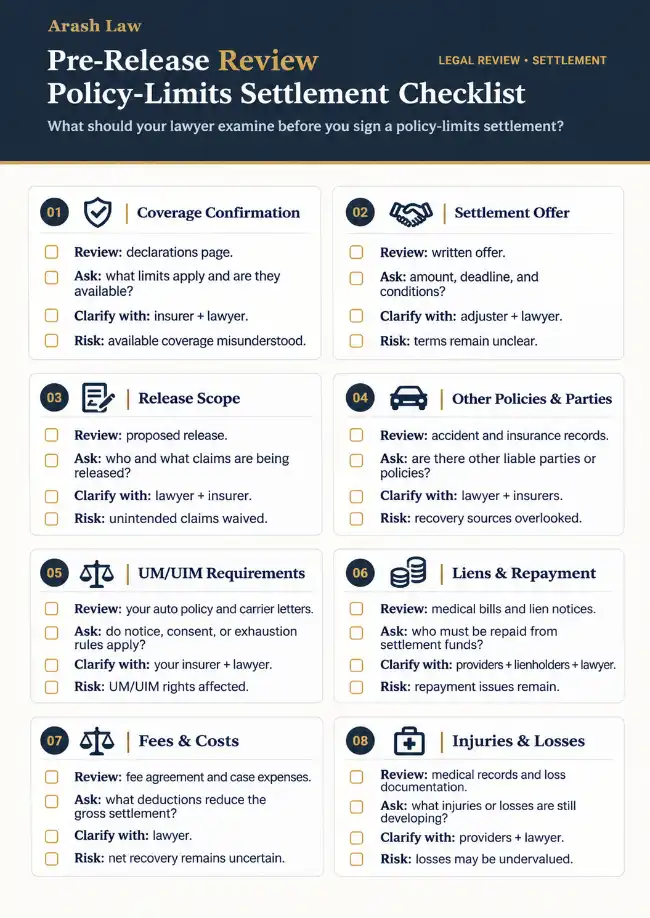
Pre-Release Review Checklist: What Should Your Lawyer Examine?
A pre-release review should identify what is confirmed, what remains unclear, and which documents can resolve each issue.
The following checklist can help you prepare for a discussion with your attorney before accepting a proposed policy-limits settlement.
| Document or Record | Question to Resolve | Who Should Clarify It? | Consequence If Unresolved |
|---|---|---|---|
| Insurance declarations page and coverage confirmation | What limits apply, and are they available for this claim? | Liability insurer and your lawyer. | Coverage may be misunderstood. |
| Written settlement offer | What amount is offered, and what conditions apply? | Claims adjuster and your attorney. | Terms or payment conditions may remain unclear. |
| Proposed liability release | Who and what claims would be released? | Your lawyer and settling insurer. | Additional claims may be affected. |
| Other insurance and accident records | Are other responsible parties or policies involved? | Your attorney, relevant insurers, and other parties. | Possible recovery sources may remain unexamined. |
| Your UM/UIM policy and insurer correspondence | Which UM/UIM notice requirements apply, and are any applicable consent or UIM exhaustion requirements satisfied? | Your insurer and lawyer. | UM/UIM coverage rights may be affected. |
| Medical bills and lien notices | Who claims repayment from the settlement? | Providers, lienholders, and your attorney. | Outstanding repayment obligations may remain. |
| Fee agreement and case expense records | What deductions apply to the settlement? | Your lawyer. | Your net recovery may remain uncertain. |
| Medical records and loss documentation | Which injuries and losses are included or still developing? | Treating providers and your attorney. | Remaining losses may not be fully evaluated. |
This checklist does not establish whether an offer is adequate. It helps identify the questions that should be answered before you make a settlement decision.
What If the Insurer Has Not Confirmed Its Policy Limits?
 Your lawyer should distinguish an adjuster’s statement from verified policy information. California’s minimum liability limits depend on when the policy was issued or renewed and whether an exception applies, such as a qualifying low-cost auto insurance policy. Your attorney should verify the limits that apply to the specific policy rather than assuming the standard minimums determine the available coverage.
However, a particular driver may have higher limits, commercial coverage, or other applicable insurance. The accident date and policy terms also matter. Your lawyer can request appropriate coverage documents and confirmation from the insurer. A declarations page alone may not resolve every question about coverage.
Could Other Insurance Policies or Responsible Parties Apply?
Other insurance policies may provide sources of recovery when the at-fault driver’s liability coverage is insufficient. Your lawyer may investigate:
- Employer Coverage: Commercial auto or other applicable liability insurance may be relevant if the driver was working at the time of the collision.
- Rideshare Coverage: A rideshare company’s insurance may apply depending on the driver’s activity and applicable coverage period.
- Umbrella or Excess Coverage: Additional liability policies may provide coverage above an underlying policy, subject to their terms.
- Other Responsible Parties: A vehicle owner, employer, or another party may share responsibility, subject to applicable liability rules and limits.
- Your Own UM/UIM Coverage: Your policy may offer protection when the other driver has no insurance or insufficient qualifying coverage.
A lawyer can also explain the legal options for recovering more than the other driver’s insurance policy limits. However, identifying another source of compensation does not guarantee additional payment.
What Should a Lawyer Check About UM/UIM Coverage?
Your attorney should check whether you have applicable uninsured or underinsured motorist coverage before resolving the other driver’s claim.
- UM coverage generally addresses qualifying accidents involving uninsured drivers.
- UIM coverage addresses certain accidents involving insured drivers whose bodily injury liability limits are lower than the injured person’s applicable UM/UIM limits.
California Insurance Code § 11580.2 governs important aspects of this coverage.
Your lawyer should review the settlement requirements that apply to your UM or UIM coverage. California law requires written consent to settlement for uninsured motorist claims (Insurance Code § 11580.2(c)(3)). However, the California Supreme Court has held that this statutory consent requirement does not apply to underinsured motorist claims.
For UIM benefits, California law generally requires exhaustion of the bodily injury liability limits applicable to all insured motor vehicles causing the injury. The claimant must establish exhaustion through paid judgments or settlements and provide proof to the UIM insurer (Insurance Code § 11580.2(p)(3)).
Uninsured motorist accident attorneys should also examine any relevant policy notice requirements, applicable deadlines, and how payments from responsible parties may reduce available UIM benefits. These requirements make it important to review your own insurance documents before signing a liability release.
What Should Your Lawyer Check in the Settlement Release?
Your lawyer should read the entire release to determine which people, companies, and claims the agreement covers. A release may extend beyond the named driver. Depending on the language used, it could also identify vehicle owners, employers, insurers, or other parties.
Your lawyer should examine whether the agreement includes:
- A broad release of all claims arising from the accident.
- A waiver under California Civil Code § 1542.
- Language covering unknown or future injuries.
- Terms affecting claims against other potentially responsible parties.
- Representations about outstanding medical liens.
- Conditions involving payment, dismissal, or additional documents.
Before signing a settlement release, have an attorney review the terms and explain which claims you may be giving up. Arash Law can review your proposed release and help you understand how it may affect your legal options. Call (888) 488-1391 to discuss your settlement documents.
How Does California Civil Code § 1542 Affect a Release?
California Civil Code § 1542 limits the effect of a general release on certain claims the releasing party does not know or suspect exist when signing. A release may include language expressly waiving this protection. An effective waiver can affect later claims for injuries or losses that were unknown at the time of the settlement.
Your lawyer should explain how the waiver works with the rest of the agreement. A § 1542 waiver does not automatically determine the effect of every possible future claim. The outcome depends on the wording, parties involved, and applicable law.
Can a Release Preserve Other Claims?
A release may be drafted to preserve specified claims, but the parties must agree to the applicable terms. Your lawyer can examine whether the document should address claims against other parties or potential insurance benefits separately.
A proposed exception, sometimes called a carve-out, does not guarantee that another insurer will provide coverage or that a later claim will succeed. The purpose is to understand the agreement’s intended scope before you sign it.
Gross vs. Net Settlement: What Amount Would You Actually Receive?
Your net settlement is the amount remaining after applicable fees, expenses, liens, and reimbursement obligations are addressed. A proposed policy-limits payment is usually a gross amount. It may not be the amount deposited into your personal account.
Ask your lawyer for an itemized settlement calculation showing the proposed gross payment, attorney’s fees, case expenses, known liens, disputed obligations, and estimated net recovery. The calculation should identify any amounts that remain unresolved.
Attorney’s Fees and Case Expenses
Your agreement with your lawyer determines your attorney’s fees. California Business and Professions Code § 6147 requires attorneys to put qualifying contingency fee agreements in writing and explain how fees and costs affect the client’s recovery.
Your lawyer may also charge case expenses, including filing fees, medical record charges, expert fees, and other documented costs. They should be able to explain how they calculate their fees and whether they deduct case expenses before or after calculating the attorney’s fee.
Medical Liens and Reimbursement Claims
Medical liens and reimbursement claims may require payment from settlement funds.
Depending on the circumstances, these may involve:
- Medicare or Medi-Cal recovery claims.
- Hospital liens under California Civil Code § 3045.1 and related provisions.
- Workers’ compensation liens under Labor Code § 3856.
- Health insurance reimbursement or subrogation claims.
- Medical providers with valid payment agreements.
Medi-Cal recovery rights are addressed in Welfare and Institutions Code § 14124.71 and related statutes.
Not every medical bill becomes an enforceable lien. Your attorney should verify each claimed obligation and determine how it applies to the settlement.
Questions to Ask About the Net Amount
Before signing, ask your lawyer to explain:
- What is the total gross settlement?
- How will attorney fees be calculated?
- What case expenses remain unpaid?
- Which medical liens or reimbursement claims are confirmed?
- Are any lien amounts disputed or still being reviewed?
- What amount can currently be estimated as your net recovery?
An estimated net amount may change while costs or liens remain unresolved. Your lawyer should explain those uncertainties without promising a final dollar amount.
What Happens If the Settlement Does Not Cover All My Losses?
A policy-limits settlement may leave losses unpaid when your damages exceed the available liability coverage. These losses may include past and future medical expenses, lost wages, reduced earning capacity, and pain and suffering.
Your attorney should compare the documented losses with the proposed settlement and explain which claims may remain available. This assessment does not mean another party or insurer will necessarily pay the difference.
Your lawyer should also consider whether the at-fault driver may remain personally liable for damages beyond their insurance limits. A settlement release may prevent further claims against that driver, even if your losses exceed the insurer’s payment. Your attorney can review the potential recovery and risks before you decide.
If you are still receiving treatment, your lawyer should review your medical prognosis and available evidence of future care needs. They should explain how unresolved medical issues affect the settlement decision, especially when the proposed release would prevent later claims for additional compensation.
Frequently Asked Questions About Policy-Limits Settlements
Should I Accept the First Policy-Limits Offer?
Before you accept an initial offer, it’s advisable to review the actual offer and release. An accident lawyer can examine the coverage, medical evidence, losses, and settlement conditions. A first offer is not automatically inadequate, and an offer at the policy limits is not necessarily enough to cover every loss.

Can My Lawyer Accept a Settlement Without My Permission?
Your lawyer generally cannot settle your claim without your authorization. California Rules of Professional Conduct, Rule 1.2, addresses the client’s authority over settlement decisions. Rule 1.4.1 requires lawyers to promptly communicate the amounts, terms, and conditions of written settlement offers.
Can I Receive More Than the Other Driver’s Policy Limits?
You may recover more than the other driver’s policy limits if another responsible party, additional insurance coverage, or another legally supported source of compensation is available. However, additional payment is not guaranteed.
Can I Sign a Release and Still Make a UIM Claim?
Yes. You may still pursue an underinsured motorist (UIM) claim after signing a liability settlement release if you meet the applicable coverage requirements. California generally requires exhaustion of the applicable bodily injury liability limits through paid judgments or settlements. Unlike uninsured motorist (UM) claims, UIM claims are not subject to the statutory settlement-consent requirement. Your lawyer should review the release, policy terms, and exhaustion requirements before you sign.
What Happens If I Discover Another Injury After Signing?
A signed release may limit or bar later claims involving injuries discovered after settlement. Its effect depends on the agreement’s scope, any Civil Code § 1542 waiver, and applicable legal defenses. There is no guarantee that a completed release can be undone.
Have Arash Law Review Your Proposed Settlement Documents Before You Sign
A proposed policy-limits settlement deserves careful review before you agree to its terms. The amount offered matters, but so do the release language, possible additional coverage, outstanding obligations, and claims the agreement may close.
Arash Law can review your written offer, proposed release, available insurance documents, and related records to help you understand your options. If you received a proposed settlement, call us at (888) 488-1391 to discuss your documents and any unresolved questions.
Sources
- California Department of Insurance. Increase in Private Passenger Motor Vehicle Financial Responsibility Requirements, Senate Bill 1107. https://www.insurance.ca.gov/0250-insurers/0300-insurers/0200-bulletins/bulletin-notices-commiss-opinion/upload/bulletin-2023-1-re-sb-1107-final-003.pdf
- California Civil Code § 1542. General releases and unknown claims. https://leginfo.legislature.ca.gov/faces/codes_displaySection.xhtml?sectionNum=1542.&lawCode=CIV
- California Insurance Code § 11580.2. Uninsured and underinsured motorist coverage. https://leginfo.legislature.ca.gov/faces/codes_displaySection.xhtml?sectionNum=11580.2.&lawCode=INS
- California Supreme Court. Hartford Fire Insurance Co. v. Macri (1992) 4 Cal.4th 318. https://law.justia.com/cases/california/supreme-court/4th/4/318.html
- California Business and Professions Code § 6147. Contingency fee agreements. https://leginfo.legislature.ca.gov/faces/codes_displaySection.xhtml?sectionNum=6147.&lawCode=BPC
- California Welfare and Institutions Code § 14124.71. Medi-Cal recovery rights. https://leginfo.legislature.ca.gov/faces/codes_displaySection.xhtml?sectionNum=14124.71.&lawCode=WIC
- California Civil Code § 3045.1 et seq. Hospital liens. https://leginfo.legislature.ca.gov/faces/codes_displaySection.xhtml?sectionNum=3045.1.&lawCode=CIV
- California Labor Code § 3856. Workers’ compensation recovery and liens. https://leginfo.legislature.ca.gov/faces/codes_displaySection.xhtml?sectionNum=3856.&lawCode=LAB
- State Bar of California. Rules of Professional Conduct, Rules 1.2, 1.4, and 1.4.1. https://www.calbar.ca.gov/legal-professionals/rules/rules-professional-conduct/current-rules-professional-conduct/chapter-1-lawyer-client-relationship
Disclaimer
This article is for general educational purposes only and does not constitute legal advice. Reading this information does not create an attorney-client relationship. Insurance coverage, settlement releases, liens, and legal rights depend on the facts of each case and applicable law. Consult a licensed California attorney before making decisions about a proposed settlement. Arash Law: (888) 488-1391.