TL;DR: You may file a premises liability claim against a church in California if it failed to maintain a safe environment. You must prove negligence and that the church knew or should have known about the hazard, leading to your injuries and damages.
Highlights:
- You may file a premises liability claim if the church’s negligence caused your injury.
- Common injuries include fractures, TBIs, and spinal cord injuries.
- Prove the church’s negligence or failure to maintain a safe environment.
- Show that unsafe conditions directly caused your injuries and damages.
- Gather evidence, such as photos, incident reports, and witness statements.
- California’s statute of limitations gives you two years to file a lawsuit.
Tip: Document the scene and seek medical attention immediately after an accident.
Table of Contents
If you get injured at a church in California, you could file a premises liability or negligence claim. Churches must keep their property reasonably safe for guests. They need to fix dangerous conditions and warn visitors about hazards. You can seek compensation from them if you can show that unsafe conditions or poor supervision caused your injuries.
However, federal and state laws classify churches as nonprofit religious corporations. As such, specific legal protections may affect your claim in some situations. Despite that, these protections do not completely shield churches from legal responsibility. Here’s more on when you can file a claim or lawsuit after getting injured at a church.
Can You Sue A Church For A Personal Injury?
You can potentially sue a church if its actions or inaction caused your injury. California’s premises liability law requires churches, like other property owners, to keep their properties safe for visitors. To have a valid case, you need to prove that they failed to do so.
Generally, state law requires you to establish these four elements of negligence:
- The church controls the property where you were injured. As such, it owed you a duty of care to keep you from harm while you were there.
- It breached that duty.
- That breach directly caused your injury.
- You incurred actual losses.
To illustrate, suppose your church installed a new sound system. However, it failed to clear a walkway of power cables afterward. You then tripped on them while visiting the church to attend a service. You broke your wrists in the fall and could not work your desk job while you were treating your injuries. As a result, you incurred both medical expenses and lost wages.
All four of the above elements must be present for you to pursue compensation. However, establishing a breach of duty can be especially challenging in premises liability claims. You have to demonstrate that the church knew about the hazard that injured you by proving either of the following:
- Actual Notice: Staff or volunteers noticed the dangerous condition, or a churchgoer directly reported it to them.
- Constructive Notice: The church should have discovered and corrected the hazard during property inspections or maintenance.
Common Causes Of Accidents At Churches
Unsafe conditions and building defects frequently cause church accidents in California. In many cases, they create hazards that lead to fall injuries. Examples include slippery surfaces, uneven floors, and loose mats.
Here’s how these dangerous conditions might appear in churches:
- Torn or bunched-up carpeting.
- Broken steps or tiles.
- Leaky ceilings that have not been repaired.
- Wet floors near baptisteries.
- Lack of safety railings on stairs.
- Various types of obstacles in pathways.
Common Injuries In Church Accident Claims
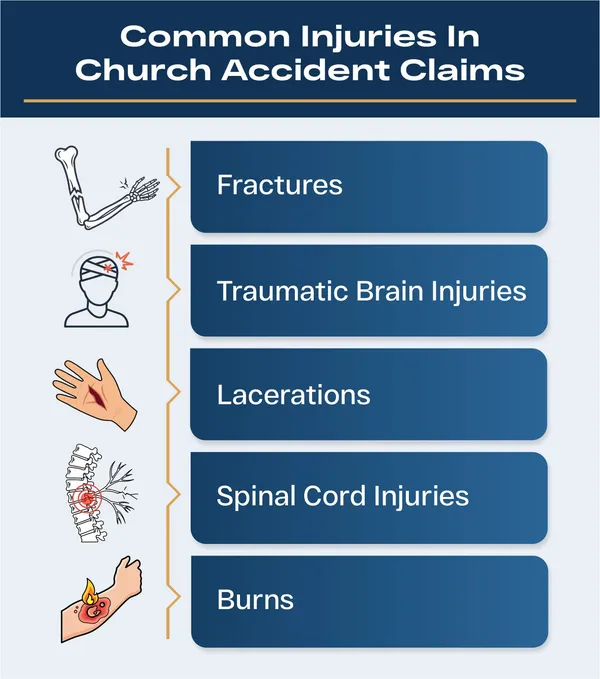
Common injuries victims sustain in a church include broken bones and head trauma. Many occur due to fall accidents. The type and severity of these injuries can influence the extent of your losses. As a result, they can impact how much compensation you can pursue. However, they can also lead to insurance disputes.
Below are common injuries victims sustain in church accidents:
- Fractures: May occur after falls from heights (such as the top of a staircase) or if victims try to brace for impact with their hands. Broken bones often prevent victims from working while healing.
- Traumatic Brain Injuries (TBIs): Range from concussions to brain damage. Extreme cases of TBIs can lead to permanent cognitive impairment.
- Lacerations: Can be caused by falls onto sharp objects, such as broken glass. Deep cuts can lead to severe infection, nerve damage, and permanent scarring.
- Spinal Cord Injuries (SCIs): Could occur when victims fall on their backs. In severe cases, SCIs can result in partial or complete paralysis.
- Burns: Such as from open flames, including candles, that start a fire. Burn injuries may lead to scarring and disfigurement.
These injuries can lead to permanent disability. Some may even require rehabilitation, including chiropractic care and physical therapy. Since these injuries often result in higher medical expenses and lost wages, victims may demand higher settlement amounts. To demonstrate their need for more compensation and prevent insurance disputes, they can gather and present detailed medical documentation from a doctor.
When Are Churches Liable For Personal Injuries?
Churches can face liability if their negligent actions injure someone, leading to losses. When assessing fault, premises liability attorneys identify who controlled the property where the injury occurred. From here, they consider whether that party failed to maintain a safe environment for visitors.
Here are some examples of when churches might be liable for injuries:
- Negligent Hiring: Like other employers, a church should screen, supervise, and train its employees. If it fails to do so and an employee’s actions injure someone, vicarious liability may apply. In California, this legal concept will hold the church responsible for the negligence of the people it hires.
- Negligent Security: In most cases, property owners are not responsible for crimes committed by others. However, they may face liability if they fail to prevent foreseeable wrongful acts. As such, churches could be at fault if they do not provide adequate safety measures for visitors.
- Vehicle Accidents: Churches may be liable if their negligence causes a vehicle accident. Cases can involve the following:
- Crashes caused by their employees within the scope of work.
- Accidents involving church-owned vehicles.
- Negligent supervision and event planning.
However, a church isn’t liable for an accident if it can demonstrate that it acted with reasonable care and had no notice of the hazard. Common defenses a church may use include:
- Open & Obvious Hazards: Clearly visible hazards that visitors should have been able to spot and avoid.
- Comparative Fault: Arguments that the injured victim shares responsibility for their injuries. For example, they only slipped and fell while distracted.
- Assumption of Risk: Participants accept the risk in inherently dangerous events, often by signing a waiver.
Who Can Be Liable In An Accident At A Church?
Churches aren’t the only parties that may face legal responsibility for your injury. In California, liability can also extend to third parties, volunteers, and employees. Here’s how each one may be at fault:
- Church: Like other property owners, the church must maintain a safe environment. If they had actual or constructive notice of the hazard that injured you but failed to fix it, they may be held liable.
- Third Parties: If a contractor creates a dangerous condition while working at the church but does not address it, they may be found partially at fault.
- Employees: Vicarious liability will not apply if the employee was not performing a job-related task at the time of the accident or injury.
- Volunteers: The Volunteer Protection Act (VPA) shields volunteers from ordinary negligence. However, they may be at fault for:
- Gross negligence
- Willful misconduct
- Motor vehicle harm
How Visitor Status Affects Duty Of Care In Premises Liability Cases
Visitor status can significantly impact your ability to pursue compensation. In California, you can generally only file a premises liability case if you were lawfully on someone else’s property when you were injured. Essentially, your reasons for being at a church will influence how much duty of care the at-fault party owed you.
In premises liability cases, courts often look at whether the injured victim was:
- An Invitee: Someone who enters the property for business purposes, such as church members. Invitees can also include individuals who provide services, like plumbers. Property owners owe them the highest duty of care. They must actively look for and resolve any hazards.
- A Licensee: Social guests or individuals invited onto the property for non-business purposes. For example, a religious tourist visiting a Catholic church to see a relic would be a licensee. Property owners have a duty to warn these visitors of known dangers that are not obvious. However, they do not need to inspect the property for hazards actively.
- A Trespasser: Individuals who enter the property without permission. Property owners owe trespassers the least duty of care. However, they must still avoid intentionally harming these individuals.
- A Child Trespasser: Minors are the exception to the trespasser rule. Property owners must protect them from appealing but potentially dangerous fixtures, such as pools and playgrounds shared by church members, that could injure them.
Evidence In A Premises Liability Claim Against A Church
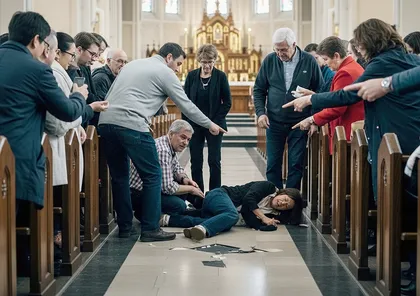
When filing a premises liability claim, victims primarily need proof that the church knew about the dangerous condition that injured them. That’s because the state’s Civil Jury Instructions (CACI) apply the preponderance-of-evidence standard. Plaintiffs must prove the defendant was, more likely than not, negligent. Premises liability attorneys, insurers, and courts review whether the evidence backs this claim.
In this regard, the following forms of proof can significantly support your case:
- Photos of the hazard that caused injury.
- Security camera footage, if available.
- Incident reports that the church creates after being informed of an accident.
- Witness statements.
What Damages Can You Recover In A Premises Liability Case?
Victims pursuing a premises liability case can recover economic and non-economic damages. Courts may award these to cover financial and intangible losses. In rare cases, victims could also seek punitive damages. However, the types of compensation they can pursue will depend on the specifics of the accident and their injuries.
Economic damages reflect financial losses. To support claims, victims typically provide financial documents such as receipts and bills. These damages include:
- Medical Costs: Current and future expenses related to injury recovery.
- Property Damage: Cost of repairing or replacing damaged property.
- Lost Wages: Paychecks missed while recovering from the injury.
- Lost Earning Potential: Diminished earning capacity, usually due to disability.
Non-economic damages cover intangible losses. They are harder to prove because they are subjective. Examples include:
- Pain and Suffering: Physical pain and emotional distress caused by the injury.
- Loss of Consortium: Harm to spousal relationships or registered domestic partnerships, often involving intimacy and love.
- Permanent Disability: Ongoing physical limitations affecting your quality of life.
- Inconvenience: Major disruptions to your daily routine.
In extreme cases, victims may seek punitive damages. These awards punish defendants for wrongful acts and deter similar behavior. California Civil Jury Instructions require clear and convincing evidence of:
- Fraud
- Malice
- Oppression
What Is The Deadline To File A Church Injury Lawsuit?
California’s statute of limitations gives you two years from the date of your injury to file a premises liability lawsuit. Courts will dismiss cases filed beyond this time limit. However, there are a few exceptions to this deadline. They may apply to cases involving minors, government entities, and injuries that did not manifest right away.
Here’s how these exceptions work:
- The deadline pauses for injured minors. It only starts when they turn 18.
- Accidents may involve public entities. For instance, a government vehicle might hit and injure someone on church property. Victims must file an administrative claim within 6 months. They can only sue the agency if it rejects the claim or fails to respond within 45 days.
- The statute of limitations may pause for the delayed discovery of injuries. It will only begin on the date the victim reasonably became aware that they were hurt, rather than on the date of the accident.
Who Pays For Church Accidents?
The church’s liability insurance may cover damages if it is found negligent. If a third-party contractor caused the accident, their insurance may apply. Workers’ compensation can also cover church employees. However, volunteers might not be included in this policy.
Factors That May Impact A Church’s Liability In Personal Injury Cases
Several factors influence liability in personal injury claims against churches. In California, the primary consideration is the church’s general duty of care. Courts may also look at:
- Volunteer Status: The VPA does not completely shield churches from liability. A church can be held liable for its volunteers’ actions while on duty. These cases usually focus on negligent supervision or selection. If a church fails in training, screening, or supervision, it may be responsible.
- Ecclesiastical Abstention Doctrine: In some cases, an insurer may deny that its client was at fault for an accident. Usually, victims can file a lawsuit and have a court resolve this issue if it can’t be settled during negotiations. You might not be able to do the same if a church is involved in your injury case. The Supreme Court requires civil courts, including those in California, to avoid intervening in matters of religion. This rule comes from the First Amendment’s Establishment and Free Exercise Clauses. If neutral principles of law can resolve the dispute, negligence claims can proceed. Otherwise, civil courts are not allowed to release formal judgments or decisions for cases involving:
- Church governance
- Religious doctrine
- Discipline
- Clergy employment decisions
- Contractual Agreements: Churches often make agreements with contractors. They might hire contractors for building projects or lease their facilities. Depending on the contract terms, a contractor may be liable for accidents.
- Assumed Risks: Church-sponsored events, such as outdoor picnics, may carry risks. When churchgoers sign waivers before participating, they acknowledge that they may be injured and release the church from liability if an accident occurs. Injured victims may be unable to pursue negligence claims in these cases.
What To Do Immediately After Getting Hurt At A Church
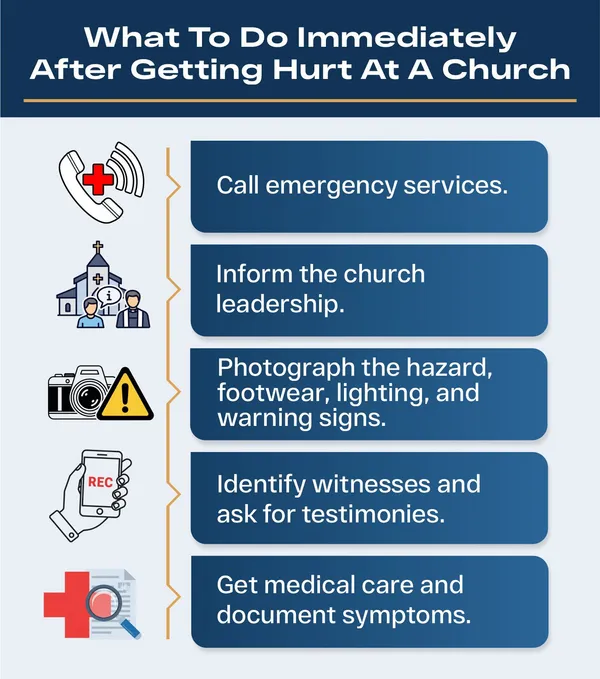
Prompt action can safeguard your health and rights if you sustain injuries at a church. Document the scene and report the accident. Seek medical attention even if the injury seems minor. A doctor can recommend a course of treatment and document your injuries.
Here are some steps you can take:
- Call emergency services.
- Inform the church leadership.
- Photograph the hazard, footwear, lighting, and warning signs.
- Identify witnesses and ask for testimonies.
- Get medical care and document symptoms.
Frequently Asked Questions About Church Accidents
Injuries at a place of worship can leave you with many questions. It’s normal to wonder about your rights and options. Some victims may ask if they can sue a church for their injuries. Clear answers can help you make informed choices about your case.
Here are common questions about accidents at church.
Can I Sue A Church For Negligence If I Share Partial Fault?
You can still sue a church for negligence if you contributed to your injuries. However, you may receive a lower payout. California comparative fault rules allow courts to divide liability among multiple negligent parties. Your share of responsibility will limit your recoverable damages. For example, a court can reduce your $100,000 award by $20,000 if you are 20% liable.
Do I Need A Personal Injury Lawyer To Sue A Church?
You are not required to hire a lawyer for a claim against a church, but a personal injury lawyer can give you personalized legal guidance and assist you with more complicated legal and insurance tasks. They can clarify liability issues and handle settlement negotiations on your behalf. If needed, a lawyer can also take your case to court.
Do Lawyers Only Get Paid If They Win My Case Against A Church?
Most personal injury lawyers in California accept cases on a contingency fee basis. That means you don’t pay your attorney unless they secure compensation for you.
How Long Do I Need To Wait For A Personal Injury Settlement?
The time it takes to settle a personal injury case varies depending on the complexity of your claim. Cases with clear evidence typically resolve faster, while more complex ones may take longer. For example, the timeline might stretch if you need to address disputes over fault or take your case to court.
What If I Signed A Waiver During A Church Event?
Signing a waiver means you accept the risks of injury at a church event. These waivers often stop you from filing ordinary negligence claims. However, you can still file a claim for accidents caused by gross negligence. Whether a waiver is enforceable also depends on its wording. Premises liability attorneys look at each case individually.
Protect Your Rights When You Get Injured At A Church
You may have the right to sue for injuries sustained at a church. California’s negligence and premises liability laws apply to these cases. Evidence must show that the church failed to act in a way that kept you safe from harm.
Given this requirement, pursuing church-related injury claims can be complex. In these cases, victims often look for free advice from premises liability attorneys. If you need help understanding your next steps, Arash Law’s attorneys can discuss the details of your case. If you have a valid claim, we can help you pursue the compensation you deserve under California law.
Call AK Law at (888) 488-1391 for a free case review.