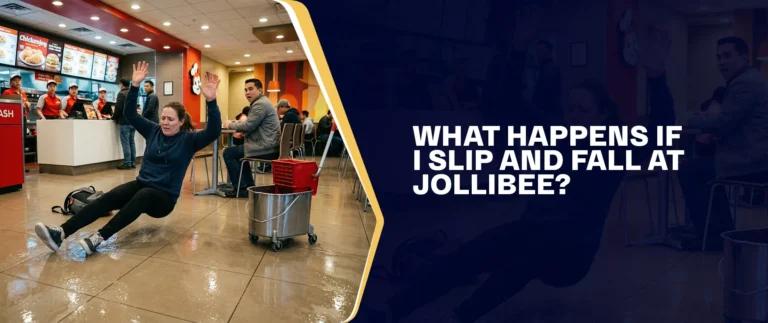
TL;DR: If you hurt yourself in a store, you may have a premises liability claim if the store’s negligence caused your injuries. Workers and customers can suffer fractures or head injuries from spills, and liability requires proof that the store had notice before the 2-year deadline.
Highlights:
- Report the injury to a store manager immediately and request an incident report.
- Take photos or videos of the scene and your visible injuries.
- Seek medical attention as soon as possible, even if symptoms seem mild.
- Preserve all records, including medical bills and documentation of lost wages.
- Consult a personal injury lawyer to understand your legal options.
- Be aware of California’s 2-year deadline to file a personal injury claim.
Tip: Avoid giving recorded statements to insurance adjusters without legal advice.
Table of Contents
If you get hurt in a store, you may suffer injuries like bruises, broken bones, or head trauma. Head injuries and traumatic brain injuries (TBIs) can be especially serious because symptoms may not appear right away. A hard fall may lead to dizziness, confusion, headaches, or memory problems that require medical attention.
A store accident can also lead to losses such as medical bills, missed work, and pain or daily limitations. Under California premises liability law, you may be able to pursue compensation if someone else’s negligence caused the accident.
California law requires property owners and businesses to take reasonable steps to keep lawful visitors reasonably safe. This duty includes inspecting the property and addressing hazards that could cause injuries. As a result, a store may be responsible if it failed to correct a dangerous condition that led to your fall.
After you seek medical attention, you may ask yourself, “What should I do next?” Start with the basic actions that protect both your health and your potential claim:
- Report the accident to a store manager or supervisor.
- Gather evidence from the scene of the incident.
- See a doctor for medical evaluation and treatment.
- Preserve records related to the accident and your injuries.
- Consult a personal injury lawyer about your legal options.
Actions To Take When You Hurt Yourself In A Store
After a store accident, prioritize your safety and seek medical attention. Once you handle your immediate safety, gather evidence before the store cleans the area or conditions change. Then take the steps below to protect your health and your rights. These actions can help establish liability and support a potential claim.
If you’re unsure about the broader legal process, reviewing guidance on what to do if you are injured on someone else’s property can help you better understand your rights after an accident.
Report The Accident
Report the injury to a store manager or supervisor immediately. Ask the store to create an incident report and request a copy for your records. Reporting the accident helps:
- Create an official record of the incident.
- Establish the time and location of the accident.
- Identify the hazard that caused the injury.
- Obtain witness information while people are still present.
Gather Evidence
Hazards can disappear quickly after the staff clean, repair, or block off the area. Take photos or videos of:
- Your visible injuries.
- The hazard that caused the injury.
- The shoes or clothing you wore at the time.
- The surrounding area, including lighting and warning signs.
If anyone saw the accident, ask for their contact information. Their statements can support your version of events if the store later disputes what happened.
See A Doctor
Seek immediate medical attention at an emergency room if you experience symptoms of head injury, severe pain, bleeding, loss of consciousness, or suspected fractures. For less severe symptoms, visit an urgent care clinic or your primary doctor as soon as possible so a medical professional can evaluate your condition and connect your injuries to the accident. Some injuries do not show symptoms immediately, so a medical evaluation is imperative even if the pain seems mild at first.
Preserve Records
Keep all documents related to the accident and your injuries. These records help show how the incident affected your health and finances. Save items such as:
- Medical records and bills.
- Prescription receipts.
- Diagnostic imaging results.
- Pay stubs showing missed work.
You may also keep a simple journal. Record pain levels, sleep problems, and daily activity limits during recovery.
Consult A Personal Injury Lawyer
The moment you realize, “I need a personal injury lawyer,” your case may already involve issues that are difficult to handle alone. Store injury claims may involve disputed hazards, multiple responsible parties, and insurance companies.
Premises liability attorneys can review the details of the accident and explain your legal options. They can also help you understand how liability works, what evidence may support your claim, and how the legal process may move forward.
What To Avoid After A Store Injury
Insurance companies review store injury claims carefully. Adjusters may look for statements, records, or actions that could reduce the value of your claim. Avoiding common mistakes after the accident can help protect your rights and maintain an accurate record of what happened.
After a store injury, avoid the following:
- Giving a Recorded Statement: Insurance adjusters may request one soon after the accident. You are usually not required to provide a recorded statement right away.
- Signing Broad Medical Authorizations: Insurers may request access to medical records. Review any authorization carefully and limit the records to those related to the accident.
- Posting About the Accident on Social Media: Photos, comments, or activity posts may be used to question your reported injuries.
- Downplaying Your Symptoms: Casual statements such as “I’m okay” or “It wasn’t that bad” may appear in claim notes and affect how insurers evaluate the injury.
- Missing Follow-up Medical Care: Insurance companies review treatment history. Missed appointments may raise questions about the seriousness of the injury.
Careful communication and consistent medical documentation help keep a clear record of the accident and its effect on your health.
Common Hazards That Lead To Store Accidents
Store accidents can occur in many retail environments. People visit grocery stores, big-box retailers, clothing shops, hardware stores, and convenience stores every day. Locations such as Walmart, Costco, Target, Home Depot, 7-Eleven, and local supermarkets receive heavy foot traffic. Busy stores increase the chance that dangerous conditions may develop and remain unnoticed for a period of time.
Retail spaces also contain displays, carts, cleaning equipment, and storage areas. Without regular inspection and maintenance, these conditions may create hazards that put customers and workers at risk.
Common hazards that can lead to store accidents include:
- Wet floors or spills left in walkways.
- Loose mats or uneven flooring in aisles and entrances.
- Merchandise that is stacked improperly on shelves.
- Defective or damaged shopping carts.
- Escalators that stop suddenly or trap clothing or footwear.
- Elevators that malfunction or fail to align with floors.
- Poor lighting in aisles, stairways, or parking areas.
- Unstable product displays or racks.
- Falling boxes or inventory in stockrooms.
Slip-and-fall accidents remain among the most common in grocery and retail stores. Wet floors, spills, and loose mats often lead to sudden falls that cause serious injuries. Slip-and-fall lawyers who handle grocery and retail store accident claims can review the incident, evaluate the available evidence, and explain the legal options after a store injury.
Common Injuries In Store Accidents
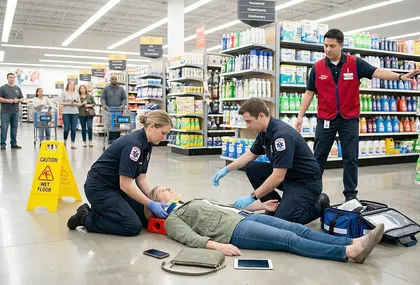
Store accidents can lead to a wide range of injuries. Unsafe conditions such as wet floors, loose mats, poor lighting, or falling merchandise may cause accidents in retail spaces. These incidents may lead to premises liability claims when a dangerous condition on the property causes harm.
According to the Centers for Disease Control and Prevention, there were about 214,110 traumatic brain injury-related hospitalizations in 2020 and 69,473 TBI-related deaths in 2021 in the United States. While these injuries do not occur only in stores, the data shows how serious a fall or sudden impact can be.
Other dangerous conditions in a store, such as falling items, broken fixtures, or unsafe walkways, may also cause serious harm. Generally, more serious injuries lead to higher medical costs, more missed work, and a higher claim value.
Common injuries include:
- Back and Spinal Injuries: Hard falls or heavy objects striking the body may injure the spine, strain muscles, or worsen an existing back condition.
- Neck Injuries: Sudden impact during a fall may strain the neck or cause whiplash-like symptoms that affect movement and may require chiropractic care or other treatment.
- Shoulder, Hip, or Knee Injuries: A fall can damage joints or tear ligaments, making walking, lifting, and other daily activities painful.
- Cuts and Lacerations: Broken glass, sharp packaging, damaged fixtures, or fallen items can cause cuts that require stitches and may leave scars.
- Crush or Impact Injuries: Falling merchandise, unstable displays, or collapsing shelves can cause blunt-force trauma, bruising, or internal injuries.
- Soft Tissue Injuries: Sprains, strains, and torn ligaments can occur when someone twists or lands awkwardly during a fall. These injuries may limit movement and require therapy.
Slip-and-fall accidents deserve separate attention because they remain one of the most common types of store injury claims. Common slip-and-fall injuries include:
- Traumatic Brain Injuries: A hard fall can cause the head to strike the floor, shelving, or nearby fixtures. This impact may lead to a concussion or a more serious brain injury.
- Bone Fractures: Many people break wrists, arms, ankles, or hips while trying to catch themselves during a fall. Some fractures require surgery or an extended recovery.
- Spinal Injuries: Falls can damage spinal discs or nerves, leading to lasting pain or limited mobility.
- Severe Soft Tissue Injuries: Torn ligaments and deep muscle strains may not appear on early imaging but can still cause long-term pain and restricted movement.
What To Know About California Premises Liability Law For Store Injuries
Store injury cases in California usually fall under premises liability law. In simple terms, this law requires property owners to use reasonable care to keep their premises safe. In the landmark case Rowland v. Christian, the court moved away from rigid categories such as “invitee.” Instead, the law now focuses on whether the property owner acted reasonably to prevent harm.
Store owners and operators must inspect the property and address hazards that could cause injuries. This duty applies to customers, workers, and other lawful visitors inside the store. Hazards may include wet floors, unsafe displays, poor lighting, or blocked walkways.
When a store fails to address a dangerous condition and that failure leads to an accident, the injured person may have the right to pursue a premises liability claim.
Actual Notice Vs. Constructive Notice In Store Accident Cases
To have a valid store injury case, you must prove the store had “notice” of the hazard. That means the business either knew the danger existed or should have known about it through reasonable inspections.
There are two ways notice may exist:
- Actual Notice: The store was aware of the hazard before the accident. For example:
- An employee saw a spill but did not clean it.
- Staff received a report about a loose floor mat, but did not repair or remove it.
- Constructive Notice: The hazard existed long enough that the store should have discovered it through reasonable inspections. For instance:
- A spill remained on the floor for an extended period.
- Store inspection records show employees did not inspect the aisle for several hours.
California courts discussed this principle in Ortega v. Kmart. Evidence such as inspection logs, surveillance footage, and employee testimony can help show how long the hazard existed before the accident.
Common Defenses Victims Should Be Aware Of In Premises Liability Cases
Property owners and insurers may raise defenses to reduce or avoid responsibility for a store injury. These arguments often focus on shifting blame or claiming the hazard was not the store’s responsibility.
Here are some arguments the defense may raise:
- They may claim you knew about the danger and chose to proceed anyway.
- The store may argue it did not know about the hazard and had no reasonable time to fix it.
- They may claim you were not allowed in the area where the injury happened.
- They may argue the injury worsened because treatment was delayed or medical advice was ignored.
Evidence such as photos, witness statements, incident reports, and medical records can help show how the accident happened and how the injury affected you.
How To Prove A Premises Liability Case After A Store Accident
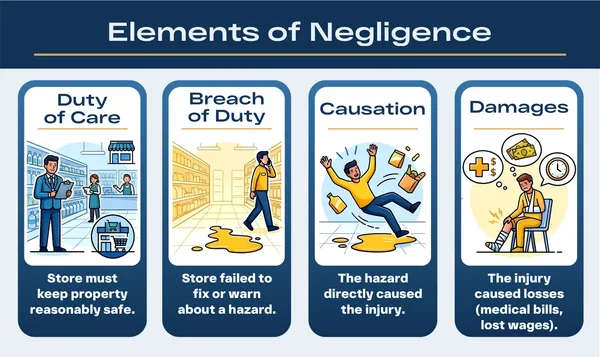
To prove a premises liability case, you must show that the store’s negligence caused your injury. In most cases, a claim must establish four legal elements: duty of care, breach of duty, causation, and damages.
- Duty of Care: The store had a legal responsibility to keep the property reasonably safe. This duty usually exists when:
- The store invites customers or workers onto the property.
- The business controls the area where the accident occurred.
- The property requires regular inspection to identify potential hazards.
- Breach of Duty: The store failed to fix or warn about a dangerous condition. This breach may appear when:
- Employees leave spills or wet floors unaddressed.
- Unsafe displays or falling merchandise remain in place.
- The store fails to place warning signs or barriers near a hazard.
- Causation: The hazardous condition directly caused the injury. You can show this connection through:
- Photos or video of the hazard.
- Witness statements describing the incident.
- Medical records linking the injury to the accident.
- Damages: The injury resulted in measurable losses. These damages may include:
- Medical expenses
- Lost wages
- Pain and suffering
- Loss of enjoyment of life
What Is Comparative Negligence And How Does It Work?
California follows a pure comparative negligence rule. This principle applies when more than one party shares responsibility for an accident. Each party receives a percentage of fault, and your compensation is reduced accordingly.
Here is a simple example:
A victim slips on a wet floor inside a store and suffers $10,000 in damages. The court finds the victim 40% responsible for the incident because the victim ignored a warning cone, while the store is 60% responsible for leaving a spill in the aisle.
The recovery would reflect those percentages:
- Total Damages: $10,000
- Fault Assigned to the Victim: 40%
- Compensation the Victim Can Recover: $6,000
Deadlines To File A Store Injury Claim In California
California law sets strict time limits for filing a lawsuit after a store injury. If you miss the legal deadline, you may lose the right to pursue compensation in court.
It is also essential to understand the difference between an insurance claim and a lawsuit filing deadline. Insurance negotiations may happen first, but the lawsuit must still be filed within the legal time limit.
The following deadlines usually apply in California:
| Claim Type | Typical Deadline |
|---|---|
| Standard personal injury claim against a private business | 2 years from the date of the injury |
| Claim involving a government entity | Generally, 6 months to submit an administrative claim, then 6 months to file suit after a written rejection |
Most store accidents involve private businesses, so the two-year deadline often applies. However, different rules may apply if the injury occurred on government-owned property. In many cases involving a government entity, you must first submit an administrative claim within six months of the injury. If the claim is rejected, you generally have six months from the rejection notice to file a lawsuit. You can consult a legal professional to understand which deadlines apply to your situation.
What Compensation Can You Recover After A Store Accident?
When you have a valid claim, you may be able to recover compensation for your losses. In legal terms, these losses are known as damages. These include economic damages, which cover financial losses, and non-economic damages, which address personal harm.
Among them are the following:
- Medical Expenses: Costs for hospital care, doctor visits, medication, therapy, and future treatment.
- Lost Wages: Income lost while you recover from the injury. Some cases may include reduced earning ability if the injury affects your ability to work.
- Pain and Suffering: Compensation for physical pain and emotional distress caused by the accident and recovery process.
- Loss of Enjoyment of Life: When injuries prevent you from participating in normal activities, hobbies, or daily routines.
For employees injured while working in a store, the claim falls under workers’ compensation, which covers medical care and a portion of lost income during recovery.
In some cases, an injured employee can pursue both a workers’ compensation claim and a third-party liability claim simultaneously. This situation may occur when another party, such as a property owner, contractor, or equipment company, contributed to the unsafe condition.
The value of a store injury claim often depends on factors such as the severity of the injury, the long-term effects, and the evidence showing the store’s responsibility.
How A Premises Liability Lawyer Can Help You
A premises liability lawyer can guide you after a store accident. These cases may involve disputed hazards, insurance companies, and multiple potentially responsible parties. Legal guidance can explain your rights and the steps that may follow after an injury.
Premises liability attorneys can help clients by:
- Investigating the accident and reviewing incident reports, photos, and witness statements. This process helps determine how the hazard led to the injury.
- Preserving vital evidence such as surveillance footage and maintenance records. Lawyers can send preservation requests before stores delete or overwrite these records.
- Identifying the parties responsible for the unsafe condition. Liability may extend to the store, the property owner, a contractor, or the maintenance company.
- Communicating with insurance companies on your behalf. Legal representation can help reduce the risk of insurers using statements to challenge your claim.
- Evaluating damages such as medical expenses, lost wages, and other injury-related losses. A careful review helps show the full impact of the accident.
Frequently Asked Questions About Store Injury Claims
Store injuries often raise questions about responsibility, evidence, and compensation. The answers below address common concerns people have after getting hurt in a store.
Who Pays If You Sue After A Store Injury?
In many cases, the store’s liability insurance pays for the damages. Most businesses carry general liability insurance to cover claims for customer injuries. The insurance company may pay for medical bills, lost wages, and other documented losses. If insurance coverage is insufficient, the store owner or another responsible party may also be financially responsible.
What If The Store Says It Did Not Know About The Spill?
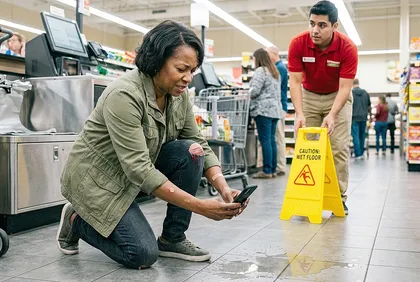
You may still have a claim. A store may be responsible if the hazard existed long enough that employees should have discovered it during routine inspections.
How Long Does A Spill Need To Be Present For The Store To Be Liable?
California law does not set a specific time limit. Liability depends on whether the store had enough time to discover and address the hazard. A store may be responsible if:
- Employees saw the spill and did not clean it.
- The spill remained long enough that routine inspections should have discovered it.
Courts often refer to these situations as actual notice or constructive notice.
Can I Still Recover Compensation If I Was Partly At Fault?
Yes, because California follows a pure comparative negligence rule. You may still be eligible to pursue compensation even if you share part of the blame. The amount you recover decreases based on your percentage of fault. You may also seek free advice from a premises liability lawyer to understand how fault can affect your potential recovery.
Do I Need An Incident Report Or Video Footage To Prove My Case?
While helpful, they are not the only evidence. Photos, witness statements, and medical records can also support your claim. A lawyer can also request surveillance footage before the store deletes or overwrites it.
Do I Need A Personal Injury Lawyer For My Store Accident Case?
You may consider speaking with a personal injury lawyer, especially if the store denies responsibility, the injuries are serious, or the insurance company disputes your claim. A store accident attorney can review the facts of the accident, gather evidence, and communicate with the insurer while you focus on recovery.
Do Lawyers Only Get Paid If They Win My Store Accident Case?
In many cases, yes. Many personal injury lawyers work under a contingency fee arrangement. Under this structure, the attorney receives payment only if the case recovers compensation through a settlement or court award. The fee is usually a percentage of the recovery.
Speak With A Premises Liability Lawyer About Your Store Injury Case
A store accident can leave you dealing with pain, medical bills, and missed time from work. Many people also feel unsure about what steps to take or who may be responsible for the unsafe condition.
If you believe someone else’s negligence caused your injury, consider speaking with a legal professional. The premises liability lawyer at Arash Law can review the details of your accident and examine the available evidence. They can also explain your legal options and outline the possible next steps for pursuing a claim.
If you’re unsure how to move forward, you can schedule a free initial consultation. During this conversation, you can better understand your situation before making any decisions.
To get started, contact AK Law at (888) 488-1391.