TL;DR: The other driver’s failure to cooperate doesn’t mean you’re out of options. Ask the insurer to explain whether it’s still investigating, disputing fault, or denying coverage. Police reports, dashcam footage, or available vehicle data may help establish fault without the driver’s statement. If coverage is denied, your uninsured motorist benefits may help, depending on your policy and the reason for denial. California’s general two-year personal injury lawsuit deadline still applies, even if the insurer delays its decision.
If the other driver’s insurer denies your claim because its driver will not respond, you can question its decision and explore other ways to pursue compensation. Ask for its position in writing and identify independent evidence, such as collision reports, witness accounts, or dashcam footage.
You may also sue the at-fault driver. However, the driver’s silence alone does not establish fault or guarantee payment.
Table of Contents

An Insurer Says It Cannot Obtain Its Driver’s Statement. What Should an Injured Claimant Ask About the Written Reason and the Evidence Still Available?
Ask the insurer to clarify its position in writing. Is it still investigating, or has it already decided to deny your claim? What information is missing, and why does it matter?
If it denies coverage, request the policy provision and facts supporting that decision. Ask when it expects to complete any remaining investigation.
Next, ask which evidence it has reviewed. Collision reports, photographs, footage, witness accounts, and available vehicle data may help establish fault. Medical records, bills, and wage documentation can help show how the accident affected your health and finances.
Keep copies of the insurer’s responses and preserve available evidence promptly. The driver’s silence alone does not prove bad faith, establish fault, or guarantee payment. A car accident lawyer can review the explanation and assess whether a denial of non-cooperation coverage is legally supported.
Key Facts About Claims Denied Because the Other Driver Won’t Respond
- Written denials are required. Under 10 CCR § 2695.7(b)(1), insurers must communicate third-party claim denials and disputes over liability or damages in writing.
- Non-cooperation does not automatically defeat coverage. The insurer generally must show that the driver’s lack of cooperation substantially harmed its ability to investigate or defend the claim.
- A liability dispute is different from a coverage denial. Denial of liability alone does not trigger uninsured motorist (UM) coverage. A denial of insurance coverage may qualify under Insurance Code § 11580.2(b).
- Personal injury claims have filing deadlines. Under Code of Civil Procedure (CCP) § 335.1, you generally have two years from the injury date to file a lawsuit against the at-fault driver.
- Regulatory complaints are available. The California Department of Insurance (CDI) can investigate potential claims-handling violations, but it cannot decide who caused the accident or order the insurer to compensate you.
Can the Insurer Deny Your Claim Because the Other Driver Won’t Cooperate?
The insurer may cite the other driver’s lack of cooperation as grounds to deny coverage, but that alone is generally insufficient.
California auto insurance policies commonly include a duty-to-cooperate clause. This provision requires the insured driver to assist with a claim investigation or defense.
If the other driver ignores the insurer’s calls, refuses to provide a statement, or cannot be found, the insurer may say it doesn’t have enough information to determine who’s responsible.
However, an inability to complete an investigation is not automatically grounds for denying coverage.
Under California case law, including Campbell v. Allstate Insurance Co. (1963) 60 Cal.2d 303, an insurer relying on the insured’s breach of a cooperation clause generally must establish substantial prejudice.
In plain terms, the insurer generally must show that the insured driver’s refusal to cooperate seriously affected its ability to investigate or defend the claim. It also matters whether the insurer made reasonable efforts to contact that driver.
What Does the Insurer’s Explanation Actually Mean?
The insurer’s stated position determines what you need to address:
- “We can’t investigate without the insured driver’s statement.” The insurer claims it lacks enough information to determine responsibility. Ask which facts are missing, what steps it has taken to obtain the statement, and whether independent evidence could resolve its concerns.
- “The insured driver violated the policy by failing to cooperate.” The insurer may deny coverage based on an alleged breach of the cooperation clause. An attorney can review whether the insurer made reasonable efforts to obtain cooperation and whether the breach caused substantial prejudice.
- “We dispute that the insured driver was at fault.” The insurer questions responsibility for the collision. Physical evidence, witness accounts, and other available records may help establish what happened.
These positions are not interchangeable. An insurer might dispute liability even when coverage exists, or it might raise a coverage defense despite evidence that its driver caused the crash.
The driver’s silence alone does not establish insurer bad faith or guarantee compensation. You still need evidence supporting fault, damages, and applicable coverage.
What Should You Ask the Insurer to Explain in Writing?
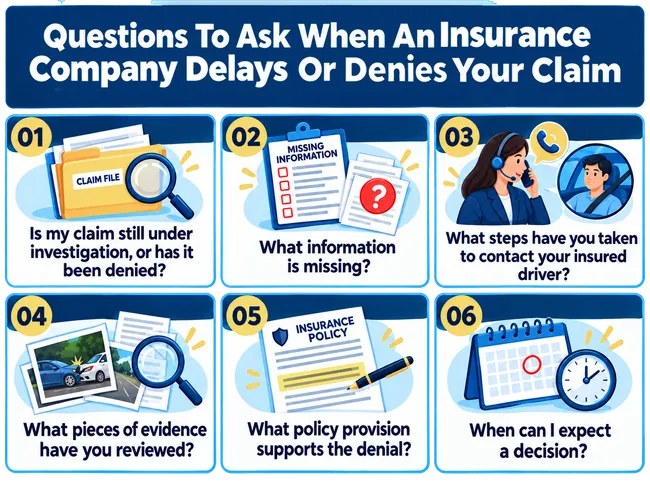
Ask the insurer to put its position in writing so you know exactly what it’s questioning.
Under Title 10 of the California Code of Regulations (CCR) § 2695.7(b)(1), insurers must communicate third-party claim denials and disputes over liability or damages in writing.
The more detailed written explanation required for first-party claim denials applies to claims involving your own insurer, such as an uninsured motorist claim. However, you can still ask the other driver’s insurer for specific reasons supporting its decision.
Ask the insurer to clarify the following:
- Claim Status: Is the insurer still investigating, denying insurance coverage, or disputing responsibility for the crash?
- Missing Information: What specific facts are unavailable because the driver has not responded?
- Investigation Efforts: What steps has the insurer taken to contact its driver and obtain the missing information?
- Independent Evidence: Which collision reports, photographs, witness statements, or electronic records has it reviewed?
- Coverage Provisions: If coverage is denied for non-cooperation, which policy provision and facts support that decision?
- Remaining Investigation: What additional information could resolve the insurer’s concerns, and when does it expect to reach a decision?
If the insurer says it needs more time, review California’s insurance claim timelines to understand its claim-handling deadlines and required notices.
Keep written correspondence, claim numbers, adjuster names, and copies of submitted evidence. If an explanation is provided by telephone, send a follow-up email summarizing the adjuster’s explanation and requesting confirmation.
What Evidence Can Help if the Other Driver Refuses to Give a Statement?
You may still be able to establish fault without the other driver’s statement. Other sources can help show what happened and how the accident affected you.
Useful evidence includes:
- Police or California Highway Patrol (CHP) Reports: A collision report may document the responding officer’s observations, witness information, vehicle locations, and citations. Eligible parties and representatives can request reports from the investigating agency under California Vehicle Code § 20012.
- Dashcam or Surveillance Footage: Video from your vehicle, nearby businesses, or other available cameras may show the collision. Request preservation promptly because recordings can be overwritten or deleted.
- Witness Statements: Independent witnesses may help establish vehicle movements, traffic signals, road conditions, or the events immediately before the collision.
- Event Data Recorder (EDR) Data: Some vehicles record information such as speed, braking, and other vehicle-system activity around a collision. Access and interpretation may require specialized equipment and legal authorization. Preservation may be necessary before a vehicle is repaired or scrapped.
- Medical Records and Bills: Emergency care records, treatment notes, imaging, and medical bills can document injuries and treatment costs. They do not independently establish which driver caused the crash.
- Lost-Income Records: Pay statements, employer documentation, and other financial records may support claimed income losses resulting from injuries.
A car accident attorney can assess which records are available and whether additional investigation is necessary.
California Insurance Code § 790.03(h)(3) addresses unreasonable failures to investigate claims. Separately, 10 CCR § 2695.7(d) requires insurers to conduct and diligently pursue thorough, fair, and objective investigations.
Ignoring relevant evidence may support a complaint to the California Department of Insurance (CDI). However, disagreeing with an insurer’s decision does not automatically mean it acted in bad faith.
Has a third-party insurer denied or delayed your claim because its driver will not respond? Arash Law’s car accident lawyers can review the insurer’s explanation, evaluate available evidence, and discuss your options for pursuing compensation.
Call (888) 488-1391 for a free case evaluation.
Can Your Uninsured Motorist Coverage Help if the Other Insurer Denies Your Claim?
Your uninsured motorist (UM) coverage may help if the other driver’s insurer denies insurance coverage, including for alleged non-cooperation.
Under Insurance Code § 11580.2(b), that denial may allow the other vehicle to qualify as uninsured. However, a claim denial, missing statement, or fault dispute alone does not establish eligibility.
Insurance Code § 11580.2(a) generally requires California auto liability policies to include UM bodily injury coverage unless a named insured rejects it in writing. Check your coverage and policy limits, then provide the other insurer’s written denial of coverage to your insurer for review. An attorney can assess the denial and your policy if eligibility remains disputed.
What Can Your Insurance Pay For?
Uninsured motorist bodily injury coverage may pay for medical expenses, lost wages, pain and suffering, and other covered injury losses. Payment depends on your damages, the other driver’s responsibility, and your policy limits.
Other coverage may help while the liability dispute continues:
- Collision Coverage: Helps pay to repair or replace your vehicle after a covered collision, regardless of fault. A deductible usually applies.
- Medical Payments Coverage (MedPay): Helps pay covered medical expenses for you and your passengers, regardless of fault, up to your policy limit.
UM bodily injury coverage does not pay for vehicle repairs. Separate uninsured motorist property damage coverage or a collision deductible waiver may help, depending on your policy and the circumstances.
What Happens After Your Insurer Pays?
After paying covered benefits, your insurer may have the right to seek reimbursement from the responsible party. This process is called subrogation.
Before accepting a settlement from the other driver or taking your lawsuit to a final court judgment, check with your own insurance company. Under California Insurance Code § 11580.2(c)(3), doing either without your insurer’s written approval could affect your uninsured motorist coverage.
How Long Do You Have to Protect Your Uninsured Motorist Claim?
Under Insurance Code § 11580.2(i)(1), you generally must complete at least one of these steps within two years after the accident:
- File a lawsuit against the uninsured driver for your injuries.
- Reach an agreement with your insurance company on how much it will pay you.
- Start the arbitration process by sending your insurer a written request through certified mail, with proof of delivery requested. Arbitration is a way to resolve a dispute without going to court.
Simply filing an insurance claim, sending medical records, or discussing a settlement with your insurer is not enough to meet this deadline.
Can You Sue the Other Driver if the Insurance Claim Goes Nowhere?
Yes. You may sue the allegedly at-fault driver even if the insurer hasn’t completed its investigation.
A lawsuit creates a formal process for requesting evidence and resolving disputed issues. Once properly served, the driver must respond or risk a default judgment.
Court procedures may help uncover evidence and create opportunities for settlement.
However, filing a lawsuit doesn’t automatically settle an insurance coverage dispute or guarantee payment.
How Long Do You Have to Sue if the Other Driver Won’t Respond?
California has different deadlines depending on the type of claim and the responsible party.
| Claim Type | General California Deadline |
|---|---|
| Personal injury | Two years from the injury date |
| Vehicle or other property damage | Three years from the date of damage |
| Government claim involving personal injury | Six months from claim accrual to present a claim to the public entity |
Legal basis: Code of Civil Procedure § 335.1, Code of Civil Procedure § 338, and Government Code § 911.2.
The insurer’s investigation, delays, or attempts to contact its driver generally do not pause these deadlines. Missing an applicable lawsuit deadline or government claim deadline can bar the claim entirely.
Government claims require additional attention. When a public entity may be responsible, the claimant generally must present a timely administrative claim before filing a lawsuit. A separate deadline may apply after the public entity acts on the claim or deems the claim rejected.
For many personal injury claims, the filing deadline is tolled while the injured person is a minor. However, exceptions apply, including special rules involving public entities.
Evidence-preservation urgency is separate from these legal deadlines. Surveillance footage, electronic records, and witness information may become unavailable long before the deadline to sue.
An attorney can determine which filing requirements and exceptions apply to your circumstances.
Frequently Asked Questions About Third-Party Claim Denials in California
Can I Sue the Other Driver’s Insurance Company Directly for Bad Faith in California?
Generally, no. California usually allows the insured driver, rather than an injured third party, to bring a bad-faith claim against the insurer. An assignment of rights may change your options.
You can sue the at-fault driver. If you obtain a covered judgment, Insurance Code § 11580(b)(2) may allow you to pursue payment from the insurer, subject to coverage terms and defenses.
Does the Other Driver’s Refusal to Cooperate Extend My Deadline to Sue?
No. California generally gives you two years from the injury date to file a personal injury lawsuit under CCP § 335.1. The driver’s silence does not automatically extend that deadline.
Can I Report the Insurer for Refusing to Explain Its Denial?
Yes. You can file a complaint with the California Department of Insurance (CDI) if the insurer fails to provide a required written denial or you suspect other claims-handling violations.
The CDI can investigate complaints, but it cannot award compensation or decide who caused the accident.
Can My Insurer Raise My Rates Because I Hired a Lawyer?
Hiring a lawyer alone does not establish a lawful reason to increase your rates or cancel coverage.
If your insurer takes action you believe is related to hiring an attorney, ask for its explanation in writing and consider contacting the CDI.
What Is a Duty-to-Cooperate Clause and Why Does It Affect My Claim?
A duty-to-cooperate provision is commonly included in California auto insurance policies. When the at-fault driver violates this provision by refusing to respond, the insurer uses it as a stated basis to deny or suspend your claim. That stated basis is not the end of your options, because California law requires the insurer to conduct a reasonable investigation on its own, and independent evidence can substitute for the missing driver statement.
Talk to Arash Law About Your Claim
Dealing with an insurer that can’t reach the other driver can be frustrating, especially while you’re recovering from an injury. However, you may still have evidence and legal options to support your claim.
Arash Law can review the insurer’s written explanation, assess available evidence, and help you understand your next steps.
Our car accident attorneys handle qualifying cases on a contingency fee basis under California Business and Professions Code § 6147. You pay nothing unless we recover compensation for you. There is no upfront cost and no obligation to continue after your free case evaluation.
Call Arash Law at (888) 488-1391. We are available 24/7.
Sources
- California Department of Insurance (CDI): Fair Claims Settlement Practices Regulations, Title 10, California Code of Regulations, Chapter 5, Subchapter 7.5. Official index of 10 CCR §§ 2695.1–2695.14, including the standards for prompt, fair, and equitable settlement of claims. https://www.insurance.ca.gov/01-consumers/130-laws-regs-hearings/05-CCR/fair-claims-regs.cfm
- California Legislative Information: Insurance Code § 790.03, Article 6.5, Unfair Practices. Defines unfair or deceptive claims practices, including failure to investigate and refusal to pay without a reasonable basis. https://leginfo.legislature.ca.gov/faces/codes_displaySection.xhtml?lawCode=INS§ionNum=790.03.
- Judicial Branch of California, Self-Help Center: “Deadlines to Sue Someone.” Explains common lawsuit deadlines, including personal injury deadlines and tolling rules. https://selfhelp.courts.ca.gov/civil-lawsuit/statute-limitations
- Cornell Law School, Legal Information Institute: 10 CCR § 2695.7 — Standards for Prompt, Fair and Equitable Settlements. Provides requirements for written denials, investigations, claim decisions, and extension notices. https://www.law.cornell.edu/regulations/california/10-CCR-2695.7
Disclaimer
Past results do not guarantee future outcomes. Every case is different. The information on this page is for general educational purposes and does not constitute legal advice. No attorney-client relationship is formed by reading or relying on this content. If you were injured, consult a licensed California personal injury attorney about your specific situation.