TL;DR: T-bone collisions are the most common type of intersection accident in California, often caused by improper turns, distracted driving, and running red lights. These accidents can result in severe injuries, including traumatic brain injuries, fractures, and spinal cord injuries. Victims may file a claim against the at-fault driver, but determining liability can be complicated due to California’s comparative negligence rules. Evidence such as traffic camera footage may help establish fault.
Highlights:
- T-bone collisions are the most common type of intersection accident in California.
- Improper turns, distracted driving, and running red lights contribute to these crashes.
- Injuries from T-bone accidents include TBIs, fractures, and spinal cord injuries.
- California’s comparative negligence rules may reduce compensation if the victim shares fault.
- Traffic camera footage can be valuable, but may require quick action to preserve.
- Victims have two years to file a car accident claim in California.
Tip: Gather medical records, police reports, and witness statements to strengthen your case.
Table of Contents
The most common type of collision at intersections in California is a T-bone accident. Though there aren’t currently any statistics on specific accident types, T-bone crashes are among those that organizations like the Insurance Institute for Highway Safety (IIHS) cite most often.
These accidents are also known as broadside or side-impact collisions. They occur when the front of one car hits the side of another, creating a “T” shape. According to the California Department of Transportation (DOT), improper turning is the most significant contributing factor to these and other intersection crashes. However, other negligent actions, such as distracted driving and running red lights, can also lead to T-bone crashes.
Determining who is legally responsible for a side-impact collision is often challenging. Victims may use traffic camera footage as evidence. However, these surveillance systems can overwrite this data quickly. You may need to send a preservation letter to the local traffic department or Caltrans.
The Most Common Type Of Accident At Intersections
In California, traffic organizations typically cite broadside collisions as the most common type of intersection accident. They often occur due to turning violations and distracted driving. California’s comparative fault rules govern these accidents. Multiple parties may face liability for injuries, including the victim.
Side-impact crashes are inherently dangerous. There’s generally limited protection for passengers from the vehicle that hits them. Additionally, T-bone collisions involve less crush space than frontal impacts, which can increase injury risk.
Injury Severity In Broadside Collisions At Intersections
After a T-bone collision, some victims sustain soft-tissue injuries, such as bruises, sprains, and strains. However, others may suffer head trauma, whiplash, and fractures. In fact, the DOT reports that most fatal crashes in California occur at intersections. Injury severity is a crucial factor in California personal injury claims. It often requires proper documentation, such as medical records.
Below are common injuries victims sustain after a T-bone collision:
- Traumatic Brain Injuries (TBIs): TBIs occur due to a blow to the head. These injuries can range from concussions to brain damage. Victims may suffer cognitive impairment and permanent disabilities.
- Broken Bones: The impact of a T-bone collision can cause fractures. People may sustain broken bones in their hips, legs, and arms. Extreme cases may require amputation. Children and older adults are particularly vulnerable to sustaining severe fractures.
- Spinal Cord Injuries (SCIs): SCIs can result in partial or complete paralysis. These injuries may affect the victim’s quality of life and prevent them from working.
- Internal Damage: Blunt force trauma in broadside collisions can cause internal bleeding and organ damage. If left unaddressed, these injuries can worsen. Symptoms may manifest days or weeks later. As such, it’s advisable to seek medical attention immediately after a crash.
- Lacerations: Deep cuts in car accidents often result from broken glass and flying debris. These injuries can lead to permanent scarring and nerve damage.
- Road Rash: Victims suffer abrasions when their skin scrapes against pavement. Severe road rash can cause extensive skin damage, leaving muscle and bone exposed. These injuries can lead to infections, permanent scarring, and disfigurement.
Some of these injuries involve a costly healing process. People may face high medical costs. These include surgery, rehabilitation, and chiropractic care. Aside from physical injuries, psychological issues also arise from T-bone collisions. Victims may suffer anxiety, depression, and PTSD. Some may benefit from seeing a psychotherapist.
What Causes T-Bone Collisions At Intersections?
T-bone collisions typically result from driver errors. However, some of them occur due to defective brakes and malfunctioning traffic signals. Intersection accident attorneys in California consider these factors when assessing who may be at fault.
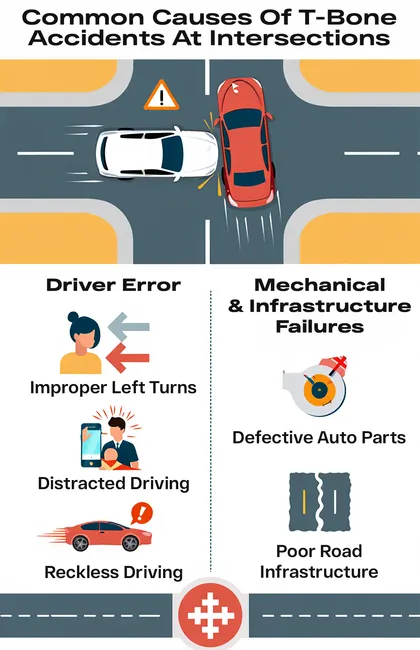
Human error is the most common cause of broadside collisions. Accidents may occur when drivers engage in unsafe driving practices. Some of the common driver errors in side-impact collisions are:
- Improper Turning: DOT data shows that this action accounts for 39% of crashes at intersections, including T-bone collisions. It happens when a driver makes a left turn at an intersection when it’s not safe to do so, such as during a red light. This dangerous maneuver causes them to cut off traffic heading in the opposite direction, potentially leading to a broadside crash.
- Distracted Driving: Drivers who aren’t paying attention to the road may fail to notice traffic signals and proceed into an intersection while cars from other lanes are crossing it. Distractions that can lead to T-bone accidents include mobile phones, music, and conversations with passengers.
- Reckless Driving: Drivers may speed, make aggressive maneuvers, and run red lights. Reckless driving can result in high-impact collisions, often resulting in severe injuries.
However, other factors can also lead to T-bone accidents, including:
- Defective Car Parts: For instance, a driver may not be able to stop at an intersection if their brakes don’t work. A car parts manufacturer or retailer may be legally responsible for any resulting injuries and losses.
- Poor Road Infrastructure: Malfunctioning traffic signals, like stoplights, might cause drivers to think that it’s safe to cross an intersection when it isn’t. Local government agencies or Caltrans may be liable for failing to keep them in good condition.
Car accident lawyers and insurers investigate the accident to identify what caused it. Understanding how the T-bone collision unfolded helps in determining who may be responsible for your injuries and losses.
Legal Considerations After A T-Bone Collision At An Intersection
Victims of a T-bone collision may have the right to file a claim against the at-fault driver. California’s tort laws hold drivers accountable for injuries caused by their negligence. A car accident claim helps victims pursue compensation for their losses. A two-year filing deadline typically applies.
Understanding California’s Right-of-Way Rules At Intersections
The California Vehicle Code’s right-of-way rules govern when a driver must yield to other road users. Lawyers, insurers, and courts usually look at who has the right of way when assessing fault for intersection accidents.
Below are key right-of-way rules in California:
- Officers, signs, and traffic signals govern right-of-way at controlled intersections. Drivers must yield to vehicles that are already in the intersection. They must also give way to vehicles approaching from the right.
- At four-way stops, all approaching traffic must come to a complete stop. Right-of-way hinges on several scenarios:
- First In, First Out: The first vehicle to arrive at the intersection and stop may proceed.
- Simultaneous Arrival: The driver on the left must yield to the vehicle on the right.
- Straight Over Turning: A driver has the right-of-way if they are traveling straight ahead and the vehicle in the opposing lane is turning left.
- Drivers turning left must yield to traffic approaching from the right.
Showing that the other driver broke a right-of-way law supports an injury claim. Their moving violation can demonstrate negligence. For instance, if another driver hits your car because they didn’t yield at an intersection, they may be found at fault.
Who Is Usually At Fault In A T-Bone Collision?
In a T-bone collision, the driver who commits traffic violations is usually at fault. Often, they cause crashes by running red lights or failing to yield when turning. However, other parties, such as car parts manufacturers, government agencies, and even the injured victim, may be to blame. The at-fault driver’s insurer may thus dispute liability.
Determining fault in T-bone accidents can be complicated. Insurers may question the extent of their clients’ responsibility. They may also raise disputes over:
- Right-of-Way: Drivers may argue that they had the right-of-way despite improper turning. These disputes often hinge on dedicated turn arrows and traffic signal phase timing.
- Yellow Lights: California traffic laws generally hold drivers who run a red light accountable. However, an at-fault party may argue that:
- They couldn’t safely stop when the traffic lights turned yellow.
- They had already entered the intersection when the traffic signal turned red.
- Four-Way Stops: Disputes may arise if two or more drivers arrive at an intersection simultaneously.
How To Prove Fault In Intersection Collisions
In California, proving fault in intersection collisions centers on negligence. Victims must demonstrate that the other driver’s actions or inaction caused the accident. To establish negligence, victims must establish the following elements of negligence:
- Duty of Care: The driver has a legal obligation to avoid causing harm.
- Breach of Duty: They failed to uphold their duty of care.
- Causation: That breach resulted in the car accident.
- Damages: The victim suffered actual harm.
Evidence To Support A T-Bone Collision Case
Under California Civil Jury Instructions, proving liability requires a preponderance of evidence. In other words, victims must present proof that the at-fault party was more likely negligent than not.
Gathering specific kinds of evidence can help support a case. For instance, you can obtain police reports and witness statements. You can also present medical records, photos, and traffic camera footage. Keep in mind that security camera footage may be available for a limited time. Taking quick action to preserve video evidence can help your case.
You may need to send a formal preservation letter to the city traffic department or local police. Footage from commercially or privately owned security cameras may require subpoenas.
How California’s Comparative Negligence Rules Affect Intersection Injury Claims
California’s comparative negligence rules allow courts to divide liability among multiple parties. Injured victims may also share legal responsibility. Even so, they may still recover compensation. However, courts can reduce their damages by the percentage of liability. For instance, sharing 20% of the fault for an intersection crash can reduce your compensation by 20%.
The Statute Of Limitations For Car Accident Cases In California
In California, the deadline for filing a car accident case is generally two years from the date of the crash. Injured victims must file a claim within this statute of limitations. Otherwise, a court will likely dismiss their case. Certain exceptions exist, which may alter the time limit.
For example:
- The deadline for injured minors only starts when they turn 18.
- Victims have six months to file an administrative claim if their case involves a government agency.
- The statute of limitations may pause for the delayed discovery of injuries. It may only start on the day they became aware of, or should reasonably have become aware of, their injuries.
Frequently Asked Questions About T-Bone Collision Cases
Broadside collisions in California raise questions about right-of-way laws and liability. Victims often wonder whether they have a right to seek damages. Below are some of the common questions about T-bone collisions at intersections.
What Is The Most Common Cause Of Collisions At Intersections According To The NHTSA?
According to the NHTSA, driver error is the most common cause of intersection collisions. One study found that this factor contributed to roughly 96% of crashes in these areas across the US. Common types of driver errors include inadequate surveillance, false assumptions about another motorist’s next movements, and unsafe or illegal maneuvers, such as improper turning.
What Are The Three Main Factors That Can Contribute To Car Accidents?
Human errors, environmental conditions, and vehicle defects often contribute to accidents. These factors can influence how lawyers, courts, and insurers assess fault under California law. For instance:
- Human errors can establish the at-fault driver’s negligence.
- Poorly maintained traffic infrastructure could provide grounds for a government claim.
- Vehicle defects may give rise to product liability lawsuits.
When Is A Government Entity Liable For My Car Accident Injuries?
In California, a government entity can be liable for injuries if its negligence contributed to a car crash. The government is typically responsible for maintaining safe conditions on roadways. A public entity may thus be liable if any of the following factors caused the accident:
- Traffic signal malfunctions
- Obstructed sightlines
- Dangerous road conditions
What Makes Intersections Prone To Accidents?
Intersections are inherently dangerous because they bring together multiple streams of traffic. For instance, Balboa Boulevard and Nordhoff Street are among the most dangerous intersections in Los Angeles County due to changes in traffic patterns created by a nearby shopping center. These issues can cause confusion about who has the right of way, leading to accidents. Speeding and distracted driving can also result in collisions at intersections.
Do I Need To Report A T-Bone Accident?
You need to report T-bone accidents if they result in injuries or fatalities. In these circumstances, the California Vehicle Code requires drivers to submit a written report to the California Highway Patrol or local police within 24 hours. You must also file an SR-1 report with the state’s DMV within 10 days if property damage exceeds $1,000.
Do I Need A Personal Injury Lawyer For My Broadside Collision Case?
You are not required to hire a personal injury lawyer for a broadside collision. However, personal injury lawyers in California may offer legal guidance. They handle complex liability issues and address disputes.
Do Lawyers Only Get Paid If They Win My T-Bone Collision Case?
Yes, but only if they work on a contingency fee basis. Under this arrangement, you only pay legal fees if you receive compensation through a settlement or verdict.
What Are Recoverable Damages In An Intersection-Related Car Accident?
Depending on the circumstances of your intersection-related car accident, a California car accident lawyer can include these recoverable damages in your claim:
- Economic Damages: Account for financial losses, such as medical bills, lost wages, and property damage.
- Non-Economic Damages: Compensate for intangible losses, such as pain and suffering.
- Punitive Damages: Intended to punish the at-fault party in rare cases where they act with extreme negligence or recklessness. However, victims must provide clear and convincing evidence of malice, oppression, or fraud.
Seek Guidance For Your Intersection Collision
After a T-bone collision, you may be searching for free accident lawyer advice to answer questions about your rights. You can bring your concerns to Arash Law, as our car accident attorneys offer free initial consultations.
During this meeting, we’ll review and discuss the details of your case to assess its strengths. If you have a valid claim, we can help you pursue damages. Our lawyers have recovered over $1 billion for clients. Additionally, we work on a no-win, no-fee basis. We won’t charge you for our services unless your claim or lawsuit resolves in your favor.
Contact AK Law at (888) 488-1391 for a free case review. You may also fill out our “Do I Have A Case?” form.