TL;DR: You can still seek compensation for crash-related injuries in California even if you were not wearing a seatbelt. Insurers must prove that the lack of restraint directly increased harm, which affects fault allocation under comparative negligence and influences the final financial outcome.
Highlights:
- Even without a seatbelt, you can still pursue compensation for your car accident injuries.
- Insurers may reduce your payout if not wearing a seatbelt worsened your injuries.
- The seatbelt defense requires proof that not wearing it directly caused more harm.
- California’s comparative negligence may reduce compensation based on a party’s share of fault.
- Insurance companies must still process valid claims, even if you weren’t wearing a seatbelt.
- Consult a lawyer to handle seatbelt defense challenges and strengthen your claim.
Tip: Preserve all evidence and medical documentation to support your claim, despite the seatbelt defense.
Table of Contents
In California, you can still pursue compensation for your losses after an accident, even if you were not wearing a seatbelt. However, insurers or courts may find you partially responsible for causing your injuries. That means they can deduct your percentage of fault from your potential settlement. This rule is based on a legal concept called comparative negligence.
The effect of not wearing a seatbelt depends on the specific facts of your case. If insurance companies can prove that doing so made your injuries worse, your compensation could be reduced. If they cannot make this connection, there may be minimal or no impact on the payout you’re seeking.
Does Not Wearing A Seatbelt Affect Accident Claims In California?
Not wearing a seatbelt can affect your ability to recover full compensation after an accident. Even if you didn’t buckle up, you may still have the right to pursue damages. However, your final payout might be lower if you worsened your injuries by not wearing a seatbelt.
What Is The “Seatbelt Defense”?
The state’s Civil Code holds each party in an accident responsible for the consequences of their actions. Since not using or improperly using a seatbelt is one of the most common causes of car crashes, California also has laws requiring vehicle occupants to wear them. That said, you could share fault for your injuries if you weren’t buckled in during an accident.
Defense attorneys and insurance companies involved in your case may rely on the seatbelt defense. This argument can affect accident claims by potentially reducing a settlement or court award.
Elements Of The Seatbelt Defense
This defense will not automatically impact your case. The insurer or opposing legal counsel usually carries the burden of proof. That means the law requires them to demonstrate the following elements before reducing your potential compensation:
- Seatbelt Availability — A working seatbelt was available in the vehicle at the moment of the crash.
- Reasonable Use Standard — A “reasonably careful person” in your exact situation would have worn the seatbelt.
- Proof of Not Wearing a Seatbelt — You were not wearing the seatbelt when the accident occurred.
- Causation of Enhanced Injuries — Your injuries could have been prevented or less severe if you had buckled up.
- Extent of Reduction — Evidence, such as medical or biomechanical testimony, can show how much your injuries would have been reduced if you had worn a seatbelt.
How Insurers Support The Seatbelt Defense
The seatbelt defense focuses on how a seatbelt may reduce the severity of injuries, not what caused the accident. To put it simply, insurers and defense attorneys aren’t trying to blame you for causing the crash. They are instead trying to show that your actions affected how badly you got hurt.
Injury mitigation looks at how you could have protected yourself after the impact began. Even if the other driver is entirely at fault, the insurer may claim your medical bills are more expensive than necessary because you didn’t buckle up.
As such, the seatbelt defense can influence how insurers determine fault after a car accident. They may:
- Question Your Injuries — Claims adjusters might point out that your injuries are more severe because you weren’t wearing a seatbelt. They may look for signs that you were thrown from your seat or suffered trauma that seatbelt use could have prevented.
- Use Expert Reports — Insurers may bring in medical professionals or accident reconstruction specialists. Their insights could establish that, by not wearing a seatbelt, you failed to minimize your own harm.
- Examine Your Seatbelt Habits — Adjusters review your statements about seatbelt use. If you admit to not wearing one or have a history of not using seatbelts, they may use this as proof of negligence.
- Gather Evidence of the Accident — Photos or witness accounts from the scene may confirm that you weren’t wearing a seatbelt.
How Shared Fault Can Reduce Compensation
When successful, the seatbelt defense can affect your potential settlement or court award. That’s because California operates under a pure comparative negligence system. Essentially, it establishes that multiple parties can share fault for an accident and the resulting injuries.
Pure comparative negligence allows victims to seek compensation for their losses, even if they’re up to 99% responsible for their injuries. If a court determines that this is the case for you due to the seatbelt defense, it will assign you a percentage of fault and deduct it from your award.
For example, your total damages are $100,000, and the court finds you to be 20% responsible for your injuries. Your recoverable amount would only be $80,000.
Why Legal Representation Matters If You Were Not Wearing A Seatbelt
Pursuing compensation in injury claims involving the seatbelt defense can be especially challenging. Advocating for a fair assessment of fault often requires making strong legal arguments and presenting thorough documentation. A lawyer can assist with these tasks and help you build a strong case.
Depending on the facts of your accident, an attorney may argue that:
- Not wearing a seatbelt didn’t cause the accident, so you shouldn’t be blamed for another driver’s negligence.
- You can’t be expected to anticipate someone else’s reckless driving.
- It’s often impossible to know exactly what injuries a seatbelt would have prevented.
- Crash tests with dummies don’t always reflect how effectively seatbelts can mitigate real-life accidents or injuries.
Furthermore, your attorney can help strengthen your case by:
- Having an accident reconstruction specialist illustrate how the crash occurred.
- Consulting medical experts who can testify about the cause and extent of your injuries.
- Collecting supporting evidence, such as:
- Photos and video footage
- Witness statements
- Vehicle damage reports
- Medical records and bills
- Clearly outlining how the other driver’s negligent conduct caused the accident.
Given all these complexities, you may now be thinking, “I need a personal injury lawyer.” Many traffic accident lawyers offer free initial consultations. You can use one to ask questions about the seatbelt defense and how it could affect your accident claim. That way, you can decide whether to enlist their help in seeking compensation.
Compensation Available For Accident Victims Who Did Not Wear A Seatbelt
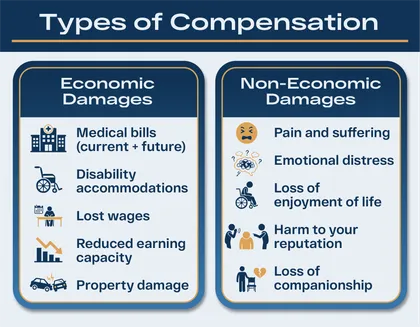
Even if you were not wearing a seatbelt at the time of the accident, you may still be eligible to pursue compensation for various losses. An attorney can identify them and estimate their values so you can anticipate which ones insurers may dispute using the seatbelt defense. The available compensation in your case may include:
- Economic Damages — These are financial losses that can be measured and documented. Your medical bills, repair estimates, pay stubs, or receipts can support these losses. Economic damages may cover:
- Current and future medical costs.
- Expenses for chiropractic care or disability accommodations.
- Lost wages and lost earning potential.
- Damage to property, including repair or replacement costs.
- Non-Economic Damages — These losses compensate for more personal, intangible injuries. They are not as easily quantified and may include:
- Physical pain and emotional suffering.
- Psychological distress.
- Diminished quality of life.
- Embarrassment or humiliation.
- Loss of companionship or consortium.
- Harm to your reputation.
- General inconvenience.
It’s important to note that you might not be able to recover non-economic damages if:
- You do not meet California’s financial responsibility laws (e.g., you were uninsured).
- You are found guilty of driving under the influence of alcohol or drugs.
If a loved one who was not wearing a seatbelt died in a car accident, eligible family members may seek compensation. Through a wrongful death claim, they can pursue the support the deceased would have provided, as well as burial and funeral costs.
Questions Victims Frequently Ask If They Weren’t Wearing A Seatbelt
Not wearing a seatbelt during an accident can raise complicated legal and insurance questions. Below are answers to some of the most common ones.
Does Not Wearing A Seatbelt Automatically Reduce My Settlement In California?
No. In California, the defense must first prove these specific elements:
- A working seatbelt was available in the vehicle.
- A reasonable person would have used it.
- You were not wearing it.
- Your injuries would have been less severe if you had worn it.
If the insurer or opposing legal counsel shows that not wearing a seatbelt worsened your injuries, you could get a lower payout.
Who’s Responsible For Making Sure That Seatbelts Are Worn?
The driver is responsible for ensuring that all vehicle occupants are wearing seatbelts. Though those aged 16 and older are responsible for themselves, drivers must directly restrain younger passengers. They’re legally required to take these steps on roads where crashes are more likely. The California Vehicle Code states that they cannot drive on highways unless all passengers are wearing seatbelts.
What If My Car Doesn’t Have Working Seatbelts?
If your seatbelts don’t work properly, you should get them fixed or replaced as soon as possible. However, you’re not required to do so for vehicles made on or before January 1, 1968. That’s the day manufacturers had to start installing them in cars under federal law. Classic or antique models from before that year are exempt from seatbelt requirements.
If A Passenger In My Car Wasn’t Wearing A Seatbelt, Does That Affect My Claim?
Generally, it won’t. The only time your claim may be affected is if the passenger’s actions helped cause the accident. For example, suppose they weren’t wearing a seatbelt and distracted you by moving around inside your car. An insurer might argue that you are partially at fault for the collision.
In California, drivers have a duty to operate their vehicles with reasonable care. If you allowed a distraction to affect you or continued driving even if your passenger didn’t buckle their seatbelt, you may be assigned fault in the crash. This partial blame could reduce your potential compensation.
Can The Insurance Company Deny My Claim Just Because I Wasn’t Wearing A Seatbelt?
In most cases, the answer is no. An insurer cannot automatically deny your personal injury claim simply because you were not wearing a seatbelt. California follows a pure comparative negligence system. Under this law, victims can still pursue damages even if they are partially responsible for the accident and their injuries. That means insurers must still process your compensation claim if it’s valid.
Injured In A Crash After Not Wearing A Seatbelt? Contact A Lawyer
If you or a passenger weren’t wearing a seatbelt in a crash, you may still be able to seek compensation. However, you’ll likely face pushback from insurers and additional legal hurdles. To tackle these challenges, you might be seeking free advice from an accident lawyer.
The team at Arash Law can help you navigate the process. Our experienced car accident lawyers can investigate your accident, prepare your case, and seek fair compensation for your injuries and losses.
However, addressing the seatbelt defense may require more case preparation and prolonged settlement negotiations. Legal representation may be more expensive for these types of claims. That said, it’s normal to worry about the costs and wonder, “Do lawyers only get paid if they win?” The answer is yes if they work on a contingency fee basis.
Our lawyers handle cases using this arrangement. You don’t pay your attorney unless they recover compensation for you. Simply put, no win, no fee! To get a free case review, call us at (888) 488-1391.