
TL;DR: California accident reporting deadlines range from immediate notice to 6 months, depending on the type of accident and filing. Key limits include 24 hours for certain crash reports, 10 days for DMV SR-1 filings, 30 days for workplace notice, 48 hours or 10 days for boating reports, and generally 6 months for government claims.
Yes, California imposes separate time limits for accident reports depending on the circumstances and the type of report required. Some reporting deadlines begin immediately after the accident.
One important filing deadline concerns the California Department of Motor Vehicles (DMV) SR-1 form, which generally must be filed within 10 days if someone is injured or killed in a traffic accident or if property damage exceeds $1,000. This requirement is separate from any report made to police, the California Highway Patrol (CHP), or an insurance company.
California uses different reporting systems for different types of accidents. The applicable deadline depends on the type of accident, the agency responsible for receiving the report, and the facts that trigger the reporting requirement. Reporting obligations may involve the CHP, the DMV, an employer, Cal/OSHA, the California Division of Boating and Waterways, a federal aviation authority, or an insurer.
Key Facts About California Accident Reporting Deadlines
- A driver of a vehicle other than a common carrier vehicle must file or arrange for someone to file a written report within 24 hours if anyone is injured or killed in a crash (California Vehicle Code § 20008).
- A DMV SR-1 must be filed within 10 days when a traffic accident causes injury, death, or property damage exceeding $1,000 (California Vehicle Code § 16000).
- An injured worker must give written notice to the employer within 30 days of the injury (California Labor Code § 5400).
- A boating accident must be reported within 48 hours when a person dies within 24 hours of the accident, disappears, or requires medical attention beyond first aid.
Table of Contents

Motor Vehicle Accidents: Police And DMV Reporting Deadlines
After a car crash involving an injury or death in California, two separate reports may be required: a written report to the CHP or local police within 24 hours and an SR-1 form to the California DMV within 10 days. Meeting one does not replace the other.
For drivers trying to understand the time limits for reporting a car accident in California, there are two main deadlines to keep in mind.
-
Report 1 — Written Police or CHP Report (California Vehicle Code, CVC § 20008): If anyone is hurt or killed, the driver of a vehicle other than a common carrier vehicle must make or cause to be made a written report within 24 hours of the accident. The SR-1 is required in addition to any report made to the police, the CHP, or an insurance company.
The report goes to the California Highway Patrol or, if the accident occurred within a city, to either the CHP or the city’s police department. Common carrier vehicles are subject to a different reporting deadline under CVC § 20008(b).
- Report 2 — DMV SR-1 Form (CVC § 16000): Within 10 days of an accident that results in injury, death, or property damage exceeding $1,000, the driver must file an SR-1 form directly with the DMV. The requirement can apply even when the accident occurs on private property. Law enforcement does not file the required SR-1 on your behalf. Missing the required filing can lead to suspension of your driving privilege, even if the crash was not your fault.
The SR-1 and a CHP or police report also serve different purposes. A CHP or police report provides law enforcement with information about the accident, while the SR-1 provides the DMV with information about a reportable accident and financial responsibility.
Workplace Injuries: Employer And Cal/OSHA Reporting Rules
If you are hurt at work, California workers’ compensation law generally requires written notice to your employer within 30 days of the injury under California Labor Code § 5400 and related provisions.
Key reporting rules include:
- Employee Notice: Written notice generally must be given to the employer within 30 days of the injury. Missing that deadline may affect a workers’ compensation claim, particularly if the delay prevents the employer from adequately investigating the injury.
- DWC-1 Claim Form: Once an employer has notice or knowledge of a work injury that results in lost time beyond the employee’s shift or medical treatment beyond first aid, the employer must generally provide or mail a workers’ compensation claim form (DWC-1) within 1 working day.
- Cal/OSHA Reporting: A work-connected death, serious injury, or illness may trigger a separate employer reporting duty.
- The employer generally must report it as soon as practicable, but no later than 8 hours after learning of it.
- In limited exigent circumstances, the reporting period may extend to 24 hours.
- Formal Claim Filing Deadline: Labor Code § 5405 generally requires workers’ compensation proceedings to begin within one year of the injury, one year after the period covered by qualifying disability payments expires, or one year after qualifying medical benefits were last furnished. The applicable date depends on the benefits provided and the circumstances of the claim.
Employer knowledge may replace formal written notice when the employer, a supervisor, foreman, managing agent, or another person in authority learns of the injury or potential claim in time to investigate. However, employees should still report workplace injuries in writing and submit the DWC-1 form as soon as possible. California accident lawyers can evaluate whether an exception to the written notice requirement applies in your situation.
Delayed notice may lead to disputes about whether an injury was work-related and can jeopardize eligibility for benefits in some circumstances.
Premises Liability: When Should You Report An Accident?

California law generally does not set a fixed statutory deadline for reporting a premises liability accident to the owner or manager of privately owned property. Such cases may involve slip-and-falls, trip-and-falls, unsafe stairs or walkways, falling objects, inadequate lighting, and other dangerous property conditions.
On private property, promptly reporting the accident can help document what happened. An incident report may record important details such as:
- The date and time of the accident.
- The exact location.
- The involved dangerous condition.
- The names of employees or witnesses who were present.
- Any injuries reported at the scene.
The rules are different when a public entity may be responsible. If an accident involves public property or a government entity, a government claim generally must be presented within six months under Government Code § 911.2 before a lawsuit may be filed against the public entity.
Although California generally does not require an injured person to complete an incident report after an accident on private property, a prompt report can help establish a contemporaneous record.
Watercraft And Aviation Incident Reporting Requirements
Boating and aviation accidents fall outside the reporting requirements for motor vehicle accidents. Each has separate reporting requirements administered by the appropriate state or federal agency.
Boating Accidents
California State Parks’ Division of Boating and Waterways (DBW) requires a boat owner or operator to report an accident involving a death, disappearance of a person, injury requiring medical attention beyond first aid, property damage exceeding $500, or complete loss of a vessel.
Here’s when to report a boating accident:
- Within 48 Hours: Accidents involving a death that occurs within 24 hours of the accident, disappearance of a person, or injury requiring medical attention beyond first aid.
- Within 10 Days: Accidents involving a death that occurs more than 24 hours after the accident, property damage exceeding $500, or complete loss of a vessel.
The $500 property-damage threshold is lower than the $1,000 threshold that triggers the DMV SR-1 reporting requirement for motor vehicle accidents.
Aviation Accidents
The National Transportation Safety Board (NTSB), rather than the Federal Aviation Administration (FAA), is the federal agency responsible for investigating civil aviation accidents. An aircraft operator must immediately notify the NTSB of an accident and certain serious incidents under 49 CFR Part 830.
The NTSB directs operators to make that initial notification through its 24-hour Response Operations Center. The operator must also file a written report within 10 days after an aircraft accident under 49 CFR § 830.15. For certain reportable incidents, a written report is required only if the NTSB requests one.
Insurance Reporting Deadlines Vs. The Statute Of Limitations For Filing A Lawsuit
Reporting an accident to an insurer and filing a lawsuit are separate steps with different deadlines. Insurance notice requirements come from the policy, while lawsuit deadlines are set by law. A government claim may add another deadline when a public entity is involved.
| Requirement | Typical Deadline | Where It Goes |
|---|---|---|
| Insurance Notice | Depends on the policy; often requires prompt notice or notice as soon as reasonably possible. | Your insurance company |
| Personal Injury Lawsuit | Generally, 2 years from accrual under California Code of Civil Procedure (CCP) § 335.1 | California Superior Court |
| Government Claim | Generally, 6 months after the cause of action accrues under Government Code § 911.2 | The responsible public entity |
These deadlines can run concurrently, but they serve different purposes. Reporting an accident to an insurer starts the claims process. Filing a lawsuit preserves your right to pursue the claim in court. A government claim is a separate administrative step that generally must come before suing a public entity, such as a city, county, state agency, or public transit agency.
The rules for filing government claims are technical, so the exact timeline should be evaluated based on how and when the public entity responded:
- If Your Claim Is Rejected: If the public entity gives a written rejection notice that complies with Government Code § 913, a lawsuit generally must be filed within 6 months from the date the notice is personally delivered or deposited in the mail.
- If No Qualifying Written Rejection: Government Code § 945.6 generally allows 2 years from the date the cause of action accrued to file the lawsuit. This rule can apply when the entity does not provide the written notice required by § 913.
California accident reporting deadlines do not all serve the same purpose. Some involve accident reporting; others involve administrative claims, and the two-year period is generally a deadline for filing a civil lawsuit rather than for filing an accident report.
The table below summarizes the main deadlines discussed in this article.
| Deadline | Who Files | Where It Goes | What May Happen If Missed |
|---|---|---|---|
| 24 hours (injury or fatal motor vehicle crash) | Driver, subject to CVC § 20008 | CHP or, for crashes within a city, either the CHP or the city police department | Failing to file the required report is an infraction under California law and may result in fines and less contemporaneous documentation of the crash. |
| 10 days (qualifying motor vehicle crash) | Driver | California DMV, through the SR-1 form | Driving privileges may be suspended. |
| 30 days (workplace injury notice) | Employee | Employer | It may affect workers’ compensation benefits, particularly if the delay prejudices the employer’s investigation. |
| 48 hours (certain boating accidents) | Boat owner or operator | California State Parks, Division of Boating and Waterways | It may violate state boating accident reporting requirements. |
| 10 days (certain boating accidents) | |||
| 6 months (personal injury or death claim involving a public entity) | Claimant | Appropriate public entity | It may jeopardize the ability to pursue a later lawsuit against the public entity; late-claim procedures may apply in some cases. |
| 2 years (personal injury lawsuit) | Plaintiff | California Superior Court | The lawsuit may be time-barred unless an exception or tolling rule applies. |
Because these deadlines can overlap, it may be difficult to know which one applies first or whether more than one filing is required. A California personal injury lawyer can review the circumstances of the accident, identify the applicable reporting and filing deadlines, and help preserve a claim before an important deadline passes.
Talk To Arash Law About Your California Accident Claim
Accident reporting and filing deadlines can vary and be subject to different rules. At Arash Law, our attorneys can identify the deadlines and requirements that apply to a particular case, including an SR-1 filing with the DMV, a government claim against a public entity, an employer notification under Labor Code § 5400, or an insurer’s notice requirement.
We can also gather and preserve evidence, including photographs, witness statements, surveillance footage, and medical records, before it is lost, overwritten, altered, or becomes harder to obtain.
Arash Law has recovered over $1 billion for clients. If we take your case, our attorneys can handle insurer communications and help track applicable reporting and filing deadlines while you focus on your recovery.
Call (888) 488-1391 for a free case evaluation. Our line is available 24 hours a day, 7 days a week.
FAQs About Accident Reporting Deadlines In California
California accident reporting deadlines vary depending on the type of accident and the agency or party responsible for receiving the report. The questions below address several issues that can arise when determining which deadline applies.
Can I File An Insurance Claim Without A Police Report?
Yes. A police report is generally not required to submit an auto insurance claim. However, if the crash involved injury or death, CVC § 20008 generally requires the driver of a vehicle other than a common carrier vehicle to make or cause to be made a written report to the CHP or, for an accident within a city, to either the CHP or the local police department within 24 hours.
A police report can also provide useful documentation about the circumstances of the crash, but you can use other evidence to support your insurance claim.
What If The Other Driver Flees And Does Not Report The Crash?
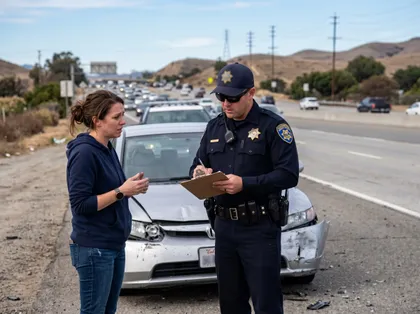
Notify your insurer and, when required by law, report the crash to law enforcement. If the accident caused injury, death, or more than $1,000 in property damage, an SR-1 generally must be filed with the DMV within 10 days, subject to statutory exceptions.
Leaving the scene of a crash involving injury or death can constitute hit-and-run under California law. Uninsured motorist coverage may also apply in some hit-and-run cases, subject to policy terms and statutory requirements.
Does The Discovery Rule Apply If I Did Not Know I Was Injured Right Away?
In limited cases, yes. For latent injuries, meaning conditions not immediately apparent at the time of the accident, California courts may delay the start of the statute of limitations until you know or reasonably should have known of the injury and its negligent cause.
This is called the discovery rule. It applies narrowly and is not a general extension. Prompt medical evaluation may help document when symptoms appeared and how the condition developed after the accident.
Can Delayed Reporting Hurt My Compensation In A Personal Injury Claim?
It can. Delayed reporting may make it harder to document when an accident occurred, how it happened, and whether an injury was connected to it.
When applicable, timely reports to law enforcement, the DMV, or an insurer can help create a consistent record. Prompt medical evaluation may also help document when symptoms appeared and what treatment was needed.
Are Employers Required To Report All Workplace Injuries To Cal/OSHA?
No, not for every injury. Cal/OSHA has its own reporting requirements for serious workplace injuries and fatalities, but the specific thresholds are technical. An attorney can advise employers and injured workers on those obligations. Your own reporting deadline as an employee is separate.
Will An NTSB Or Cal/OSHA Investigation Determine The Outcome Of My Personal Injury Case?
No. An NTSB investigation or Cal/OSHA enforcement action does not by itself decide liability in a personal injury or wrongful death lawsuit. NTSB materials are also subject to special evidentiary rules. Federal law generally bars NTSB Board accident reports from being admitted or used in civil damages cases, although certain factual investigation materials may be treated differently.
Cal/OSHA findings or investigation materials may also be relevant in some cases, but their admissibility depends on the specific evidence and applicable rules. A civil claim must still be supported by its own evidence, such as medical records, witness testimony, expert analysis, and the circumstances of the accident.
How Timely Reporting And Evidence Preservation Affect Outcomes
Meeting reporting deadlines and preserving evidence can help strengthen a claim by creating a clearer record of what happened, who was involved, and how the injuries developed. The case results below show the types of serious claims Arash Law has handled.
$12,000,000 — Auto vs. Pedestrian: The case settled for $12 million as jury selection was about to begin. The 74-year-old client was struck while crossing the street and suffered severe injuries that necessitated extensive medical care and a lengthy recovery.
$11,250,000 — Workers’ Compensation: Arash Law secured an $11.25 million settlement for a worker who fell four stories down an elevator shaft. The client suffered a severe traumatic brain injury, broken ribs, a fractured jaw, and other internal and orthopedic injuries. The structured settlement included a $500,000 lump-sum payment and $33,000 per month for life.
Important Note: Past results do not guarantee future outcomes. Every case is different, and results depend on the specific facts and evidence involved.
Do Not Let A Deadline Close Your Case. Call Arash Law Now!
California’s reporting and filing deadlines can be short, and several may apply simultaneously. Missing a government claim deadline can jeopardize your ability to pursue a lawsuit against a public entity. A late SR-1 filing may result in license suspension, while delayed workplace injury reporting can affect workers’ compensation benefits.
Arash Law’s attorneys can help identify which deadlines apply to your case and track them from the start. We can also gather and preserve available evidence, communicate with insurers, and handle required claim filing to ensure we do not overlook important steps.
Arash Law has recovered over $1 billion for injured clients. If we take your case, our team can manage the legal process while you focus on your recovery.
Call Arash Law at (888) 488-1391 for a free case evaluation. Our 24-hour accident hotline is available 7 days a week.
Make Them Pay, Call AK.
Sources
California Vehicle Code § 20008: Written Reporting Requirements for Motor Vehicle Accidents Involving Injury or Death. California Legislative Information.
https://leginfo.legislature.ca.gov/faces/codes_displaySection.xhtml?lawCode=VEH§ionNum=20008California Vehicle Code § 16000: Driver’s Duty to Report Qualifying Accidents to the DMV. California Legislative Information.
https://leginfo.legislature.ca.gov/faces/codes_displaySection.xhtml?lawCode=VEH§ionNum=16000California DMV, Report of Traffic Accident Occurring in California (SR-1): 10-Day Filing Requirement, $1,000 Property-Damage Threshold, and Separate Filing Requirement. California Department of Motor Vehicles.
https://www.dmv.ca.gov/portal/dmv-virtual-office/accident-reporting/California Labor Code § 5400: Employee Notice of Workplace Injury. California Legislative Information.
https://leginfo.legislature.ca.gov/faces/codes_displaySection.xhtml?lawCode=LAB§ionNum=5400California State Parks, Division of Boating and Waterways, Reporting Boat Accidents: Reporting Thresholds and 48-Hour and 10-Day Deadlines.
https://dbw.parks.ca.gov/?page_id=2877649 CFR Part 830: NTSB Notification and Reporting Requirements for Aircraft Accidents and Certain Serious Incidents. Electronic Code of Federal Regulations.
https://www.ecfr.gov/current/title-49/subtitle-B/chapter-VIII/part-830California Code of Civil Procedure § 335.1: Two-Year Statute of Limitations for Personal Injury and Wrongful Death Actions. California Legislative Information.
https://leginfo.legislature.ca.gov/faces/codes_displaySection.xhtml?lawCode=CCP§ionNum=335.1California Government Code § 911.2: Claim-Presentment Deadline for Personal Injury, Death, and Certain Property Claims Against Public Entities. California Legislative Information.
https://leginfo.legislature.ca.gov/faces/codes_displaySection.xhtml?lawCode=GOV§ionNum=911.2California Government Code § 913: Written Notice of Rejection of a Government Claim. California Legislative Information.
https://leginfo.legislature.ca.gov/faces/codes_displaySection.xhtml?lawCode=GOV§ionNum=913California Government Code § 945.6: Deadlines to File Suit Following Action on a Government Claim. California Legislative Information.
https://leginfo.legislature.ca.gov/faces/codes_displaySection.xhtml?lawCode=GOV§ionNum=945.6Disclaimer
The information on this page is for general educational purposes and does not constitute legal advice. Reading or relying on this content does not create an attorney-client relationship. If you were injured, consult a licensed California personal injury attorney about your specific situation.