TL;DR: Pedestrian negligence in California means a driver, pedestrian, or both failed to use reasonable care and caused injury. You can still recover compensation if you were partly at fault. Most injury lawsuits have a two-year deadline, while claims against public agencies generally require action within six months.
Pedestrian negligence happens when a pedestrian, driver, or both act carelessly, and that conduct contributes to a crash. Fault depends on what each person did before the accident, not simply on the fact that a pedestrian was hit.
California recorded 1,106 pedestrian deaths in 2023 out of 4,061 total traffic fatalities statewide, according to the Office of Traffic Safety. These cases often turn on whether either side failed to follow traffic laws or otherwise acted unreasonably.
When both sides share responsibility, California’s comparative negligence rule determines how fault affects compensation. The sections below explain how negligence is proven, how shared fault works, and which deadlines may apply.
Key Facts About Pedestrian Negligence In California
- Four elements must be proven: Duty, breach, causation, and damages.
- Crosswalk rules matter: Drivers must yield to pedestrians in marked and unmarked crosswalks. Pedestrians also have duties when crossing outside a crosswalk or using pedestrian signals. (CVC §§21950, 21954, 21456)
- Shared fault does not bar recovery: California uses pure comparative negligence, so the injured person’s compensation is reduced by their percentage of fault.
- Most injury lawsuits have a 2-year deadline: Injured pedestrians generally have two years from the date of injury to file suit. (CCP §335.1)
- Public agency claims move faster: A government claim generally must be filed within six months before a lawsuit can proceed. (Gov. Code §911.2)
- Minimum auto liability limits increased in 2025: Policies issued or renewed on or after January 1, 2025, generally must provide at least $30,000/$60,000 for bodily injury and $15,000 for property damage.
Table of Contents

How Is Pedestrian Negligence Proven In California?
California negligence law is built on four elements: duty, breach, causation, and damages. All four must be present for a claim to succeed.
A pedestrian negligence claim generally requires proof of four things:
- Duty of Care: Drivers and pedestrians must use reasonable care to avoid causing harm to others.
- Breach of Duty: Someone failed to act reasonably. For example, a driver may run a red light, or a pedestrian may suddenly step into traffic.
- Causation: That unsafe conduct must have played a meaningful role in causing the injury.
- Damages: The injured person must have suffered losses, such as medical expenses, lost income, pain and suffering, or other harm.
Evidence helps show what happened and who was responsible. Useful evidence may include:
- Police or CHP collision reports
- Traffic or surveillance video
- Witness statements
- Photos of the scene
- Vehicle damage and other physical evidence
Video can be especially important, but there is no single retention period for traffic or surveillance footage. Some systems may keep recordings only briefly, while others retain them longer or may not record continuously at all. Because footage can be overwritten or deleted, it is important to request and preserve it as soon as possible.
A preservation letter can help prevent the destruction of relevant footage or other evidence. Arash Law attorneys review the available evidence to determine how each element of negligence can be proven and how fault should be divided.
Injured in a pedestrian accident in California? Arash Law has recovered over $1 billion for clients across the state. Call (888) 488-1391 for a free case evaluation, available 24 hours a day.
Common Examples Of Pedestrian And Driver Negligence
Negligence can come from either side of a crosswalk. A driver who speeds past a pedestrian already in the crosswalk and a pedestrian who steps off a curb without checking oncoming traffic can each breach their duty under California law. Identifying exactly which behaviors occurred determines who bears responsibility for the harm and in what proportion.
Driver negligence in pedestrian accidents commonly includes:
- Distracted Driving: Using a phone, eating, or adjusting controls while driving pulls attention away from pedestrians who are legally crossing.
- Failing to Yield at a Crosswalk: CVC §21950 requires drivers to yield to pedestrians crossing within a marked or unmarked crosswalk at an intersection. If a driver violates this rule and the violation contributed to the harm the law was meant to prevent, the law may presume the driver acted negligently unless the driver can show a valid excuse.
- Speeding: Higher speeds reduce reaction time and dramatically increase the severity of injuries when a pedestrian is struck.
- Running Red Lights or Stop Signs: A driver who proceeds through a red signal strikes a pedestrian who is crossing legally and with every right to be there.
- Impaired Driving: Alcohol-impaired driving fatalities in California reached 1,355 in 2023, according to OTS data. Any crash where impairment played a role can significantly affect a negligence determination.
Pedestrian negligence commonly includes:
- Crossing Against the Signal: A pedestrian may not start crossing when a steady “Don’t Walk” signal is displayed. A flashing countdown signal may still allow the pedestrian to begin crossing if there is enough time to reach the other side before the countdown ends. (CVC §21456)
- Darting Into Traffic: Pedestrians may not suddenly step off the curb into the path of a vehicle that is too close to stop safely. (CVC §21950)
- Walking While Distracted: Using a phone or wearing headphones can support a finding of shared fault if the distraction contributed to the crash. (Li v. Yellow Cab Co. (1975) 13 Cal. 3d 804)
- Jaywalking (Crossing Outside a Crosswalk): Pedestrians crossing outside a crosswalk must yield to vehicles that are close enough to pose an immediate hazard. Under California’s Freedom to Walk Act, officers generally cannot cite a pedestrian for jaywalking unless the crossing creates an immediate danger of a collision. However, a pedestrian may still share civil responsibility if an unsafe crossing contributes to a crash. (CVC §§21954, 21456; AB 2147)
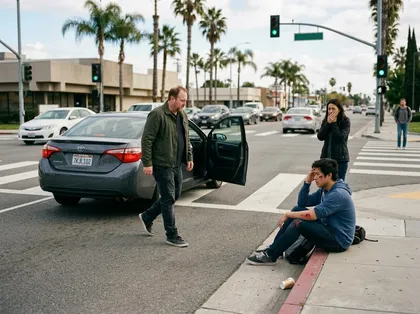
In many California pedestrian accidents, both the driver and the pedestrian may share some fault. California’s comparative negligence rule determines each party’s percentage of responsibility and reduces compensation accordingly.
Shared Fault: California’s Pure Comparative Negligence Rule
California follows pure comparative negligence. This means a pedestrian can still recover compensation even if they were partly at fault for the accident. Their recovery is simply reduced by their percentage of fault. (Li v. Yellow Cab Co. (1975) 13 Cal. 3d 804)
For example:
- Total damages: $100,000
- Pedestrian’s fault: 30%
- Driver’s fault: 70%
- Pedestrian’s recovery: $70,000
Even a pedestrian who is 99% at fault may still recover 1% of their damages if another party was 1% at fault.
Because the percentage of fault directly affects compensation, insurers may argue that the injured pedestrian was more responsible for the crash. Evidence such as collision reports, video footage, witness statements, and scene evidence can help determine a fair allocation of fault.
The amount recovered ultimately depends on the facts of the accident, the injuries, the available evidence, and the insurance coverage.
What Arash Law Has Recovered In Pedestrian Accident Cases
Arash Law has recovered over $1 billion for clients across California. For pedestrian accidents specifically, our case results reflect what it takes to go up against insurers and defense teams that contest fault, injury severity, and damages at every stage:
$10,000,000 settlement: A client suffered serious injuries after being run over by a speeding vehicle. The firm secured the recovery and arranged for a full medical care and treatment team.
$6,100,000 settlement: A six-year-old child was injured in a pedestrian accident.
These results show prior pedestrian recoveries. Past results do not guarantee future outcomes, and every case depends on its own facts, injuries, evidence, and applicable law.
When A Public Agency May Be Liable
A public agency may be responsible if a dangerous road, crosswalk, traffic signal, or other public property contributed to the pedestrian accident.
Examples may include:
- Broken or poorly placed traffic signals
- Unsafe crosswalk design
- Obstructed signs or visibility
- Dangerous road conditions the agency knew about but failed to address
Claims involving a city, county, Caltrans, or another public agency have much shorter deadlines than most personal injury claims. In many cases, you must first file a government claim within six months of the accident.
If the pedestrian dies from their injuries, eligible family members may also be able to bring a wrongful death claim.
What to Do If You Were Hurt in a Pedestrian Accident
If you are hurt in a California pedestrian accident, your most urgent priorities are seeking medical care immediately and preserving evidence. What you do in the hours and days after the crash can shape the value of your claim significantly. Evidence disappears quickly, especially video footage, and gaps in your medical record give insurers a tool to dispute causation.
- Seek medical care immediately. See a doctor even if your injuries feel minor. Emergency room records can tie your injuries to the crash. If you skip treatment, insurers may use treatment gaps to argue that injuries were not serious or were caused by something other than the accident.
- Preserve physical evidence. Photograph your visible injuries as soon as possible and continue documenting them as they develop. Keep the clothing you were wearing in an unaltered bag. Do not wash it. Request a copy of the police or CHP collision report.
- Send a preservation demand for camera footage. If the crash occurred near a camera, send a preservation demand letter to the custodian immediately, ideally the same day. Overwrite windows differ by system and agency; for details on why timing is critical, see the evidence section above.
- Do not give a recorded statement to the at-fault driver’s insurer. Adjusters conduct recorded statements to build a record that minimizes your claim. Wait until you have spoken with an attorney before saying anything on record to the opposing insurer.
-
Consult an attorney. Pedestrian accident lawyers can identify all potentially liable parties, including public entities subject to a six-month claim deadline under Government Code §911.2.
An attorney can also assess how comparative negligence applies to your specific facts and calculate the full value of your losses. Consulting an attorney early is especially important when a public entity may be involved, because missing the six-month government-claim window can permanently bar that portion of the recovery.
For many private personal injury claims, the filing deadline may be tolled while the injured person is a minor. Government-entity claims, medical malpractice claims, and other specialized claims can have different timing rules, so the applicable deadline should be reviewed with an attorney.
Frequently Asked Questions About Pedestrian Negligence In California
Every pedestrian negligence claim raises questions about fault, deadlines, and what you can actually recover. The answers below cover the situations that come up most often, from jaywalking and hit-and-run drivers to government claims and medical bills. Use them as a starting point, then talk to an attorney about the specific facts of your case.
Do Pedestrian Accident Lawyers Only Get Paid If They Win?
Most California pedestrian accident lawyers work on a contingency fee basis. Under Business and Professions Code §6147, your written fee agreement must explain the fee rate and how case costs affect your recovery. Arash Law handles pedestrian accident cases this way. If there is no recovery, there is no attorney’s fee.
Can I Sue If I Was Jaywalking In California?
Yes. Jaywalking does not automatically prevent you from recovering compensation in California. Under the state’s pure comparative negligence rule, you can still pursue a claim if a driver or another party also contributed to the accident. Your percentage of fault reduces your compensation.
How Long Do I Have to File a Pedestrian Injury Lawsuit In California?
A lawsuit against a private party, such as a driver or business, generally must be filed within two years of the injury.
A claim against a public entity, such as a city, county, or Caltrans, generally requires a written claim within six months. The government agency generally has 45 days to respond. If it sends a compliant written rejection, the law generally gives you six months from that notice to file suit.
Missing the filing deadline may permanently bar recovery from that party. Exceptions and tolling rules may apply; consult an attorney to confirm which deadlines govern your situation.
What If A Hit-And-Run Driver Caused My Pedestrian Accident?
If the driver fled and cannot be identified, uninsured motorist (UM) coverage under your own auto policy, or a household member’s policy, may cover your losses. For an unidentified hit-and-run driver, Insurance Code §11580.2 generally requires physical contact with the vehicle, a police report within 24 hours, and a sworn statement to your insurer within 30 days.
An attorney can confirm whether you qualify as an insured and whether these deadlines apply to your situation. Pedestrians without their own auto policy should check whether a household policy provides coverage.
Who Pays My Medical Bills After A Pedestrian Accident?
Your own health insurance can cover medical costs while the claim is pending. Once liability is established, the at-fault driver’s automobile liability policy may compensate you for reasonable medical expenses and other damages as part of the claim.
Is A Driver Always At Fault When A Pedestrian Is Hit?
No. California law assigns fault based on the evidence, not on the identity of the parties. Pedestrians can be found partially or primarily at fault when they cross against a signal, step into traffic without warning, or otherwise breach their own duty of reasonable care. CVC §21950 places obligations on both drivers and pedestrians, and California’s pure comparative negligence rule allocates damages in proportion to each party’s fault, regardless of which side of the crosswalk they were on.
Talk To Arash Law About Your California Pedestrian Claim
After a pedestrian accident, insurers move quickly to limit what they pay. They will investigate the scene, review the police report, and begin building a fault allocation before you have seen a doctor or spoken to anyone about your rights. Arash Law has recovered over $1 billion for injured Californians, and its attorneys review every pedestrian negligence case, including shared-fault cases, to ensure the evidence, rather than the insurer’s math, determines what you recover.
Call (888) 488-1391 any time, day or night, for a free case evaluation.
Arash Law. Make them pay. Call AK.
Sources
California Office of Traffic Safety (OTS): Traffic Safety Quick Stats (2023). California traffic fatalities decreased nearly 11% from 4,539 in 2022 to 4,061 in 2023; 2023 Mileage Death Rate of 1.26 per 100 million miles traveled, a 6% decrease from 1.34 in 2022. https://ots.ca.gov/ots-and-traffic-safety/score-card
California Office of Traffic Safety (OTS): Pedestrian Safety Campaign. OTS characterizes pedestrian danger in California as “bad and growing worse,” with fatalities continuing at a high rate even as walking becomes more common. https://ots.ca.gov/media-and-research/campaigns/pedestrian-safety
California LegInfo: Code of Civil Procedure §335.1 sets the two-year statute of limitations for personal injury claims. https://leginfo.legislature.ca.gov/faces/codes_displaySection.xhtml?lawCode=CCP§ionNum=335.1
California LegInfo: Code of Civil Procedure §377.60 identifies who may file a wrongful death action. https://leginfo.legislature.ca.gov/faces/codes_displaySection.xhtml?sectionNum=377.60.&lawCode=CCP
California LegInfo: Code of Civil Procedure §377.61 governs wrongful death damages and is not a statute of limitations. https://leginfo.legislature.ca.gov/faces/codes_displaySection.xhtml?sectionNum=377.61.&lawCode=CCP
California LegInfo: Code of Civil Procedure §352 addresses minor tolling. https://leginfo.legislature.ca.gov/faces/codes_displaySection.xhtml?sectionNum=352.&lawCode=CCP
California LegInfo: Government Code §911.2 requires a written claim to be presented to a public entity within six months of the incident before filing suit. https://leginfo.legislature.ca.gov/faces/codes_displaySection.xhtml?lawCode=GOV§ionNum=911.2
California LegInfo: California Vehicle Code §21950 (pedestrian right-of-way in crosswalks and pedestrian duties). https://leginfo.legislature.ca.gov/faces/codes_displaySection.xhtml?lawCode=VEH§ionNum=21950
California Department of General Services / Office of Risk and Insurance Management (DGS/ORIM): Government Claims Program. Filing destination for claims for damages caused by the State of California; Caltrans handles highway-specific claims separately. https://dgs.ca.gov/orim/file-a-claim
California Department of Motor Vehicles (DMV): Insurance Requirements. SB 1107 minimum automobile liability coverage: $30,000 per person / $60,000 per occurrence / $15,000 property damage, effective January 1, 2025. https://dmv.ca.gov/portal/vehicle-registration/insurance-requirements
Stanford Supreme Court of California Historical Archive: Li v. Yellow Cab Co. (1975) 13 Cal.3d 804. California Supreme Court decision establishing pure comparative negligence. https://scocal.stanford.edu/opinion/li-v-yellow-cab-co-27850/
Disclaimer
Past results do not guarantee future outcomes. Every case is different. The information on this page is for general educational purposes and does not constitute legal advice. No attorney-client relationship is formed by reading or relying on this content. If you were injured, consult a licensed California personal injury attorney about your specific situation. Arash Law, (888) 488-1391.