TL;DR: After an accident in California, avoid admitting fault, delaying medical care, signing documents too quickly, or posting about the incident online. Preserve evidence, be careful with insurer requests, report the accident when required, and pay attention to filing deadlines. Some claims, including those involving public entities, can have much shorter time limits.
After an accident in California, do not admit fault, delay medical care, or sign any document until you understand what it covers. Also, avoid oversharing with insurance adjusters, posting about the accident online, or waiting too long to report the incident, investigate what happened, or file a claim.
Avoiding these mistakes can help protect a potential claim and preserve your legal rights while you evaluate the facts. These concerns often arise after car accidents, but many also apply to motorcycle crashes, pedestrian accidents, slip-and-falls, workplace injuries, construction accidents, and other incidents. Your actions in the hours and days after an accident can affect both your recovery and the evidence available later.
Key Facts About Post-Accident Mistakes In California
- Two-Year Filing Deadline (CCP § 335.1): California Code of Civil Procedure § 335.1 generally gives an injured person two years from the date of injury to file a personal injury lawsuit. Missing the applicable deadline can bar the lawsuit unless a tolling rule or other exception applies.
- Six-Month Government-Claim Deadline (Gov. Code § 911.2): If a city, county, state agency, or other public entity may be responsible for personal injury, wrongful death, or personal property damage, a written government claim generally must be presented within six months after the claim accrues. This is often the date of the incident. The administrative claim process generally must be completed before a lawsuit may proceed against the public entity.
- Traffic Accident Reporting, Report of Traffic Accident Occurring in California (SR-1): A person required to report a California motor vehicle accident that causes injury, death, or more than $1,000 in property damage generally must submit an SR-1 to the California Department of Motor Vehicles (DMV) within 10 days. Failure to file when required can result in suspension of driving privileges.
- Updated Minimum Auto Insurance Limits (SB 1107): For standard California auto policies subject to the state’s minimum liability requirements, the minimum limits increased on January 1, 2025, to $30,000 for bodily injury or death to one person, $60,000 for bodily injury or death to two or more people in one accident, and $15,000 for property damage. Available coverage in a particular case depends on the policies involved.
- Comparative Fault Does Not Automatically Bar Recovery: California follows pure comparative fault. An injured person’s damages may be reduced according to their percentage of responsibility rather than being automatically barred because they shared some fault, as established in Li v. Yellow Cab Co. (1975).
Table of Contents

Don’t Leave Without Preserving Evidence
Leaving an accident scene without documenting it can result in the loss of evidence that may be difficult or impossible to recreate later.
After a car crash, vehicles may be moved, repaired, or towed soon afterward. Debris may also be cleared, and surveillance footage from nearby businesses, residences, or other cameras may be overwritten under the system’s normal retention schedule. If you can do so safely, try to preserve the following:
- Photographs or videos of vehicle damage.
- License plates.
- Skid marks.
- Road and weather conditions.
- Traffic signs and signals.
- Debris or vehicle parts.
- The surrounding area from multiple angles.
- Contact information for witnesses.
You should also exchange the driver, vehicle, and insurance information required under California law when applicable.
Other types of accidents may require different documentation:
- Slip-and-Fall Accidents: Photograph the condition that contributed to the incident, such as a spill, uneven flooring, a broken threshold, or poor lighting. The condition may be cleaned, repaired, or changed soon after the incident. Report the accident to the property owner, manager, or business and, when possible, keep a copy of any written report.
- Workplace or Construction Accidents: Document the equipment, tools, work area, and companies working onsite. Report the incident through the appropriate workplace channel. Damaged equipment or other physical evidence may also need to be preserved.
Evidence that seems unimportant immediately after an accident may become significant later as investigators examine the circumstances. A well-documented scene can make it easier to determine what happened and who may be responsible.
If you decide to work with a lawyer, they can send a preservation request or litigation hold to the person or business that controls relevant video or other evidence. This may help prevent the evidence from being routinely deleted, overwritten, altered, or destroyed.
Don’t Admit Fault Or Guess About What Happened
Avoid saying things like “It was my fault” or “I’m sorry,” and do not guess about speed, distance, visibility, or what another person was doing.
Right after an accident, you may only know part of what happened. A driver you thought was moving normally may have been speeding or distracted. A turn that looked lawful may have violated the right-of-way. In other settings, the cause may also be less obvious than it first appears.
For example:
- A person who slips in a store may not know whether employees had prior notice of the hazard.
- A construction worker may not know whether another contractor created the unsafe condition.
- A motorcyclist or pedestrian may not immediately know whether a driver was distracted, impaired, or failed to yield.
California crash data also shows why assumptions about impairment can be risky. In 2023, 1,355 people were killed in alcohol-impaired driving crashes in California. In 2021, 50.3% of fatally injured California drivers who were tested for drugs tested positive for legal or illegal drugs. These statewide figures do not prove impairment in any individual crash, but they reinforce the importance of waiting for the evidence before concluding.
When speaking with the California Highway Patrol (CHP) officers, local law enforcement, medical providers, employers, property managers, or insurers:
- Stick to facts you actually know.
- Say when you are unsure about something.
- Avoid estimating or filling in details you did not personally observe.
- Do not speculate about another person’s conduct or condition.
Early statements can later be compared with photographs, witness accounts, medical records, vehicle data, or other evidence. A guess made in the confusion after an accident may create an unnecessary dispute later.
Don’t Delay Medical Care Or Ignore Your Symptoms

Feeling normal right after an accident does not mean you are uninjured, and waiting to find out can harm your health and your claim. Head and neck injuries, including concussion and whiplash, can sometimes cause symptoms that appear hours or days after an accident. Other injuries may also become more noticeable over time.
After a car crash, mild stiffness or other symptoms may later be associated with conditions such as a cervical strain, herniated disc, or traumatic brain injury (TBI). Similar delayed symptoms can occur after falls and workplace incidents.
Medical records created soon after an accident can help document symptoms, diagnoses, treatments, and the timing of injury reporting, which may be relevant to whether the claimed injuries are connected to the incident.
Seek emergency care for serious or potentially life-threatening symptoms. For less obvious injuries, see a provider promptly, even if you feel uncertain. After that first appointment, pay attention to new or worsening symptoms, such as:
- Headaches
- Dizziness
- Weakness or numbness
- Confusion
- Swelling
- Limited range of motion
Follow up with your provider if these symptoms appear or worsen. If a recommended course of treatment is not working or is becoming difficult to maintain, discuss it with your provider rather than simply stopping it.
Gaps in treatment may become relevant when an insurer evaluates whether the medical records support the claimed injuries and their relationship to the accident.
Don’t Treat Your Own Insurer And The Other Party’s Insurer The Same
Insurance adjusters may begin their investigation soon after you report the accident. Their questions can shape how the insurer evaluates the claim, so you should be accurate without volunteering more information than necessary.
After a car crash, an adjuster from the other party’s insurer may ask:
- How the collision happened.
- Whether you were injured.
- Whether you have prior medical conditions.
- Whether you will provide a recorded statement.
- Whether you will sign a medical authorization.
Similar requests can arise in slip-and-fall claims, where a property owner’s or business’s insurer may conduct its own investigation.
The other party’s insurer is not your representative. Its role is to investigate the claim under its insured’s policy and determine what, if anything, it believes should be paid. You generally do not have the same contractual relationship with the other party’s insurer that you have with your own carrier. Do not confuse caution when dealing with an adverse insurer with ignoring your own insurance company. Your policy may require prompt notice of an accident and reasonable cooperation with your insurer’s investigation. The exact duties depend on the policy, the type of coverage, and the circumstances of the claim.
Failing to provide information required under your own policy can create a coverage dispute. At the same time, having a contractual duty to cooperate does not mean every request is automatically unlimited in scope. Read the request and your policy carefully, and ask questions if you do not understand what information is being requested or why.
Be truthful in everything you say, but do not guess. Saying “I’m fine” shortly after a crash may not reflect symptoms that appear later. Casual estimates of speed, distance, or the circumstances of the accident can also create inconsistencies if later evidence shows otherwise.
Keep copies of correspondence, forms, and other documents you receive or send. Before giving a recorded statement or signing an authorization, consider speaking with a California accident lawyer about what the request covers and whether it could affect your claim.
Don’t Sign A Settlement Or Other Documents Too Quickly
An early settlement offer may arrive before the full extent of your injuries, future treatment needs, or other losses is known.
A person who expects to recover in a few days may later need:
- Physical therapy
- Specialist consultations
- Surgery
- Extended time away from work
Once a settlement agreement is signed and a release of claims is executed, additional compensation for claims covered by that release may generally no longer be available. The ability to undo a premature settlement can be very limited.
Other documents deserve the same scrutiny. Insurers, employers, businesses, and property managers may present:
- Medical authorizations
- Incident statements
- Wage verification forms
- Property damage paperwork
Do not assume a document is routine or harmless because the person presenting it calls it “standard.” Read every document carefully and understand what rights you may be releasing before you sign.
Early settlements may fail to account for future medical care, specialist treatment, or lost wages that have not yet materialized. Waiting until you better understand the injury picture can help you evaluate whether a settlement fairly reflects your losses.
Don’t Post About The Accident Or Your Injuries Online
Social media content may be reviewed or sought in an insurance claim or lawsuit and can be used to dispute the severity of alleged injuries or limitations.
Posts, photographs, check-ins, tagged content, and even comments on other people’s posts can surface in an insurance evaluation or litigation. A photograph of you attending a family event does not prove you are uninjured, but it can be presented out of context to challenge your claimed physical limitations. The same photograph that a jury would understand as showing someone managing pain at a family gathering may look very different when presented as a standalone exhibit.
Avoid posting details about any of the following while your claim is open:
- How the accident happened or who you believe was at fault.
- Your medical diagnosis, prognosis, or treatment plan.
- Ongoing settlement negotiations or the amount of a potential claim.
- Activities that could be misinterpreted without the surrounding context.
Also, avoid deleting existing posts or messages simply because you think they may relate to the case. Once litigation is pending or reasonably anticipated, relevant electronic information may need to be preserved.
You do not need to disappear from social media or misrepresent your condition. Simply treat your open accident claim as a private matter and keep it off your public feed.
Don’t Wait Too Long To Report, Investigate, Or File A Claim
Time can weaken evidence and close legal deadlines simultaneously. Surveillance footage may be overwritten, vehicles may be repaired, witnesses may become harder to locate, and dangerous property conditions may be corrected before they are documented. The longer you wait, the harder some evidence may be to recover.
Do not assume that filing a lawsuit is the only deadline or notice requirement that matters. Depending on what happened, earlier reporting may be required or important. For example:
- A motor vehicle accident may require reports or information exchanges under California law.
- A work injury should be reported to the employer promptly.
- A fall or other premises incident should generally be reported to the property owner, manager, or business so there is a record of what occurred.
- An insurance policy may require timely notice to your own carrier.
For slip-and-fall injury claims, for example, the condition that caused the incident may be cleaned, repaired, or changed soon after the accident. Photos, witness statements, and other documentation can help preserve what happened.
Delay can also make it harder to identify responsible parties, obtain records, inspect damaged property, or reconstruct the circumstances of an accident. Even when a claim is still within the applicable filing period, waiting too long can make the investigation more difficult.
It’s important to know how to file a personal injury claim after an accident. Different claims are subject to different legal deadlines, with shorter deadlines when a public entity is involved. Identifying the applicable time limits early can help avoid losing the right to pursue a claim.
Deadlines To Know After An Accident In California
California accident claims can involve several different deadlines. Some apply within days, while others allow months or years. Missing one can affect your ability to pursue compensation, so it helps to identify the deadlines that apply to your accident as early as possible.
Accident Reports And Notices
Some accidents require you to report what happened even before you file an insurance claim or lawsuit.
- DMV SR-1 Report: If a California motor vehicle accident causes an injury, death, or more than $1,000 in property damage, you or your representative generally must submit an SR-1 report to the DMV within 10 days. You must file it regardless of fault, and a police or insurance report does not replace the SR-1.
- Workers’ Compensation Injury Report: If you suffer a work-related injury or illness, notify your employer as soon as possible. California law generally requires written notice within 30 days, and waiting longer can put workers’ compensation benefits at risk.
Workers’ Compensation Claims
Workers’ compensation generally applies when you suffer an injury or illness arising out of and in the course of your employment. Report your injury to your employer as soon as possible. California generally requires notice within 30 days, although exceptions may apply.
You should also complete and return the DWC-1 workers’ compensation claim form promptly after your employer provides it to you. California generally gives an injured worker one year to initiate workers’ compensation proceedings, measured from certain triggering events, such as the date of injury, the last payment of disability benefits, or the last date medical benefits were provided. Different rules can affect when that period begins or pauses.
Other workers’ compensation deadlines can apply later in the claim, so the 30-day reporting period and one-year limitation period should not be treated as the only deadlines that may matter.
Government Claims
If a city, county, state agency, public school district, transit agency, or another public entity may be responsible for your injuries, you may need to complete an administrative claim process before filing a lawsuit.
For claims involving personal injury, wrongful death, or damage to personal property, California generally requires you to present a government claim within six months after the claim accrues. In this context, a claim usually accrues when the injury or loss occurs, though certain exceptions can alter that date.
Consult an attorney promptly if you have missed this deadline. For claims against Caltrans, the filing process depends in part on the amount claimed. Caltrans currently accepts certain death, personal injury, and personal-property claims of $12,500 or less through its damage claim portal, while claims over $12,500 generally must be submitted through California’s Government Claims Program.
The lawsuit deadline can then depend on how the public entity responds.
- If the entity gives a qualifying written rejection notice, you generally have six months from the date the notice is delivered or mailed to file suit.
- If the entity does not provide a qualifying written rejection notice, the lawsuit generally must be filed within two years from the date the claim accrued.
Lawsuit Deadlines
Several common California accident lawsuits have their own statutes of limitations:
- Personal Injury Lawsuit: You generally have two years to file a lawsuit for injuries caused by another person’s wrongful act or negligence under California Code of Civil Procedure § 335.1.
- Wrongful Death Lawsuit: California generally also applies a two-year deadline to a lawsuit for a person’s death caused by another’s wrongful act or neglect under California Code of Civil Procedure § 335.1.
- Property Damage Lawsuit: A lawsuit for damage to personal property, such as a vehicle, generally has a three-year statute of limitations under California Code of Civil Procedure § 338(c)(1).
Exceptions can shorten, extend, or otherwise change these deadlines. Cases involving minors, delayed discovery, public entities, or other special circumstances may follow different rules.
Don’t Assume You Have To Handle A Serious Or Disputed Claim On Your Own
Not every accident requires legal representation, and some people handle straightforward claims themselves. However, attempting to resolve a serious or disputed injury claim without first understanding the evidence, available coverage, future losses, and applicable deadlines can create avoidable problems.
You may want to speak with a lawyer if:
- Your injuries are serious, long-lasting, or still being diagnosed.
- Fault is disputed, or more than one party may be responsible.
- An insurance company denies the claim, delays payment, or makes an offer that does not appear to cover your losses.
- A public entity, employer, contractor, property owner, or commercial vehicle may be involved.
- You are asked to give a recorded statement, sign a release, or provide a broad medical authorization.
- You are approaching a reporting or filing deadline.
- You are unsure how workers’ compensation, liability insurance, or other coverage applies to your situation.
This can matter particularly when future treatment, reduced earning capacity, multiple insurance policies, disputed liability, or significant non-economic losses may be involved. Resolving the claim before those issues are understood can make it harder to evaluate whether an offer accounts for the losses being claimed.
A California accident lawyer can review the facts, identify possible sources of compensation, explain applicable deadlines, and help preserve evidence. If you decide to hire one, it is generally better to do so before important evidence gets lost or legal deadlines become difficult to manage.
Arash Law’s past case results show how that work can look in practice. These cases involve disputed liability, efforts to shift blame, property owners, public entities, and cases that proceed to arbitration or trial. The examples below illustrate how the attorneys have handled those issues in practice.
$18,700,000 — Premises Liability / Workplace Injury: We pursued a disputed claim involving a young worker who suffered severe leg injuries after farm machinery collapsed. When the defendant denied responsibility, the case proceeded to arbitration, resulting in an $18.7 million award.
$17,900,000 — Auto Injury / Public Entity: We litigated a case involving Los Angeles County, challenged efforts to shift fault, and presented evidence of the clients’ injuries and losses to a jury, which returned a unanimous $17.9 million verdict.
Note: Past results do not guarantee a similar outcome. The value and strategy of any accident case depend on its specific facts, injuries, evidence, insurance coverage, and applicable law.
Talk To Arash Law About Your California Accident Claim
If you were injured in a car crash, motorcycle accident, slip-and-fall, or workplace incident anywhere in California, the decisions made in the days after the accident can shape the outcome. Arash Law’s attorneys can evaluate what happened, identify the applicable deadlines, and begin preserving evidence before it disappears.
Call (888) 488-1391 for a free case evaluation — 24 hours a day, 7 days a week.
Frequently Asked Questions About What Not To Do After An Accident In California
If you were injured in an accident, the choices you make afterward can affect your health, your insurance claim, and the evidence available to support it. The FAQs below address common concerns about missed SR-1 filings, recorded statements, uninsured drivers, settlement timing, delayed symptoms, and when it may help to speak with a lawyer.
What Happens If I Don’t File The SR-1 With The DMV?
If you are required to file an SR-1 and fail to do so, the California DMV may suspend your driving privilege under Vehicle Code § 16004, subject to applicable exceptions. Filing the required accident report is separate from proving that you had financial responsibility, such as qualifying insurance coverage, at the time of the crash.
Am I Required To Give A Recorded Statement To The Other Driver’s Insurance Company?
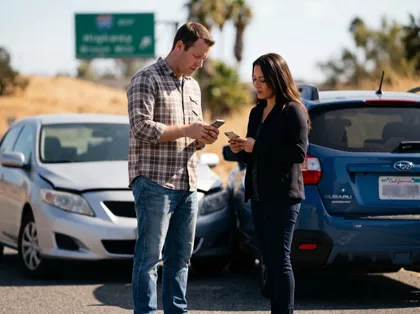
No. Under California law, you are generally not required to give the other driver’s insurer a recorded statement. You may decline. It is generally advisable to consult with an attorney before agreeing to any recorded statement from the opposing insurer, because recorded statements can be used to limit or challenge your claim in negotiations and at trial.
What If The At-Fault Driver Has No Insurance?
If you have UM/UIM coverage, your policy may help if the at-fault driver has no insurance or insufficient coverage. Coverage depends on your policy terms and limits.
What Is Maximum Medical Improvement, And Why Does It Matter For My Settlement?
Maximum Medical Improvement (MMI) may be considered in personal injury cases when evaluating whether a person’s medical condition has stabilized and whether future treatment or limitations can be assessed. In California workers’ compensation, MMI specifically means that the condition is well-stabilized and unlikely to change substantially within the next year, with or without further treatment. Reaching MMI does not necessarily mean you are fully healed.
Settling before reaching MMI may mean your future medical costs, long-term care needs, or lasting limitations are not yet clear. Once you sign a settlement release, you generally cannot seek additional compensation for claims covered by that release, even if additional costs become apparent later. Reaching MMI, or having an attorney evaluate whether your medical condition is sufficiently understood, can help you assess the timing of a settlement.
What If I Did Not Feel Hurt Until The Day After The Accident?
Some injuries may not cause noticeable symptoms immediately after an accident. For example, whiplash symptoms may develop over the following hours or days, and some mild TBI or concussion symptoms may not appear until hours or days after the injury. Seek medical attention as soon as symptoms develop or worsen, and tell the provider exactly when the accident occurred and when you first noticed the symptoms. That timeline is part of your medical record and can be important to your claim.
How Long Should I Wait Before Talking To An Accident Lawyer?
There is no rule requiring every injured person to contact an attorney immediately. Earlier involvement can be useful when injuries are serious, liability is disputed, multiple parties are involved, a commercial vehicle caused the accident, or a government entity may share responsibility.
In these situations, early investigation can help preserve evidence, and claims involving public entities may also be subject to shorter deadlines. Waiting too long can make some evidence harder to obtain or cause an applicable deadline to expire.
Can I Still Recover Compensation If I Was Partly At Fault?
Yes. California follows pure comparative fault, which means being partly responsible for an accident does not automatically prevent you from recovering compensation. Instead, your damages may be reduced by your percentage of fault, as established in Li v. Yellow Cab Co. (1975).
Injured In An Accident? Arash Law Can Evaluate Your Case
Every accident case involves its own facts, responsible parties, insurance issues, and deadlines. Some may also involve disputed fault, public entities, or third-party claims that require closer investigation.
Arash Law represents people injured in car, truck, motorcycle, pedestrian, bicycle, premises liability, workplace, and construction accidents throughout California. The injury law firm has recovered over $1 billion for injured clients and continues to take on cases that other firms decline. Our attorneys can investigate what happened, identify potentially responsible parties and available insurance coverage, send preservation letters when appropriate, and explain deadlines that may apply to your situation.
Contact Arash Law at (888) 488-1391 for a free case evaluation. Lines are open 24 hours a day, seven days a week. You will not pay an attorney’s fee unless we recover compensation for you.
Arash Law — Make Them Pay, Call AK.
Sources
California Office of Traffic Safety (OTS) — California Traffic Safety Quick Stats (Score Card). Traffic fatalities decreased nearly 11% from 4,539 in 2022 to 4,061 in 2023; 2023 Mileage Death Rate 1.26; alcohol-impaired driving fatalities 1,355 in 2023; 2021 drug-impaired driving statistics. https://ots.ca.gov/ots-and-traffic-safety/score-card
California Office of Traffic Safety (OTS) — Data and Statistics (media and research hub). Identifies the California Highway Patrol (CHP) as the primary collision-report generating agency and the Statewide Integrated Traffic Records System (SWITRS) and Transportation Injury Mapping System (TIMS) as primary data sources. https://ots.ca.gov/media-and-research/data-and-statistics
California Department of Motor Vehicles (DMV) — Report of Traffic Accident Occurring in California (SR-1). Documents the 10-day SR-1 filing requirement for accidents involving injury, death, or property damage over $1,000. https://dmv.ca.gov/portal/dmv-virtual-office/accident-reporting
California Legislative Information (LegInfo) — California Code of Civil Procedure §335.1 (two-year personal injury statute of limitations); Government Code §911.2 (six-month government claim deadline). https://leginfo.legislature.ca.gov/faces/codes_displaysection.xhtml
California Department of Insurance — New Year Means New Changes for Insurance (2025 consumer alert). Confirms SB 1107 raised minimum auto liability limits to $30,000 per person / $60,000 per occurrence / $15,000 property damage effective January 1, 2025. https://insurance.ca.gov/0400-news/0102-alerts/2025/new-year-means-new-changes-for-insurance.cfm
Arash Law — Case Results. Source for the case results referenced in this post, including the $41,950,000 Walmart premises liability verdict, the $18,700,000 farm machinery arbitration award, and the $17,900,000 County of Los Angeles verdict. https://arashlaw.com/case-results/
Disclaimer
Past results do not guarantee future outcomes. Every case is different. The information on this page is for general educational purposes and does not constitute legal advice. No attorney-client relationship is formed by reading or relying on this content. If you were injured, consult a licensed California personal injury attorney about your specific situation.