TL;DR: Depending on the circumstances, an operator may have duties to provide practical and necessary assistance to people affected by the accident, stop, exchange identifying information, notify law enforcement, and file a boating accident report. These duties may overlap and can depend on whether the accident caused injury, death, disappearance, or property damage.
Under California law, the operator must provide practical and necessary assistance to people affected by the accident when that help can be given safely. If the accident caused property damage, the operator must stop when it is reasonable under the circumstances and provide the required identifying information. Injuries, deaths, and disappearances trigger additional requirements under other sections of California boating law.
For an injured victim, these rules matter because they establish what the operator should have done immediately after the accident. If the operator failed to help you, left before providing information, or failed to report the accident when required, that conduct may become part of the investigation. It does not automatically establish who caused the collision, but it can be important in determining what happened and whether the operator complied with California law.
Key Facts About California Boating Accident Duties
- Under Harbors and Navigation Code (HNC) § 656, an operator must provide practical and necessary help to people affected by the accident when it can be done without danger to the vessel, crew, or passengers.
- Under HNC § 656.1, an operator must stop after an accident involving property damage when reasonable and provide identifying information. If the owner or other operator cannot be found, the operator must leave written notice and notify the appropriate law enforcement agency.
- Under HNC § 656.2, an operator who knows or should know someone was injured must provide identifying information and reasonable assistance to the injured person.
- Title 14 California Code of Regulations (CCR) § 6504 generally requires qualifying boating accidents to be reported within 48 hours for certain injuries, deaths, or disappearances, or within 10 days for certain property damage, vessel loss, or later deaths.
- Under 46 U.S.C. § 30106, a maritime personal injury or death claim generally has a three-year filing period.
- If a California public entity is involved, Government Code § 911.2 generally requires that a personal injury or death claim be presented within six months.
Table of Contents

What Must A Boat Operator Do First After An Accident?
California law does not require the same first step after every boating accident. What an operator must do depends on the circumstances, but one key duty is to provide practical and necessary assistance to people affected by the accident.
Under HNC § 656, the operator must take reasonable steps to help people who are in danger, as long as doing so does not seriously endanger the vessel, crew, or passengers. Federal law imposes a similar duty on vessels covered by 46 U.S.C. § 2303.
As a practical safety matter, the operator may need to stop, slow, or control the vessel to ensure safe assistance. Depending on what happened, the operator may also need to:
- Check for injured, missing, or endangered people.
- Throw a flotation device or line to someone in the water.
- Help an injured or endangered person aboard when it can be done safely.
- Call 911, the Coast Guard, harbor patrol, or another emergency service.
- Remain available to assist while rescue personnel respond.
- Take reasonable steps to prevent further harm.
If someone is in the water near a motorized vessel, California State Parks advises operators to use propeller precautions, including taking the engine out of gear and turning it off at least one boat length before reaching the person.
These duties may overlap and sometimes need to occur simultaneously. Depending on what happened, the operator may also have to exchange identifying information, notify law enforcement, and file a boating accident report.
Who Is The Operator Required To Help?
HNC § 656 refers broadly to other persons affected by the collision, accident, or casualty. The assistance duty, therefore, is not limited to passengers aboard the operator’s own vessel or occupants of another boat.
Depending on the accident, the duty may extend to:
- Passengers or crew members.
- Occupants of another vessel.
- A person who was thrown overboard.
- A swimmer or another individual who was endangered by the accident.
If you were an injured passenger or other non-operator, California law generally places this specific assistance duty on the vessel operator.
Exchanging Information Under The Law
An operator should not simply leave while statutory duties created by the accident remain unperformed. Depending on what occurred, California law may require the operator to render assistance, stop, provide identifying information, or contact authorities before leaving.
If an operator knows or has reason to know that an accident injured someone, HNC § 656.2 requires the operator to provide the following:
- Their name and address.
- The vessel’s registration number.
- The vessel owner’s name.
Operators must provide this information to the injured person, an occupant of another vessel involved, or a peace officer at the scene.
What If The Other Boat Operator Leaves?
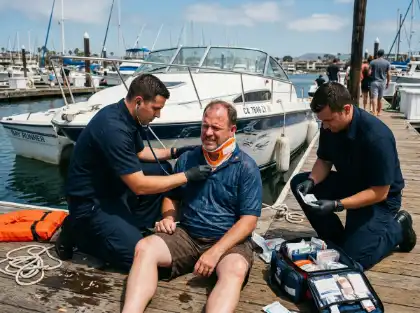 If the other operator leaves without providing required assistance or information, report what happened to law enforcement as soon as possible.
Try to remember or record:
- The vessel registration number.
- The color and type of vessel.
- Any name or markings on the boat.
- The operator’s appearance.
- The direction the vessel traveled.
- Photos or videos taken before it left.
- Names of witnesses who saw the vessel.
Depending on the circumstances, leaving without performing the duties required under California boating law can result in criminal penalties.
For a civil injury claim, however, the operator’s departure does not automatically establish that they caused the crash. Investigators may still use physical evidence, witnesses, vessel records, GPS information, marina records, or surveillance footage to determine how the collision happened.
Boat accident attorneys can help gather incident reports from responding agencies early in a case, before evidence fades and before an at-fault operator has the opportunity to change their account of what happened. This may include reports from the local sheriff’s marine patrol, harbor or port police, California State Parks officers, the California Highway Patrol, where it responded, or another law enforcement agency with jurisdiction over the waterway, as well as applicable filings with the California State Parks Division of Boating and Waterways (DBW).
Victims of a boating hit-and-run may also have coverage options beyond the at-fault operator’s insurance. Some boat insurance policies may include uninsured-boater or similar coverage, but the terms and availability depend on the specific policy. Claims may also be available against marina operators or rental companies where their conduct contributed to the collision.
When Must A California Boating Accident Be Reported?
Under HNC § 656(d) and California Code of Regulations, Title 14, § 6504, a written report to the California State Parks DBW is required when a boating accident results in any of the following:
- Death.
- A person’s disappearance under circumstances indicating possible injury or death.
- An injury requiring medical treatment beyond first aid.
- Property damage exceeding $500.
- Complete loss of a vessel.
The written reporting duty generally falls on the vessel operator or owner. If you were an injured passenger, you may not personally be responsible for the operator’s statutory reporting duties. Still, you should find out whether the accident was reported and which law enforcement or marine agencies responded.
When Is The Written Report Due?
California’s boating accident rules have different deadlines depending on what happened.
The operator generally must submit a written report within 48 hours when the accident results in:
- A death occurring within 24 hours.
- A person’s disappearance under circumstances indicating possible injury or death.
- An injury requiring medical treatment beyond first aid.
The written-report deadline is generally 10 days when:
- A death occurs more than 24 hours after the accident.
- Property damage exceeds $500.
- A vessel is completely lost.
A death or disappearance also triggers a separate immediate-notification duty. Under Title 14 CCR § 6502, the operator must notify the DBW and the nearest law enforcement agency with jurisdiction over the waterway without delay and by the quickest available means. This notice does not replace the written accident report.
If a public entity may be responsible for the accident, a separate government-claim deadline may also apply. Government Code § 911.2 generally requires personal injury and death claims against California public entities to be presented within six months.
Understanding the time limit for filing an accident report in California can help injured victims protect their claims.
Can You Use The DBW Accident Report To Prove Fault?
Do not rely on the required DBW accident report as the main evidence of your injury claim. HNC § 656 gives required boating accident reports special confidentiality and trial-use protections. The report cannot be referred to or used as evidence of negligence or due care at a civil damages trial. That makes your own evidence particularly important.
Depending on the accident, useful evidence may include:
- Witness statements.
- Photos and video.
- Law-enforcement records.
- Vessel damage.
- GPS or navigation data.
- Marina surveillance footage.
- Rental records.
- Maintenance records.
- Medical records.
- Expert analysis.
An attorney may also investigate whether other records exist outside the protected DBW report.
What Do These Duties Mean If You Were Injured?
Boating accidents can cause serious injuries and deaths. According to the U.S. Coast Guard’s 2024 Recreational Boating Statistics report, there were 3,887 reported recreational boating accidents and 556 deaths nationwide, including 377 accidents and 45 deaths in California.
If you were injured in a boating accident, the operator’s legal duties can help establish what should have happened immediately after the collision. You do not need to determine at the scene whether the operator violated every boating law. Your priorities should be your safety, medical treatment, and the preservation of information about the accident.
Investigators may later consider whether the operator:
- Helped you after the collision.
- Stopped when required.
- Provided their name and vessel information.
- Contacted law enforcement.
- Reported the accident when required.
- Left before emergency responders arrived.
Failing to perform a required duty can have legal consequences for the operator. However, a post-accident violation does not automatically prove that the operator caused the collision. Liability still depends on evidence showing how the accident happened and whether the operator’s negligence contributed to your injuries.
What If The Operator Failed To Help You?
If the operator knew you were injured but failed to provide the assistance required under California law, that conduct may expose the operator to criminal penalties.
It may also become relevant to the investigation of the accident.
However, there is an important distinction: failing to help after an accident does not, by itself, prove that the operator caused the collision.
For a negligence claim, you generally still need evidence showing that another person’s conduct caused or contributed to the accident and your injuries.
For example, evidence might show that an operator:
- Traveled at an unsafe speed.
- Failed to keep a proper lookout.
- Violated navigation rules.
- Operated while impaired.
- Failed to use the required lights.
- Created an unsafe wake.
- Operated a vessel carelessly.
What the operator did after the collision can be one part of the case, but the circumstances that caused the collision remain important.
What Should You Do If The Operator Does Not Perform These Duties?
If you were injured and the operator leaves, refuses to provide information, or fails to render necessary assistance, prioritize immediate safety and emergency assistance.
When possible:
- Call or signal for emergency assistance.
- Seek medical treatment.
- Record identifying information about the vessel and operator.
- Identify witnesses who saw the collision and what happened afterward.
- Preserve photos, video, GPS information, communications, and other evidence.
- Find out which law enforcement or marine agency responded and whether an accident report was made.
Evidence of what occurred immediately after the collision may matter both for identifying the operator and for determining whether a failure to assist caused additional harm.

Filing A Personal Injury Claim After A California Boating Accident
Filing a personal injury claim may be necessary when another boat operator, vessel owner, company, or other party is legally responsible for the accident and your injuries. Understanding how to file a personal injury claim also means identifying the responsible parties, gathering evidence, documenting your damages, and meeting the deadline that applies to your case.
Depending on the facts, a California accident claim may seek compensation for:
- Medical expenses and future treatment.
- Lost income and reduced earning ability.
- Pain and suffering.
- Property damage.
- Wrongful death losses in fatal boating accidents.
The operator’s criminal and reporting duties under HNC §§ 656 through 656.3 are separate from a civil injury claim. An operator may comply with post-accident reporting rules and still be liable for causing the collision. Likewise, a failure to report does not automatically prove fault for the accident.
Filing Deadlines Can Vary
For many California personal injury claims, Code of Civil Procedure § 335.1 generally provides a two-year deadline from the date of injury. In a wrongful death case, the two-year period generally runs from the date of death.
If a boating accident is fatal, CCP § 377.60 identifies who may bring a wrongful death action, including certain:
- Surviving spouses or domestic partners.
- Children.
- Other eligible heirs or representatives in circumstances covered by the statute.
Different deadlines may apply in other situations. For example:
- Maritime Claims: Some accidents on navigable waters may fall under federal maritime law. Under 46 U.S.C. § 30106, maritime personal injury and death claims generally have a three-year limitations period, unless another law provides a different deadline.
- Claims Against California Public Entities: Government Code § 911.2 generally requires that personal injury or death claims be presented within six months. The correct agency depends on the public entity involved.
- Claims Involving Minors: The ordinary filing period may be tolled in some private personal injury cases while the injured person is a minor.
- Federal or Specialized Vessel Claims: Other rules may apply when a federal vessel or a specialized maritime issue is involved.
Because the governing law can depend on the waterway, vessel, and parties involved, the correct deadline should be identified early.
Arash Law has recovered over $1 billion for injured clients across California. From the initial consultation through resolution, our attorneys will handle the legal aspects of your case so you can focus on healing. If you were injured in a California boating accident, call Arash Law at (888) 488-1391 for a free case evaluation.
Frequently Asked Questions About Boating Accident Duties In California
California boating laws require operators to take specific steps after an accident. Here are common questions about those duties and how they may affect an injury claim.
When Should An Injured Boating Accident Victim Consider Calling A Lawyer?
You may want legal guidance if:
- You suffered serious injuries.
- Someone died or disappeared.
- The other operator left the scene.
- The operator failed to provide the required information.
- Fault is disputed.
- More than one vessel was involved.
- A rental company or marina may share responsibility.
- A commercial vessel was involved.
- A public entity or government vessel may be responsible.
- An insurer disputes your injuries or denies the claim.
- Important evidence may disappear.
- You do not know whether California or federal maritime law applies.
If you’re injured on a waterway, our California boating accident lawyers can:
- Review how the collision happened.
- Identify potentially responsible parties.
- Determine whether California law or federal maritime law applies.
What Should I Do If I Were Injured In A Boating Accident In California?
Seek medical attention immediately, even if your injuries seem minor. Some boating injuries are obvious immediately. Others may become more noticeable after the initial shock of the collision wears off.
Boating accidents can cause injuries such as:
- Head and brain injuries.
- Neck and back injuries.
- Broken bones.
- Cuts and lacerations.
- Propeller injuries.
- Internal injuries.
- Near-drowning injuries.
- Shoulder or joint injuries.
Seek medical care when you are injured or develop symptoms after the accident.
Medical treatment is important for your health, but it also creates records showing when you reported symptoms, what medical professionals found, and what treatment you needed. Those records may later help connect your injuries to the boating accident.
What If The Operator Blames You?
Do not assume that being partly responsible prevents you from bringing a claim. If negligence law applies, California uses a pure comparative fault system, so responsibility can be divided among the people who contributed to the accident. Federal maritime law may instead apply to some boating accidents.
Fault in a boating collision may depend on several factors, including:
- Vessel speed.
- Right-of-way rules.
- Operator attention.
- Visibility.
- Alcohol or drug use.
- Navigation lights.
- Water and weather conditions.
- Wake.
- Mechanical failures.
- Operator experience.
- Actions of other vessels.
Because fault can be disputed, avoid guessing about what happened or accepting blame before the evidence has been reviewed.
What If I’m Partly Responsible For The Boating Accident In California?
You may still be able to recover compensation even if you were partly responsible for the accident. California follows a pure comparative fault rule. If you are found partly responsible, your compensation may be reduced by your percentage of fault.
For example, if your damages total $100,000 and you are found 20% responsible, your recovery would generally be reduced by 20%, leaving $80,000. California negligence law does not automatically bar recovery even if a plaintiff bears a majority of the fault, although federal maritime law may apply to some boating accidents instead.
Talk To Arash Law About Your California Boating Accident Claim
If you were injured in a boating accident, the other operator’s duties are only one part of what may need to be investigated. You may also need to determine how the collision happened, who was responsible, what insurance applies, and whether California or federal maritime law controls your claim.
Arash Law represents people injured in boating accidents throughout California. Our attorneys can investigate the collision, preserve available evidence, identify potentially responsible parties, and explain the filing deadlines that may affect your case.
Call Arash Law at (888) 488-1391 for a free case evaluation.
Make ‘Em Pay, Call AK.
Sources
- California Harbors and Navigation Code §§ 656–656.3: Duties after boating accidents. https://leginfo.legislature.ca.gov/faces/codes_displayText.xhtml?division=3.&chapter=5.&part=&lawCode=HNC&article=1
- California Harbors and Navigation Code § 668: Criminal penalties for certain boating-law violations. https://leginfo.legislature.ca.gov/faces/codes_displaySection.xhtml?sectionNum=668.&lawCode=HNC
- California State Parks, Division of Boating and Waterways: Boating accident reporting requirements, deadlines, and forms. https://dbw.parks.ca.gov/?page_id=28776
- California State Parks, Division of Boating and Waterways: Propeller Safety. https://dbw.parks.ca.gov/?page_id=30839
- California Code of Regulations, Title 14, §§ 6502 and 6504: Immediate notification and written boating accident reporting requirements and deadlines. https://govt.westlaw.com/calregs/Document/I6D5DB57B5B4D11EC976B000D3A7C4BC3?viewType=FullText&originationContext=documenttoc&transitionType=CategoryPageItem&contextData=(sc.Default)
- https://govt.westlaw.com/calregs/Document/I6D6E57435B4D11EC976B000D3A7C4BC3?viewType=FullText&originationContext=documenttoc&transitionType=CategoryPageItem&contextData=(sc.Default)
- California Code of Civil Procedure § 335.1: General two-year limitations period for personal injury and wrongful death claims. https://leginfo.legislature.ca.gov/faces/codes_displaySection.xhtml?sectionNum=335.1.&lawCode=CCP
- California Code of Civil Procedure § 352: Tolling of certain limitations periods during minority or lack of legal capacity. https://leginfo.legislature.ca.gov/faces/codes_displaySection.xhtml?sectionNum=352.&lawCode=CCP
- California Code of Civil Procedure § 377.60: Persons who may bring a wrongful death action. https://leginfo.legislature.ca.gov/faces/codes_displaySection.xhtml?sectionNum=377.60.&lawCode=CCP
- California Government Code § 911.2: Six-month claim-presentation deadline for certain claims against public entities. https://leginfo.legislature.ca.gov/faces/codes_displaySection.xhtml?sectionNum=911.2.&lawCode=GOV
- California Department of General Services, Government Claims Program: Filing claims for damages against the State of California. https://www.dgs.ca.gov/ORIM/Services/Page-Content/Office-of-Risk-and-Insurance-Management-Services-List-Folder/File-a-Government-Claim
- 46 U.S.C. § 2303: Federal duties related to rendering assistance after a marine casualty and providing identifying information. https://uscode.house.gov/view.xhtml?edition=prelim&path=/prelim@title46/subtitle2/partA/chapter23
- 46 U.S.C. § 30106: General three-year limitations period for personal injury or death claims arising from maritime torts. https://www.govinfo.gov/content/pkg/USCODE-2024-title46/pdf/USCODE-2024-title46-subtitleIII-chap301-sec30106.pdf
- U.S. Coast Guard, 2024 Recreational Boating Statistics: National and California boating accident, injury, and fatality data. https://uscgboating.org/library/accident-statistics/Recreational-Boating-Statistics-2024.pdf
- Judicial Council of California, CACI No. 405, Comparative Fault of Plaintiff, 2026 Edition; citing Li v. Yellow Cab Co. (1975) 13 Cal. 3d 804. https://courts.ca.gov/partners/california-jury-instructions/civil-jury-instructions-resource-center/civil-jury-instructions
Disclaimer
Past results do not guarantee future outcomes. Every case is different. The information on this page is for general educational purposes and does not constitute legal advice. No attorney-client relationship is formed by reading or relying on this content. If you were injured, consult a licensed California personal injury attorney about your specific situation.