TL;DR: Yes. You can still file a claim if the other driver refuses to give you their insurance information after a California crash. Document the driver, vehicle, license plate, damage, and witnesses, then report the accident to law enforcement and your insurer when appropriate. A police report, vehicle records, or your own insurance coverage may help identify coverage and move the claim forward.
You do not need the other driver’s insurance details in hand to move forward with a claim after a California crash. If they refuse to share that information, you can still document the collision, report it, and use other records to help identify available coverage later.
Your immediate priorities are safety, documentation, and reporting the accident. A license plate number, photographs, witness information, police report, and your own insurance policy can all become important if the other driver will not cooperate.
California also requires drivers involved in collisions to exchange certain information. If another driver refuses, you can document the refusal, contact law enforcement when appropriate, and report the crash to your own insurer.
Key Facts About Missing Insurance Information After a California Crash
- California requires an insurance exchange. California Vehicle Code § 16025 requires drivers involved in a collision to provide evidence of financial responsibility when the law applies, and they are physically able to do so.
- A refusal does not end your claim. The driver’s identity, vehicle information, police records, and other evidence may help identify available insurance coverage after the crash.
- Your own policy may provide coverage. Uninsured motorist, underinsured motorist, collision, medical payments, or uninsured motorist property damage coverage may apply, depending on your policy and the facts.
- The SR-1 requirement still applies. California generally requires a Department of Motor Vehicles accident report within 10 days when someone is injured or killed or property damage exceeds $1,000.
- Evidence can disappear quickly. Witnesses leave, surveillance footage may be overwritten, and vehicles may be repaired before important evidence of damage is preserved.
Table of Contents

What California Law Says About Sharing Insurance Information
California law requires drivers involved in a collision to exchange certain identifying and insurance information when possible. Under California Vehicle Code § 16025, drivers must provide:
- Their name and current residence address.
- Their driver’s license number.
- The vehicle identification number.
- The registered owner’s current residence address.
- Evidence of financial responsibility.
When an insurance policy provides financial responsibility, the driver must also provide the insurer’s name and address, and the policy number. These duties apply regardless of who believes they caused the crash.
Failing to provide the required information can result in an infraction and a fine of up to $250. Refusing to share insurance information does not, by itself, make the collision a hit-and-run. Leaving the scene can trigger separate legal duties.
What to Do if the Other Driver Won’t Share Their Insurance Information
Stay safe and create a record instead of arguing with the other driver. A confrontation will not make an insurance claim easier and can create additional risks.
- Move to a safe location when possible. Get yourself out of moving traffic and avoid standing between damaged vehicles.
- Ask for the required information once. You can calmly request the driver’s insurance company and policy information without debating fault.
- Photograph the vehicle and license plate. Capture the plate, make, model, color, visible damage, and overall vehicle from several angles.
- Document the crash scene. Photograph traffic controls, lane markings, debris, skid marks, vehicle positions, road conditions, and anything that affected visibility.
- Get witness information. Ask anyone who saw the collision for a name and telephone number before they leave.
- Record the refusal. Write down what the driver said, including any statement that they had no insurance, were borrowing the car, were working, or would not provide the information.
- Contact law enforcement when appropriate. Injuries, suspected impairment, threatening behavior, serious damage, refusal to identify, or an attempt to leave can make police involvement particularly important.
- Notify your insurer promptly. Report the facts you know and explain that the other driver refused to provide insurance information.
Do not chase a driver who leaves, block their vehicle, reach into their car, or try to take their documents. A plate number and vehicle description can be far more useful than escalating the situation. If the refusal makes it harder to identify coverage or pursue an injury claim, a car accident lawyer can help investigate the available evidence and insurance options.
How Can You Find the Other Driver’s Insurance Information After the Crash?
A police report, your insurer’s investigation, and California DMV records may help identify coverage after the collision. Missing insurance information at the scene does not necessarily mean no policy exists.
If police or the California Highway Patrol investigated the crash, the collision report may contain information about the driver, registered owner, vehicle, and insurance. Your insurer may also investigate available coverage using the information you collected.
Do You Still Need to File an SR-1 if Information Is Missing?
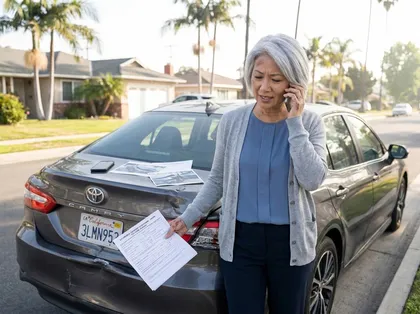
Yes, if the collision meets California’s reporting requirements. The driver must generally file a Report of Traffic Accident Occurring in California, or SR-1, with the California Department of Motor Vehicles (DMV) within 10 days when:
- Someone was injured.
- Someone was killed.
- Property damage to any one person exceeded $1,000.
The requirement applies regardless of fault or whether the other driver cooperated. If information is missing because the other driver refused to provide it, submit the information you do have rather than ignoring the reporting requirement.
An SR-1 is an administrative report. It is separate from the deadlines for filing a personal injury lawsuit, property damage lawsuit, or government claim. A police or California Highway Patrol report does not replace the SR-1.
How Can You Request the Other Driver’s Insurance Information From the DMV?
If the other driver’s insurance information is still unknown, an eligible person involved in the crash can submit California DMV Form SR 19C, Financial Responsibility Information Request.
The form can be used to request available insurance information from the DMV’s file. The DMV currently charges a $20 fee for each requested document and states that processing may take about 30 days.
If an SR-1 has not already been filed for the accident, the SR-19C instructions allow the requester to complete an SR-1 and attach it. A law enforcement collision report does not, on its own, establish the DMV financial responsibility file.
The DMV can only provide information available in its records. Filing an SR-19C, therefore, does not guarantee that an insurance policy will be located.
What Insurance Coverage May Apply if the Other Driver’s Policy Is Unknown?
Your own auto insurance may provide benefits while the other driver’s insurance status is being investigated. Coverage depends on your policy, its limits and exclusions, and the circumstances of the collision.
According to an Insurance Research Council estimate, approximately 20.4% of California motorists were uninsured in 2023. A refusal to provide insurance does not prove the driver is uninsured, but uninsured motorist coverage can become important if an investigation later confirms there was no liability policy in effect.
- Uninsured motorist coverage. Uninsured motorist (UM) coverage may provide benefits for qualifying bodily injuries caused by an uninsured at-fault driver.
- Underinsured motorist coverage. Underinsured motorist (UIM) coverage may apply when the responsible driver has insurance but not enough bodily injury coverage for the covered loss.
- Uninsured motorist property damage. Uninsured motorist property damage (UMPD) may cover qualifying vehicle damage when the uninsured driver is identified.
- Collision coverage. Collision coverage may pay for covered damage to your vehicle regardless of fault, subject to your deductible and policy terms.
- Medical payments coverage. Medical payments (Med Pay) coverage may pay certain medical expenses regardless of fault when included in your policy.
- Rental reimbursement. This optional coverage may help pay rental expenses while a covered vehicle is being repaired.
California currently requires minimum liability limits of $30,000 for bodily injury to one person, $60,000 for bodily injury per accident, and $15,000 for property damage. Even when insurance is eventually found, those limits may not cover all losses from a serious crash.
Your uninsured and underinsured motorist coverage may provide another source of recovery when the responsible driver has no insurance or insufficient limits. If collision coverage pays for vehicle damage, your insurer may later seek reimbursement from the responsible party through subrogation.
If missing insurance information is delaying an injury claim, a car accident lawyer can investigate vehicle ownership, potential policies, and other available evidence. Arash Law offers free case evaluations at (888) 488-1391.
What Mistakes Can Make the Claim Harder?
The other driver’s refusal already creates an investigation problem, so avoid actions that make the available evidence harder to use.
Here are the most common errors that can affect your claim:
- Do not guess about what happened. Stick to what you personally saw, heard, or experienced rather than estimating speed, distance, or fault.
- Do not repair the vehicle before documenting it. Take clear photographs of the damage and the vehicle’s overall condition before repairs begin.
- Do not ignore new pain or symptoms. Seek appropriate medical care if you experience symptoms after the crash.
- Do not accept a quick cash payment without considering later losses. Injuries or additional vehicle damage may become apparent after the scene has cleared.
- Do not wait to preserve time-sensitive evidence. Witnesses may become difficult to locate, and camera or dashcam footage may be overwritten.
- Do not assume missing insurance means there is no possible recovery. Your policy or another policy connected to the driver, vehicle owner, employer, or commercial activity may need to be investigated.
How Arash Law Can Help When the Other Driver Refuses to Cooperate
Arash Law can handle the insurance and liability issues that arise when the other driver refuses to cooperate.
Our attorneys can:
- Identify available coverage. We can investigate the driver, vehicle owner, employer, rideshare company, or other possible insurance sources.
- Preserve important evidence. We can take steps to protect available video, records, vehicle data, and other evidence before it disappears.
- Handle insurer communications. We can communicate with liability, UM, and UIM insurers and respond to coverage or fault disputes.
- Build the claim. We can gather records, witness statements, medical evidence, and other proof needed to support liability and damages.
- Protect filing deadlines. We can track the deadlines for insurance claims and California lawsuits.
Arash Law can review the available liability and uninsured motorist coverage after a California crash. We can handle the legal process for you while you focus on recovery.
Call (888) 488-1391 for a free case evaluation.
Frequently Asked Questions About Driver Insurance Refusals in California
Do You Have to Give Someone Your Insurance Information if You Were Not at Fault?
Yes. California’s information-exchange requirements do not depend on which driver believes they caused the collision. Fault is addressed through the later investigation and claims process.
Can I Still File a Claim if I Only Have the License Plate Number?
Often, yes. A license plate can lead to the registered owner and their insurer. The police, your insurance company, or an attorney may be able to use it to find coverage.
Can the Police Give Me the Other Driver’s Insurance Information?
A collision report may contain insurance information gathered by the investigating agency. Whether the information appears in the final report depends on what officers obtained and recorded.
If the needed insurance information is not available in the report, an eligible person may also request available financial responsibility information from the DMV.
What Deadlines Apply to My Claim?
The other driver’s refusal does not extend California deadlines. Personal injury lawsuits generally have a two-year deadline under CCP § 335.1, property damage claims generally have a three-year deadline under CCP § 338, and government claims may require action within six months under Gov. Code § 911.2. Uninsured motorist claims can also have separate two-year requirements, while some hit-and-run claims may involve much shorter notice deadlines.
Missing an applicable lawsuit or government claim deadline may bar that claim, while missing an SR-1 can create administrative problems. Evidence such as video or electronic records may disappear much sooner.
How Much Does It Cost to Hire a Car Accident Lawyer?
Many California car accident lawyers use contingency fee agreements, meaning the attorney’s fee depends on a recovery. The fee percentage and other required terms must be stated in the written agreement.
Review the agreement before signing so you understand how attorney fees and case costs will be handled.
Case Results Involving Insurance and Coverage Issues
Arash Law has handled accident claims where insurance was missing, disputed, or difficult to locate. These case results closely relate to those issues.
$1,750,000 — Auto vs. Pedestrian: An uninsured driver struck our client at an unsafe intersection. We pursued the city after evidence showed a history of crashes at that location.
$1,000,000 — Auto vs. Pedestrian: The case initially appeared to have no insurance coverage. Litigation later uncovered a policy, and the defendants paid the maximum limits.
Past results do not guarantee future outcomes. Every case depends on its own facts, evidence, insurance coverage, and applicable law.
Talk to Arash Law About a Driver Who Refused to Provide Insurance
A driver’s refusal to provide insurance information does not end your ability to pursue a California accident claim. The next steps may involve identifying the vehicle owner, locating coverage, reviewing your policy, and preserving evidence of the collision.
Arash Law represents injured Californians statewide, including UM/UIM claims, disputed fault cases, hit-and-run accidents, and claims in which the at-fault driver had no insurance. We have recovered over $1 billion for our clients.
Call Arash Law at (888) 488-1391 for a free case evaluation. You can reach out to us 24 hours a day, 7 days a week.
There are no fees unless we win.
Sources
- Insurance Information Institute / Insurance Research Council. 2023 uninsured motorist rates by state. https://www.iii.org/table-archive/20641
- California Vehicle Code § 16025. Required information exchange after a crash.
https://leginfo.legislature.ca.gov/faces/codes_displaySection.xhtml?lawCode=VEH§ionNum=16025- California DMV. SR-1 accident reporting requirements.
https://www.dmv.ca.gov/portal/dmv-virtual-office/accident-reporting/- California DMV. Financial Responsibility Information Request (Form SR-19C). https://www.dmv.ca.gov/portal/file/financial-responsibility-information-request-sr-19c-pdf/
- California Insurance Code § 11580.2. UM/UIM coverage and hit-and-run requirements.
https://leginfo.legislature.ca.gov/faces/codes_displaySection.xhtml?lawCode=INS§ionNum=11580.2- California Department of Insurance. Auto insurance coverage and liability limits.
https://www.insurance.ca.gov/01-consumers/105-type/95-guides/01-auto/auto101.cfm- California Code of Civil Procedure § 335.1. Personal injury deadline.
https://leginfo.legislature.ca.gov/faces/codes_displaySection.xhtml?lawCode=CCP§ionNum=335.1- California Code of Civil Procedure § 338. Property damage deadline. https://leginfo.legislature.ca.gov/faces/codes_displaySection.xhtml?lawCode=CCP§ionNum=338
- California Government Code § 911.2. Government claim deadline.
https://leginfo.legislature.ca.gov/faces/codes_displaySection.xhtml?lawCode=GOV§ionNum=911.2- Arash Law. Case Results.
https://arashlaw.com/case-results/Disclaimer
The information on this page is for general educational purposes and does not constitute legal advice. No attorney-client relationship is formed by reading or relying on this content. If you were injured, consult a licensed California personal injury attorney about your specific situation. Past results do not guarantee future outcomes. Arash Law — (888) 488-1391.