TL;DR: A truck accident lawyer can often use a license plate to begin identifying the vehicle’s owner, operating company, and potential insurer. They may compare DMV records, crash reports, photographs, and federal carrier information. Because the registered owner may differ from the operating carrier, additional records or legal requests may be necessary. Identification, insurance coverage, and liability are not guaranteed.
If you were injured in a truck accident, the truck’s license plate number can help a lawyer begin identifying the operating company. They can compare Department of Motor Vehicles (DMV) records, U.S. Department of Transportation (USDOT) identifiers, and details from the official traffic accident report to understand the potentially responsible parties you may name in your claim.
The registered owner may differ from the motor carrier that operated the truck, so identifying the owner may require further investigation to determine who dispatched the driver.
Closing that gap requires reviewing the available evidence, such as the crash report, physical markings on the truck, and federal carrier databases. In some cases, the relevant information may need to be obtained through a formal legal process.
Table of Contents

I Was Injured in a Collision With a Truck or Trailer and Only Have a License Plate Number. What Can a Lawyer Investigate to Identify the Company and the Insurance Provider?
If you only have the truck or trailer’s license plate number, a lawyer may be able to identify the trucking company and insurer by reviewing the available information and pursuing specific records through lawful requests or discovery:
- Vehicle Registration: They can use the plate number and issuing state to request records identifying the registered owner.
- Photographs and Witness Accounts: They can compare the trailer description, cab markings, company names, USDOT numbers, and unit numbers.
- Crash Report Information: They can review the driver’s personal information, insurance details, and any statements they provided to the investigating agency.
- Ownership and Lease Records: They can investigate these records to determine the relationships among the driver, owner, lessee, and business operating the truck.
- Carrier and Insurance Records: They can search Federal Motor Carrier Safety Administration (FMCSA) records using a USDOT number, MC/MX number, or company name, then seek policy information to investigate coverage on the crash date.
The FMCSA’s Safety and Fitness Electronic Records (SAFER) system does not offer a general license plate search. A trailer plate may identify its owner without establishing who operated the tractor or dispatched the driver.
Additionally, identifying the carrier does not necessarily establish which insurer may cover the accident. A lawyer may need to review additional insurance records to confirm the applicable provider and policy.
Bring the plate number, any photographs, the crash date and location, and available report or witness information. These details can guide the investigation. However, they do not guarantee identification, insurance coverage, or company liability.
Key Facts About Identifying a Trucking Company After a California Crash
- A license plate can start the investigation. Counsel checks whether it belongs to the tractor or trailer and investigates the registered owner.
- The owner may differ from the operating carrier. Driver information, lease agreements, and company records can help identify who controlled the truck.
- DMV records are not freely accessible. Federal privacy laws restrict access to personal information, although qualifying litigation-related investigations may permit disclosure.
- Federal carrier records can help identify the company. FMCSA databases allow searches by company name or carrier identifiers, such as USDOT and MC/MX numbers, but not directly by license plate.
- Early evidence preservation matters. Photographs, witness details, crash reports, and footage can support the investigation.
What a License Plate Can and Cannot Identify
A license plate can help identify the registered vehicle owner. It cannot name the driver, the hiring company, or the entity that dispatched the truck. In commercial trucking, those three parties are routinely separate legal entities, and liability may fall on one or more of them.
The first step is to determine whether the plate belongs to the tractor or the trailer, since each may have a different owner. A tractor can be owned by one company, leased to another, and operated under the USDOT authority of a third. The trailer behind it may belong to a fourth entity, a logistics company, with its plates, its own registered owner, and its own separate insurance.
Those relationships help determine which parties and insurance policies require further investigation. To connect the vehicle to the business operating it, attorneys compare registration records with photographs, crash reports, and witness accounts. Cab markings, USDOT numbers, company names, and unit numbers provide additional leads. Missing or conflicting details guide the next records request.
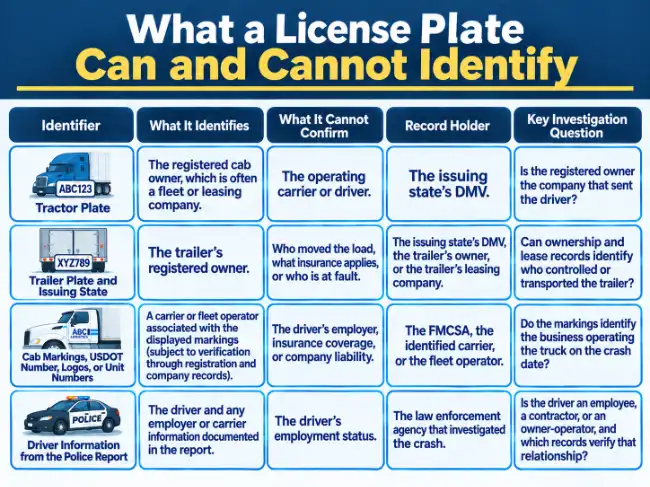
The table below explains what each identifier can reveal, its limits, and where counsel may seek additional records.
| Identifier | What It Identifies | What It Cannot Confirm | Record Holder | Key Investigation Question |
|---|---|---|---|---|
| Tractor plate | The registered cab owner, which is often a fleet or leasing company. | The operating carrier or driver. | The issuing state’s DMV. | Is the registered owner the company that sent the driver? |
| Trailer plate and issuing state | The trailer’s registered owner. | Who moved the load, what insurance applies, or who is at fault. | The issuing state’s DMV, the trailer’s owner, or the trailer’s leasing company. | Can ownership and lease records identify who controlled or transported the trailer? |
| Cab markings, USDOT number, logos, or unit numbers | A carrier or fleet operator associated with the displayed markings (subject to verification through registration and company records). | The driver’s employer, insurance coverage, or company liability. | The FMCSA, the identified carrier, or the fleet operator. | Do the markings identify the business operating the truck on the crash date? |
| Driver information from the police report | The driver and any employer or carrier information documented in the report. | The driver’s employment status. | The law enforcement agency that investigated the crash. | Is the driver an employee, a contractor, or an owner-operator, and which records verify that relationship? |
California truck accident lawyers investigate whether the registered owner, operating carrier, and their insurers are connected to the crash. They compare registration records, lease agreements, and other evidence to identify potentially responsible parties and applicable coverage.
Why a License Plate Alone May Not Reveal a Truck’s Insurance
A license plate alone may not reveal a truck’s insurer because registration records identify vehicle ownership, not necessarily the insurance covering the truck’s operation. The registered owner and operating carrier may have different insurance arrangements.
The Driver’s Privacy Protection Act (DPPA), 18 U.S.C. § 2721, also limits access to personal information in vehicle records. Section 2721(b) permits certain uses, including qualifying litigation-related investigations. Attorneys may request California DMV records for permitted purposes, but access to ownership information does not necessarily reveal the applicable insurer.
Public “plate lookup” websites do not bypass these restrictions. Their results may also be incomplete or unreliable because they cannot lawfully access DMV personal information records without a DPPA-permissible use.
Beyond privacy restrictions, two other factors can make it harder to identify a truck’s insurer from its license plate alone:
- Federal carrier searches require different information. The FMCSA’s Company Snapshot searches by company name, USDOT number, or MC/MX number. It does not search by license plate. Once a lawyer identifies a possible carrier, the FMCSA’s Licensing and Insurance system can provide information about insurance filings. Those filings may not establish which policy covered the crash.
- The registered owner may differ from the operating carrier. A plate search may identify a leasing company that owns the truck while another business operates it. Attorneys can seek lease agreements, dispatch records, and insurance documents through lawful requests or discovery, including subpoenas when appropriate. Those records can help connect the truck to its operator and identify potentially applicable insurance.
The search often follows this path: trace the plate, identify the operating carrier, and investigate which insurance covered its activities on the date of the crash. This distinction between the registered owner and the operating carrier is one reason a truck accident differs from a car accident.
Finding the Operating Motor Carrier Beyond the License Plate
 A truck’s crash report, cab markings, and carrier records can help connect its license plate to the company operating it. Each source provides a different piece of the investigation:
- Start with the crash report. It may identify the driver, registered owner, insurance information, and federal carrier numbers. If the California Highway Patrol (CHP) investigated the traffic collision, your attorney can request the traffic collision report under Vehicle Code §20012. The report provides leads but does not, by itself, establish liability.
- Check the cab’s markings. Covered interstate commercial trucks must display the carrier’s legal or trade name and USDOT number under 49 CFR §390.21. An “operated by” label can help distinguish the carrier from another business named on the truck. Unit numbers may connect the vehicle to maintenance and inspection records.
- Compare federal carrier records. Attorneys can use FMCSA’s SAFER system to check the identified carrier’s business details and operating status. If federal records do not identify the operator, counsel can investigate applicable state records.
- Look beyond delivery brands. A logo on a delivery van may identify a retailer or shipper, while a separate contractor employs the driver or operates the vehicle. For example, an Amazon-branded van may be operated by an independent Delivery Service Partner. Attorneys review contracts, dispatch records, and lease agreements to identify the businesses involved and investigate their potential responsibility and insurance coverage.
Together, these records help attorneys identify the operating carrier, investigate its role in the crash, and determine which insurance may apply.
What If the Truck Has a Fraudulent Plate or Was Stolen?
These issues can complicate efforts to identify the operating company. A fraudulent plate may lead to registration records for an unrelated vehicle, while a stolen truck may have been used without its owner’s permission.
A lawyer can compare the available plate information with crash reports, photographs, witness accounts, and other evidence. If investigators identify the vehicle, ownership records and reports of theft may help clarify who possessed or operated it at the time of the collision.
Identifying the registered owner does not automatically establish that owner’s liability. An attorney may need additional evidence to determine whether the owner, operating carrier, driver, or another party bears responsibility.
Preserving Evidence Before It Disappears
When a license plate does not immediately identify the trucking company, additional evidence may help connect the vehicle to its operating carrier. Preserving these records early matters because they may become unavailable by the time you need to file a claim or lawsuit.
Under 49 CFR §395.8(k), motor carriers must retain records of duty status and supporting documents, including electronic logging device (ELD) data, for at least six months, so key records may be overwritten or unavailable unless a preservation letter is sent early. Other evidence may have shorter retention periods, making early preservation important.
A spoliation or evidence preservation letter requests the carrier preserve ELD data, dispatch and trip records, dashcam footage, inspection logs, and maintenance logs before they are overwritten or purged.
An attorney can send evidence preservation letters to the carrier and other record holders, identifying evidence they should keep:
- ELD Data: These records track driving time, duty status, and location at specified intervals. They may help connect the driver and vehicle to a motor carrier operating at the time of the crash. Separate fleet GPS systems may provide additional location details.
- Dispatch and Trip Records: Dispatch instructions, trip schedules, bills of lading, and delivery records may help identify the company that assigned the driver or controlled the shipment. These records can connect the truck’s movements to a particular carrier.
- Camera Footage: Truck dashcams, roadside cameras, and nearby business cameras may capture the plate, company markings, or collision itself. Retention periods vary, and recordings may be overwritten quickly. Prompt requests give record holders a better opportunity to save relevant footage.
- Inspection and Maintenance Records: These documents may identify the truck’s vehicle identification number (VIN), fleet number, owner, or maintenance provider. They can provide leads to connect the vehicle with the company responsible for its operation.
A preservation letter identifies relevant records and requests that they be protected. However, it cannot guarantee that missing or overwritten evidence will be available.
What If the Truck Cannot Be Identified? California Hit-and-Run Rules
If a truck leaves the scene and cannot be identified, the uninsured motorist (UM) coverage on your own (or a qualifying household member’s) auto policy may help pay for your injuries. Covered losses may include follow-up visits, physical therapy, and specialist care, subject to your policy’s terms and limits.
California Insurance Code §11580.2 generally sets these requirements for a hit-and-run UM claim:
- Physical Contact: The unidentified vehicle must have made physical contact with you or the vehicle you occupied.
- A Police Report Within 24 Hours: Report the accident to the city’s police department or, in unincorporated areas, the county sheriff or local CHP headquarters.
- A Sworn Statement Within 30 Days of the Report: Submit a sworn written statement to your insurer explaining your claim against the unidentified driver and providing supporting facts.
Missing these requirements can lead to a denial. Your policy may also require cooperation with the insurer’s investigation. Notify your insurer promptly while the investigation continues, since waiting to identify the truck could put your coverage at risk.
A Separate Two-Year Deadline Applies
Simply notifying the police and your insurer early will not preserve your UM bodily injury claim. Under Insurance Code §11580.2(i), you generally must take one of these steps within two years after the accident:
- File a qualifying lawsuit against the uninsured motorist.
- Reach an agreement with your insurer on the amount owed.
- Formally begin arbitration through the required written notice to your insurer.
Vehicle repairs follow different coverage rules. A UM property damage claim generally requires identifying the at-fault vehicle or driver. If the truck remains unknown, your collision coverage may help pay for repairs, subject to your deductible and policy terms.
If you do not carry UM coverage, you can explore other recovery options after a hit-and-run.
Were you unable to get a truck’s full plate or company name after a crash? Share what you have, and an attorney from our firm can assess what an investigation may realistically uncover.
Arash Law has recovered over $1 billion for California clients. Call (888) 488-1391 for a free case evaluation.
How Long Do You Have to File a Truck Accident Case in California?
California generally allows you two years to sue a private trucking company for personal injury. Claims involving government vehicles require different steps and may have much shorter deadlines.
Understanding the differences between these filing deadlines matters because identifying the truck’s registered owner may not indicate whether a private company, a California public agency, or a federal agency operated it.
| Who May Be Responsible? | General Deadline | Required Action |
| A private driver or trucking company | Two years after the injury | File a personal injury lawsuit under Code of Civil Procedure (CCP) §335.1. |
| A California state or local public agency | Six months after the injury | Present a written government claim under Government Code §911.2. |
| A federal agency, such as USPS | Two years after the claim arises | Present an administrative claim to the appropriate federal agency under 28 U.S.C. §§2401(b) and 2675. |
An investigation to identify the trucking company does not automatically pause these filing deadlines.
Exceptions may apply, depending on the circumstances. For instance, many private personal injury lawsuit deadlines pause while the injured person is a minor. The six-month government-claim deadline generally does not.
Government claims are separate from lawsuits. Additional deadlines apply after an agency responds to a claim, and they can vary depending on whether you filed a claim against a local, state, or federal agency.
An attorney can assess which requirements apply while investigating the identity of the truck’s owner or operating carrier.
FAQs About Identifying a Trucking Company in California
Will Police Tell Me Who Owns the Commercial Truck Based on the License Plate?
Not necessarily. Police can use a truck’s license plate number to identify its registered owner, but they may not release that information directly to you. Privacy restrictions apply, although eligible parties may obtain ownership information through an official crash report.
What the police can do is record the registered owner, USDOT number, and driver information in the official crash report. Once you obtain that report, you or an attorney can use its details to begin identifying every potentially responsible party.
Can My Insurance Company Find the At-Fault Truck Carrier Using the Plate Number?
Yes. Your insurer may use the truck’s license plate number to investigate the registered owner and identify the operating carrier. The DPPA permits insurers to access certain motor vehicle information to investigate qualifying claims.
Your insurer can compare registration information with the police report and available carrier records. However, identifying the registered owner does not necessarily establish which trucking company operated the vehicle or caused the accident.
What If the Trailer Plate Does Not Match the Cab Plate?
Mismatched trailer and cab plates are common in commercial trucking and are not automatically a sign of fraud. Trailers are frequently leased or owned by a different company than the one operating the cab.
The cab’s plate and USDOT markings provide the more direct link to the responsible carrier. A truck accident attorney checks both units separately because they can be traced to entirely different legal entities with different insurers and liability exposures.
Does a Company Name on the Side of a Truck Prove Who Is Liable?
No. A company name or logo on a truck may belong to a shipper or retail brand, not the responsible carrier. Federal regulations require the responsible carrier to display its legal name and USDOT number on the cab. Establishing liability requires cross-referencing those markings against FMCSA records and the crash report.
Can Dashcam Footage Help Identify a Hit-and-Run Truck?
Yes. Nearby dashcams, roadside cameras, and a truck’s own onboard recording system can capture the plate number, physical markings, and the vehicle’s direction of travel. That footage can be critical when a truck leaves the crash scene without stopping.
However, dashcam footage may be overwritten when storage fills. Retention varies by camera system, settings, and vehicle use, so request preservation promptly.
Talk to Arash Law About Your California Truck Accident Claim
If you were hit by a truck you could not fully identify, Arash Law can help investigate using the details you have. A partial plate, crash location, approximate time, or truck description can provide a starting point.
Our attorneys can request carrier records from the DMV and FMCSA, search federal carrier databases, issue preservation demands to fleets and camera owners, and subpoena leasing entities to identify the true operating carrier.
Call (888) 488-1391 for a free case evaluation.
Sources
- Federal Motor Carrier Safety Administration (FMCSA): SAFER Company Snapshot and Licensing & Insurance. Carrier identification, operating status, and available insurance filings. https://safer.fmcsa.dot.gov/CompanySnapshot.aspx and https://li-public.fmcsa.dot.gov/LIVIEW/pkg_carrquery.prc_carrlist
- California Legislative Information: Code of Civil Procedure §335.1. General two-year deadline for personal injury lawsuits. https://leginfo.legislature.ca.gov/faces/codes_displaySection.xhtml?lawCode=CCP§ionNum=335.1.
- California Legislative Information: Government Code §§911.2. Government claim presentation deadlines. https://leginfo.legislature.ca.gov/faces/codes_displaySection.xhtml?lawCode=GOV§ionNum=911.2.
- California Legislative Information: Vehicle Code §20012. Confidentiality of collision reports and access for people with a proper interest. https://leginfo.legislature.ca.gov/faces/codes_displaySection.xhtml?lawCode=VEH§ionNum=20012.
- U.S. Government Publishing Office: 18 U.S.C. §2721. Driver’s Privacy Protection Act restrictions and permissible uses of personal information from motor vehicle records. https://www.govinfo.gov/content/pkg/USCODE-2024-title18/html/USCODE-2024-title18-partI-chap123-sec2721.htm
- California Legislative Information: Insurance Code §11580.2. Uninsured motorist coverage, hit-and-run claim requirements, and claim-preservation deadlines. https://leginfo.legislature.ca.gov/faces/codes_displaySection.xhtml?lawCode=INS§ionNum=11580.2.
- United States Code: 28 U.S.C. §§ 2401(b) and 2675. Federal Tort Claims Act administrative claim deadlines and exhaustion requirements. https://uscode.house.gov/view.xhtml?req=granuleid:USC-prelim-title28-section2401 and https://uscode.house.gov/view.xhtml?req=granuleid:USC-prelim-title28-section2675
- Electronic Code of Federal Regulations: 49 CFR §§ 395.8(k) and 390.21. Retention of records of duty status and supporting documents, and identification markings required on covered commercial motor vehicles.
https://www.ecfr.gov/current/title-49/section-395.8 and https://www.ecfr.gov/current/title-49/section-390.21Disclaimer
The information on this page is for general educational purposes and does not constitute legal advice. No attorney-client relationship is formed by reading or relying on this content. If you were injured, consult a licensed California personal injury attorney about your specific situation. Arash Law: (888) 488-1391.