TL;DR: Ask the insurers to confirm who handles your injury claim and explain any referral in writing. Identify the reason for the delay, record their responses, and request a supervisor if necessary. Insurance disputes do not automatically extend legal filing deadlines.
If your insurer tells you to contact another company after a crash, ask both to clarify their roles in your injury claim. Request each company’s position in writing, identify any missing information, and keep records of their responses.
California requires insurers to follow rules when handling claims and responding to claimants. However, a referral alone does not establish that either insurer has violated the law.
Table of Contents

My Insurance Company Tells Me to Contact the Other One. How Do I Find Out Which Company Should Handle My Injury Claim, and What Information Should I Ask For?
Contact both insurers and ask each to confirm their role in handling your injury claim. If one company refers you elsewhere, verify that the other has received or opened your claim.
Request the following information from each insurer:
- Claim Status: Confirm that the company received your injury claim and whether it is investigating, accepting, or denying responsibility.
- Reason for Referral: Ask why the insurer directed you elsewhere and which company or department it believes should handle your claim.
- Written Explanation: Request the insurer’s written position if it denies coverage or disputes fault.
- Claim Details: Obtain the claim number, assigned adjuster’s name, direct contact information, and available policy identifiers.
- Next Steps: Ask which documents remain missing, where to submit them, and when to expect an update.
If neither company confirms responsibility, request clarification from a claims supervisor. A referral alone does not establish which insurer must pay your injury claim, so unnecessary delays must be addressed immediately.
Key Facts About Insurance Companies Passing You From One to Another After a Crash
- California rules require written decisions for certain disputed injury claims. Under 10 California Code of Regulations (CCR) § 2695.7(b)(1), insurers must communicate third-party claim denials and disputes over liability or damages in writing.
- Different insurers may handle separate losses. The California Department of Insurance (CDI) distinguishes liability, collision, and other automobile insurance coverages.
- Insurers must respond to qualifying claim communications. Under 10 CCR § 2695.5(b), insurers generally have 15 calendar days to respond to communications that reasonably require an answer.
- Ongoing investigations may require written updates. Under 10 CCR § 2695.7(c)(1), insurers generally must provide updates every 30 calendar days when additional investigation time is needed.
- Insurance referrals do not automatically extend legal deadlines. California Code of Civil Procedure (CCP) § 335.1 generally provides two years to file a personal injury lawsuit.
Why Do Insurance Companies Pass You Around After a Crash?
Insurance companies may refer your claim elsewhere because they disagree about fault, question coverage, or handle different parts of the accident. For example, one insurer may handle vehicle repairs, while another reviews bodily injury claims.
Referrals can also occur when an adjuster needs more information or believes another policy applies. Sometimes, unclear communication or unanswered requests prevent the claimant from identifying the appropriate claim handler.
These circumstances do not automatically indicate intentional delays or improper claims handling. The reason behind the referral determines which explanation or document you should request next.
Which Insurance Companies May Be Involved in Your Claim?
Two insurers may participate in the same accident because their policies cover different claims or losses. A first-party claim involves benefits under your own insurance policy. A third-party claim involves seeking compensation through another person’s liability insurance.
Your Own Insurance Provider
 Your insurer may handle certain benefits under your policy, even when another driver caused the accident. For example, Medical Payments (MedPay) coverage may help pay eligible medical expenses regardless of fault.
Uninsured or underinsured motorist coverage may also apply when the responsible driver has no insurance or insufficient coverage. Your policy terms and California law determine which benefits are available.
Under 10 CCR § 2695.7(e), an insurer generally cannot delay or deny a first-party settlement solely because someone else should pay. However, policy provisions, statutes, or regulations may create exceptions, including rules governing benefit coordination.
If your insurer refers you elsewhere for that reason, ask it to identify the policy provision or legal rule supporting its position.
The Other Driver’s Insurance Provider
If another driver caused your crash, you may pursue a bodily injury claim through that driver’s liability insurer. The company will investigate its policyholder’s responsibility and the applicable coverage.
Its investigation may involve medical records, accident reports, and other evidence. However, the insurer may dispute fault or question whether its policy covers the collision.
Vehicle Damage and Injury Claims May Have Different Handlers
The insurer that pays for vehicle repairs may not handle your bodily injury claim. Your own insurer might pay for repairs while another company investigates your injuries.
For example, a property damage payment followed by a delayed injury claim presents a different issue from conflicting insurer referrals. In either situation, confirming who handles the injury portion helps identify the next appropriate step.
Four Common Insurance Responses and What to Do Next
The appropriate response depends on why an insurer referred your claim elsewhere. Use this table to identify the obstacle and request the information needed to move forward.
| Situation | What the Insurer Says or Does | Written Explanation to Request | Details to Organize |
|---|---|---|---|
| 1. Referral | The insurer refers you elsewhere, sometimes after a vehicle damage payment. | Ask which part of your claim it handles, why it referred you, and which company should review your injuries. | Both insurers’ names, claim numbers, policy identifiers, and adjuster contacts. |
| 2. Coverage Denial | The insurer says its policy does not cover the accident. | Request its written coverage position and relevant policy terms. | Denial letter, policy identifier, insured driver or vehicle, and adjuster contact information. |
| 3. Disputed Fault | The insurer disputes its driver’s responsibility for the crash. | Request its written liability position, reasons for disputing fault, and any missing evidence. | Claim number, adjuster details, accident report, photographs, and witness information. |
| 4. No Response | The insurer has not responded to your requests or provided a claim update. | Request written confirmation of the claim’s status, outstanding documents, and expected response date. | Claim and policy identifiers, adjuster contacts, communication dates, and previous requests. |
These are examples of possible insurer responses, not verified statements from individual claimants. Each situation calls for different information, so the next step should address the specific issue the insurer identifies.
A car accident lawyer can review conflicting explanations and help identify the next steps.
How to Get a Clear Written Explanation From Each Insurer
Send each insurer a written request if phone calls do not clarify who handles your injury claim. Email or the company’s claims portal can help preserve a record of your communication.
You can use this message structure:
“Please confirm which part of my injury claim your company is reviewing, why you are referring me elsewhere, and what information is missing. Please also identify the assigned adjuster and confirm whether your company has denied the claim or is still investigating.”
This request helps organize your claim information. It is not a formal legal demand and does not require either insurer to accept responsibility.
Include your claim number, accident date, and contact information so the company can identify your file.
California regulations require written explanations for certain claim denials. Under 10 CCR § 2695.7(b)(1), first-party denials must identify the applicable reasons and relevant policy provisions when appropriate.
For third-party claims, insurers must also communicate denials and disputes over liability or damages in writing. The specific requirements for explanation differ between first-party and third-party claims.
Keep a Two-Carrier Communication Log
A communication log helps you compare the insurers’ responses and track unresolved requests. Use this blank record for both companies, adding another row after each contact.
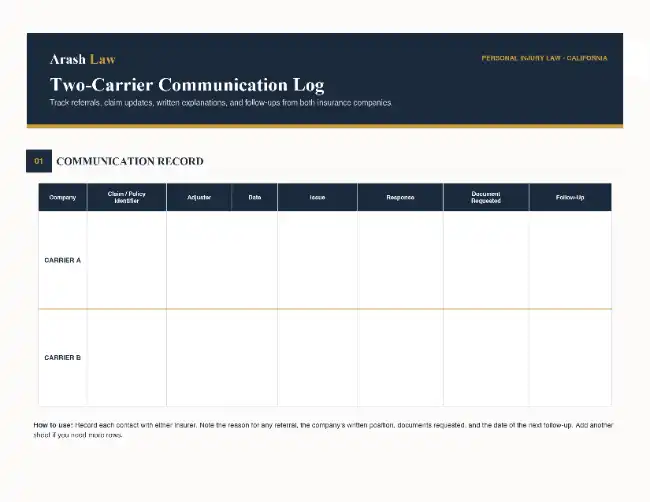
Record calls, emails, written decisions, and promised follow-ups. Keep copies of the documents you submitted and note the dates you sent them.
Your log can help a supervisor, regulator, or attorney identify the unresolved issue. However, maintaining records does not guarantee that either insurer will accept responsibility.
If insurers continue to refer your injury claim elsewhere, Arash Law can review their explanations and the available claim records. Our attorneys can assess the evidence and help identify the legal options that apply to your situation.
Call (888) 488-1391 for a free initial consultation about your California crash injury claim.
What California Law Requires When an Insurer Does Not Respond
California’s Fair Claims Settlement Practices Regulations establish requirements for acknowledging claims, responding to claimants, and conducting investigations. Under 10 CCR § 2695.5, insurers generally must acknowledge a claim within 15 calendar days after receiving notice.
The regulation also generally requires a response within 15 calendar days to claimant communications that reasonably require one. Insurers must provide necessary forms and assistance and begin any required investigation.
Under 10 CCR § 2695.7(b), insurers generally must accept or deny claims within 40 calendar days after receiving proof of claim. Certain exceptions apply, and insurers may need additional time to complete an investigation.
In that situation, § 2695.7(c)(1) generally requires a written explanation and further updates every 30 calendar days. These rules do not guarantee approval, and a missed deadline does not automatically establish a separate bad-faith lawsuit.
When to Escalate an Unresolved Insurance Claim
You can request a claims supervisor, contact the CDI, or consult an attorney when repeated referrals remain unresolved. The appropriate option depends on the insurer’s response and the issue preventing progress.
Request a Claims Supervisor
A supervisor may clarify the company’s position when the assigned adjuster cannot resolve the issue. Provide your claim number, earlier correspondence, and a summary of the problem.
Ask the supervisor to identify the appropriate claim handler and explain the company’s current position. Request confirmation of any outstanding documents and the expected next update.
How to File a Complaint With the California Department of Insurance
The CDI accepts complaints involving insurance company conduct, including claim-handling concerns. Its Claims Services Bureau investigates complaints about insurers’ claim-handling practices.
You may file a complaint when an insurer repeatedly fails to respond, delays its investigation, or does not provide a required explanation.
To submit a complaint:
- Access the CDI Complaint Portal: Visit the Consumer Complaint Center and create an account or continue as a guest.
- Identify the Insurer: Provide the company’s name, claim number, available policy information, and adjuster details.
- Describe the Issue: Explain the referrals, unanswered requests, or conflicting responses. Include relevant dates.
- Submit Supporting Records: Provide available correspondence, written decisions, and your communication log.
- Keep the Complaint Reference: Save the confirmation and reference details for future follow-ups.
The CDI can investigate possible violations of insurance regulations, but it cannot automatically require an insurer to pay a disputed injury claim. You can also contact the department at 1-800-927-4357 for assistance.
The CDI’s automobile claims mediation program does not cover bodily injury, third-party liability, or coverage disputes. It addresses certain vehicle damage disputes involving a policyholder’s own insurer.
Consult a Personal Injury Attorney
An attorney can review the insurers’ explanations and investigate which parties and policies may be involved. For example, a crash involving a borrowed vehicle or an employee driving for work may require reviewing multiple policies.
A lawyer can also evaluate fault, examine available evidence, and help pursue claims against responsible parties. Hiring a lawyer does not guarantee coverage or payment. However, an attorney can request written explanations, address conflicting insurer responses, and track unresolved claim issues.
In California, third-party claimants generally cannot sue another driver’s insurer solely for violating unfair claims settlement rules. However, policyholders may have separate remedies against their insurers when circumstances permit.
Mistakes to Avoid When Dealing With Multiple Insurers
When multiple insurance companies become involved in your injury claim, certain actions can create confusion or affect your legal rights. Each company may request different information or give conflicting explanations about responsibility. Avoid these common mistakes while working to resolve the issue:
- Assuming the Other Insurer Received Your Claim: A referral does not guarantee that the second company received your documents. Confirm that it opened a claim and assigned an adjuster.
- Treating a Referral As a Final Denial: An insurer may refer you elsewhere without formally denying your claim. Request its written position before assuming it has rejected responsibility.
- Giving Recorded Statements Without Clarification: Confirm which insurer requested the statement and its purpose. Your own policy may require cooperation, while the other driver’s insurer has different obligations.
- Signing a Settlement Release Without Reviewing It: Check which claims the release covers before signing. A broad release could affect unresolved injury claims, even when the insurer has already paid for vehicle damage.
- Relying Only on Phone Conversations: Keep written records of referrals, decisions, and promised follow-ups. These records can help clarify conflicting information if the dispute continues.
- Overlooking Legal and Policy Deadlines: Do not assume ongoing insurance discussions extend your filing deadlines. Track applicable lawsuit deadlines and separate insurance requirements, including those for uninsured motorist claims.
A personal injury lawyer can help you avoid these mistakes. They can guide you throughout the whole process.
Insurance Referrals Do Not Pause Your Claim Deadlines
Insurance discussions generally do not extend the time allowed to bring a personal injury lawsuit. Under California Code of Civil Procedure § 335.1, most personal injury lawsuits must be filed within two years of the injury.
If a government entity contributed to the crash, Government Code § 911.2 generally requires that an injury claim be presented within six months. Different rules and exceptions may apply, including those involving minors.
Your insurance policy may also impose separate notice requirements. Missing an applicable filing deadline can prevent you from pursuing compensation, regardless of whether the insurance companies have resolved their dispute.
Uninsured Motorist Claims Have Separate Requirements
If your claim involves uninsured motorist (UM) coverage, California Insurance Code § 11580.2(i) imposes a separate two-year requirement.
You generally must complete one of these actions within two years of the accident:
- File a bodily injury lawsuit against the uninsured driver.
- Reach an agreement with your insurer on the amount payable under the policy.
- Formally initiate arbitration by sending written notice to your insurer through certified mail, return receipt requested.
An open UM claim or ongoing insurance discussions generally do not satisfy the filing deadline. Following Blankenship v. Allstate Insurance Co. (2010), a child’s age alone also does not preserve the claim.
Limited exceptions may apply under § 11580.2(i). Section 11580.2(k) also provides additional time when an insurer fails to give a required deadline notice for a pending UM claim.
That notice rule does not apply when the insurer has received notice that an attorney represents the insured. Underinsured motorist claims also have distinct requirements.
An open insurance claim, supervisor review, or CDI complaint does not automatically pause these deadlines. Preserve accident photographs, witness information, medical records, and available footage while the insurers investigate.
Frequently Asked Questions About Insurance Claim Referrals in California

What if the Second Insurance Company Says It Never Received My Claim?
Ask the second company to confirm whether it has a record of your claim. Provide the accident date, driver’s information, and available claim number.
Request written acknowledgment after submitting the claim directly. You can also ask the first insurer to confirm which information it forwarded and when.
What if an Insurer Says the Other Driver Had No Coverage?
Request a written explanation of the insurer’s coverage position. Confirm the driver, vehicle, and accident date involved in its decision.
Your own uninsured motorist coverage may provide benefits if the responsible driver lacked applicable insurance. Eligibility depends on California law, the policy terms, and the circumstances of the crash.
Can I Pursue an Injury Claim While Both Insurers Dispute Fault?
Yes. A disagreement between insurers does not automatically prevent you from pursuing an injury claim.
You can provide relevant evidence, including accident reports, photographs, and witness information. If the dispute continues, an attorney can evaluate fault and the available legal options.
Can I Sue an Insurance Company for Repeatedly Referring My Claim Elsewhere?
Repeated referrals alone do not automatically establish grounds for a lawsuit against an insurer. Third-party claimants generally cannot sue another driver’s insurer solely for violating California’s unfair claims settlement rules.
However, policyholders may have remedies when their own insurer breaches contractual duties or acts in bad faith. The available options depend on the insurer’s conduct and the applicable legal relationship.
Contact Arash Law About Your Injury Claim Involving Multiple Insurers
When insurance companies keep referring your injury claim elsewhere, understanding each company’s position can help clarify the dispute. Arash Law can review their correspondence, assess possible coverage, and investigate the evidence supporting your claim.
Our car accident claims lawyers can help determine the appropriate legal steps when insurers disagree about responsibility.
Call (888) 488-1391 for a free case evaluation. Our team can discuss your situation and the available options under California law.
Sources
- California Code of Regulations, Title 10, § 2695.5. Claim acknowledgments and responses.
https://govt.westlaw.com/calregs/Document/IE63146575C2F11EC9C68000D3A7C4BC3- California Code of Regulations, Title 10, § 2695.7. Claim decisions, updates, and settlement standards.
https://govt.westlaw.com/calregs/Document/IE642F9A05C2F11EC9C68000D3A7C4BC3- California Department of Insurance, Automobile Insurance Guide. Auto insurance coverage types.
https://www.insurance.ca.gov/01-consumers/105-type/95-guides/01-auto/auto101.cfm- California Department of Insurance, Consumer Services Division. Insurance complaints and investigations.
https://www.insurance.ca.gov/0500-about-us/02-department/030-csmcb/consumer-services.cfm- California Department of Insurance, Consumer Complaint Center. Insurance complaint submissions.
https://cdiapps.insurance.ca.gov/CP/login/- California Department of Insurance, Automobile Claims Mediation Program. Mediation eligibility and exclusions.
https://www.insurance.ca.gov/01-consumers/105-type/95-guides/01-auto/AutoMediation.cfm- California Code of Civil Procedure § 335.1. Two-year personal injury deadline.
https://leginfo.legislature.ca.gov/faces/codes_displaySection.xhtml?lawCode=CCP§ionNum=335.1.- California Government Code § 911.2. Government claim filing deadlines.
https://leginfo.legislature.ca.gov/faces/codes_displaySection.xhtml?lawCode=GOV§ionNum=911.2.- California Insurance Code § 11580.2(i) and (k). UM deadlines and exceptions.
https://leginfo.legislature.ca.gov/faces/codes_displaySection.xhtml?lawCode=INS§ionNum=11580.2.- California Judicial Branch, Official Reports. Blankenship v. Allstate Insurance Co. (2010) 186 Cal.App. 4th 87. UM deadline for minors.
https://courts.ca.gov/opinions/publishedcitable-opinionsDisclaimer
The information on this page is for general educational purposes and does not constitute legal advice. No attorney-client relationship is formed by reading or relying on this content. If you were injured, consult a licensed California personal injury attorney about your specific situation. Arash Law: (888) 488-1391.