TL;DR: California requires notifying law enforcement or the CHP within 24 hours if anyone was injured or killed in a car accident. You must also file an SR-1 form with the DMV within 10 days if the crash caused injury, death, or over $1,000 in property damage. Missing either deadline may result in a driver’s license suspension.
Highlights:
- Report to police or CHP within 24 hours if the crash caused injury or death.
- File an SR-1 form with the DMV within 10 days if there’s injury, death, or over $1,000 in property damage.
- If police don’t respond, file a counter report at your local station to create an official record.
- Get a copy of the police report from CHP or your local police by submitting the appropriate form.
- Obtain the police report to strengthen your claim since insurance adjusters may rely on it to verify facts and determine fault.
- Request corrections to a police report if it contains errors by providing supporting evidence to the officer.
Tip: If the police do not respond to the scene, protect your claim by immediately gathering your own evidence like photos and witness contacts.
Table of Contents
If a car accident results in injury or death, reporting the crash to the police or CHP within 24 hours is mandatory. Also, each involved driver must file an SR-1 form with the DMV within 10 days if someone is injured or killed, or when property damage exceeds $1,000.
When Are You Legally Required To Report A Car Accident In California?
California law requires you to report a car accident in two separate ways: to law enforcement and to the DMV. These are two different deadlines, two different forms, and two different agencies.
Here is what each rule requires:
-
Police or CHP Report (California Vehicle Code (CVC) §20008): You must report to your local police or the CHP within 24 hours if the crash caused any injury or death.
When you call 911 from the scene, an officer may also respond and prepare a collision report, which may satisfy the reporting requirement. If no officer prepares a report, make sure a written report is submitted to the appropriate police department or CHP office within 24 hours.
Also, call 911 if you suspect the other driver is under the influence of alcohol or drugs so law enforcement can dispatch an officer to test the driver.
- DMV Report, SR-1 Form (CVC §16000): You must file an SR-1 form with the DMV within 10 days if the crash caused any injury, death, or more than $1,000 in property damage. You file this form yourself at dmv.ca.gov.
Having police respond does not satisfy the DMV rule. Even if an officer filed a report, you still must file the SR-1. The reports go to different agencies. You must ensure each required report is completed; although an officer may prepare the law enforcement report, an insurance agent, broker, or legal representative may submit the SR-1 on your behalf.
Failing to file the SR-1 can result in your driver’s license being suspended, and failing to report a crash carries its own legal penalties. If you are not sure what you need to file, car accident lawyers can help you sort out your obligations.
Police are not always dispatched to crash scenes. That means both filings may fall entirely on you, so knowing your obligations in advance protects your license and your claim.
What To Do If The Police Do Not Respond To The Crash Scene
If police do not respond to your crash, you still have a duty to create a record of what happened. Documenting the scene and filing a counter report can help establish an official record, which may be important for any potential claim.
Consider this when no officer arrives:
- Document the Scene. If there is no investigating officer at the scene, collect the evidence yourself:
- Take clear photos of all damaged vehicles, license plates, skid marks, road conditions, traffic signals, and weather conditions.
- Exchange names, phone numbers, driver’s license numbers, insurance carrier policy numbers, and vehicle registration with all relevant parties.
- Get the names and phone numbers of any potential witnesses before they leave.
- File a Counter Report. To file a counter report (also known as an over-the-counter traffic collision report), go to the nearest local police station or CHP office. This report creates a dated record of the information you provide, but it may not include an independent investigation or a determination of fault.
- File an SR-1 Report. Even if the police never come to the scene, your duty to notify the DMV does not change. You must still file an SR-1 form within 10 days if the crash involved any injury, death, or property damage over $1,000. Filing a counter-report with the police does not satisfy this separate requirement.
If you run into issues securing information or fear missing a critical deadline, consulting an attorney who handles car accidents can help safeguard your claim and keep your driving record clear.
How To Obtain A Copy Of Your California Police Report
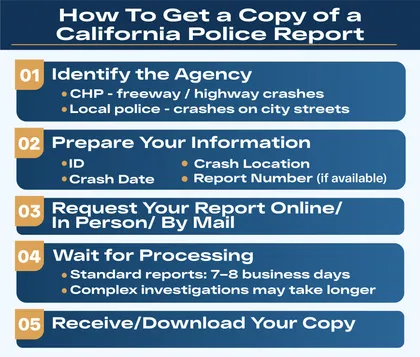
To obtain a copy of a police report in California, you must request it directly from the specific local law enforcement agency. Follow these steps to get your copy:
- Identify Which Agency Responded. Where your crash happened determines who holds your report:
- Freeways, State Highways, or Unincorporated Roads: Handled by the California Highway Patrol (CHP).
- City Streets: Handled by your Local Police Department.
- Wait for Processing. Police reports are not available immediately. The officer must finish their investigation and submit the report for review.
- Standard cases: Usually ready within 7 to 8 business days.
- Complex cases: Crashes involving severe injuries, fatalities, or ongoing investigations can take several weeks or longer.
You can call the responding agency’s non-emergency line after a few days to check if your report is ready.
- Submit Your Request. To request your document, you will generally need a photo ID, the crash date and location, your report number (if you have it), and a small fee (typically $10 to $40).
- For CHP Reports: Fill out a CHP 190 form (Collision Request Form) and submit it by mail or in person to the specific CHP office that handled your crash.
- For Local Police Reports: Most city departments let you request reports online (often through portals like LexisNexis BuyCrash), in person at the police station, or by mail.
Why A Police Report Is Essential For Your Insurance Claim
A police report serves as the official, objective record of an incident, making it a critical piece of evidence in an insurance claim. Insurance adjusters use these reports to verify crash details and determine fault.
Here is why neutral documentation is critical for your claim:
- Preserves an Initial Account: A report may record driver statements, witness information, roadway conditions, vehicle positions, and the officer’s observations before memories fade.
- Documents Reported Symptoms: Statements about pain or other symptoms at the scene may help establish when those symptoms were first reported. However, medical evidence is generally necessary to connect an injury to the crash.
- Supports the Liability Investigation: Diagrams, witness statements, physical observations, and citations may be considered together with photographs, video, vehicle damage, and other evidence. The report does not conclusively determine civil fault, and an insurer or court may reach a different conclusion.
Before talking to an insurer, many people get free advice from a car accident attorney to learn how the report shapes their claim. Specific situations often raise their own questions, and getting clear answers early can protect your case.
Additional Insurance-Reporting Requirement For Hit-And-Run Crashes
Hit-and-run crashes trigger additional insurance reporting requirements that differ from those of a standard accident.
If the driver who hit you cannot be identified, failing to promptly report the crash can disqualify you from using your Uninsured Motorist (UM) coverage. For a hit-and-run to qualify for UM benefits, California law generally requires:
- Physical contact with the unknown vehicle.
- A report to the appropriate police, sheriff, or CHP office within 24 hours.
- A sworn statement to your insurer within 30 days explaining that you have a claim against an unidentified driver.
These insurance requirements are separate from filing an SR-1 with the DMV. Notify your insurer promptly and review your policy because additional claim requirements may apply.
What Other Evidence Can You Use For A Car Accident Claim?
Beyond a police report and witness statements, you can use digital evidence, physical debris, and official vehicle data to prove your car accident claim. Other useful evidence includes:
- Photos and videos of the vehicles, visible injuries, debris, skid marks, traffic controls, and road or weather conditions.
- Dashcam, surveillance, traffic-camera, or cellphone footage.
- Names and contact information for witnesses.
- Vehicle repair estimates, inspection reports, and photographs showing the location and severity of the damage.
- Electronic information from the vehicles, phones, navigation systems, or commercial-driver records when available.
- Medical records, bills, test results, and treatment recommendations.
- Pay records, employer statements, and other proof of lost income.
- Notes documenting your symptoms, physical limitations, missed activities, and recovery.
Preserve these pieces of evidence early on. Seek medical attention promptly, keep records organized, and consider hiring a lawyer to manage the legal process.
An insurer may conduct its own investigation and reach a different conclusion about fault, causation, or the value of your losses. That’s why strong evidence is important in seeking compensation.
Reporting Deadlines Vs. Legal Filing Deadlines
The 24-hour police reporting rule and the 10-day SR-1 deadline are separate from your deadline to file a personal injury lawsuit. In California, you generally have two years from the date of the accident to file a personal injury case (California Code of Civil Procedure §335.1). If a loved one died in the crash, a wrongful death claim also generally must be filed within two years from the date of death.
Sometimes, a government driver causes the crash, or a dangerous public road condition contributes to it. In these cases, you may have a claim against a California public entity or public employee, and a much shorter deadline may apply. Under Government Code §911.2, a claim involving personal injury generally must first be presented to the appropriate public entity within six months after the claim accrues.
Missing these deadlines can permanently bar your right to compensation, regardless of whether you filed your police report or SR-1 on time. If you’re unsure which deadline applies to your situation, an attorney can confirm it before the deadline passes.
Frequently Asked Questions About Car Accident Reporting In CA
After a crash, you may have questions about the police report before you even know where to start. Getting a copy costs money, takes time, and may contain errors that could affect your claim. Knowing how reports work, how to fix errors, and how insurers get them can help protect your case.
Does The Police Report Determine Who Is Legally At Fault?
No. A police report can contain useful evidence, including driver statements, witness information, diagrams, observations, and citations. However, the officer’s report or decision to cite a driver does not conclusively determine civil liability or guarantee that an insurance company or court will reach the same conclusion.
Insurers, attorneys, judges, and juries may consider additional evidence, such as photographs, video footage, vehicle damage, electronic data, medical records, witness testimony, and expert analysis. Preserve this evidence even when the police report appears favorable to you.
Can You File A Car Insurance Claim Without A Police Report?
Yes, but having one is strongly recommended. Without a report, the insurance company may dispute who is liable for the crash, which can delay or reduce your claim.
Can I Correct A Police Report If It Has Errors?
You can contact the reporting officer to request a correction. Bring supporting evidence, such as photos or witness statements, to back up your request. If the officer declines, you can usually submit a supplemental statement to be added to the official record.
Does A Police Report Automatically Get Sent To The Insurance Company?
No. Police reports are not necessarily sent to your insurer automatically. You, your attorney, or the insurance company may request a copy from the reporting agency. Confirm with your adjuster whether the insurer has already obtained it.
Can You File A Police Report After You Leave The Scene?
You can contact your local police department or the CHP to file a report after leaving the scene. Filing as soon as possible gives you the best chance of an accurate record. If the crash involved injury or death, California Vehicle Code §20008 requires you to file a written report within 24 hours.
Do I Still Have To File An SR-1 Form If The Accident Wasn’t My Fault?
Yes. The SR-1 requirement applies to every driver involved in a qualifying crash, regardless of fault. Fault is determined separately through the police report, insurance investigation, or litigation. Passengers are not required to file an SR-1, since the obligation applies only to drivers.
Who Files The SR-1 If I Were Driving My Employer’s Vehicle?
If you were involved in a reportable accident while driving a vehicle owned by your employer, notify your employer within five days. Your employer is generally responsible for filing the SR-1 with the DMV within 10 days after receiving your report.
You should confirm that the form was submitted and keep proof of when you notified your employer. If you were using your own vehicle for work, the ordinary SR-1 filing requirement may still apply directly to you.
How Much Does A California Police Report Cost?
The CHP charges a small fee to cover reproduction costs. To learn the cost of your report, please contact the CHP office where the report was submitted. The CHP uses the following fee schedule for collision reports:
- $10.00: 01 – 25 pages
- $20.00: 26 – 50 pages
- $30.00: 51 – 75 pages
- $40.00: 76 – 100 pages
- $10.00: For each additional 25 pages exceeding 100
Some reporting agencies offer reduced or waived fees in certain circumstances.
Arash Law Case Results: Police Reports And Fault Disputes
A police report can carry real weight in an insurance claim, but, as the cases below show, it doesn’t always tell the full story, and it isn’t the final word on who’s legally at fault. Here are a few examples of how Arash Law handled inaccurate reports and unreported hit-and-run cases.
- $3,000,000 Recovery: A police report wrongly blamed Arash Law’s client for running a stop sign. Our attorneys pulled black box data from the other vehicle, proving that the other driver was speeding and caused the crash.
- $1,000,000 Recovery: With no witnesses to confirm what happened, a car-vs-car crash became a “he said, she said” liability dispute. Our skilled attorneys stood firm for the client and reached a strong settlement during mediation just one month before trial.
- $1,000,000 Recovery: A rideshare driver was struck by a driver who fled the scene. With no at-fault driver identified, the case proceeded to Underinsured Motorist arbitration, resulting in the maximum policy limits.
Past results do not guarantee future outcomes. Every case is different, and results depend on the specific facts and evidence involved.
Call Arash Law After A Car Accident In California
If you were hurt in a car crash, you do not have to handle the police reports, DMV filings, and insurance calls alone. If you need a personal injury lawyer, Arash Law is ready to help. When you choose to work with us, our attorneys will handle the critical details for you. That includes securing the police report and filing your SR-1 with the DMV so you can focus on healing.
You may be wondering, “Do lawyers only get paid if they win?” At our firm, the answer is yes. You pay no attorney fees unless your case resolves in your favor. Arash Law (frequently referred to as AK Law) handles personal injury cases on a contingency fee basis.
If another driver’s negligence caused your injuries, you may be entitled to compensation. That compensation can cover medical bills, lost wages, and pain and suffering. Call (888) 488-1391 for a free consultation with no upfront cost or obligation.