TL;DR: You generally need a personal injury lawyer who handles premises liability, product liability, or both, depending on what caused your injury and who may be legally responsible. Premises liability may apply when unsafe property conditions contributed to the incident, while product liability may apply when defective equipment caused the harm. You do not need to determine which claim applies before seeking legal help.
If equipment at a business injured you, look for a personal injury lawyer who can investigate both premises liability and product liability claims. These are areas of personal injury law, and some lawyers handle both. The right choice depends on what caused the injury, not simply whether a machine or other equipment was involved.
Premises liability generally concerns unsafe property conditions and the responsibilities of the people or businesses that control them. Product liability concerns injuries caused by legally recognized defects in products, including certain manufacturing, design, and warning defects.
In California, equipment injury claims may also involve negligence by businesses, equipment operators, installers, or maintenance providers. You do not have to determine the cause before contacting a lawyer. Instead, look for someone who can evaluate the available evidence, identify potentially responsible parties, and explain which types of claims the firm actually handles.
Table of Contents

Equipment at a Business Was Involved in My Injury. How Do I Find a Lawyer Who Can Work Out Whether the Issue Was Operation, Maintenance, the Property, or the Equipment Itself?
Look for a personal injury lawyer who can investigate the equipment incident without assuming the cause until the evidence is reviewed. The lawyer should understand how premises liability, negligence, and product liability may apply to different aspects of the same event.
For example, suppose a customer is injured when automated equipment moves unexpectedly at a car wash. Several explanations may be possible. An employee might have operated the machinery incorrectly, a maintenance provider might have missed a problem, or the equipment might have contained a defect.
Each possibility calls for a different investigation. A personal injury lawyer who handles these claims should explain which evidence matters and whether the firm can pursue the appropriate legal claims once the cause becomes clearer.
Key Facts About Equipment Injuries at California Businesses
- Equipment involvement does not automatically mean product liability. A machine can cause an injury without having a legally recognized defect.
- Premises liability focuses on property safety. A person or business responsible for the property may be liable when a failure to use reasonable care causes injury.
- Product liability requires proof of a defect. California recognizes manufacturing, design, and warning-based product liability claims.
- Operation and maintenance can raise separate negligence issues. Employee conduct, installation work, inspections, and repairs may need investigation.
- Records help distinguish possible causes. Photographs, equipment manuals, inspection reports, maintenance histories, and witness accounts can support an investigation.
- Personal injury lawyers may handle both types of claims. Ask whether the firm investigates premises liability, negligent equipment operation, and product liability when the evidence supports them.
When Might My Personal Injury Lawyer Pursue a Premises Liability Claim?
A personal injury lawyer may investigate premises liability when the injury involves an unsafe condition at the business or a failure to use reasonable care in managing the property.
The Judicial Council of California’s Civil Jury Instructions (CACI) Nos. 1000 and 1001 address premises liability and the basic duty of care. Under California law, property owners and others who control property must use reasonable care to maintain reasonably safe conditions. The Judicial Council’s official civil jury instructions explain the standards used to evaluate these responsibilities.
Examples worth investigating include:
- Unsafe Customer Areas: Moving equipment is accessible to customers without reasonable protective measures.
- Inadequate Inspection: An unsafe condition remains because reasonable inspections were not performed.
- Unaddressed Hazards: Employees or managers knew, or reasonably should have known, about a dangerous property condition.
- Missing Safeguards: The surrounding area lacks appropriate barriers, warnings, or other protective measures.
A business is not automatically liable because someone was injured on its property. A premises liability attorney will look for evidence supporting the applicable duty, breach, causation, and damages in your claim.
When Might My Personal Injury Lawyer Pursue a Product Liability Claim?
 A personal injury lawyer may pursue a product liability case if a defect in the equipment caused the injury. Product liability is another area of personal injury law, but not every personal injury firm accepts these cases.
California product liability law generally recognizes three categories:
- Manufacturing Defects: A particular piece of equipment differs from its intended design.
- Design Defects: The product’s design presents a legally actionable safety problem under the applicable test.
- Warning Defects: The product lacks legally adequate warnings or instructions concerning certain risks.
These claims have different legal requirements, addressed in CACI Series 1200.
A machine malfunction alone does not prove a product defect. The problem might instead involve ordinary wear and tear, incorrect installation, improper use, or inadequate maintenance.
A product liability lawyer may need technical analysis and additional records before deciding whether you have a well-supported claim.
Can Premises Liability and Product Liability Apply to the Same Injury?
Yes. Premises liability and product liability may both be relevant when separate evidence supports each theory.
Because both are types of personal injury claims, a lawyer at a firm that handles both may be able to investigate them together. However, each claim has its own legal requirements.
For example, suppose a customer is injured by moving equipment. The investigation might reveal that the business failed to maintain a reasonably safe customer area. It might also identify evidence suggesting a product defect.
Those would be separate legal questions requiring proof. One theory does not automatically establish the other.
Alternatively, the investigation may reveal that the equipment itself was sound but was operated incorrectly. In that situation, negligent operation could be more relevant than product liability.
A lawyer should evaluate the evidence before deciding which claims are appropriate.
What If the Problem Was Operation, Installation, or Maintenance?
If operation, installation, or maintenance contributed to your injury, your claim may involve ordinary negligence rather than premises liability or product liability alone.
For example:
- An employee might activate machinery while a customer remains in an unsafe position.
- A contractor might install equipment incorrectly.
- A maintenance provider might fail to perform work with reasonable care.
Scenarios such as these can raise questions about who performed the work, what responsibilities they had, and whether their conduct contributed to the injury. A personal injury lawyer can investigate these possibilities. The goal is to identify the claims supported by the evidence, rather than assume every equipment injury involves premises liability or product liability.
What Could Have Caused My Equipment Injury, and What Should My Lawyer Investigate?
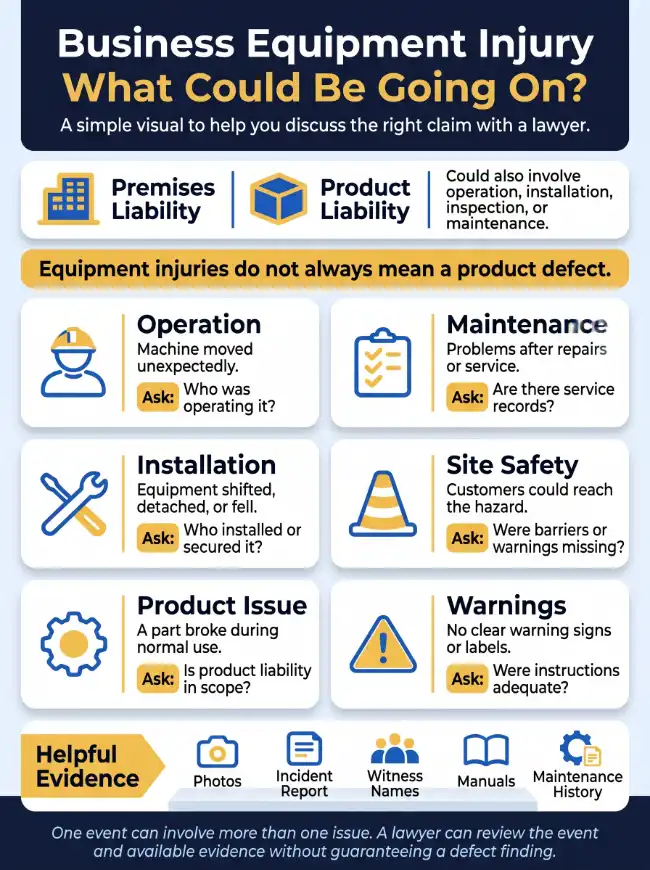
When equipment at a business causes an injury, the reason may not be obvious. The problem could involve how someone operated the equipment, whether it was properly installed or maintained, or whether the business kept the area reasonably safe. In some cases, the equipment itself may have been defective.
A lawyer can investigate these possibilities by reviewing records, photographs, and other evidence. The table below shows what might have gone wrong, what evidence could help, and what to ask a lawyer before hiring them.
| What Happened? | What Might Have Gone Wrong? | What Evidence Could Help? | What Should You Ask the Lawyer? |
|---|---|---|---|
| A machine suddenly moved, injuring someone. | An employee may have operated it incorrectly. | Security footage, employee instructions, and witness statements. | Can you investigate whether the machine was operated safely? |
| Equipment malfunctioned after being repaired or serviced. | Someone may have missed or inadequately fixed a problem during maintenance or inspection. | Repair records, maintenance logs, and past complaints. | Can you investigate whether poor maintenance contributed to my injury? |
| Equipment came loose, shifted, or fell. | The equipment may have been installed or secured incorrectly. | Installation instructions, photographs, and contractor records. | Can you investigate whether the equipment was installed properly? |
| A customer was injured near equipment in a publicly accessible area. | The business may have failed to provide adequate barriers, warnings, or other safety measures. | Photos of the area, warning signs, security footage, and inspection records. | Can you investigate whether the business kept the area reasonably safe? |
| A machine part broke while the equipment was being used. | The part may have been defective, worn out, improperly maintained, or damaged. | Equipment manuals, repair history, photographs, and an inspection of the part. | Do you handle product liability claims if the evidence suggests a defective part? |
| Someone was injured by equipment without noticing any safety warnings. | The business or equipment manufacturer may have failed to provide legally adequate warnings. | Warning labels, posted signs, equipment manuals, and photographs. | Can you investigate whether missing or inadequate warnings contributed to my injury? |
More than one issue may have contributed to the injury. For example, a machine part might break because it was defective at the time of manufacture, and poor maintenance exacerbated the defect. A lawyer may need to investigate both possibilities before deciding which legal claims are supported.
Perhaps more importantly, you do not need to identify the exact cause or prove that the equipment was defective before contacting an attorney. A personal injury lawyer who handles the relevant claims can explain what needs to be investigated and whether the firm can represent you.
Seeking help early is even more crucial because state law only gives you a limited amount of time to take legal action: generally two years to sue a private party for personal injury (Code of Civil Procedure § 335.1) and six months to present a claim to a potentially liable government entity (Government Code § 911.2), unless an exception applies. Identifying which lawyer you need for an equipment injury claim does not pause these deadlines.
What Evidence Should a Lawyer Investigate After an Equipment Injury?
A lawyer may review several types of evidence to determine whether the injury involved unsafe property conditions, negligent operation or maintenance, or a possible equipment defect. Key evidence includes:
- Equipment Ownership and Control: Ownership records, lease agreements, and service contracts can help identify who operated, installed, maintained, or controlled the equipment and surrounding area.
- Equipment Manuals and Maintenance Records: Operating instructions, repair histories, and inspection reports may reveal previous problems, maintenance practices, or safety requirements. These records can help assess possible causes but do not, on their own, prove negligence or a defect.
- Photos, Videos, and Witness Statements: Scene photographs may show equipment conditions, warning signs, and safety barriers. Surveillance footage and witness accounts can help establish how the incident happened.
If the equipment is a consumer product, you can also check the U.S. Consumer Product Safety Commission’s reporting resource for information about reporting unsafe products. A safety report does not prove that the equipment was defective or establish who was responsible for your injury.
A lawyer can compare these records, identify gaps in the evidence, and determine whether further investigation or technical analysis is needed.
How Can I Preserve Evidence Before Choosing a Personal Injury Lawyer?
Preserving evidence can help a lawyer determine whether your injury involved unsafe property conditions, negligent equipment operation, or a possible product defect. You do not need to know which type of claim applies before gathering information.
Consider these steps:
- Record what happened. Note when and where the injury occurred, what the equipment was doing, and whether anyone was operating it.
- Take photographs. Capture the equipment, surrounding area, warning signs, safety barriers, and visible injuries. These details may help identify safety concerns at the premises or possible equipment problems.
- Identify witnesses. Save contact information for anyone who saw the incident, including employees who may know how the equipment was operated.
- Request an incident report. Ask the business for a copy of its report, if available. It may contain details relevant to either type of claim.
- Request evidence preservation. Ask the business to retain surveillance footage, equipment manuals, inspection records, and maintenance histories. A lawyer can help pursue records that are not publicly available.
- Keep medical records. Save treatment documents, medical bills, and proof of missed work to help establish your injuries and related losses.
Do not dismantle equipment, perform mechanical tests, or enter restricted areas to collect evidence.
A personal injury lawyer may investigate both unsafe property conditions and possible product defects. The evidence can help determine whether the case involves premises liability, product liability, or another negligence claim. Ask whether the firm handles the types of claims that may apply.
Preserve what you can and seek legal advice promptly. Equipment may be repaired, surveillance footage may be overwritten, and property conditions may change, making it harder to determine the cause of the injury over time.
Request a Review of the Equipment Incident and Available Evidence
If you were injured by equipment at a California business, Arash Law offers free initial consultations to discuss potential personal injury claims.
You can describe what happened, provide available photographs or reports, and ask whether the firm handles the potential issues raised by your circumstances.
For injuries involving car-wash machinery, Arash Law’s car wash accident lawyers page discusses investigations involving surveillance footage, maintenance records, employee logs, and potentially responsible parties.
Call (888) 488-1391 to request a free case evaluation and confirm whether the firm accepts your particular matter, including any potential product liability component.
How to Choose a Personal Injury Lawyer When the Cause Is Unclear
If you aren’t sure what caused the harm, you do not necessarily have to determine the specific type of lawyer you need right away. Instead, look for a personal injury firm that investigates equipment-related injuries and accepts the claims your case may involve.
When comparing personal injury lawyers, consider whether they can investigate these situations:
| What Might Have Happened? | What Should the Lawyer Look Into? |
|---|---|
| You were injured because the area around the equipment was unsafe. | Did the business fail to provide reasonable safety measures, such as barriers or warnings? |
| A worker was using the equipment when you got hurt. | Did the worker operate the equipment incorrectly or carelessly? |
| Equipment came loose, shifted, or fell. | Was it installed or secured improperly? |
| Equipment broke down or stopped working properly. | Were repairs or safety inspections missed? |
| A machine or one of its parts may have been defective. | Was there a problem with how the equipment was made, designed, or labeled? |
Ask whether the personal injury firm accepts both premises liability and product liability cases. While both fall within personal injury law, some firms focus on particular types of claims and may not handle complex equipment-defect cases.
A lawyer can review the available evidence, investigate possible causes, and explain which claims the firm may be able to pursue.
What Questions Should I Ask During the Consultation?
A consultation should help you understand the firm’s proposed investigation, not merely its general experience with injury claims.
Consider asking:
- What possible causes would you investigate before deciding which claim applies?
- How would you distinguish a product defect from improper operation or maintenance?
- Which records would you request from the business, equipment owner, or contractors?
- Would a technical inspection or engineering opinion be necessary?
- Does your personal injury firm handle both premises liability and product liability cases, including equipment-related claims?
- How would you determine which parties may be legally responsible?
The answers can help you assess whether the proposed representation matches the uncertainty surrounding your injury.
When addressing your concerns, the lawyer should not guarantee that the investigation will reveal a defect or establish liability.
Does Arash Law Handle Both Premises Liability and Product Liability?
Yes. Arash Law handles personal injury cases involving premises liability and product liability. Premises liability attorneys and product liability lawyers are personal injury lawyers who handle claims involving unsafe property conditions and defective products, respectively.
Arash Law also handles car-wash accident cases involving equipment malfunctions, unsafe premises, and possible employee negligence. Depending on the circumstances, these incidents may involve premises liability, product liability, or other negligence claims.
Before hiring the firm, ask whether your particular case falls within its accepted scope of representation. This is especially important when a possible equipment defect requires technical investigation.
Frequently Asked Questions About Product and Premises Liability Lawyers in California

Do I Need a Product Liability Lawyer If a Machine Injured Me?
Not necessarily. A personal injury lawyer who handles product liability may be able to investigate your equipment injury and determine whether product liability applies. That type of claim generally requires evidence that a manufacturing, design, or warning defect caused the injury.
If the problem instead involved unsafe premises, negligent operation, or poor maintenance, another personal injury claim may be more appropriate.
Can I Sue a Business If Its Equipment Injured Me?
You may have a claim against the business if evidence shows that its negligence or failure to maintain reasonably safe property conditions caused your injury.
The business is not automatically responsible simply because the equipment was located there.
Can a Maintenance Company Be Responsible for an Equipment Injury?
Yes, a maintenance company may be responsible if it owed a duty of care, performed its work negligently, and that negligence contributed to the injury.
Repair records, contracts, inspection histories, and witness information may help establish its role.
What If I Don’t Know Who Owned the Equipment?
You can contact a lawyer without knowing who owned the equipment.
A lawyer may investigate ownership, leasing, operating agreements, installation contracts, and maintenance responsibilities to identify potentially responsible parties.
Do I Need to Prove the Equipment Was Defective Before Hiring a Lawyer?
No. You do not need to independently establish a product defect before requesting a legal consultation.
A lawyer can evaluate the circumstances and determine whether technical evidence or additional investigation may support a product liability claim.
Can One Lawyer Handle Both Premises Liability and Product Liability?
Yes. Some personal injury lawyers handle both premises liability and product liability, and some firms accept both types of cases. You do not automatically need separate attorneys for each claim.
However, you should confirm that the firm accepts both types of matters and has a plan to investigate the issues involved in your incident.
Find Out Which Legal Claim the Evidence May Support
You do not have to decide whether you need a premises liability lawyer or a product liability lawyer before seeking legal help. A personal injury lawyer who handles both types of claims can review the incident, assess the available evidence, and explain which legal options may apply.
Arash Law offers free initial consultations for injured people in California. You can ask the firm to review your account, discuss the available records, and explain whether your situation falls within its accepted practice areas.
Call (888) 488-1391 to request a free case evaluation. An investigation may help clarify whether the injury involved unsafe premises, negligent operation, maintenance problems, or a possible product defect. No specific finding or legal outcome is guaranteed.
Sources
- Judicial Council of California. California Civil Jury Instructions, 2026 Edition. CACI Series 1000 and 1200, addressing premises liability, property safety, manufacturing defects, design defects, and inadequate product warnings. https://courts.ca.gov/system/files/file/judicial_council_of_california_civil_jury_instructions_2026.pdf
- Judicial Council of California. California Civil Jury Instructions, July 2026 Supplement. Updated civil jury instructions and legal authorities, including premises liability. https://courts.ca.gov/system/files/file/judicial_council_of_california_july_2026_supp.pdf
- California Legislature. California Civil Code § 1714. Establishes the general duty to exercise ordinary care in managing one’s property or conduct. https://leginfo.legislature.ca.gov/faces/codes_displaySection.xhtml?sectionNum=1714.&lawCode=CIV
- California Legislature. California Code of Civil Procedure § 335.1. Establishes the general two-year statute of limitations for personal injury lawsuits. https://leginfo.legislature.ca.gov/faces/codes_displaySection.xhtml?sectionNum=335.1.&lawCode=CCP
- California Legislature. California Government Code § 911.2. Generally requires presenting personal injury claims to a public entity within six months of accrual. https://leginfo.legislature.ca.gov/faces/codes_displaySection.xhtml?sectionNum=911.2.&lawCode=GOV
- U.S. Consumer Product Safety Commission. SaferProducts.gov. Official resource for reporting and reviewing potential safety concerns involving consumer products. This resource does not cover every type of commercial equipment. https://www.cpsc.gov/Safety-Education/Safety-Guides/General-Information/SaferProductsgov
Disclaimer
This content is for general educational purposes and does not constitute legal advice. Reading it or requesting an initial consultation does not create an attorney-client relationship. Past results do not guarantee future outcomes.
Equipment-related injury claims depend on the circumstances, available evidence, and applicable California law. Consult a licensed California attorney about your particular injury, potential claims, and filing requirements.
Arash Law — (888) 488-1391.