TL;DR: To help prevent bicycle accidents, stay visible, follow traffic rules, ride predictably, keep your bicycle in good condition, and watch closely at intersections, driveways, and parked cars. Drivers also help prevent crashes by checking blind spots, yielding when required, slowing down, and giving bicyclists enough room when passing. Private entity cases must generally be filed within two years, while public entity administrative claims have a six-month deadline.
Bicyclists can prevent accidents by staying visible with required lights and bright clothing, following traffic rules, riding predictably, and scanning for turning vehicles and open-door zones. However, prevention isn’t only up to cyclists. Bicycle accidents often happen when a rider and a vehicle enter the same space unexpectedly, so both must be careful when sharing the road.
California law puts real obligations on drivers. When those obligations are ignored, an injured cyclist may have the right to seek compensation.
Key Facts About Bicycle Safety In California
- CVC §21200 gives cyclists the same rights and duties as motor vehicle operators, including the obligation to obey traffic signals, stop signs, and yield rules.
- 145 bicyclists were killed in California in 2023, according to the California Office of Traffic Safety (OTS), making California responsible for approximately 12.4% of all U.S. bicycle fatalities that year (1,166 nationally, per UC Berkeley SafeTREC).
- California’s pure comparative negligence rule reduces a cyclist’s recovery in proportion to their own fault.
- Government Code §911.2 requires a written claim to be filed within 6 months if a dangerous road condition, such as an unfilled pothole, caused the crash and a public entity is responsible. Missing this deadline can permanently bar a lawsuit against the public entity. Limited exceptions may apply.
- CVC §21201 mandates that bicycles have a white front light visible from 300 ft and a red rear reflector visible from 500 ft when riding in darkness. Noncompliance is a traffic violation and can affect a comparative fault analysis.
- California’s two-year statute of limitations (CCP §335.1) applies to most private-party bicycle injury lawsuits.
Table of Contents

Tip #1: Wear The Right Safety Equipment
Cycling safety is crucial for preventing accidents and minimizing legal liabilities. Adhering to California’s safety laws is essential for both protection and compliance. This includes necessary safety equipment, such as helmets, lights, and visibility gear, as well as maintaining your bicycle to meet legal standards.
Helmets
In California, a person under 18 must wear a properly fitted and fastened safety helmet when riding a bicycle, nonmotorized scooter, skateboard, in-line skates, or roller skates in areas covered by state law. The helmet must meet ASTM or U.S. Consumer Product Safety Commission (CPSC) standards.
Adults riding regular bicycles are generally not required by state law to wear helmets. However, Class 3 e-bike operators and passengers must wear them regardless of age. Helmet use can help lower the risk of serious head injuries and skull fractures in bicycle crashes.
Lights And Reflectors
Under CVC § 21201(d), a bicycle ridden during darkness must have a red reflector or a solid or flashing red light with a built-in reflector on the rear, visible from 500 feet under the conditions specified by law. The bicycle must also have a white front light visible from at least 300 feet ahead and to the sides.
Under § 21201(e), the front light may be mounted on the bicycle or attached to the rider. California law also requires specified pedal and side reflectors. Riding at night without the required lighting or reflectors is a Vehicle Code violation and may result in a citation. If inadequate lighting contributed to a crash, the violation may also be considered when determining comparative fault.
As of January 1, 2026, electric bicycles are subject to an additional requirement. Under CVC §21201(f), an e-bike must comply with the rear-visibility requirement in §21201(d)(2) during all hours, not only during darkness. This means an e-bike must have the required rear red reflector or a qualifying solid or flashing red light with a built-in reflector, even when ridden during the day.
Visibility Gear, Fit, And Mechanical Compliance
Beyond helmets and required bicycle lights, riders can improve their visibility by wearing bright colors during the day and reflective gear in low-light conditions. Reflective vests, wristbands, ankle bands, and reflective material on helmets or clothing can help drivers notice bicyclists sooner.
Under CVC § 21201(a)–(c), bicycles used on California roadways and highways must meet specific requirements for brakes, handlebar height, and bicycle size. A bicycle that does not meet these requirements may increase the risk of crashes. A violation could become relevant to fault if it contributed to an accident.
Tip #2: Do The ABC Quick Check Before Every Ride
The ABC Quick Check is a simple pre-ride inspection recommended by bicycle-safety organizations. It can help riders identify common mechanical problems before getting on the road.
- A — Air: Check tire pressure and inspect the tires for cuts, cracks, excessive wear, or other damage. Inflate the tires according to the tire or bicycle manufacturer’s guidance.
- B — Brakes: Squeeze the brake levers and make sure the brakes engage firmly before the levers reach the handlebars. Inspect the brake pads and other brake components for wear or damage. Under CVC §21201(a), a bicycle operated on a roadway must have a brake capable of making one braked wheel skid on dry, level, clean pavement.
- C — Cranks, Chain, and Cogs: Check that the cranks are secure and the chain moves smoothly through the drivetrain. Look for rust, damaged links, excessive dirt, or shifting problems.
- Quick — Quick Releases and Wheel Security: If the bicycle uses quick-release levers, make sure they are properly closed. Bikes with thru-axles should also be checked to make sure the wheels are securely attached.
- Check — Test the Bicycle: Take a short, slow ride in a safe area. Make sure the brakes, steering, gears, wheels, seat, and other components work normally before entering traffic.
Performing this check before a ride can help identify maintenance problems that could otherwise contribute to a bicycle crash.
Tip #3: Follow California’s Bicycle Laws And Ride Defensively
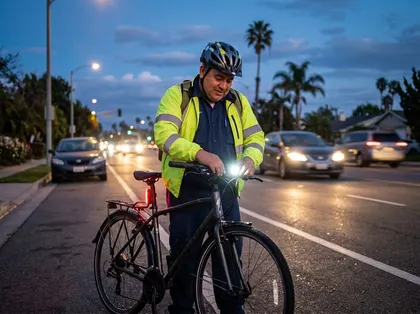
Cycling in California requires an understanding of the laws governing road use to ensure safety and legal compliance. California treats cyclists as motor vehicle operators, meaning they share the same rights and responsibilities on the road. Familiarizing yourself with these regulations is crucial, not only for your safety but also for any legal claims that may arise from an accident.
When people don’t follow traffic rules, the consequences can be severe. Some accidents can even lead to death. California recorded 145 bicyclist deaths in motor-vehicle traffic crashes in 2023, according to the California Office of Traffic Safety. That same year, 1,106 pedestrians were killed, about 9% fewer than in 2022 but 56% more than in 2014.
Bicyclists’ Rights And Duties
Under CVC §21200, bicyclists have the same rights and duties as drivers. They are subject to the same traffic laws as vehicle drivers, except for rules that, by their nature, do not apply to bicycles. Cyclists must generally obey traffic signals, stop signs, and applicable right-of-way rules. Following these laws can reduce crash risk and may also help avoid allegations of comparative fault after an accident.
California follows pure comparative negligence. If a cyclist’s own negligence contributed to the crash, their damages may be reduced according to their percentage of responsibility. For example, if a cyclist were found 40% at fault and another party 60% at fault, the cyclist’s recoverable damages would generally be reduced by 40%. The defendant must show both that the cyclist was careless and that the negligence was a substantial factor in causing the harm.
A cyclist who follows applicable traffic laws may be better positioned to dispute allegations that their own conduct contributed to the collision. However, compliance with traffic laws does not automatically establish another party’s liability or guarantee full compensation.
Riding lawfully helps protect both your safety and your legal rights after a crash. If you have been injured while riding, California bicycle accident lawyers can evaluate the circumstances and explain how California’s fault rules may apply to your claim.
Ride With Traffic
Under CVC §21650.1, bicycles must travel in the same direction as other traffic, never against it. California law generally requires traffic to use the right half of the roadway, subject to certain exceptions.
The separate question of where a cyclist should ride within the lane is mainly governed by CVC §21202(a), which applies when the cyclist is traveling slower than normal traffic and includes several safety-related exceptions. Wrong-way riding can create dangerous conflicts because drivers may not expect a bicyclist to approach from the opposite direction.
When To Take The Lane
Cyclists must ride as close to the right as practicable, except in specific situations specified by CVC §21202(a):
- When passing
- Preparing for a left turn
- Avoiding a hazard
- When the lane is too narrow to share side by side
- When approaching an authorized right-turn zone
If the lane is genuinely too narrow for a bike and a vehicle to travel side by side safely, a cyclist may move farther into the lane when reasonably necessary for safety. A driver who crowds or unsafely passes a cyclist in a narrow lane may be found negligent if that conduct contributes to a collision.
Use Hand Signals When Required
California law requires cyclists to signal when required, such as when another vehicle may be affected. CVC §22111 specifies how hand-and-arm signals are given:
- Left Turn: Extend the left hand and arm horizontally.
- Right Turn: Extend the left hand and arm upward. A bicyclist may instead extend the right hand and arm horizontally to the right.
- Stop or Sudden Decrease in Speed: Extend the left hand and arm downward.
Keep control of the bicycle while signaling. Under CVC § 21205, a cyclist may not carry an item that prevents them from keeping at least one hand on the handlebars.
No Headphones In Both Ears
California law generally bars cyclists from wearing headphones in both ears while riding. Under CVC §27400, a bicyclist generally may not wear a headset, earplugs, or earphones covering, resting on, or inserted in both ears while riding. Using headphones in both ears can reduce a rider’s ability to hear approaching vehicles, horns, sirens, and other warning sounds.
A single earbud in one ear is not prohibited by §27400, although riders should still make sure they can hear surrounding traffic. Wearing headphones or earphones in both ears generally violates California law, subject to limited statutory exceptions.
Defensive Habits That Reduce Crash Risk
Cyclists can reduce crash risk by riding predictably, staying visible, watching for hazards, and anticipating drivers’ movements at intersections, driveways, and near parked vehicles.
Follow these defensive riding tips:
- Check behind you. Look over your shoulder before turning or changing your position in the roadway. A properly adjusted bicycle mirror may provide additional awareness.
- Do not assume drivers see you. Try to make eye contact when possible, but remain prepared to stop or take evasive action if a driver fails to yield.
- Stay out of blind spots. Avoid lingering beside large trucks, buses, and other vehicles where the driver may have difficulty seeing you.
- Watch for opening car doors. Leave reasonable clearance from parked vehicles when conditions allow. Under CVC §22517, a person may not open a vehicle door into moving traffic unless it can be done reasonably safely and without interfering with traffic. If a dooring crash occurs, fault depends on the circumstances.
- Anticipate turning vehicles. A vehicle that passes you may turn right across your path, while an oncoming vehicle may turn left in front of you at an intersection.
- Plan safer routes. Choose routes with lower traffic volumes, slower speeds, bicycle lanes, or separated bicycle facilities. Under CVC §21208, cyclists traveling slower than normal traffic generally must use an established bicycle lane, subject to exceptions for passing, turning, avoiding hazards, and other specified situations.
Main Causes Of Bicycle Accidents In California
UC Berkeley SafeTREC’s 2025 Bicycle Safety facts report found that the three most common primary factors in California fatal and serious-injury bicycle crashes in 2023 were:
- Unsafe speed (16.5%)
- Automobile right-of-way violations (16.3%)
- Improper turning (15.0%)
Traffic signal and sign violations, as well as wrong-side-of-road violations, were also among the five leading factors. These categories describe the primary factor identified in the crash and should not be interpreted as showing that motorists were responsible for every crash.
Cyclists cannot control every road user, but they can reduce their exposure to common hazards. Understanding the main causes of bicycle accidents can help cyclists take proactive measures to stay safe on the roads.
- Right-of-Way Conflicts: Do not assume a driver has seen you at an intersection or driveway. Watch for vehicles entering, crossing, or turning through your path and be prepared to react.
- Distracted Drivers: A distracted motorist may fail to notice a bicyclist. Ride predictably, stay visible, and assume drivers may not always see you.
- Unsafe Passing: Under CVC §21760, motorists generally must leave at least three feet when passing a bicyclist. When another lane in the same direction is available, drivers must change lanes when practicable, lawful, and safe.
- Unsafe Speed: Higher vehicle speeds reduce the time available to avoid a collision and increase the risk of severe injury. When possible, choose routes with lower traffic speeds or separated bicycle facilities.
- Dooring: Under CVC §22517, a person may not open a vehicle door into moving traffic unless it can be done reasonably safely and without interfering with traffic. Cyclists should watch for occupants in parked vehicles and maintain reasonable clearance when conditions allow.
- Road Hazards: Potholes, cracks, debris, sand, and uneven pavement can be particularly dangerous to bicyclists. Scan the roadway ahead and adjust your speed when approaching hazards.
What Drivers Can Do To Prevent Bicycle Accidents
Cyclists are not the only road users responsible for preventing crashes. Under CVC § 21760, California’s Three Feet for Safety Act, drivers generally must leave at least three feet of clearance when passing a bicyclist traveling in the same direction. If traffic or roadway conditions prevent that clearance, the driver must slow to a reasonable and prudent speed and may pass only when doing so will not endanger the cyclist.
Since January 1, 2023, the law also requires a driver passing a bicyclist in the same lane to change into another available same-direction lane when practicable, lawful, and safe.
Drivers can help prevent bicycle accidents when they:
- Check mirrors and blind spots before turning or changing lanes.
- Slow down in areas where bicyclists are likely to be present, such as near schools, parks, and bike routes.
- Watch out for bicyclists before pulling out of driveways, parking spaces, or side streets.
- Check for approaching cyclists before opening a vehicle door.
- Change lanes when required and safely, or wait until there is enough space to pass a bicyclist safely.
Schedule Your Free Case Review For Your Bike Accident Claim
Hurt on a California road? Arash Law has recovered over $1 billion for injured clients across California. Our bicycle accident lawyers handle cases from initial investigation through trial. Call (888) 488-1391, available 24 hours a day.
What To Do After A Bicycle Accident In California
Get medical care first, then document everything else: the scene, the other driver’s information, and witness accounts. Do these while avoiding assumptions about who was at fault. Even a careful rider may suffer injuries in a collision. What you do afterward can affect your health and help preserve important information about how the crash occurred.
-
Seek medical attention. Some injuries, including concussions, may not be immediately obvious. Prompt medical care can also create a record of your injuries and treatment. Under CVC § 20008, an injury or fatality accident must be reported in writing within 24 hours as required by the statute.
CVC § 21200 generally makes these accident-reporting provisions applicable to bicyclists riding on highways. If law enforcement responds, obtain the agency name and report or incident number when available.
- Exchange information with the driver. Get the driver’s name, contact information, driver’s license number, license plate number, vehicle information, insurance company, and policy number. Photograph the documents if it is safe and permitted to do so.
- Photograph the scene. Document your bicycle, injuries, vehicle damage, skid marks, lane markings, traffic controls, road defects, parked vehicles, and other relevant conditions. Nearby businesses, homes, or vehicles may also have surveillance or dashcam footage. Because retention periods vary and recordings may be overwritten, relevant footage should be identified and preserved as soon as possible.
- Get witness contact information. Ask witnesses for their names, phone numbers, and email addresses before they leave. Independent accounts may become important if the parties later disagree about how the crash happened.
- Do not speculate about fault. Give police and medical personnel accurate, factual information. Avoid guessing about speed, distance, visibility, or who caused the collision when you do not know.
- Preserve your bicycle and gear. Do not repair, alter, or discard the bicycle, helmet, clothing, lights, or other damaged equipment before they have been documented. Their condition may help investigators or experts evaluate how the collision occurred.
- Consider speaking with a bicycle accident attorney. An attorney can explain applicable deadlines, insurance issues, and steps for preserving evidence based on the circumstances of the crash.
How Arash Law Advocates For The Rights Of Injured Cyclists
At Arash Law, we are dedicated to helping injured cyclists and ensuring their rights are protected. Our team understands the challenges that come with bicycle accidents, as well as the importance of safe road conditions for all users. Our goal is to provide clear support and effective legal representation for our clients.
Below are examples of how we successfully represented clients in various cases. They highlight distracted driving, unsafe speeds, and hazardous intersections, the same roadway dangers that cyclists face on California roads.
$10,000,000 — Pedestrian Accident: A client suffered serious injuries after being run over by a speeding vehicle. Arash Law pursued the claim while also helping the client obtain medical care and treatment, ultimately securing a $10 million recovery.
$1,750,000 — Auto vs. Pedestrian: An uninsured driver struck a client at a hazardous intersection, creating limited options for recovery. Arash Law pursued a claim against the city and uncovered a history of crashes at the intersection, which provided evidence supporting the case.
Past results do not guarantee future outcomes. Every case is different, and results depend on the specific facts and evidence involved.
Frequently Asked Questions About Bicycle Accident Prevention In California
This section provides key information on bicycle accident prevention in California. We address common questions and concerns that cyclists may have regarding safety measures, legal responsibilities, and best practices to reduce the risk of road accidents.
Does Not Wearing A Helmet Prevent Me From Recovering Compensation In California?
No. Failing to wear a bicycle helmet does not automatically disqualify you from recovering compensation in California. State law generally does not require adults riding ordinary bicycles to wear helmets, although CVC §21213 requires helmets for all Class 3 e-bike operators and passengers.
In a claim involving a head injury, an insurer or defendant may argue that wearing a helmet could have reduced the severity of the injury. However, a reduction in damages is not automatic. The defendant would need to establish a legal and factual basis for assigning fault to the cyclist and to show that the cyclist’s lack of a helmet contributed to the injuries claimed.
An attorney can evaluate whether helmet use is legally relevant based on the rider’s age, type of bicycle, injuries, and circumstances of the collision.
Does Insurance Cover Bicycle Accidents In California?
Yes. If a driver causes a bicycle crash, the driver’s auto liability insurance may cover the cyclist’s injuries and other losses, up to the available policy limits. For most California auto policies issued or renewed on or after January 1, 2025, the minimum liability limits are:
- $30,000 per injured person
- $60,000 per accident
- $15,000 for property damage
Qualifying California’s Low Cost Auto (CLCA) policies may carry lower limits.
If the at-fault driver has no insurance or insufficient coverage, the cyclist’s own uninsured/underinsured motorist (UM/UIM) coverage may apply. This depends on the policy and the cyclist’s insured status. Health insurance may also pay covered medical expenses. Notably, the health plan may have reimbursement or lien rights if the cyclist later receives compensation from another source.
What Is The Filing Deadline For A Bicycle Accident Claim In California?
California Code of Civil Procedure §335.1 generally gives you two years from the date of injury to file a lawsuit against a private party.
If a government entity may be responsible, the deadline is much shorter. For example, if a dangerous public road, pothole, or missing sign contributed to the crash, Government Code §911.2 generally requires you to present a written claim to the responsible public entity within six months.
These deadlines can vary in certain situations. This may include claims involving minors or other special circumstances. Missing the applicable deadline can prevent you from pursuing compensation. Consider speaking with an attorney as soon as possible after a bicycle accident.
What Should I Do If A Pothole Or Road Defect Caused My Bicycle Crash?
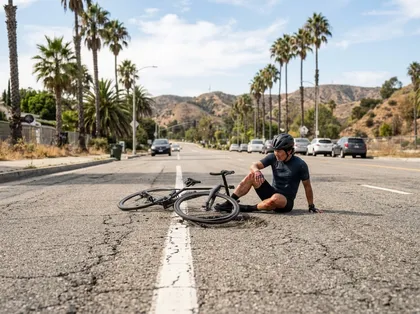
If a pothole or other road defect caused your bicycle crash, document the condition before it’s changed.
- Photograph and video the defect. Capture close-up and wide-angle views that show its size, depth, location, and position relative to the bike lane or roadway.
- Measure it if you can do so safely. Record the pothole’s approximate depth, width, and length. Include a ruler or another object for scale.
- Record the exact location. Note the street, nearest intersection, direction of travel, bike lane, and any nearby landmarks.
- Photograph your bicycle and injuries. Preserve evidence showing how the crash affected you and your bike.
- Look for witnesses and cameras. Get witness contact information. Identify nearby businesses, homes, buses, or vehicles that may have recorded the crash.
- Report the road hazard. Notify the city, county, Caltrans, or other agency responsible for the roadway. Save the report or service-request number.
- Preserve your bicycle and damaged gear. Do not repair or discard them until they have been photographed and, when appropriate, inspected.
- Seek medical care. Tell your medical provider how the crash occurred and what part of your body was injured.
- Preserve evidence of earlier complaints. An attorney may investigate prior service requests, inspection records, repair records, crash history, and complaints showing how long the dangerous condition existed.
If a public entity owns or controls the road, California Government Code §835 may allow the injured party to bring a claim. This can be possible when a dangerous condition caused the injury and the other statutory requirements are met, including requirements concerning how the condition was created or whether the entity had notice of it.
Consider contacting an attorney promptly to preserve important evidence.
Can I Ride My Bicycle On Any California Road?
No. Bicycles are generally permitted on many California roads. However, bicycles may be prohibited or restricted on certain freeways, expressways, or portions of them under CVC §21960. Riders should obey posted signs.
When an established bicycle lane is available, a cyclist traveling slower than normal traffic must use it (CVC §21208). Exceptions apply when passing, preparing for a left turn, avoiding debris or other hazards, or approaching a place where a right turn is allowed.
Cyclists also do not have to stay at the far right when the lane is too narrow for a bicycle and a vehicle to travel side by side safely. Under CVC §21202(a), a rider may move farther into the lane when reasonably necessary for safety.
Talk To Arash Law About Your California Bicycle Accident Claim
If you were injured in a bike crash, you may have the right to compensation for medical bills, lost income, pain and suffering, and more. Arash Law has recovered over $1 billion for injured Californians, including cyclists and pedestrians struck by inattentive drivers.
Call (888) 488-1391 for a free case evaluation, available 24 hours a day. You may also contact Arash Law online to schedule your consultation. Contingency fee rates are not set by law and are negotiable. Clients may be responsible for costs and expenses regardless of outcome.
Arash Law. Make ‘em pay. Call AK.
Sources
California Office of Traffic Safety (OTS) — Pedestrian and Bicycle Safety Program. Data on 145 bicyclists killed on California roads in 2023, and 1,106 pedestrians struck and killed, a 56% increase from 2014, despite a 9% single-year decrease from 2022.
https://www.ots.ca.gov/grants/pedestrian-and-bicycle-safety/
UC Berkeley Safe Transportation Research and Education Center (SafeTREC) — 2025 SafeTREC Traffic Safety Facts: Bicycle Safety. National bicycle fatality count of 1,166 in 2023; California crash factor data (unsafe speed 16.5%, failure to yield 16.3%, improper turning 15%).
https://safetrec.berkeley.edu/2025-safetrec-traffic-safety-facts-bicycle-safety
California Legislative Information (LegInfo) — CCP §335.1, two-year statute of limitations; Government Code §911.2, six-month government claim deadline; Government Code §835, dangerous condition of public property.
https://leginfo.legislature.ca.gov/faces/codes_displaySection.xhtml?sectionNum=335.1&lawCode=CCP
https://leginfo.legislature.ca.gov/faces/codes_displaySection.xhtml?sectionNum=911.2.&lawCode=GOV
https://leginfo.legislature.ca.gov/faces/codes_displaySection.xhtml?sectionNum=835.&lawCode=GOV
California Legislative Information (LegInfo) — CCP §377.60, wrongful death standing; CCP §377.61, wrongful death damages (not a filing deadline).
https://leginfo.legislature.ca.gov/faces/codes_displaySection.xhtml?lawCode=CCP§ionNum=377.60.
https://leginfo.legislature.ca.gov/faces/codes_displaySection.xhtml?lawCode=CCP§ionNum=377.61.
California Department of General Services / Office of Risk and Insurance Management (DGS/ORIM) — Government Claims Program. Filing information for claims against the State of California, including Caltrans claims over $12,500.
https://www.dgs.ca.gov/ORIM/File-A-Claim
California Department of Transportation (Caltrans) — Submit Damage Claim. Filing information for qualifying claims of $12,500 or less involving Caltrans; claims over $12,500 generally must be submitted through the Government Claims Program.
https://dot.ca.gov/online-services/submit-damage-claim
Disclaimer
The information on this page is for general educational purposes and does not constitute legal advice. No attorney-client relationship is formed by reading or relying on this content. If you were injured, consult a licensed California personal injury attorney about your specific situation. Arash Law: (888) 488-1391.