TL;DR: You can sue a nightclub for your injuries if unsafe conditions or negligent security caused harm and the venue failed to act reasonably. You must prove duty, breach, causation, and damages. In addition, you must file within 2 years before evidence like surveillance footage disappears.
Highlights:
- Consult a personal injury lawyer as soon as possible to protect your claim.
- Preserve evidence like surveillance footage, incident reports, and witness statements early.
- Prove duty, breach, causation, and damages under California’s premises liability law.
- File a lawsuit within two years of the injury or six months for government-owned properties.
- Document your injuries and medical treatments to link them to the nightclub incident.
- Understand that comparative negligence may reduce your compensation if you’re partially at fault.
Tip: Secure evidence promptly to strengthen your case and prevent loss of critical documentation.
Table of Contents
Under California’s premises liability law, you can sue a nightclub for your injuries if unsafe conditions or negligent security caused harm. To have a valid case, you have to prove that the establishment created, knew, or should have known about a dangerous situation. However, it failed to fix that hazard or warn guests, and your injury resulted from that failure.
Anyone who visits a nightclub can get injured, whether they are customers, employees, or performers such as DJs. Because evidence such as surveillance footage and incident reports can disappear quickly, these victims need to support their claims by seeking medical care, documenting what happened, and preserving evidence early.
Understanding Nightclub Liability In California
Nightclubs owe a legal duty of care to their guests. The nightclub owner or property manager must take reasonable steps to keep the property safe and prevent foreseeable harm to guests. Because nightlife settings involve alcohol, crowds, dim lighting, and security staff, certain risks are predictable. If management ignores those risks, liability can follow.
Under California premises liability law, this is called a negligence claim. To succeed in filing a lawsuit, you must present evidence that proves four elements:
- Duty of Care: The nightclub had a legal obligation to keep you reasonably safe as a paying guest.
- Breach: The venue failed to act reasonably under the circumstances, such as ignoring a spill, allowing overcrowding, or failing to provide adequate security.
- Causation: The unsafe condition or negligent act directly caused your injury. You must show that the harm would not have occurred but for the nightclub’s failure.
- Damages: You suffered measurable financial and personal losses, including medical bills, lost wages, pain, and emotional distress.
One aspect that makes slip-and-fall claims unique is that, unlike other personal injury cases, victims must prove that the property owner and manager knew of the hazard. In other words, you must demonstrate that they had either:
- Actual Notice: The nightclub was directly aware of the dangerous condition. For example, it learned about a spilled drink because a customer reported it.
- Constructive Notice: The nightclub should have discovered and corrected the hazard during property inspections or maintenance. For instance, it may be liable if it failed to spot and replace a broken floor tile in the bathroom, even if its employees regularly checked and cleaned it.
To support these elements and prove notice, strong evidence is critical. Evidence may include:
- Incident reports prepared by managers or employees.
- The nightclub’s security staffing and shift records.
- Surveillance footage from inside or outside the venue.
- Maintenance, inspection, and alcohol service logs.
- Witness statements from other patrons or employees.
- Medical records linking your injury to the incident.
- Any documents proving the venue’s prior history of incidents, if available.
Because surveillance systems often overwrite footage within days, timing matters. Acting quickly to preserve evidence can significantly strengthen your claim.
Common Reasons People Sue A Nightclub
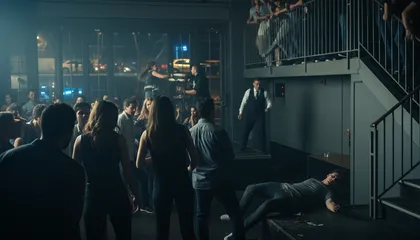
Nightclub injury claims usually arise under California’s negligence rules. Property owners and operators must take reasonable steps to prevent foreseeable harm. If a nightclub fails to do so or does not properly supervise guests and staff, it can be responsible for the resulting injuries. Premises liability attorneys can help evaluate whether those injuries support a claim.
Below are the most common scenarios that lead to lawsuits.
Slip And Fall Hazards
Nightclubs create unique fall risks. Drinks spill easily. Floors become slick. Lighting stays dim. Music and crowd movement distract guests from spotting hazards.
Common dangerous conditions include:
- Spilled alcohol, ice, and broken glass.
- Recently mopped floors without warning signs.
- Broken tiles or loose flooring.
- Worn carpeting on stairs.
- Inadequate lighting in walkways or restrooms.
- Floors cluttered with cables, lighting rigs, or stage equipment.
Liability in these premises liability claims often depends on timing. If staff knew about the spill and failed to clean it, or if the hazard existed long enough that employees should have discovered it during routine checks, the nightclub may be responsible.
Negligent Security
Violence in nightlife settings is not always random. Fights often escalate from visible disputes. When warning signs appear, and staff ignore them, the risk increases.
Negligent security claims may involve:
- Too few security guards for the size of the crowd.
- Poorly trained bouncers.
- Failure to remove aggressive patrons.
- Lack of security in parking lots.
- Broken or missing surveillance cameras.
A nightclub does not guarantee absolute safety. However, it must take reasonable steps to prevent foreseeable harm, especially if similar incidents have occurred at the venue before.
Bouncer Misconduct
Security staff sometimes use reasonable force to remove disruptive guests. However, they should not use excessive force.
Claims arise when a bouncer:
- Strikes a patron without justification.
- Uses force after the situation is under control.
- Causes injury during an unnecessary physical confrontation.
- Acts out of anger rather than self-defense.
Because bouncers act as employees or agents of the nightclub, the venue may be legally responsible for their conduct under the concept of vicarious liability.
Overcrowding
Clubs must follow California’s fire code and occupancy limits. When venues allow too many guests inside, the risk of injury increases.
Overcrowding can lead to:
- Crush injuries near exits.
- Falls on packed staircases.
- Panic during emergencies.
- Blocked or locked emergency exits.
Failure to control capacity or manage crowd flow may support a negligence claim, especially if the club ignored safety regulations.
Structural Defects And Poor Maintenance
Property owners must maintain the building in a reasonably safe condition. Structural issues create serious hazards in dark, high-traffic environments.
Examples include:
- Loose railings on elevated areas.
- Unstable DJ platforms or stages.
- Defective stairs.
- Broken furniture.
- Dangerous pyrotechnics or faulty lighting rigs.
When maintenance records show delayed repairs or ignored complaints, liability becomes more likely.
When a business ignores known hazards or fails to correct dangerous conditions, the law may allow you to sue a company for putting you in danger if that negligence leads to injury.
In many cases, more than one factor contributes to an injury. A crowded club with poor lighting and inadequate security may create layered risks. Identifying every contributing condition helps establish negligence and strengthens the claim.
Who Can You Sue After A Nightclub Injury?
When suing a nightclub for your injuries, identifying who is legally responsible is a key step. Liability can depend on alcohol service, unsafe conditions, negligent security, or a combination of factors. In many cases, more than one party shares responsibility.
Though California does not enforce a specific dram shop law, a nightclub can be held responsible for alcohol-related injuries in limited situations. Courts generally treat the act of drinking alcohol, not the act of serving it, as the legal cause of injury. That means adults are usually responsible for the harm they cause after choosing to drink.
There are limited exceptions. A nightclub may face liability if it served alcohol to a minor (under 21) who was already obviously intoxicated.
In those situations, the establishment may be legally responsible because it contributed to the risk in a significant way.
Outside of these exceptions, most claims involving adult patrons focus on other forms of negligence. A nightclub may still be liable if it:
- Failed to clean up spills or fix dangerous conditions.
- Ignored escalating fights or aggressive behavior.
- Allowed unsafe overcrowding or blocked exits.
- Was unable to provide reasonable security.
- Neglected structural maintenance or lighting.
In many adult intoxication cases, unsafe property conditions or negligent supervision form the basis of the lawsuit rather than alcohol service alone.
Liability may also extend beyond the business operating the club. Depending on the facts, responsible parties may include:
- The nightclub business owner.
- The property owner or landlord.
- A management company that oversees operations.
- A third-party security firm.
- An event promoter controlling a specific event.
A thorough investigation determines who controlled the premises, who hired and trained staff, and who made safety decisions. Correctly naming all responsible parties increases the likelihood of recovering full compensation for your injuries.
How Does Your Partial Fault Affect Your Nightclub Injury Claim?
California follows a pure comparative negligence system. This rule directly affects how you sue a nightclub and how much compensation you can recover. If you were partially responsible for what happened, an insurer can dispute liability during settlement negotiations. A court can also reduce your compensation by your percentage of fault.
This issue often arises in nightclub cases involving alcohol. Being intoxicated does not automatically prevent you from suing. However, it could affect your potential payout. For example, if you were found 20% responsible, a court would reduce your total recovery by 20%. The key legal question is whether the nightclub also acted negligently. If the venue failed to fix a known hazard, ignored escalating violence, or allowed unsafe overcrowding, it may still be held responsible.
When filing a negligence claim against a nightclub, prepare to address comparative fault arguments and clearly show how the venue’s unsafe conditions contributed to your injuries.
Types Of Injuries That May Lead To A Lawsuit
Injuries at nightclubs can happen suddenly and escalate quickly. Crowded dance floors, low lighting, alcohol service, and physical altercations create an environment where serious harm can occur in seconds. When an injury results from unsafe conditions or negligent supervision, it can support a personal injury lawsuit.
Nightclub injuries range from minor to catastrophic. They may include:
- Broken bones and fractures
- Head injuries and traumatic brain injury
- Spinal injuries
- Deep cuts
- Facial or dental injuries
- Crush injuries
- Burns from pyrotechnics or faulty equipment
- Soft tissue injuries that require physical therapy or chiropractic treatment
The severity of the injury often determines the value and complexity of the claim. A concussion may require neurological evaluation. A spinal injury may lead to long-term treatment or permanent impairment. Facial injuries can result in scarring that affects both physical health and emotional well-being.
Even injuries that initially seem minor can worsen over time. Symptoms such as headaches, neck stiffness, or back pain may appear hours or days later. Seeking prompt medical care protects your health and creates a clear medical record that links your injuries to the nightclub incident. That documentation plays a critical role in proving causation and recovering compensation.
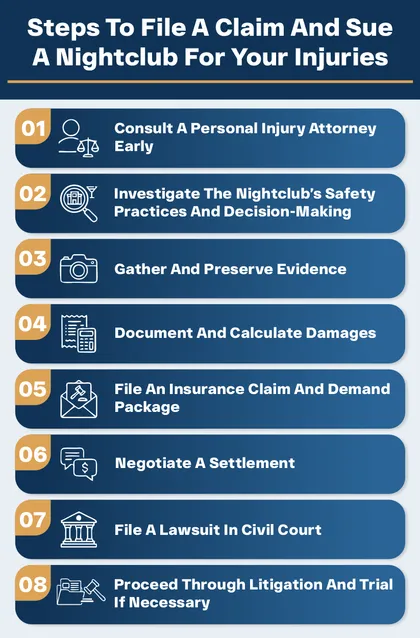
Steps To File A Claim And Sue A Nightclub For Your Injuries
Suing for negligence after a nightclub injury involves a structured legal process. An experienced personal injury attorney plays a central role at every stage. That starts with investigating liability and continues to filing a lawsuit and presenting the case in court.
Step 1: Consult A Personal Injury Attorney Early
Start by speaking with a personal injury attorney as soon as you can. A lawyer will review what happened, look at any photos or reports, and explain whether the nightclub may be legally responsible. They will also explain your rights under California law and how long you have to take action.
Early legal help is important because nightclub evidence can disappear fast. Video footage may get erased. Witnesses may become hard to find. Conditions inside the club may change.
An attorney can quickly:
- Send a letter to preserve surveillance footage.
- Request incident reports.
- Identify who may be responsible.
- Guide you on documenting your injuries.
Acting early protects your case.
Step 2: Investigate The Nightclub’s Safety Practices And Decision-Making
Once you identify all potential liable parties, the next step is to investigate what actually went wrong. The goal is to understand how the nightclub operated on the night of your injury and whether it followed reasonable safety practices.
Your attorney will examine:
- Security policies and training procedures.
- Staffing levels and crowd control plans.
- Maintenance and cleaning schedules.
- Incident history at the venue.
- Prior complaints or code violations.
They may also review internal communications, shift logs, and surveillance footage to see how staff responded before and after the incident.
This investigation focuses on one core question: Did the nightclub act reasonably under the circumstances? If the evidence shows ignored risks, poor supervision, or unsafe conditions, it strengthens your negligence claim.
Step 3: Gather And Preserve Evidence
To win a negligence case, you must prove the nightclub failed to act reasonably and that failure caused your injury. Strong evidence makes that possible.
Your attorney will work to collect:
- Medical records
- Surveillance video
- Incident reports
- Maintenance or cleaning logs
- Witness statements
In some cases, experts may review lighting, crowd control, or security practices to show what went wrong.
Because video systems may delete footage within days, timing is critical. The sooner evidence is secured, the stronger your case will be.
Step 4: Document And Calculate Damages
You must also prove how the injury affected your life. Your case can consider both financial losses and personal harm.
Economic damages may include:
- Hospital bills
- Surgery or follow-up care
- Physical therapy or chiropractic treatment
- Lost wages
- Future medical costs
Non-economic damages may include:
- Pain and suffering
- Emotional distress
- Loss of enjoyment of life
- Permanent scars or limitations
Your attorney will gather bills, wage records, and medical opinions to calculate the full value of your claim. A clear damages breakdown prevents insurance companies from undervaluing your case.
Step 5: File An Insurance Claim And Demand Package
Most cases start by filing a claim with the nightclub’s insurance company. Your lawyer prepares a demand letter that explains:
- What happened
- Why the nightclub is legally responsible
- What evidence supports your claim
- How much compensation you are seeking
The demand package usually includes:
- Medical records and bills
- Proof of lost income
- Photos and video
- Witness statements
- Incident reports
After receiving the claim, the insurance company assigns an adjuster to investigate. The adjuster may:
- Ask for a recorded statement.
- Review internal reports.
- Examine maintenance records.
- Look at whether you were partially at fault.
The insurer may accept responsibility, deny the claim, or offer a settlement. First offers can be low if you receive them when you haven’t fully discovered the extent of your losses. Your attorney negotiates and pushes for fair compensation. If the insurer refuses to pay a reasonable amount, the next step is filing a lawsuit.
Step 6: Negotiate A Settlement
Settlement talks can go back and forth several times. Your attorney handles all communication with the insurance company and responds to any attempts to reduce your claim.
During this stage, your lawyer may:
- Submit updated medical records.
- Provide expert opinions.
- Challenge blame arguments.
- Adjust the demand if treatment continues.
Preparing the case as if it will go to trial puts pressure on the insurer to take the claim seriously.
Step 7: File A Lawsuit In Civil Court
If negotiations fail, your attorney files a formal complaint in a California civil court. This document explains:
- Who is being sued.
- What they did wrong.
- How their actions caused your injury.
- What damages you are requesting.
In most cases, you have two years from the date of injury to file. Once filed and served, the lawsuit officially begins.
Step 8: Proceed Through Litigation And Trial If Necessary
After filing, the case moves into discovery. During this phase, both sides exchange evidence and ask questions under oath.
Litigation may include:
- Written questions
- Requests for documents
- Depositions
- Expert testimony
At this point, negotiations can continue. Both sides may choose to conduct them through mediation, with an unbiased third party presiding over their discussions. Many cases settle during this stage once the evidence becomes clear. If no agreement is reached, the case goes to trial. A judge or jury will decide who was at fault and how much compensation should be awarded.
How Long Do You Have To File?
In most California personal injury cases, you have two years from the date of injury to file a lawsuit in civil court. This deadline is called the statute of limitations. If you do not file within that time, the court will likely dismiss your case. You could lose your right to recover compensation.
There are important exceptions. One of them involves the Government Claims Act. If the nightclub operates on government-owned property, such as city-owned land or a public venue, you may need to file a government claim within six months of the injury. This is a separate administrative process that must happen before you can file a lawsuit.
Other limited exceptions may apply in cases involving:
- Injuries that were not immediately discovered.
- Claims involving minors.
- Situations where the defendant concealed wrongdoing.
Because deadlines can vary depending on the facts, it is critical to speak with an attorney as soon as possible. Missing the statute of limitations can permanently bar your claim, no matter how strong the evidence may be.
When To Contact A Lawyer For A Nightclub Injury Case
Consider contacting a lawyer as soon as possible after a nightclub injury. Nightlife venues often move quickly to protect themselves. Incident reports can be brief or incomplete. Staff members might provide limited details. Some surveillance systems overwrite video within days. Witnesses who were present that night can be challenging to locate.
Early legal involvement helps level the playing field. An experienced firm such as AK Law can immediately take steps to protect your claim.
Your attorney can:
- Send formal evidence preservation letters to prevent the deletion of surveillance footage.
- Obtain internal incident reports and security logs.
- Subpoena maintenance records and cleaning schedules.
- Review staffing levels and security policies.
- Work with safety or industry experts to evaluate whether the venue acted reasonably.
- Prepare the case for litigation from the beginning.
Acting early strengthens your position. The sooner evidence is secured and liability is investigated, the stronger your claim will be during settlement negotiations or in court.
FAQs On Suing A Nightclub For Injuries
You may be seeking free advice from a nightclub injury lawyer, as these cases raise many practical questions about fault, timing, and compensation. Below are clear answers to some of the most common concerns people have when considering suing a nightclub for injuries.
Can I Sue If I Was Drunk?
Yes. Being intoxicated does not automatically prevent you from filing a claim. California follows a pure comparative negligence system, which means you can still recover compensation even if you were partially at fault.
However, your recovery may be reduced by your percentage of responsibility. The key issue is whether the nightclub also acted negligently, for example, by failing to address a hazard or by ignoring unsafe conditions.
What If The Nightclub Denied Responsibility?
A denial does not end your case. Nightclubs and their insurers often dispute fault early in the process. Your claim can still move forward if the evidence shows negligence. Surveillance footage, maintenance logs, security records, and witness statements can help establish what actually happened and whether the venue acted reasonably.

How Long Does A Nightclub Injury Case Take?
The timeline varies based on the case’s complexity. Straightforward claims with clear liability and completed medical treatment can be resolved in several months. Cases involving serious injuries, disputed fault, or multiple defendants can take a year or longer. If you file a lawsuit, the litigation process can extend the timeline, especially if the case proceeds to trial.
What If Security Used Excessive Force?
If a bouncer or security guard used unreasonable force, you may have a claim for assault and battery in addition to premises liability. Nightclubs can be held responsible for the actions of their employees or contracted security personnel. The focus will be on whether the force used was necessary and reasonable under the circumstances.
What If My Injuries Seemed Minor At First?
Some injuries, such as concussions, soft tissue damage, or internal injuries, might not show symptoms immediately. It is important to seek medical evaluation as soon as possible. Delays in treatment can worsen your condition and make it harder to link the injury to the nightclub incident. Medical records created early in your case help support causation in your claim.
Do Lawyers Only Get Paid If They Win?
Most personal injury lawyers work on a contingency fee basis. That means you do not pay attorney fees up front. Instead, the lawyer receives a percentage of any settlement or court award.
You may be wondering, “Do lawyers only get paid if they win?” The answer in most injury cases is yes. If there is no recovery, you generally do not owe attorney fees. Always review the fee agreement carefully so you understand how a lawyer handles costs.
Injured At A Nightclub? Take Action Now
If you sustained injuries at a nightclub, your health and safety come first. Seek medical care right away and make sure that doctors properly document your injuries. Prompt treatment protects both your well-being and your ability to prove what happened.
Report the incident to management and request a written report. If you can do so safely, take photos of the area, including any hazards such as spills, broken flooring, poor lighting, or overcrowded exits. Get contact information from witnesses before they leave. Evidence in nightclub cases can disappear quickly, especially surveillance footage.
If you are dealing with medical bills, lost income, or lasting pain, you might be thinking, “I need a personal injury lawyer to support me.” An attorney from Arash Law can evaluate your situation and explain your legal options. Call AK Law at (888) 488-1391 to schedule a confidential consultation and learn what steps you can take next.