TL;DR: The right lawyer depends on the issue: a personal injury attorney can help dispute fault or injury value, while a coverage lawyer can address policy disagreements. You may need both. A denial alone doesn’t prove bad faith. Check the applicable policy, denial explanation, and injury records. Ask lawyers what services and proceedings are covered, how fees work, and who tracks deadlines.
You may need a personal injury lawyer, an insurance coverage attorney, or both, depending on whose policy is involved and why the insurer says there is no coverage. An injury lawyer can address fault and compensation disputes, while a coverage attorney can evaluate questions about the policy.
Before choosing an attorney, review the insurer’s written explanation, the coverage involved, and the facts of your injury claim. A coverage refusal alone does not prove that the insurer acted unlawfully or in bad faith.
Key Facts About Insurance Denials in California
- Claim Denials Must Be in Writing: Under 10 CCR § 2695.7(b)(1), insurers must issue claim denials in writing. First-party denials must list the factual and legal bases for the denial, and denials that rely on policy provisions must identify those provisions and explain how they apply.
- Insurers Must Investigate Fairly: Under 10 CCR § 2695.7(d), insurers must diligently conduct thorough, fair, and objective investigations without repeatedly requesting information unrelated to the claim’s resolution.
- Claim Acknowledgment Generally Has a 15-Day Limit: Under 10 CCR § 2695.5(e), insurers generally must acknowledge a claim within 15 calendar days after receiving notice, subject to regulatory exceptions.
- Claim Decisions Generally Have a 40-Day Limit: Under 10 CCR § 2695.7(b)–(c), insurers generally must accept or deny claims within 40 calendar days after receiving proof of claim, or explain why additional time is needed.
- Injury Lawsuits Usually Have a Two-Year Deadline: Under CCP § 335.1, most personal injury lawsuits must be filed within two years after the injury. Exceptions and different deadlines may apply.
- Other Filing Deadlines May Apply: California generally allows three years for property damage lawsuits (CCP § 338) and six months to present injury or property damage claims against government entities (Gov. Code § 911.2). Missing these deadlines may bar a claim, while delays can weaken evidence.
Table of Contents

An Insurance Company Says There Is No Coverage After The Accident. How Do I Know If I Need Help With My Injury Claim, With The Policy, Or With Both?
You may need help with your injury claim, the insurance policy, or both. The right help depends on whose insurer denied coverage and its stated reason. Reviewing the denial letter alongside your injury records can help identify which issues need attention.
When You Need Legal Help With Your Injury Claim
A personal injury lawyer can help when an insurer disputes who caused the accident or what your injuries are worth. These disputes may involve medical records, witness accounts, crash reports, and expert opinions.
Your attorney can gather evidence, evaluate responsibility, and document your losses. If an insurer also denies coverage, the lawyer can assess how that affects the injury claim and whether a coverage specialist, such as a specialized claims adjuster, risk management analyst, or underwriting professional, should participate.
When You Need Legal Help With the Insurance Policy
An insurance coverage attorney can help evaluate an insurer’s statement that the policy does not cover the claim. The dispute may concern an exclusion, a coverage lapse, or whether a particular driver or vehicle was insured.
The attorney can review the policy, denial letter, and accident details to assess the insurer’s stated position. If the claim involves your own insurer, the attorney may also evaluate potential bad faith. A denial alone does not establish wrongdoing.
When You Need Legal Help With Both Issues
You may need both types of legal help when coverage questions arise alongside disputes about fault or injury value. For example, an insurer might dispute coverage for a driver while also challenging that driver’s responsibility for the crash.
Some attorneys handle both areas; others work with separate counsel. When the setup involves referrals or coordinated counsel, ask who will address each issue and protect the applicable deadlines. A consultation with a car accident lawyer can help identify whether your situation requires additional coverage advice.
For example, an insurer may refuse payment because it says a driver, vehicle, or accident is not covered. Without reviewing the actual policy, the insurer’s letter, and the facts behind the refusal, no one can determine whether that position is correct. The refusal should not be treated as proven bad faith, an unlawful denial, or necessarily a decision under your own policy.
First-Party vs. Third-Party Claims: Who Is Denying Coverage?
A first-party denial involves coverage under your own policy. A third-party denial involves the liability insurer of someone you claim caused the accident. This distinction affects your legal options and the insurer’s duties toward you.
| Point of Comparison | First-Party Claim | Third-Party Claim |
|---|---|---|
| Whose Coverage Is Involved? | Coverage available to you under your own policy, such as uninsured/underinsured motorist, collision, or medical payments insurance. | Another person’s liability insurance. |
| What Duty Does the Insurer Owe You? | Your insurer owes you a contractual duty of good faith and fair dealing. | The other party’s insurer does not owe you the same contractual duty it owes its insured. |
| Can You Bring a Bad-Faith Claim? | You may have a claim if your insurer unreasonably withholds benefits owed under the policy. However, a denial alone does not establish bad faith. | Third-party claimants generally cannot sue the other party’s insurer for bad faith. |
| Can Damages Exceed Policy Benefits? | A successful bad-faith claim may allow additional damages, depending on the facts. | The denial alone does not give you a right to bad-faith damages against the other party’s insurer. |
Even when the same insurance company handles both claims, your legal rights depend on which policy and coverage are involved.
Both first-party and third-party claimants may report claim-handling concerns to the California Department of Insurance (CDI). California Insurance Code § 790.03 identifies unfair claims practices that CDI may enforce. However, the statute does not itself create a private right to sue, as established in Moradi-Shalal v. Fireman’s Fund Ins. Cos., 46 Cal. 3d 287 (1988).
How to Tell Whether the Dispute Is About Coverage, Fault, or Claim Value
An insurer may dispute coverage, liability, or the value of your injuries. These are different questions, and each may require different legal work.
- Coverage Disputes: The insurer says the policy does not cover the claim. It may cite an excluded driver, vehicle, or accident, or a policy lapse. An attorney can review the policy language, exclusions, and accident details to evaluate whether the insurer’s stated reason supports its denial.
- Liability Disputes: The insurer disputes its insured’s responsibility or alleges that you contributed to the accident. Under California’s pure comparative fault rule, shared fault generally reduces compensation rather than barring recovery. An attorney can review the evidence and evaluate the insurer’s position on fault and causation.
- Valuation Disputes: The insurer disputes the amount of compensation your injuries and losses justify. It may question treatment, medical expenses, lost income, or future care needs. An attorney can review medical records, bills, employment documents, and expert opinions to support the damages you seek to recover.
The denial letter may identify one issue or several overlapping disputes.
For example, a letter saying that the driver was excluded from the policy raises a coverage question. A letter saying that the insured driver was not responsible raises a liability question. A low settlement offer based on disputed medical expenses calls the claim value into question. These positions should not be treated as interchangeable.
Reservation of Rights vs. Full Denial: Understand the Difference
Before assuming an insurance company has completely walked away from the claim, check whether the document is an outright denial or a reservation of rights (ROR) letter.
In California, an insurer may send a reservation of rights letter while it investigates coverage and continues defending its insured. The letter may identify questions about exclusions, notice, or the driver’s coverage.
A reservation of rights is not the same as a final denial. Even when coverage is denied, the letter may address only certain benefits, duties, or claims. Ask an attorney to identify what the insurer actually refused and whether any part of the injury claim remains open.
What Options Remain If the At-Fault Driver’s Insurer Denies Coverage?
A coverage denial from the other driver’s insurer does not automatically end your injury claim against a responsible party. A car accident lawyer can investigate whether to sue the responsible driver directly or identify secondary coverage. However, if the driver has limited personal assets, collecting a judgment can be difficult.
You may also have protection under your own policy. If the at-fault driver is uninsured or the denial leaves the driver without coverage, your own uninsured motorist (UM) coverage may apply. Underinsured motorist (UIM) coverage may also apply when the driver’s policy limits are too low to cover your losses.
Medical payments (MedPay) coverage, if you have it, may help with medical bills regardless of who was at fault. These are first-party claims, so your insurer owes you the duty of processing the claim in good faith.
Whether these benefits are available depends on your policy, the other driver’s coverage, and the circumstances of the accident. A denial by the other insurer does not automatically establish eligibility for UM or UIM benefits.
Your own policy also has its own notice requirements and deadlines, which may differ from the deadline for suing the at-fault driver. Under California Insurance Code § 11580.2(i), you generally must preserve a UM claim within two years of the accident by:
- Filing a bodily injury lawsuit against the uninsured driver.
- Reaching an agreement on the amount owed.
- Formally initiating arbitration through written notice sent by certified mail (return receipt requested).
These are alternative ways to preserve a qualifying UM claim, not steps that must all be completed. Other timing rules and exceptions may apply.
Notify your own insurer promptly and have an attorney review your policy.
Why Was Your Claim Denied: Coverage, Liability, or Valuation?
An insurer may deny your claim by disputing coverage under the policy, liability for the accident, or the valuation of your injuries. Each dispute type calls for different evidence and specific legal help. Knowing which one applies tells you what your case will need to prove.
- Coverage Disputes: The insurer says the policy does not cover the claim. It may cite an excluded driver, vehicle, or accident, or a policy lapse. An attorney can review the policy language, exclusions, and accident details to evaluate whether the insurer’s stated reason supports its denial.
- Liability Disputes: The insurer disputes its insured’s responsibility or alleges that you contributed to the accident. Under California’s pure comparative fault rule, shared fault generally reduces compensation rather than barring recovery. An attorney can review the evidence and evaluate the insurer’s position on fault and causation.
- Valuation Disputes: The insurer disputes the amount of compensation your injuries and losses justify. It may question treatment, medical expenses, lost income, or future care needs. An attorney can review medical records, bills, employment documents, and expert opinions to support the damages you seek to recover.
The denial letter may identify one issue or several overlapping disputes. Reviewing its stated reasons can help you determine which documents and legal assistance you need.
Need help understanding the written coverage refusal? Call Arash Law at (888) 488-1391 for a free case evaluation. Share the insurer’s written explanation and the facts of your injury. Ask whether the firm can handle the injury claim, review the coverage issue, or discuss the possibility of separate counsel. A review does not guarantee that coverage will be restored or that coverage litigation will follow.
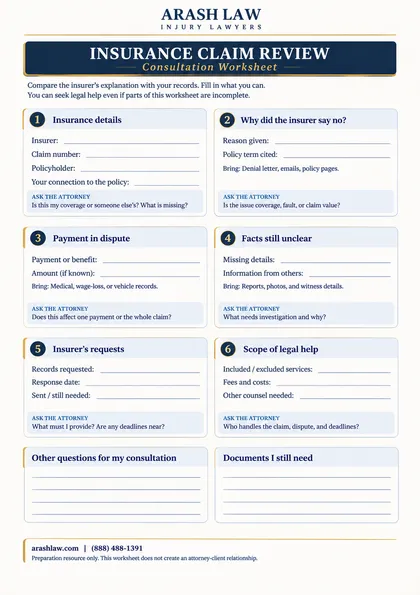
Insurance Claim Review Consultation Worksheet
Compare the insurer’s written explanation with your available policy documents and injury records. Use this map to record what you know, identify missing information, and list questions about the legal services you may need.
You can seek help before completing every row.
Keep the denial letter and any supporting documents together. Write down information you do not know instead of guessing.
Frequently Asked Questions About Denied Injury Claims in California
What Should I Look for in My Denial Letter?
Look for the insurer’s stated reason, any policy provisions it cites, and whether it denied all or part of your claim. Note any requested documents, response dates, or review procedures.
Bring the complete letter and related correspondence to an attorney. The attorney can compare the explanation with available policy documents and evidence of injury to identify the dispute and discuss appropriate next steps.
Can I Sue the At-Fault Driver’s Insurance Company for Bad Faith?
Generally, no. The other driver’s insurer owes its contractual duty of good faith to its insured, rather than to you as a third-party claimant. You may pursue an injury lawsuit against the responsible driver or file a California Department of Insurance complaint about claim handling. Limited exceptions, such as a valid assignment of the insured’s rights, require separate legal review.
What If the Insurer Blames Me for the Accident Under California Law?
You may still recover compensation even if you partly caused the accident. California’s pure comparative fault rule reduces your compensation by your percentage of responsibility. For example, if you were 20% at fault, your recoverable damages would decrease by 20%.
However, the insurer’s allegation does not establish your share of fault. An attorney can review the evidence and challenge an unsupported assessment.
Do Lawyers Only Get Paid If They Win a Denied Claim Case?
Arash Law attorneys handle personal injury cases on a contingency fee basis, meaning they only get paid if they win your case or secure a settlement. Insurance coverage attorneys may offer different fee arrangements.
Before hiring counsel, ask how attorney fees and case costs work, whether coverage-related services are included, and whether separate counsel would charge additional fees. Review these terms in the written agreement.
California Business and Professions Code § 6147 generally requires that qualifying contingency fee agreements be in writing and state the applicable fee percentage.
Can the California Department of Insurance Reverse a Third-Party Denial?
No. The CDI cannot order another person’s insurer to pay your injury claim. However, it can review complaints and investigate potential violations of California’s insurance laws and claims-handling regulations. The insurer may reconsider its denial following that review, but a complaint does not guarantee payment or decide a civil bad-faith claim. An attorney can separately evaluate whether negotiation or litigation is appropriate.
Do I Have to Appeal Directly with the Insurance Company Before Hiring a Lawyer?
No. You can consult or hire a lawyer before asking the insurer to reconsider its denial. Bring the written explanation, available policy documents, and claim correspondence. An attorney can review the insurer’s reasoning, identify missing information, and explain your options. Ask whether the proposed representation includes requesting reconsideration, handling the injury claim, or addressing the policy dispute.
Requesting reconsideration generally does not pause the deadline to file an injury lawsuit, which is usually two years from the injury under CCP § 335.1, subject to exceptions. Ask an attorney to confirm your filing deadline before you rely on the insurer’s review process.
Request a Review of Your Denial Letter and Injury Facts with Arash Law
A review of the insurer’s written explanation and your injury records can help clarify the dispute and the legal assistance you may need.
Use the Consultation Worksheet above to organize what you have. Missing documents do not prevent you from requesting an initial consultation.
Call (888) 488-1391 or contact Arash Law online for a free case evaluation.
Ask for a review of the insurer’s written explanation and the facts of your injury. The firm can discuss the legal services it may offer and whether separate coverage counsel might be appropriate. A consultation does not guarantee reversal of the denial, coverage litigation, or bad-faith recovery.
Sources
- California Code of Regulations, Title 10, §§ 2695.5 and 2695.7: Fair Claims Settlement Practices Regulations. California Department of Insurance. https://www.insurance.ca.gov/01-consumers/130-laws-regs-hearings/05-CCR/fair-claims-regs.cfm
- California Insurance Code § 11580.2: Uninsured and Underinsured Motorist Coverage. California Legislature. https://leginfo.legislature.ca.gov/faces/codes_displaySection.xhtml?lawCode=INS§ionNum=11580.2
- California Code of Civil Procedure § 335.1: Two-Year Statute of Limitations for Personal Injury. California Legislature. https://leginfo.legislature.ca.gov/faces/codes_displaySection.xhtml?lawCode=CCP§ionNum=335.1
- Moradi-Shalal v. Fireman’s Fund Ins. Cos., 46 Cal. 3d 287, 304 (1988) (no private right of action under Ins. Code § 790.03), as applied in Chalal v. United Financial Casualty Co., No. 2:25-cv-00037-TLN-SCR, slip op. at 8 (E.D. Cal. Sept. 30, 2025). https://www.govinfo.gov/content/pkg/USCOURTS-caed-2_25-cv-00037/pdf/USCOURTS-caed-2_25-cv-00037-0.pdf
- Victor E. Schwartz. “Li v. Yellow Cab Company: A Survey of California Practice under Comparative Negligence.” Pacific Law Journal, vol. 7, no. 2 (1976). https://scholarlycommons.pacific.edu/cgi/viewcontent.cgi?article=2458&context=mlr
Disclaimer
The information on this page is for general educational purposes and does not constitute legal advice. No attorney-client relationship is formed by reading or relying on this content. If you were injured, consult a licensed California personal injury attorney about your specific situation. Arash Law | (888) 488-1391.