TL;DR: Motorcycle helmets work and significantly reduce the risk of death and traumatic brain injury in a crash. Studies show helmets cut head injuries by 69 percent and full-face models lower fatal risk, which can affect medical costs and injury claims for riders.
Highlights:
- Wear a DOT-compliant helmet every ride, even for short trips.
- Choose a full-face helmet for stronger head and face protection.
- Avoid novelty helmets that do not meet federal safety standards.
- Buy a motorcycle with ABS, or prioritize ABS as an upgrade.
- Practice controlled emergency braking to avoid wheel lock and falls.
- Confirm your state’s helmet rules and minimum insurance/medical coverage requirements.
- If riding helmetless in FL or MI, verify $10,000/$20,000 medical coverage.
Tip: After a crash, document the scene and gear, stick to facts with insurers, and keep all medical records.
Table of Contents
According to a report by the Insurance Information Institute (III), there were 5,014 motorcycle riders killed in a crash in 2019. That figure was double the number from 1997.

In comparison, the National Highway Traffic Safety Administration (NHTSA) recorded that in 2018, motorcyclists were approximately 27 times more likely to die per mile traveled than passenger car occupants. One of the main reasons for this statistic is that motorcycles lack the enclosure protection that a vehicle provides.
When a crash happens, the injuries for a motorcycle rider will be much more severe than they would be for a car driver. At Arash Law, we understand the severity of these injuries. We also understand the devastating impact these crashes can have on the lives of victims.
A motorcycle accident changes lives in an instant. If you have been a victim of a motorcycle crash, you may be able to pursue compensation for your losses. Call our California motorcycle accident attorneys at (888) 488-1391, and we’ll review your case in a free initial consultation.
Types Of Motorcycles
The number of motorcycles registered to Americans has risen from 4.3 million in 2002 to 8.6 million in 2021. California and Florida have the largest number of registrations for motorcycle riders in the United States.
10 different types of motorcycles are characterized according to their design and use:
- Scooter — Small wheels, small engines, automatic transmissions.
- Cruiser — Heavier bikes, more torque and less horsepower in engines, feet forward.
- Chopper — Much like cruisers, longer wheelbase, highly customized (“chopped”) bikes.
- Touring — High-displacement and high torque engines, wind protection, improved technology (ABS, GPS, heated handgrips, etc.).
- Dual-Purpose — Four-stroke emission-compliant engines, comfortable riding position.
- Standard — Upright riding position, improved ground clearance.
- Sport Touring — Drive trains, touring features such as high windshields and heated grips.
- Unclad Sport — Does not have full body panels, feet under the seat, reduced horsepower– Light with high power-to-weight ratios, second to the supersport class.
- Supersport — Comparable to factory racing bikes with a superior power-to-weight ratio.
In the United States, cruisers and touring bikes have the highest number of registrations. Data indicates that supersport motorcycles have a fatality rate that is four times higher than that of fatalities for cruisers and standard motorcycles.
What Helps Reduce The Risks Of Crashes For Motorcycles?
Two essential measures that can help reduce crash-related injuries and losses are wearing proper helmets and having anti-lock braking systems. According to safety research, the proper use of helmets has prevented numerous motorcycle fatalities since 2002, demonstrating the importance of this safety equipment. Laws have been changed all across the country because of this data.
If every motorcycle rider had worn a helmet in 2017, an additional 749 lives would have been saved. Helmets are said to be 37 percent effective in preventing motorcycle riders’ injuries and 41 percent for their passengers. Although only 70.8 percent of riders and passengers wore helmets in 2019, this number shows a gradual improvement in helmet compliance over time.
Antilock braking systems are also known to reduce the risk of crashes for motorcyclists. These systems will prevent wheels from locking up, which is more critical to bikes than to cars. For cars, locked brakes might lead to a skid. On a motorcycle, locked brakes could lead to a fall.
In one study, anti-lock brake systems reduced motorcycle injury crashes in Italy by 24 percent, in Spain by 29 percent, and in Sweden by 34 percent. This data is used widely across the world, along with other studies, as support for the effectiveness of anti-lock braking systems at reducing crashes on motorcycles.
At Arash Law, we frequently work with victims of motorcycle accidents. We know that if you have been in a motorcycle accident, you might suffer several losses and trauma. We can help you navigate this challenging time and seek compensation. Call our attorneys for motorcycle accident cases at (888) 488-1391 for a free case evaluation.
Do Motorcycle Helmets Work?
The research consistently shows that helmets save lives for motorcycle riders while on the road and during crashes. Overall, the death rate in regions with motorcycle helmet laws is lower for helmet-wearers, and so is the rate of lethal head injuries. The severity of injuries during a crash is also reduced for those who wear helmets.
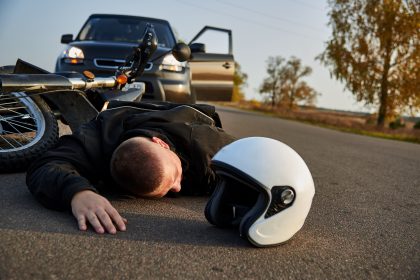
When a rider survives a motorcycle crash, the result is often traumatic brain injury (TBI), even with a helmet. These injuries will vary by individual and will have a devastating impact on the victim and families involved, sometimes permanently. Still, head injury was reduced by 69 percent among helmet-wearers in an accident. Many studies are consistent with this.
There are many different kinds of helmets sold in the United States and across the world. Where there are universal helmet laws, motorcycle riders must wear helmets that are mandated by federal standards. Helmets that do not meet those standards are known as novelty helmets.
One study on the effectiveness of novelty helmets looked at data from 84 law enforcement agencies in California and found that the risk of fatal injury rose with the use of novelty helmets. At the same time, there is a discussion of full-face or half-face helmets for riders purchasing new helmets. Riders prefer half-face helmets, as they are lighter, cooler, and easier to wear.
However, full-face helmets will provide more protection from brain injury or death every time. The information we have on this is very specific. Those who wear full-face helmets can reduce their risk of injury and death by 64 percent overall, and the risk of injury or death is 57 percent lower than that of those with half-face helmets.
This is the kind of data used by lawmakers statewide and nationally when they make motorcycle helmet laws. Not every state mandates motorcycle helmets. For those that do, they are called universal helmet laws. If you have been in a motorcycle accident and suffer a brain injury or other trauma, we can help.
At Arash Law, we advocate for the rights of motorcycle crash victims and their families and work to pursue damages for their accident-related injuries and losses. Call our motorcycle accident and California brain injury accident attorneys at (888) 488-1391 to book a free initial consultation.
Motorcycle Helmet Laws
States that require helmets for all motorcycle riders have laws called universal helmet laws. To date, there are only 19 states, along with the District of Columbia, that have these laws. At least 29 states have laws that mandate helmet use for some riders, often in the younger age ranges.
For example, riders under the age of 21 or 18 are the only riders in some states required to wear helmets. The states of Illinois, New Hampshire, and Iowa are the only states that do not require any helmets at all.
In states where there are no helmet laws or helmet laws are weakened, we see an increase in deaths from motorcycle accidents:
- California — When a universal helmet law became effective on January 1, 1992, fatalities decreased by 37 percent.
- Nebraska — The universal helmet law enacted on January 1, 1989, resulted in a 22 percent decrease in traumatic brain injury and head injury, as well as a reduction of medical bills by 38 percent.
- Louisiana — With the repeal of its universal helmet law in 1999, motorcycle fatalities increased by 100 percent.
- Florida — When Florida weakened their laws to exempt motorcycle riders over 21 with $10,000 medical coverage, their fatalities increased. The medical costs for personal injury sustained from motorcycle crashes averaged $34,500.
- Michigan — As of 2012, Michigan has similar laws to Florida, but requires $20,000 medical coverage for those without helmets. The result was an increase in insurance payments by 22 percent.
- Iowa — This state has no helmet laws, and the outcomes are what you would expect. In 90.8 percent of crashes, 60.2 percent of motorcycle riders died of traumatic brain injury.
The information on motorcycle crashes and universal helmet laws is interesting. The lawmakers in states that stipulate insurance mandates and medical minimums for motorcycle riders are telling us something. They are saying that medical costs and the risk of injury and death are high.
Our injury lawyers at AK Law have seen this every day for decades. The more traumatic a crash, the more expensive it is. The costs and losses add up with every piece of glass broken. If you or a loved one has been in a motorcycle accident, we can help you pursue compensation for your losses.
Handling cases involving motorcycle accidents and brain injury accident victims is what we do. You don’t have to deal with this alone. Contact our California accident lawyers at (888) 488-1391 and let us review your case. We will not collect any upfront fees.
We work on a contingency fee basis. This means our fee is only a percentage of what we recover on your behalf. Regardless of the outcome, there may be case-related expenses, but you only have to pay the attorney’s fees if we secure compensation on your behalf. This approach enables you to access legal services without incurring upfront costs.
Do Motorcycle Anti-Lock Brake (ABS) Systems Save Lives?
After motorcycle helmets, anti-lock braking systems (ABS) help save lives on motorcycles. This system on a bike will work to measure the speed of the wheel continuously, working through a small ring called a tonewheel that is located on the brake disc. A wheel sensor will pick up the speed of the tone wheel reading to the ABS system, which can detect when a wheel is to stop rotating.
This information is used to slow down the wheels on a bike or vehicle. Most drivers in cars or on bikes won’t notice the ABS working. You can brake and drive as you usually would. Drivers will see it working during an emergency and will be glad it is there.
ABS is not required on motorcycles, but more than half of all models will have that as a standard feature or an option when purchasing a new vehicle. The science on ABS and accidents is as clear as the science on motorcycle helmets. With ABS, a bike’s wheels will not lock during an accident, enabling a bike rider to apply the full weight of the brakes during an accident.
One study found that over a five-year period, ABS reduced crashes by 37 percent. At the same time, insurance claims occur less frequently for bikes with ABS than for bikes without it.
The reasons for that are simple. Whether road and weather conditions are good or bad, stopping on any surface will be easier with ABS. That is why the system is there. Many riders and car drivers do not know that stopping on a bike is different from stopping in a car. Most bikes have separate controls for both wheels, and both can lock up during a hard brake.
This lock could mean a skid or a hard fall, neither of which is a leading cause of motorcycle accidents, but it is a cause. Slamming the brakes too hard in any vehicle could become a dangerous situation. ABS gives drivers the ability to brake without worrying too much about that.
This function helps reduce brake pressure, since ABS handles this intuitively to help prevent the wheels from jamming when you need to brake hard. For motorcycle riders, it saves lives and keeps insurance costs low.
If you have been a victim of a motorcycle accident, the ABS function is just one of the many issues that will be considered in your crash case. A California injury attorney can help you assess the factors in your crash.
Contact Our California Motorcycle Accident Attorneys For A Free Initial Consultation
Riding a motorcycle is inherently riskier than driving a car. However, other risk factors, such as not wearing a helmet or having ABS on your bike, could result in serious lifelong injuries or death.
That doesn’t mean every rider is automatically considered to be at fault in the event of an injury or motorcycle accident. Fault in motorcycle crashes is another factor entirely.
A motorcycle accident can be an overwhelming experience for everyone involved. At Arash Law, if you or someone you love has been in a motorcycle accident, we can assist you. We can review your case and explain your potential legal options.
The motorcycle accident lawyers at Arash Law have worked with injured victims for years. The car accident lawyers have experience handling complex motorcycle accident cases and can guide you through the legal process to seek compensation. Contact our accident lawyers at (888) 488-1391 or complete our “Do I Have A Case?” form to schedule a free initial consultation.