TL;DR: Yes. A California personal injury lawyer can investigate a pedestrian collision even when the driver took you home without providing their name or insurance information. Vehicle details, witnesses, medical records, potentially available camera footage, and your remembered route may help identify the driver. Accepting a ride does not automatically mean you admitted fault or gave up your injury claim. Identification, liability, and insurance coverage remain subject to investigation.
A lawyer can help even if the driver who hit you took you home without giving you their name or insurance information. An attorney can organize what you remember, identify potential evidence, contact witnesses, and determine which records may lawfully be obtained.
Under California Vehicle Code §§ 20001 and 20003, drivers involved in injury collisions must stop, provide identifying information, and render reasonable assistance. Taking an injured pedestrian home does not automatically fulfill these obligations.
A lawyer can investigate whether nearby cameras, witnesses, or other records may help identify the driver. If investigators cannot locate that driver, an attorney can review alternative insurance coverage and legal options.
Key Facts About Pedestrian Accident Claims Where the Driver’s Information is Unavailable
- A ride home does not replace identification duties. California Vehicle Code § 20003 requires drivers involved in injury collisions to provide specified identifying information and reasonable assistance.
- Accepting assistance does not automatically waive your rights. A ride home is not, by itself, an admission of fault or agreement to release an injury claim.
- Missing driver information does not automatically prevent a claim. A lawyer can investigate the collision and assess available legal and insurance options.
- Evidence may exist beyond the collision location. Witnesses, medical records, communications, and possible recordings along the route may provide investigative leads.
- Insurance coverage depends on the facts. Under California Insurance Code § 11580.2, uninsured motorist coverage may be available in qualifying circumstances, including some pedestrian collisions.
- Legal and reporting deadlines differ. California generally allows two years for personal injury lawsuits, while certain insurance conditions and government claims have shorter deadlines.
Table of Contents

A Driver Took Me Home After Hitting Me While I Was Walking, but I Did Not Get Their Name or Insurance. What Can an Injury Lawyer Investigate?
An injury lawyer can investigate the collision location, the route to your home, possible witnesses, vehicle descriptions, existing records, and legally accessible evidence that may help identify the driver. The investigation begins with what you know, not an assumption that the driver deliberately disappeared.
A driver who stopped and offered transportation may have been trying to help. However, the driver may still have failed to provide information required by California law. An attorney can examine both the collision and what happened afterward.
Surveillance and Camera Footage
A lawyer can identify nearby businesses, residences, and public agencies that might control relevant recordings. Potential sources include:
- Intersection Cameras: A traffic agency may operate a camera near the collision location, but that does not establish that usable footage exists.
- Business Surveillance: Stores, gas stations, and parking facilities may have cameras facing relevant roads or entrances.
- Residential Cameras: Doorbell or security cameras might have captured the vehicle arriving at your home.
- Route Cameras: Recordings along the route may help establish the vehicle’s movements or appearance.
An attorney may contact camera owners, request voluntary cooperation, and pursue lawful preservation or disclosure procedures when appropriate.
Not every traffic camera records continuously. Some provide only live monitoring without retaining footage. Retention periods also vary. That being said, any recording must be treated as a potential lead rather than established evidence.
Vehicle Descriptions and License Plate Information
A description of the vehicle can help narrow the investigation. Its color, body style, unusual damage, stickers, or partial plate characters may become useful when compared with other evidence.
However, neither the public nor a private attorney has unrestricted access to California Department of Motor Vehicles (DMV) owner information or government automated license plate recognition (ALPR) databases.
California privacy laws restrict access to and disclosure of this information. A lawyer can assess whether an authorized law enforcement investigation or another lawful process may produce relevant records. A partial plate does not guarantee identification.
Digital and Communication Records
An attorney can review records you already possess, including:
- Calls, messages, or contact information exchanged around the collision.
- Location history you voluntarily saved on your phone.
- Photos, receipts, or transportation records showing where you were.
- Communications with family members about the collision or ride home.
Phone carrier records, account information, and records belonging to other people may require consent or an appropriate legal process. A lawyer cannot freely access another person’s private communications.
Witnesses and Existing Reports
Witnesses may remember the vehicle, the driver, the collision, or the ride home. An attorney can contact potential witnesses and document what they independently observed.
An attorney can also determine whether the police, the California Highway Patrol (CHP), or another appropriate agency received a report. Existing collision reports may provide useful information, but they are not automatically created merely because someone later reports an event.
The goal is to connect reliable observations without treating assumptions as facts.
Safe Identity-Reconstruction Worksheet: What to Record Before Calling a Lawyer
Even if you do not know the driver’s name or license plate number, details you remember may help an attorney investigate the accident. Use this checklist to organize what you know and identify records that might support your account.
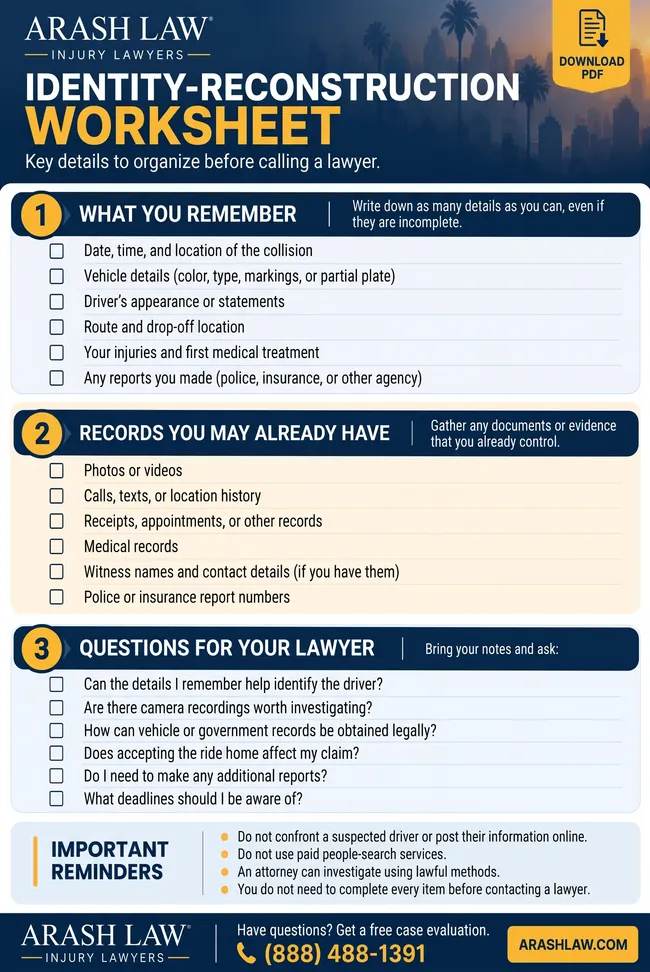
1. Write Down What You Remember
Record as many details as possible, even if some are incomplete.
- When and Where It Happened: The accident date, approximate time, street, or intersection.
- What the Vehicle Looked Like: Its color, size, type, and any unusual markings, damage, or partial license plate numbers.
- What You Remember About the Driver: Their appearance, statements, and actions before and after the collision.
- The Ride Home: Where you entered the vehicle, where the driver dropped you off, and any streets, turns, or landmarks you remember along the way.
- Your Injuries: When you first noticed pain, what symptoms you experienced, and when you received medical treatment.
- Any Reports You Made: Whether you contacted the police, your insurance company, or another agency.
If you are unsure about a detail, mark it as approximate or unknown rather than guessing.
2. Gather Records You Already Have
Some existing records may help confirm the accident timeline or provide clues about the vehicle.
- Photos and Videos: Pictures of your injuries, the accident location, or the vehicle, if available.
- Phone Records: Relevant calls, messages, and saved location history.
- Receipts and Appointments: Records that may help establish where you were before or after the accident.
- Medical Records: Documents showing your injuries and when you first sought treatment.
- Witness Information: Names and contact details of people who saw the collision or the driver, if you have them.
- Police or Insurance Documents: Any report numbers, correspondence, or claim confirmations.
You can also note possible cameras near the collision scene, along the route, or outside your home. Do not assume footage exists. An attorney can evaluate whether recordings may be available and how to request them lawfully.
3. Ask the Lawyer These Questions
Bring your notes and available records to your consultation. Consider asking:
- Can the details I remember help identify the driver?
- Are there potential witnesses or camera recordings worth investigating?
- How can relevant vehicle or government records be obtained legally?
- Does accepting the ride home affect my injury claim?
- Do I need to make any additional police or insurance reports?
- What deadlines should I be aware of?
Important: Do not confront someone you suspect was driving, publish their personal information online, or attempt to access private records. An attorney can explain which investigative methods are lawful and appropriate.
You do not need to complete every item before contacting a lawyer. Even a few reliable details can serve as a starting point for reviewing your case.
Did the Driver Break the Law by Not Giving Their Information?
Possibly. Under California law, a driver involved in a collision that causes injury must fulfill certain responsibilities. Taking an injured pedestrian home may satisfy part of the duty to assist, but it does not replace the duty to provide identifying information.
Under California Vehicle Code § 20003, the driver generally must:
- Provide identifying information. Give their name, current address, and vehicle registration number.
- Show their driver’s license. Present it upon request, when available.
- Provide reasonable assistance. Help injured individuals obtain medical treatment when necessary, including transportation when appropriate.
California Vehicle Code § 20001 also requires drivers involved in injury or fatal collisions to stop and fulfill applicable post-collision duties. A violation does not necessarily require the driver to flee immediately.
Does this mean the driver committed a hit-and-run? Not necessarily. The answer depends on what happened, what the driver knew, and whether they fulfilled their legal obligations.
A driver who stopped and took an injured pedestrian home is different from one who immediately fled. However, helping someone get home does not automatically excuse the failure to provide required information. An attorney can review the circumstances to determine whether the driver fulfilled their legal obligations.
Does Accepting a Ride Home Affect Your Injury Claim or Reporting Duties?
Accepting a ride from the driver does not automatically mean you admitted fault, released the driver from liability, or gave up your right to compensation. However, if you signed an agreement or accepted payment, an attorney should review the circumstances.
Providing transportation also does not replace the driver’s reporting duties. California law generally requires:
- A Police Report: Under Vehicle Code § 20008, qualifying injury collisions must generally be reported in writing to the appropriate law enforcement agency within 24 hours, subject to exceptions.
- A DMV Report: Drivers must submit an SR-1 form within 10 days if the collision caused injury, death, or more than $1,000 in property damage.
An injured pedestrian is not automatically responsible for the driver’s reporting obligations. However, reporting the incident can help create a record of what happened.
What Compensation Options Remain If the Driver Is Never Identified?
Even if the driver cannot be identified, you may still have options for recovering compensation. An attorney can review your insurance coverage, the available evidence, and whether another party may be legally responsible.
Can Uninsured Motorist Coverage Apply to a Pedestrian?
Yes. California Insurance Code § 11580.2 allows uninsured motorist (UM) coverage to cover qualifying pedestrian accidents. However, an unidentified driver does not automatically qualify as an uninsured motorist.
For claims involving an unidentified driver under the statute’s hit-and-run provisions, key requirements generally include:
- Physical Contact: The vehicle must have struck the insured pedestrian or otherwise met the applicable physical-contact requirement.
- Police Report: The accident must generally be reported to the appropriate police agency within 24 hours.
- Insurer Statement: The insured must generally submit a statement under oath to their insurer within 30 days of the report, explaining the claim against the unidentified person and the supporting facts.
These conditions apply to a specific UM claim pathway, not every pedestrian injury claim. Because the driver initially stopped and provided assistance, an attorney should evaluate whether these provisions apply.
What Other Compensation Options May Be Available?
Depending on the circumstances, you may be able to seek compensation for losses such as medical expenses, lost income, and pain and suffering from other sources, such as:
- The Identified Driver’s Insurance: If the driver is eventually found, you may pursue a claim against their liability insurance. UM coverage may remain relevant if they are uninsured.
- A Public Entity: If a dangerous road condition contributed to the collision, a government agency may share liability. Establishing liability requires evidence beyond the existence of a hazard.
Pedestrian accident lawyers can evaluate which options may apply.
What are the Filing Deadlines?
California generally imposes the following deadlines:
- Personal Injury Lawsuits: Two years under Code of Civil Procedure § 335.1.
- Property Damage Lawsuits: Three years under Code of Civil Procedure § 338.
- Government Injury Claims: Six months under Government Code § 911.2. Claims against state agencies, including Caltrans, may need to be filed with the Department of General Services’ Office of Risk and Insurance Management.
Missing an applicable lawsuit or government claim deadline may bar the claim, subject to exceptions. Insurance reporting requirements have separate consequences and may affect coverage.
Acting early also helps preserve evidence. Camera recordings, witness recollections, and other records may become unavailable before the legal filing deadline expires.
What Arash Law Has Recovered for Pedestrian Accident Victims
Arash Law has handled pedestrian injury claims involving disputed liability and serious injuries. The following published results illustrate the firm’s work in pedestrian accident cases, although they do not establish that the unidentified-driver scenario described here will produce a similar outcome.
$10,000,000 — Pedestrian Accident: A client suffered serious injuries after being run over by a speeding vehicle. The firm obtained a financial recovery and helped arrange medical care.
These results are published on Arash Law’s case results page.
Past results do not guarantee future outcomes. Every case depends on its facts, evidence, liability, insurance coverage, and applicable law.
If the driver who hit you left without providing their information, you may still have a path to compensation. Evidence disappears fast, and deadlines are real. Call Arash Law at (888) 488-1391 for a free case evaluation. No upfront fees. No pressure.
Frequently Asked Questions About Driver-Left-Without-Information Claims in California
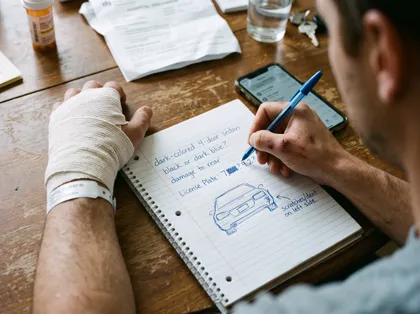
Can a Lawyer Help If I Only Remember the Driver’s Vehicle Color?
Yes. Vehicle color may be a useful starting observation when combined with an approximate time, location, route, or witness account.
Color alone is unlikely to identify a particular driver reliably. An attorney can evaluate whether other evidence helps distinguish the vehicle.
Can Intersection Cameras Identify the Driver Who Took Me Home?
Possibly, but there’s no guarantee that you can get usable footage from these cameras. An investigation must establish whether a camera existed, recorded usable images, and retained them.
Some intersection cameras are used for traffic monitoring rather than recording. Even existing footage may not show a license plate or the person driving.
Does Accepting a Ride Home Prevent Me From Filing an Injury Claim?
No. Accepting help after a pedestrian collision does not automatically waive your right to pursue compensation.
An attorney can examine the collision evidence and review any agreements or communications that might affect your rights.
What If I Did Not Get the Driver’s Insurance Information?
A lawyer can investigate lawful ways to identify the driver and determine whether applicable insurance coverage exists.
If identification is unsuccessful, counsel can review available UM coverage or other possible claims. Neither coverage nor compensation is automatic.
Can I Still Report the Collision Days Later?
Yes. You can contact the appropriate law enforcement agency to report what happened, even if time has passed.
A delayed report may affect evidence collection or particular insurance conditions. It does not automatically establish that every legal option is unavailable.
How Long Do I Have to Sue If the Driver Is Unknown?
California’s general personal injury filing deadline is 2 years from the date of injury under Code of Civil Procedure § 335.1, subject to applicable exceptions.
A shorter government claim deadline or separate insurance conditions may apply. An unknown driver’s identity does not automatically stop the filing clock.
Contact Arash Law for a Free Case Evaluation
If a driver hit you while you were walking, took you home, and left without providing identifying information, your recollection and existing records may still be useful.
Arash Law can review the circumstances, consider lawful investigative avenues, and evaluate whether the available evidence supports an injury claim. The firm cannot promise to identify the driver, obtain camera footage, establish liability, or recover compensation.
Call (888) 488-1391 for a free case evaluation based on the information you have. Arash Law handles personal injury matters on a contingency fee basis, with the attorney’s fees governed by the written agreement. Case costs and other terms should also be reviewed before signing.
Sources
- California Vehicle Code § 20001 — Duties Following an Injury or Fatal Collision https://leginfo.legislature.ca.gov/faces/codes_displaySection.xhtml?lawCode=VEH§ionNum=20001.
- California Vehicle Code § 20003 — Driver Identification and Assistance Requirements https://leginfo.legislature.ca.gov/faces/codes_displaySection.xhtml?lawCode=VEH§ionNum=20003.
- California Vehicle Code § 20008 — Written Collision Reporting Requirements https://leginfo.legislature.ca.gov/faces/codes_displaySection.xhtml?lawCode=VEH§ionNum=20008.
- California Insurance Code § 11580.2 — Uninsured Motorist Coverage and Claim Conditions https://leginfo.legislature.ca.gov/faces/codes_displaySection.xhtml?lawCode=INS§ionNum=11580.2
- California Code of Civil Procedure § 335.1 — Two-Year Personal Injury Filing Deadline https://leginfo.legislature.ca.gov/faces/codes_displaySection.xhtml?lawCode=CCP§ionNum=335.1
- California Code of Civil Procedure § 338 — Three-Year Property Damage Filing Deadline https://leginfo.legislature.ca.gov/faces/codes_displaySection.xhtml?lawCode=CCP§ionNum=338.
- California Government Code § 911.2 — Six-Month Government Claim Presentment Deadline https://leginfo.legislature.ca.gov/faces/codes_displaySection.xhtml?lawCode=GOV§ionNum=911.2
- California Department of Motor Vehicles: Driver reporting obligations, SR-1 requirements, and collision reporting guidance. https://www.dmv.ca.gov/portal/handbook/california-driver-handbook/financial-responsibility-insurance-requirements-and-collisions/.
- California Department of Justice: California Automated License Plate Reader Data Guidance, including restrictions on access, disclosure, and sharing. https://oag.ca.gov/system/files/media/2023-dle-06.pdf.
- California Department of General Services: Government Claims Program and procedures for claims involving state agencies.
https://www.dgs.ca.gov/ORIM/File-A-ClaimDisclaimer
Past results do not guarantee future outcomes. Every case is different. The information on this page is for general educational purposes and does not constitute legal advice. No attorney-client relationship is formed by reading or relying on this content. If you were injured, consult a licensed California personal injury attorney about your specific situation. Arash Law, (888) 488-1391.