TL;DR: Tell your lawyer how your daily activities have changed since the accident, when those changes began, and whether you have received professional care. A simple activity diary and available records can help document these effects without labeling them as a medical condition. A lawyer can review their possible legal relevance, but only a qualified healthcare professional can provide a medical diagnosis.
If you’re afraid to go out after an accident, tell your lawyer what has changed in your daily life. You can discuss difficulty leaving home, changes in eating habits, missed activities, or the need for help with tasks you previously handled alone. You do not need a medical diagnosis to describe these experiences.
A California personal injury lawyer can review when these changes started, how often they happen, and what records may support your account. They can also explain whether they may be relevant to a personal injury claim without treating your observations as proof of a medical condition.
Key Facts About Discussing Routine Changes After an Accident
- Medical Diagnosis: California’s non-economic damages framework recognizes emotional distress and loss of enjoyment of life. A formal psychiatric diagnosis is not always required, but the claimed harm must be supported by evidence. (California Civil Jury Instructions No. 3905A)
- Daily Activities: Changes in errands, household tasks, and social activities may be relevant when evaluating claimed emotional distress or loss of enjoyment of life. (CACI No. 3905A)
- Supporting Evidence: Personal observations and testimony may help establish emotional distress. Expert evidence may be necessary for claims involving certain psychiatric or psychological disorders. (CACI No. 3905A, Sources and Authority)
- Medical Records: California Health and Safety Code § 123110 generally allows patients to inspect and obtain copies of their health records, subject to statutory requirements and exceptions
- Attorney-Client Privacy: California Evidence Code § 954 generally protects confidential attorney-client communications. Separate rules may apply to mental health records when a condition is placed at issue in a legal proceeding. (Evidence Code § 1016)
- Possible Compensation: California law recognizes mental suffering, anxiety, emotional distress, and loss of enjoyment of life as potential non-economic damages. Recovery depends on the evidence and applicable legal requirements. (CACI No. 3905A)
Table of Contents

Since the Accident, I’ve Had a Hard Time Going Out, and My Routine Has Changed. What Information Can a Lawyer Review Regarding These Effects Without Confusing Them With a Medical Diagnosis?
A lawyer can review changes in your activities, the timing of those changes, your routine before the accident, and any supporting information you choose to share. These details help the attorney understand how the accident may have affected your daily life without assuming you have a particular medical condition.
You can discuss the following:
- Tasks, errands, or social activities that have become harder to complete.
- Whether the difficulties started immediately after the accident or appeared later.
- Activities you regularly performed before the collision.
- How often the changes occur and how long they affect your activities.
- Whether you now rely on someone else for activities you previously managed independently.
- Any medical consultation, evaluation, or treatment you have received, if applicable.
- Personal notes, appointment records, or observations from people who have noticed changes.
These details describe what you have experienced. They do not establish post-traumatic stress disorder (PTSD), an anxiety disorder, or any other medical diagnosis.
A lawyer assesses the legal significance of the information. An appropriately qualified healthcare professional can evaluate symptoms, consider possible medical causes, and determine whether a diagnosis or treatment is appropriate.
What Changes in Daily Activities Should You Tell Your Lawyer About?
You can tell your lawyer about activities that became more difficult, less frequent, or different after the accident. Focus on observable changes rather than on conclusions about their medical causes.
Changes in Errands and Activities Outside the Home
A lawyer can review whether the accident affected your ability or willingness to complete ordinary errands. For example, you may avoid grocery trips because leaving home means driving through the intersection where your crash happened. Tell your car accident lawyer which trips you avoid, how often this happens, and whether someone now drives you to certain locations.
Explain what you did before the accident and what you do now. If an activity became difficult only on certain days, include that detail.
Changes in Eating Habits and Household Routines
Changes in eating habits or household activities may provide context about how your routine has changed. You can describe eating at different times, preparing fewer meals, or needing help with household tasks.
These changes do not, by themselves, establish a medical condition or prove that the accident caused them. A lawyer can consider the surrounding facts and whether additional information is needed.
Changes in Work and Social Activities
A lawyer can also review changes in your work schedule, family responsibilities, or social activities. Examples include declining invitations, leaving events early, or having difficulty completing tasks that involve going outside.
Tell the attorney whether the change happens regularly or only under certain circumstances. This distinction can help you avoid describing an occasional difficulty as a constant limitation.
Changes in Independence and Assistance Needed
Your need for assistance may help explain changes in your independence after the accident. For example, a family member may now handle errands, provide transportation, or accompany you to activities you previously completed alone.
Describe the type of assistance, how often you need it, and whether you needed similar help before the accident.
Why Does Your Routine Before the Accident Matter?
Your routine before the accident helps a lawyer understand what changed afterward. Without that context, an attorney may not know whether an activity became difficult because of the collision or was already difficult beforehand.
Consider these questions when describing your previous routine:
- How often did you leave home for errands, work, or social activities?
- Which activities did you usually complete independently?
- Did you already need assistance with certain tasks?
- Were there earlier circumstances that affected your schedule or activities?
- Which changes began after the accident, and which were already present?
You can answer these questions without sharing unrelated personal details. The goal is to give the lawyer an accurate comparison, not to present your life before the accident as free of all difficulties.
What If You Experienced Similar Difficulties Before the Accident?
You should tell your lawyer if similar difficulties existed before the collision. This information may help distinguish an existing issue from a new or worsening change.
For example, someone who rarely attended large gatherings before an accident should not describe that preference as a new limitation. However, if the person previously completed weekly errands independently and now regularly needs assistance, that difference may be relevant.
A lawyer can review whether the available evidence supports a connection between the accident and the reported changes.
How Should You Document Changes in Your Routine?
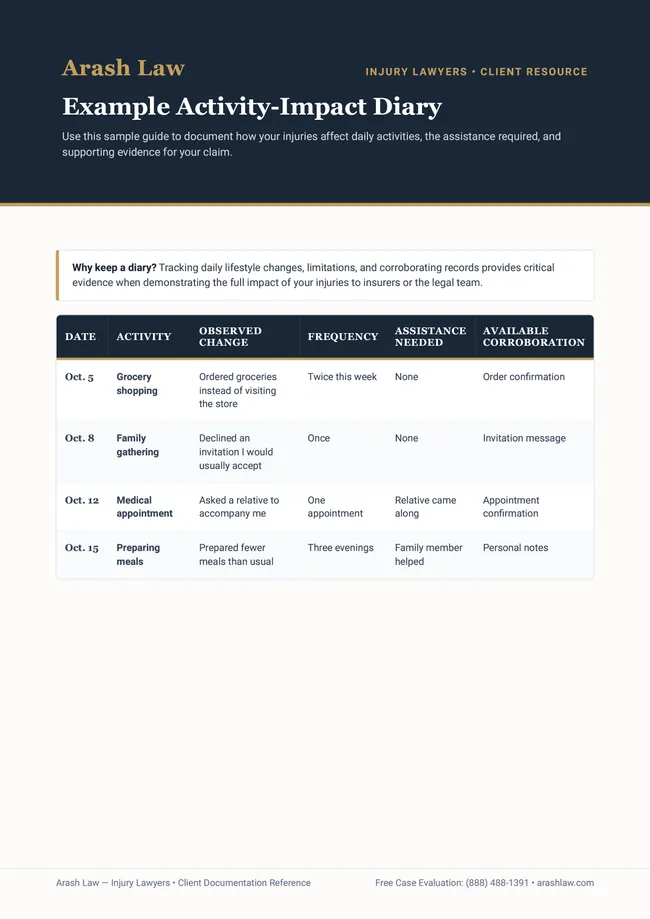
An activity-impact diary can help you organize factual information about changes in your daily life. It gives your lawyer a dated account to review, rather than requiring you to remember every detail during a consultation.
You can use a notebook, spreadsheet, or private digital document. Record only what happened and what you personally observed.
Here’s an example of how you can document changes in your routine:
These are hypothetical examples for organizing observations. They are not medical findings or a description of a particular client’s experience.
For each diary entry, try to cover at least these six details:
- Date: Record when the activity or change occurred.
- Activity: Identify the task, errand, or event involved.
- Observed Change: Explain what was different from your usual routine.
- Frequency: Record how often the change happened.
- Assistance Needed: Identify any help you received.
- Available Corroboration: Note whether messages, appointments, receipts, or other people can confirm relevant details.
You do not need to complete every field for each entry. If no supporting information exists, leave that field blank rather than creating or guessing details.
Keep Observations Separate From Medical Conclusions
Your diary should describe what happened rather than label the experience as a medical condition. For example:
| Observation | Medical Conclusion to Avoid Without Evaluation |
|---|---|
| “I declined two invitations this week because I felt uncomfortable going out.” | “I have agoraphobia.” |
| “I asked someone to accompany me to an appointment.” | “I have a permanent psychological impairment.” |
| “My eating schedule has changed since the accident.” | “The accident caused an eating disorder.” |
| “I have been going out less often than before.” | “I have severe PTSD.” |
These examples show the difference between reporting an experience and identifying a medical condition.
An accident attorney may use your observations to understand the reported changes. However, your diary does not establish a diagnosis, prove causation, or guarantee that the information will be accepted as evidence in court.
Keep Entries Accurate and Balanced
An accurate diary should include improvements, ordinary days, and activities you can still perform. You can also explain when a change may have another possible cause.
You do not need to record symptoms every hour or make your experience appear worse than it is. Consistent, factual entries are more useful than exaggerated descriptions.
If you begin keeping a diary weeks after the accident, use the actual date you wrote each entry. You can describe earlier events from memory while making clear that the entry was written later.
Accurate documentation also means preserving original records and avoiding guesses about what happened. Understanding common mistakes people make after a vehicular accident may help you avoid errors when organizing information for a legal consultation.
What Records Can a Lawyer Review During a Consultation?
Lawyers can review records documenting changes in your daily life and medical well-being, as well as observations from people familiar with your routine. You can begin with the materials you already have and discuss whether additional records are necessary.
Personal and Activity Records
Personal records may help show changes in your routine. Depending on your circumstances, these may include:
- Calendar entries showing postponed or missed activities.
- Messages about canceled plans or requests for assistance.
- Appointment confirmations.
- Receipts or service records reflecting changes in regular activities.
- Notes recording dates and specific observations.
These records provide context. They do not automatically establish the reason for a change or prove that an accident caused it.
Medical Records and Professional Care
Medical records may help a lawyer understand whether you sought professional care and what a healthcare provider documented. Relevant materials may include appointment summaries, treatment records, or recommendations from a provider.
You can tell your lawyer whether you have received care without assuming that treatment was required or that a diagnosis exists.
If you have not sought professional care, you can still describe your experiences during a consultation. A lawyer can explain how the available evidence may affect the evaluation of a claim.
Under California Health and Safety Code § 123110, patients generally have rights to inspect and obtain copies of their health records, subject to the statute’s requirements and exceptions.
Observations From Other People
People familiar with your routine may help document changes they personally noticed after the accident. A family member, coworker, or friend might confirm that you stopped attending certain activities or began asking for help with errands.
Their observations should remain factual and should not be treated as medical diagnoses. An attorney can determine whether these accounts are relevant and how they should be collected.
Legal Documentation Vs. Medical Evaluation
Legal documentation helps a lawyer assess how changes in your daily life may affect a claim. Medical evaluation helps a healthcare professional assess your health and care needs. You can describe your experiences to a lawyer without assuming they establish a medical condition.
| Legal Review | Medical Evaluation |
|---|---|
| Reviews reported changes in daily activities. | Assesses reported symptoms and health concerns. |
| Compares activities before and after the accident. | Reviews relevant medical history. |
| Examines available evidence and possible causes. | Evaluates possible medical explanations. |
| Considers whether legal requirements are met. | Determines whether a diagnosis is appropriate. |
| Assesses possible damages under applicable law. | Recommends treatment or follow-up care when appropriate. |
An accident lawyer should not identify PTSD, agoraphobia, or another psychiatric condition based solely on descriptions of changed activities.
Likewise, a medical diagnosis does not automatically establish that another person is legally responsible for the condition. Legal responsibility requires a separate review of the applicable law and evidence.
How Does a Lawyer Evaluate Whether Changes in Your Routine Support Compensation?
A lawyer evaluates whether changes in your routine support compensation by reviewing their timing, your previous activities, available records, and other possible causes. They assess whether the evidence shows that the defendant’s conduct substantially contributed to your harm. Changes that began after an accident do not, by themselves, prove causation or establish a right to compensation.
In a California negligence claim, you generally must show that the defendant’s conduct was a substantial factor in causing your harm. Changes that began after the accident do not, by themselves, prove that connection.
Changes in daily activities may help show mental suffering, anxiety, emotional distress, or loss of enjoyment of life. CACI No. 3905A recognizes these as potential non-economic damages. However, changes in your routine do not automatically establish a right to compensation.
You do not always need a psychiatric diagnosis to establish emotional distress damages. Some claimed conditions or injuries may require medical or expert evidence. Your lawyer can review your experiences without labeling them as a medical condition.
How Can You Protect Your Privacy When Sharing Personal Information?
You can discuss sensitive changes in your routine during a private legal consultation, even before hiring a lawyer. California law provides confidentiality protections for qualifying communications with prospective clients and people receiving legal representation.
During an Initial Consultation: California Rule of Professional Conduct 1.18 generally protects confidential information shared during a qualifying consultation for legal services, even if the lawyer does not take the case. Unsolicited communications may not receive the same protection. A consultation does not automatically establish an ongoing attorney-client relationship.
During Legal Representation: An attorney-client relationship may arise by agreement or by the parties’ conduct. Although a signed agreement is not required in every situation, California Business and Professions Code § 6147 generally requires a written agreement for contingency-fee representation. California Evidence Code § 954 generally protects qualifying confidential attorney-client communications.
Limits on Privacy: These protections have exceptions. Disclosure to third parties, applicable waiver rules, or other legal requirements may affect confidentiality. If you pursue a personal injury claim, certain medical or personal records may also become relevant.
You can ask a lawyer what information is necessary for the consultation, how it will be protected, and whether the firm has agreed to represent you before sharing additional sensitive records.
What Happens If You Pursue a Personal Injury Claim?

Some personal or medical information may become relevant if you pursue damages connected to your emotional or mental condition. California Evidence Code §§ 1014 and 1016 address the psychotherapist-patient privilege and an exception involving communications relevant to a condition placed at issue in a legal proceeding. This exception does not automatically make every mental health record available.
An attorney can explain whether particular records may become subject to disclosure and what steps may help protect information that is not relevant to the case.
You can also ask the lawyer to explain:
- Which records are needed for the initial consultation.
- Whether you should provide copies or original documents.
- Who may receive information if a claim proceeds.
- How sensitive information may be handled during negotiations or litigation.
Privacy concerns are a valid topic for a consultation. An accident attorney can discuss the legal review process without requiring you to disclose unrelated intimate details.
Not Sure What Information to Share With a Lawyer? Call Arash Law
Arash Law can help you identify which details about your changed routine may be relevant to an accident claim. You can discuss your concerns and ask questions during a private consultation without needing a medical diagnosis. Call us at (888) 488-1391 to discuss your situation in a free case review.
Frequently Asked Questions About Discussing Routine Changes After an Accident
Will I Have to Share My Entire Mental Health History?
Not necessarily. The records that may become relevant depend on the nature of your claim and the conditions placed at issue. A lawyer can explain which information may be needed and what privacy protections apply before you share sensitive records.
Do I Need to Keep an Activity Diary Every Day?
No. You can record meaningful changes when they happen, including days when your usual activities become easier. An accurate diary does not require daily entries, but you should avoid guessing dates or adding details you cannot remember.
What If I Cannot Remember Exactly When My Routine Changed?
You can tell your lawyer if you are unsure of the exact date. Appointment records, messages, calendars, and other dated information may help establish a timeline. Avoid guessing or presenting an estimated date as certain.
Should I Share My Activity Diary With the Insurance Company?
No, not automatically. You do not necessarily have to give an insurance adjuster your entire activity diary simply because they request it. However, relevant entries may become subject to disclosure during litigation. A lawyer can review the diary and explain your obligations. Preserve the original entries without changing or deleting them.
Talk to Arash Law About Changes in Your Daily Routine
Arash Law can privately review the changes you have experienced since an accident and explain how they may relate to a California personal injury claim. You can begin by describing what happened, which activities have changed, and what supporting information is available.
Our attorneys can assess the legal issues without treating your observations as a medical diagnosis. They can also discuss relevant evidence, privacy concerns, and filing deadlines.
Call (888) 488-1391 to discuss your situation with Arash Law.
Sources
- California Civil Jury Instructions (CACI) No. 3905A — Physical pain, mental suffering, emotional distress, and other non-economic damages. https://courts.ca.gov/system/files/file/judicial_council_of_california_civil_jury_instructions_2026.pdf
- California Civil Jury Instructions (CACI) No. 430 — Substantial-factor causation standard in negligence cases. https://courts.ca.gov/system/files/file/judicial_council_of_california_civil_jury_instructions_2026.pdf
- California Health and Safety Code § 123110 — Patient rights to inspect and obtain copies of medical records.
https://leginfo.legislature.ca.gov/faces/codes_displaySection.xhtml?lawCode=HSC§ionNum=123110.- California Evidence Code § 951 — Definition of a client, including qualifying consultations for legal advice or representation.
https://leginfo.legislature.ca.gov/faces/codes_displaySection.xhtml?lawCode=EVID§ionNum=951.- California Evidence Code § 954 — Attorney-client privilege protecting confidential communications.
https://leginfo.legislature.ca.gov/faces/codes_displaySection.xhtml?lawCode=EVID§ionNum=954.- California Evidence Code § 1014 — Psychotherapist-patient privilege protecting qualifying confidential communications.
https://leginfo.legislature.ca.gov/faces/codes_displaySection.xhtml?lawCode=EVID§ionNum=1014.- California Evidence Code § 1016 — Exception to psychotherapist-patient privilege when a mental or emotional condition is placed at issue in a legal proceeding.
https://leginfo.legislature.ca.gov/faces/codes_displaySection.xhtml?lawCode=EVID§ionNum=1016.- California Rules of Professional Conduct, Rule 1.18 — Confidentiality duties owed to prospective clients, including when no ongoing representation follows.
https://www.calbar.ca.gov/legal-professionals/rules/rules-professional-conduct/current-rules-professional-conduct/chapter-1-lawyer-client-relationship- California Rules of Professional Conduct, Rule 1.6 — Confidentiality of protected client information and limited exceptions.
https://www.calbar.ca.gov/legal-professionals/rules/rules-professional-conduct/current-rules-professional-conduct/chapter-1-lawyer-client-relationshipDisclaimer
This article is for educational purposes only and does not provide legal or medical advice. Changes in daily activities after an accident do not automatically establish a medical diagnosis or a right to compensation. Reading this article does not create an attorney-client relationship. Consult a licensed California attorney about your legal options and a qualified healthcare professional about medical concerns. For questions about your accident claim, contact Arash Law at (888) 488-1391.