
TL;DR: A lawyer can check official records, contact identified insurers, and review relevant policies to investigate the other driver’s insurance. A missing insurance card or verbal statement does not confirm that the driver was uninsured. If no liability coverage applies, the injured person’s own insurance may provide another option.
A lawyer can verify whether the other driver had insurance by reviewing collision reports, requesting Department of Motor Vehicles (DMV) records, and contacting identified insurers. The attorney can also check the vehicle owner’s insurance and other policies that might have covered the accident. These steps help determine whether the driver had applicable coverage on the date of the crash.
Being told that the other driver “might not have insurance” does not confirm that the driver was uninsured. A missing insurance card, incomplete police report, or verbal statement may leave questions about coverage unanswered. A lawyer can examine the available records, request written clarification from insurers, and review your own insurance policies.
Table of Contents

I Was Told that the Other Driver May Not Have Insurance, but I Haven’t Confirmed This. What Can a Lawyer Check Before Deciding There Are No Options?
A lawyer can investigate the other driver’s insurance before concluding that no coverage exists. A statement from someone at the scene or at a police department does not necessarily mean anyone verified the driver’s policy.
An attorney can assess the information based on its source and supporting records. Different situations require different follow-up steps:
| Situation | What a Lawyer Can Check |
|---|---|
| Secondhand Information: Someone says the driver might not have insurance. | Identify the source and review any supporting records. Without verification, the driver’s insurance status remains unknown. |
| Missing Insurance Card: The driver could not provide proof of insurance at the scene. | Examine the collision report and contact any insurer identified in the records. The absence of proof does not establish that the driver lacked coverage. |
| Pending Insurance Investigation: An insurer is still checking whether a policy covers the accident. | Request updates and identify the coverage issues under review. These may involve the policy dates, driver, or vehicle. |
| Written Coverage Decision: An insurer confirms or denies coverage in writing. | Review the decision and its stated reasons. A denial may apply only to a particular policy, driver, vehicle, or accident. |
A witness may help confirm the driver’s identity or vehicle details. However, a witness’s account does not necessarily establish that insurance coverage existed or was absent.
Beyond these statements, a lawyer can check the driver’s identity, vehicle ownership, and accident date. Collision reports, insurance cards, claim numbers, emails, and insurer letters can help identify the next steps.
The attorney can also check any applicable policies that may cover the vehicle’s owner or the driver’s employer, depending on the circumstances. If you have auto insurance, the attorney can review your policy for uninsured motorist coverage. This investigation does not guarantee that another policy exists or that an insurer will provide coverage.
The goal is to separate confirmed information from unanswered questions before deciding which insurance options may be available.
Key Facts About Verifying Insurance After a Crash
- A missing insurance card never proves a driver lacked coverage. California Vehicle Code § 16025 requires drivers to exchange identifying information and evidence of financial responsibility after a collision.
- Police reports may contain unverified insurance information. The collision report may document information exchanged under Vehicle Code § 16025. It does not guarantee that an insurer confirmed coverage.
- DMV records have limits. Form SR 19C allows eligible parties to request information on available financial responsibility. The DMV does not maintain complete insurance records for every vehicle.
- A written denial identifies an insurer’s position. California Code of Regulations, Title 10, § 2695.7 requires written notice when insurers deny or reject third-party claims.
- Court discovery can identify relevant insurance agreements. Code of Civil Procedure § 2017.210 allows parties to obtain certain insurance information during litigation, including coverage limits and the existence of coverage disputes.
Insurance Verification Ladder for a California Car Accident
A lawyer can compare different sources of information to determine which insurance details remain unconfirmed. The following table shows how each statement may affect the investigation.
| What Was Said | Who Said It | Supporting Documentation | Remaining Uncertainty | Next Appropriate Question |
|---|---|---|---|---|
| The other driver might not have insurance. | Someone at the police department. | Intake notes describing the conversation. | No verified policy search or insurer response. | Did anyone contact an insurer to verify coverage? |
| The driver could not provide an insurance card. | Driver or responding officer. | Collision report or insurance exchange records, if available. | The driver’s actual insurance status. | Does another available record identify an insurer? |
| The insurer is investigating coverage. | Insurance adjuster. | Claim number, email, or status letter. | The insurer has not reached a final coverage decision. | Which coverage issues remain under review? |
| The insurer confirmed or denied coverage. | Insurance company. | Written confirmation or denial. | The scope and basis of the coverage decision. | Which policy, driver, vehicle, and date does the decision address? |
| No insurance information was found. | California DMV. | DMV Form SR 19C response. | Missing records may not establish a lack of insurance. | Does the response certify uninsured status or report that information as unavailable? |
These examples show different stages of verification, not findings established in every accident. A lawyer can use the documents to identify which inquiries are appropriate.
The attorney may also review your insurance declarations page and applicable coverage. This review helps identify possible benefits without assuming that an undisclosed policy exists.
How Can a Lawyer Verify the Other Driver’s Insurance in California?
A lawyer can review accident records, contact insurers, and use legal procedures to investigate the other driver’s coverage. The investigation focuses on the insurance in effect on the date of the accident, not just the driver’s current coverage.
- Review the Police or Collision Report: A lawyer can request the report from the California Highway Patrol (CHP), the local police, or another investigating agency. It may identify the driver, registered owner, insurer, and policy number. However, the report may contain incomplete or unverified insurance information.
- Contact the Identified Insurance Company: A lawyer can ask the insurer to confirm coverage on the date of the accident. The company may confirm coverage, report an ongoing investigation, or deny coverage. If questions remain, the attorney can request a written explanation about the policy, driver, or vehicle involved.
- Request Insurance Information From the DMV: A lawyer can submit Form SR 19C to request available financial responsibility records or an uninsured motorist certification. The DMV charges $20 per requested document and advises allowing 30 days for processing. However, missing DMV records do not necessarily prove the driver lacked insurance. The DMV uses SR 1 accident report forms to establish financial responsibility records. If no SR 1 was previously filed, you may complete one and attach it to your SR 19C request. A police report cannot replace the SR 1. The DMV may also reject a request if it received the SR 1 more than one year after the accident.
- Use Formal Discovery During Litigation: If a lawsuit is filed, a lawyer can request relevant insurance information under California Code of Civil Procedure § 2017.210. Discovery may identify insurers, policy limits, and coverage disputes. However, it does not automatically provide unrestricted access to an insurer’s internal files.
These steps may confirm coverage or show that further investigation is necessary. A lawyer can explain the findings without assuming another insurance policy exists.
What Other Insurance Can a Lawyer Check?
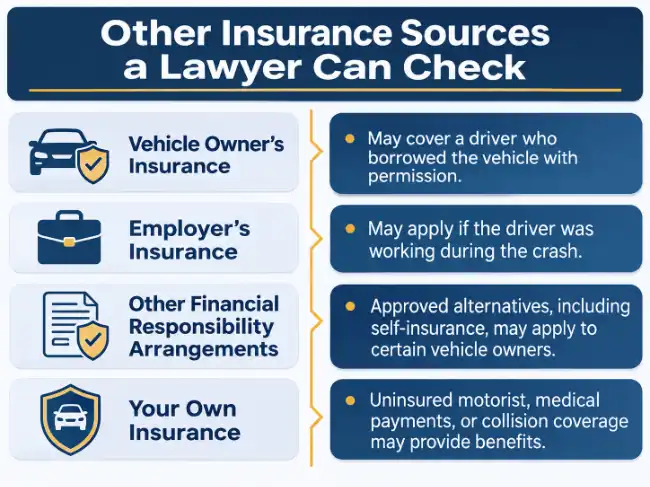 A lawyer can check whether another policy covers the crash based on who owned the vehicle, how the driver used it, and your existing coverage.
Other insurance policies that a lawyer can check include:
- Vehicle Owner’s Insurance: If the at-fault driver only borrowed the vehicle with permission, the owner’s policy may cover your losses. Coverage depends on the policy terms and applicable exclusions.
- Employer’s Insurance: Commercial coverage may apply if the driver was performing work duties at the time of the accident. The lawyer can review the driver’s employment and vehicle use.
- Other Financial Responsibility Arrangements: Some vehicle owners meet California’s financial responsibility requirements through approved alternatives, including self-insurance. These arrangements require separate verification.
- Your Own Insurance: Uninsured motorist, medical payments, or collision coverage may provide benefits, depending on your policy.
Your policy’s declarations page identifies the coverages and limits you purchased. A lawyer can examine your uninsured motorist coverage while investigating the other driver’s insurance.
A car accident lawyer can also review the circumstances of the crash and identify potentially responsible parties. Finding an insurance policy does not automatically establish fault or guarantee payment.
What Does a Written Insurance Denial Mean?
A written insurance denial does not always mean the driver lacked coverage. The reason for the denial determines what the statement establishes.
An insurer may reject a claim because it disputes the driver’s responsibility for the crash. This scenario differs from denying coverage because a policy was inactive or did not cover the driver.
A lawyer can review the denial to identify the company’s position and the policy involved. If the letter addresses only one policy, it does not automatically establish that no other coverage exists.
The attorney may need to clarify the denial before treating the driver as uninsured. A written decision provides useful evidence, but its scope must align with the facts of the accident.
Arash Law can review the available accident records and insurance communications during a free case evaluation. Call (888) 488-1391 to discuss the information you have and any remaining questions.
What If the Other Driver Really Has No Insurance?
If the investigation confirms that no applicable liability insurance covers the accident, you may still have options. The next step depends on your insurance policy, the driver’s responsibility, and other available evidence.
Your own uninsured motorist coverage may help pay for injuries caused by an uninsured driver. Medical payments or collision coverage may also provide separate benefits under your policy.
You can also pursue an at-fault driver personally. However, winning a judgment does not guarantee payment. A lawyer can assess whether the driver has income or assets available for collection and explain the practical costs of proceeding.
Steps to Take If You Were Told the Driver May Be Uninsured
You do not need to confirm the other driver’s insurance before seeking medical attention or legal assistance. However, preserving the information you have can help a lawyer investigate coverage.
Consider these steps while the driver’s insurance status remains uncertain:
- Record what you were told. Write down who said the driver might be uninsured and when the conversation occurred. Include the person’s exact statement if you remember it.
- Keep the accident information. Save the collision report number, driver’s information, license plate details, photographs, and available insurance records. Keep any witness contact information you already received.
- Notify your insurance company. Report the accident promptly, even if you believe the other driver caused it. Explain that the driver’s insurance status remains unconfirmed. Ask about your uninsured motorist coverage and other applicable benefits.
- Save insurance communications. Keep emails, claim numbers, letters, and adjuster contact information. If an insurer denies coverage, request its decision in writing.
- Arrange a legal review. Share the available records with a car accident lawyer. The attorney can identify missing information, contact appropriate parties, and explain your options.
You can take these steps without waiting for the police department to confirm coverage. Your policy’s notice requirements and California’s legal deadlines may continue to apply during the investigation.
Mistakes to Avoid When the Other Driver’s Insurance Is Unconfirmed
Avoid treating uncertain insurance information as a final answer or delaying action while someone checks coverage. These mistakes can make it harder to evaluate your options:
- Assuming the Driver Is Uninsured: A missing insurance card or verbal statement does not establish that no policy exists. Supporting records may be needed before reaching that conclusion.
- Confusing a Denied Claim With No Insurance: An insurer may reject your claim because it disputes responsibility for the crash. That does not necessarily mean the driver lacked coverage.
- Waiting Too Long to Notify Your Insurer: Your policy may require prompt notification of an accident. Delaying notice while awaiting the other driver’s insurance information could create coverage problems.
- Accepting Payment Without Reviewing the Terms: Signing a settlement release too soon is one of the things you should not do after an accident. Review any proposed settlement or release before signing. A lawyer can guide you during this stage.
- Stopping Medical Treatment Because Coverage Is Uncertain: Insurance questions do not determine your medical needs. Continue following your treating provider’s advice and keep records of your care.
You should not wait for insurance verification before addressing urgent medical needs or reporting the accident. A lawyer can review available information before you make decisions that affect your claim.
How Long Can You Wait to Confirm the Other Driver’s Insurance?
California has no single deadline for confirming another driver’s insurance. However, legal and policy deadlines may expire while you investigate.
Under Code of Civil Procedure § 335.1, most personal injury lawsuits must be filed within two years. Certain exceptions may change that period.
Uninsured motorist claims have separate requirements under California Insurance Code § 11580.2. Generally, you must take one of three actions within two years of the accident to preserve the claim.
- File a qualifying lawsuit against the uninsured driver.
- Reach an agreement with the insurer on the amount due.
- Formally start arbitration by notifying the insurer through certified mail, return receipt requested.
Simply reporting the accident to your insurer may not preserve your uninsured motorist claim.
California also requires drivers to file DMV Form SR 1 within 10 days after qualifying accidents. This generally means a crash that causes injury, death, or more than $1,000 in property damage.
A lawyer can review these deadlines during coverage investigation. Waiting for an insurer’s response does not automatically extend your deadline to act.
Frequently Asked Questions About Verifying Insurance After a California Car Accident
Can a Lawyer Verify Insurance Without Filing a Lawsuit?
Yes. A lawyer can review collision reports, contact identified insurers, and request available DMV information without filing a lawsuit. However, certain documents may require formal legal procedures or appropriate authorization.
Can the Police Confirm if the Other Driver Had Insurance?
Police may record the information a driver provides, but that does not guarantee coverage was verified. A collision report may identify an insurer or document that the driver failed to provide proof of insurance.
Can the Other Driver Have Insurance Without Being Named on the Vehicle Owner’s Policy?
Yes. Some automobile policies cover people who drive the insured vehicle with the owner’s permission. However, the policy terms, exclusions, and accident circumstances determine if coverage applies.
Does an Insurer Have to Share Its Entire Policy With Me?
Not necessarily. An insurer may provide information about its coverage position without releasing every policy document before litigation. Formal discovery may provide access to relevant insurance agreements after a lawsuit begins.
Can a Lawyer Check Every Insurance Company for an Undisclosed Policy?
A lawyer cannot guarantee a search of every insurer or access to every private insurance record. The investigation depends on available evidence, lawful requests, and applicable discovery procedures.
The absence of a confirmed policy does not necessarily mean there is no insurance.
Ask Arash Law to Review the Other Driver’s Insurance Information
If someone told you the other driver might not have insurance, available records may help clarify the situation. You do not need all the answers before requesting a legal review.
Arash Law offers a free case evaluation to discuss the accident, existing insurance communications, and possible next steps. Our team can assess the known facts without assuming another source of coverage exists.
Call (888) 488-1391 to discuss your situation. A consultation does not guarantee case acceptance, available insurance, or compensation.
Sources
- California DMV, Financial Responsibility Information Request (Form SR 19C). Insurance records and uninsured motorist certification requests.
https://www.dmv.ca.gov/portal/file/financial-responsibility-information-request-sr-19c-pdf/- California DMV, Accident Reporting. Requirements for reporting qualifying accidents using Form SR 1.
https://www.dmv.ca.gov/portal/dmv-virtual-office/accident-reporting/- California Department of Insurance, Fair Claims Settlement Practices Regulations. Requirements for insurer investigations and written claim decisions.
https://www.insurance.ca.gov/01-consumers/130-laws-regs-hearings/05-CCR/fair-claims-regs.cfm- California Department of Insurance, Automobile Insurance Guide. Liability insurance, uninsured motorist coverage, and other policy benefits.
https://www.insurance.ca.gov/01-consumers/105-type/95-guides/01-auto/auto101.cfm- California Code of Civil Procedure § 2017.210. Discovery of insurance agreements during litigation.
https://leginfo.legislature.ca.gov/faces/codes_displaySection.xhtml?lawCode=CCP§ionNum=2017.210.- California Insurance Code § 11580.2. Uninsured motorist coverage and statutory claim requirements.
https://leginfo.legislature.ca.gov/faces/codes_displaySection.xhtml?lawCode=INS§ionNum=11580.2.- California Code of Civil Procedure § 335.1. General two-year deadline for personal injury lawsuits.
https://leginfo.legislature.ca.gov/faces/codes_displaySection.xhtml?lawCode=CCP§ionNum=335.1.- California Vehicle Code § 16025. Information drivers must exchange after certain collisions.
https://leginfo.legislature.ca.gov/faces/codes_displaySection.xhtml?lawCode=VEH§ionNum=16025.- California DMV, Financial Responsibility Information Request (Form SR 19C). Notice and DMV-use-only section on page 1.
https://www.dmv.ca.gov/portal/file/financial-responsibility-information-request-sr-19c-pdf/- California DMV, Accident Reporting. Separate 10-day filing requirement for qualifying accidents using Form SR 1.
https://www.dmv.ca.gov/portal/dmv-virtual-office/accident-reporting/Disclaimer
The information on this page is for general educational purposes and does not constitute legal advice. No attorney-client relationship is formed by reading or relying on this content. If you were injured, consult a licensed California personal injury attorney about your specific situation. Arash Law: (888) 488-1391.