TL;DR: If someone crosses double solid lines and hits you, they are usually at fault for violating California lane laws. Head-on and sideswipe crashes often cause serious injuries, and you have 2 years to file a lawsuit or lose the right to pursue compensation.
Highlights:
- Get medical care immediately, then follow all treatments and referrals.
- Photograph lane markings, vehicle positions, debris, and skid marks before cars move.
- Ask witnesses for contact info and a quick statement of what they saw.
- Locate and request nearby dashcam, traffic, or business surveillance footage fast.
- Request the police collision report and note any citation for lane violations.
- Track bills, missed work, and symptoms daily to document your damages.
- Calendar the 2-year lawsuit deadline and consult counsel well before it.
Tip: When speaking with insurers, stick to clear facts and preserve all photos, messages, and repair estimates.
Table of Contents
After a crash where a driver crosses double solid lines, the case usually moves into an insurance investigation and claims process. The insurance companies review evidence to decide who is at fault. Even if the driver who crossed the lines is often blamed early, the final fault depends on all the facts.
Crossing yellow or white lines and causing a crash is strong evidence of negligence. However, fault can still depend on the situation and whether any exceptions apply. Understanding these rules helps explain how insurance companies decide fault and what options may be available after an injury.
What Happens After You Are Hit By A Driver Who Crossed Double Solid Lines
When a driver crosses double solid lines and hits you, they may be responsible for any injuries or losses you sustain. You may be eligible to pursue compensation from them through an insurance claim. This claim moves through several steps, including the first report, medical records, and a review of who caused the crash:
- Insurance Investigation: Insurance companies open an investigation upon receiving notice of the crash. They review police reports, photos, witness statements, and available video footage to determine whether the driver crossed double solid lines. The at-fault driver’s insurer typically leads the liability review.
- Fault Determination and Liability Review: Insurers evaluate whether the illegal lane crossing caused the crash and whether comparative fault applies. A clear violation of traffic law often leads to an early fault decision, but insurers still analyze all available evidence. Final liability depends on the full facts of the case, not just the traffic citation.
- Medical Documentation and Claim Valuation: Insurance adjusters review the injured person’s medical records to calculate the value of the claim. They examine hospital visits, treatment plans, and ongoing care to connect injuries to the crash. These records help determine medical costs, lost income, and other related losses.
- Settlement Negotiation Process: The insurer presents a settlement offer after it evaluates liability and damages. The first offer is often lower than the total claim value as the insurer attempts to resolve the case quickly. Negotiations continue until both sides agree on a final amount, or the claim moves toward litigation.
- Litigation: If the insurer denies liability or refuses to offer a reasonable settlement, the case may proceed to a lawsuit. During litigation, both sides exchange evidence and may take depositions to support their positions. Many cases still resolve through settlement before reaching trial.
What Are California’s Rules On Double Solid Lines?
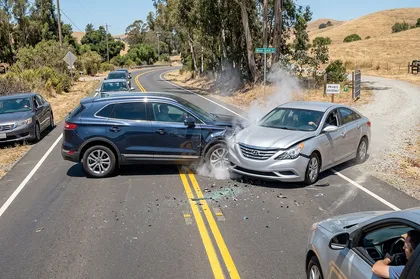 State law generally prohibits drivers from crossing double solid yellow or white lines. Yellow double solid lines separate traffic moving in opposite directions. White double solid lines separate lanes moving in the same direction, including HOV (carpool) lanes. Drivers cannot cross these lines except in limited situations.
Here are the state’s general rules regarding double solid lines:
- On two-way roads with yellow double solid lines, drivers must remain on their side of the road. They may cross only where exceptions, such as lawful turns, are permitted.
- On freeways with white double solid lines, the California DMV Driver Handbook says drivers need to stay in their lane. They can only cross the line at the designated access point where the markings break.
- Some roads also use double yellow lines with intermittent barriers to separate traffic in opposite directions. Drivers cannot enter or cross this divider except at marked openings. The law treats this gap as a physical divider, not just a painted marking.
Driving on the wrong side of a road with double solid lines in California is a serious traffic offense that can lead to an infraction. These rules apply whether the driver crossed intentionally or by mistake. Though a citation won’t automatically establish a driver’s fault for an accident, it may be considered along with other evidence as proof of their negligence. Liability depends on the overall circumstances.
Legal Exceptions: When Can You Cross Double Lines?
California Vehicle Code § 21460 generally prohibits crossing double solid yellow or white lines, with limited exceptions depending on roadway markings and conditions. That matters if the other driver claims they had a legal reason to enter your lane.
Typically, it’s legal to cross double lines in these situations:
- Left Turn at an Intersection or Driveway: A driver may cross double solid yellow lines when making a lawful left turn into an intersection, driveway, or private road.
- Lawful U-Turn: A driver may make a U-turn where signs and road conditions allow, provided it can be done safely.
- Broken Lines on the Driver’s Side: A driver may cross a broken yellow or white line when passing or changing lanes if it’s safe to do so.
Even when the law allows a driver to cross, the driver must still signal, yield to oncoming traffic, and complete the maneuver safely.
A legal exception does not relieve the driver of liability if the driver acts carelessly and causes a crash. A driver may still be responsible for a crash if they fail to yield, misjudge distance, or enter the lane unsafely. Fault depends on how the maneuver was performed, not just whether the driver was allowed to cross. A crash can support evidence of unsafe driving, but fault still depends on all surrounding circumstances.
How Negligence Per Se Applies After These Accidents
To have a valid claim, victims must prove that the other driver was negligent. State law imposes a duty of care on all drivers to act reasonably to prevent harm. When they don’t, such as by speeding or texting while driving, they can be considered negligent. If you were hit by someone who crossed double solid lines, you may not have to prove ordinary negligence because the legal principle of negligence per se may apply.
Under this legal principle, a driver who violates a safety law and causes harm may create a presumption of negligence. Rather than demonstrating that their carelessness caused the accident, you would instead have to show that the driver directly caused the crash, your injuries, and your losses because they broke a traffic law.
A double-line violation may support a negligence per se argument, but fault still depends on causation, available evidence, and any rebuttal or comparative-fault issues.
California follows a pure comparative fault rule. A person can still recover damages even if they share some responsibility for the crash. However, any recovery is reduced based on their percentage of fault. That matters because the at-fault driver’s insurer may use pure comparative fault to shift more of the blame to you and reduce the amount it owes.
The right evidence can show that the crossing happened and that it caused the crash. An experienced car accident lawyer can help gather and preserve this evidence before it disappears:
- Scene Photos and Video: Images of the road markings, including where yellow and white lines appear, along with vehicle positions and skid marks.
- Surveillance Footage: Video from security cameras, or dashcams, that captured the crossing before impact.
- Eyewitness Accounts: Statements from bystanders or other drivers who saw the crossing occur.
- Police and Collision Reports: Official records noting contributing factors and any issued citation.
Injuries, Compensation, And Deadlines In Double Solid Line Crashes
When a driver crosses yellow or white double solid lines, they may cause a head-on or sideswipe collision. These crashes can create a strong impact that can cause severe injuries and long recovery times.
Victims may sustain traumatic brain injuries, even when a seatbelt is worn. These injuries can affect memory, focus, and daily activities. Broken bones are also common and may require surgery and physical therapy.
The force of impact can also injure soft tissue in the neck, leading to whiplash. Whiplash affects muscles, ligaments, and tendons and may require ongoing medical care from a chiropractor or other doctor. Some victims also experience internal injuries or emotional trauma, such as PTSD.
California law allows injured victims to seek compensation for the losses these injuries cause, including:
- Medical bills
- Future treatment costs
- Lost income
- Reduced earning capacity
- Pain and suffering
However, you only have a limited time to pursue these damages. Under the statute of limitations in California, you generally only have two years from the date of the crash to file a personal injury lawsuit. Missing this deadline will generally mean losing your right to sue. Certain exceptions may apply based on your situation.
In these cases, many victims think, “Do I need a personal injury lawyer?” A traffic accident lawyer can review these cases, assess fault, and explain the next steps based on the facts of the accident.
What Should I Do After a Crash Involving Double Solid Lines?
If it’s safe to do so after the accident, consider taking steps to gather evidence at the scene. Proof of a crash involving double solid lines may get erased quickly, especially on busy roads where heavy traffic can degrade skid marks and other signs of what occurred. From here, seek immediate medical attention and be cautious when discussing the incident with others.
These steps can help you preserve both your health and ability to file a claim:
-
Call law enforcement and obtain the collision report.
An official accident report from the California Highway Patrol or local police may document lane positions, statements, citations, and officer observations. Though this document is not required to file a claim and does not establish legal fault, it can provide details like the time and date of the crash, where it occurred, and the contact information of the drivers and witnesses involved.
-
Photograph the roadway markings.
Capture images of the double solid lines, vehicle positions, skid marks, traffic signs, and surrounding conditions.
-
Collect witness information.
Witnesses can serve as unbiased third parties who can provide a fresh perspective on how the accident occurred. They can help establish specific facts, such as whether the other driver crossed into your lane.
-
Seek medical care promptly.
Some crash injuries, such as concussions and internal bleeding, may not appear immediately. Visiting a doctor right away, such as within 24 hours of your crash, can help you get diagnosed and treated before those injuries worsen. A doctor can also create records that link those injuries to the accident.
-
Stick to the facts when talking to others.
The other party’s insurer may review statements when evaluating liability. Even a simple “I’m sorry” or “I’m fine” can give them grounds to argue that you helped cause the crash or that your injuries aren’t as severe as they actually are.
FAQs About Accidents Caused By Drivers Who Cross Double Solid Lines
Injured people often look for free advice from a car accident attorney when they have questions about accidents involving centerline rules in California. These answers explain how traffic laws can affect fault assessments when claims arise from these crashes.
Is It Legal To Cross Double Yellow Lines To Make A Left Turn Into A Parking Lot?
Yes, you may cross double yellow lines to turn left into a driveway, parking lot, or private road, provided it’s allowed. You must yield to oncoming traffic and complete the Turn safely. If traffic is too close or a sign restricts the Turn, the exception does not apply.
Can You Pass A Slow Car By Crossing A Solid Yellow Line?
No. Crossing solid yellow or double yellow lines to pass another car is prohibited in California unless the line on your side is broken. If you are on the broken-line side, you may cross to pass. If a solid line is on your side, passing is not permitted, no matter how slowly the other car is moving.
What Happens If I Hit A Car Illegally Parked On Double Yellow Lines?
Both drivers may share fault depending on the circumstances. The driver of a parked vehicle may bear some responsibility if they stopped unlawfully or created a hazard. The moving driver may also be liable for factors such as speeding and poor visibility. California’s comparative fault rules reduce recovery based on each party’s share of responsibility.
Are Raised Pavement Markers Treated The Same As Painted Lines?
Yes. California law gives raised pavement markers, such as the reflective dots on yellow and white lane markings, the same legal weight as painted lines under Caltrans standards. Crossing a row of raised markers in a no-passing zone is treated the same as crossing a painted double yellow line.
Does Using A Turn Signal Excuse Crossing A Double Line Illegally?
No. California law requires drivers to signal before turning, but signaling alone does not make an illegal crossing lawful. Drivers must still follow lane markings and traffic rules.
Can A Driver Be Sued In Civil Court If They Only Received A Traffic Ticket?
Yes. A traffic ticket and a civil lawsuit are separate legal matters. Traffic infractions do not prevent a driver from being sued for damages in California. A traffic violation can serve as strong evidence of negligence when it meets the legal requirements for negligence per se, but courts still evaluate the full circumstances of the crash.
Every case depends on its specific facts. A car accident lawyer can help you understand how these rules apply to your situation.
Speak With A Lawyer About Your Double Solid Line Accident
If you were hurt in a crash involving a driver who crossed double yellow or white centerlines, you may have the right to seek compensation based on the facts of your case. California gives you a limited time to file a claim under its statute of limitations. If you wait too long, you may lose the right to bring a claim for your injuries and losses.
You may have questions about what to do next or where to start. Many clients also ask, “Do lawyers only get paid if they win?” The answer is yes. Arash Law, also known as AK Law, works on a contingency fee basis, meaning you owe no attorney’s fees unless we recover compensation for you.
Call at (888) 488-1391 for a free initial consultation and find out if you have a valid case.