TL;DR: Before accepting a case referral, ask whether the new lawyer will replace your current attorney or work alongside them. Review the proposed agreement, confirm any fee changes and required consent, and clarify who will handle your claim.
If an injury law firm refers your case to another lawyer, ask who will handle your claim, what services each firm will provide, whether your attorney’s fees or case costs will change, and what documents require your consent. You should also confirm who will provide updates, handle important decisions, and manage any upcoming deadlines.
A referral does not automatically mean your case has a problem. The new lawyer may take over your claim, work alongside your current attorney, or handle a specific legal issue. Before agreeing, ask the firm to explain the proposed arrangement and your options so you understand who will represent you and what responsibilities each lawyer will have.
Table of Contents

An Injury Firm Says Another Lawyer May Handle My Case. What Should I Ask About Responsibility, Fees, Consent, and Communication Before Agreeing?
Before agreeing to a referral, ask the firm to explain each lawyer’s responsibilities, the proposed fee arrangement, any required consent, and how you will receive updates. The answers should help you understand how the change could affect your representation.
Consider these questions:
- Will my current attorney remain involved, or will the new lawyer take over my case?
- Which lawyer will investigate my claim, negotiate with insurers, and handle court proceedings if necessary?
- Will the firms share the attorney’s fees? Will my contingency fee or responsibility for case costs change?
- What documents must I sign, and what am I agreeing to?
- Who will contact me about important developments and decisions?
- How will the new lawyer receive my medical records, evidence, and other case documents?
- Who will handle urgent matters while the proposed arrangement is being finalized?
California Rule of Professional Conduct 1.5.1 generally requires a written agreement between the lawyers, plus your written consent after written disclosure, when lawyers from different firms agree to divide legal fees. Other changes in representation may involve separate requirements.
You can request copies of the proposed documents and ask for clarification before making a decision.
Key Facts About Injury Case Referrals in California
- Fee-Sharing Requirements: California Rule 1.5.1 generally requires lawyers from different firms to have a written fee-division agreement and obtain the client’s written consent after providing the required written disclosures.
- Attorney’s Fee Protection: Under Rule 1.5.1, lawyers cannot increase the total attorney’s fee solely because they agree to divide it.
- Client Decision-Making: California Rule 1.2 requires lawyers to follow clients’ decisions about the objectives of representation and whether to accept a settlement.
- Limited Representation: California Rule 1.2 allows lawyers to limit the scope of their services when the limitation is reasonable, and the client gives informed consent.
- Communication Duties: California Rule 1.4 requires lawyers to keep clients reasonably informed about significant case developments and respond to reasonable requests for information.
What Is the Difference Between a Referral, Co-Counsel Arrangement, and Case Transfer?
A referral, co-counsel arrangement, and transfer may involve different responsibilities and legal requirements. The actual agreement determines how the attorneys will handle your case.
| Arrangement | What it may involve | Main concern |
|---|---|---|
| Referral | The original firm directs the case to another attorney who may accept representation. | Whether the new lawyer has accepted the case, and whether the original firm will remain involved. |
| Co-counsel | Lawyers from different firms work together on the claim. | How they divide legal work and responsibilities. |
| Transfer of representation | A new attorney or firm replaces the original representative. | When the change takes effect, and what paperwork is needed. |
| Outside specialist | Another lawyer assists with a specific legal issue or stage of a case. | Whether the specialist directly represents the client and who oversees the work. |
For example, a personal injury firm handling an e-bike collision claim may involve electric bike accident lawyers for additional case support or specific legal services. Depending on the arrangement, the receiving attorney may take over the case, work as co-counsel, or assist with a limited issue. The client should clarify each lawyer’s role before agreeing.
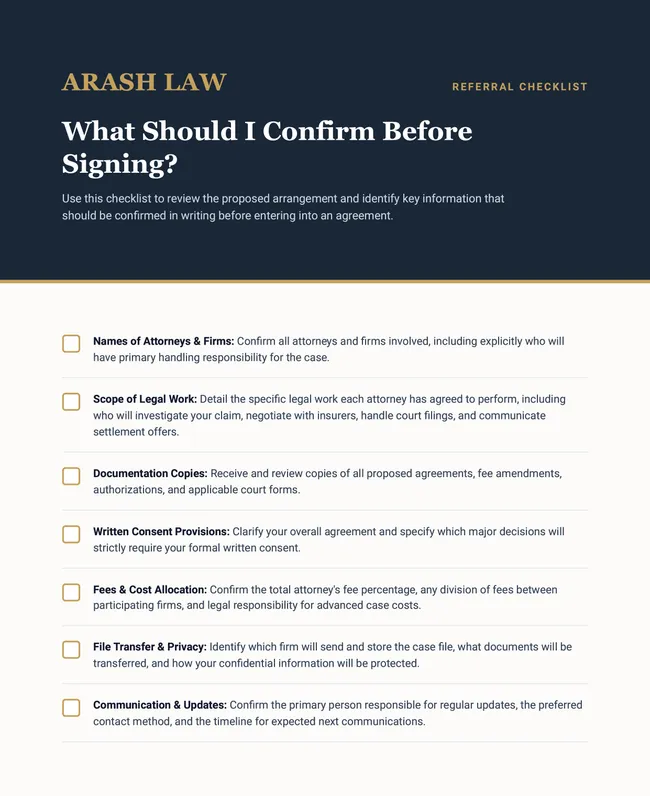
Referral-Clarification Checklist: What Should I Confirm Before Signing?
Before agreeing to a referral, use this checklist to clarify who will handle your injury claim, what responsibilities each lawyer will have, and whether your fees or case costs may change.
- Responsible Attorney and Firm: Confirm which attorneys and firms will represent you, who has primary responsibility, and whether the new attorney has accepted your case.
- Scope of Services: Ask which lawyer will investigate your claim, negotiate with insurers, handle court filings, and communicate settlement offers.
- Documents: Request copies of proposed representation agreements, amendments, fee disclosures, authorizations, and applicable court forms. Ask who must sign each document.
- Consent: Clarify what you are agreeing to, which decisions require your written consent, and whether the arrangement changes your existing representation.
- Fee Explanation: Confirm whether the firms will divide attorney’s fees, whether your contingency fee or responsibility for case costs will change, and how previously incurred expenses will be handled.
- Records Transfer: Ask which firm will transfer your medical records, evidence, insurance correspondence, and court documents. Confirm that the receiving lawyer has the necessary materials.
- Next Contact: Identify your primary contact, how you will receive updates, when to expect the next communication, and who will handle urgent matters or deadlines during the transition.
Keep copies of the completed checklist, signed agreements, and written explanations. These records can help clarify each attorney’s responsibilities if questions arise later.
Who Will Be Responsible for My Injury Case After the Referral?
Responsibility depends on whether your original lawyer remains involved or the new attorney takes over representation. Before relying on the new lawyer, confirm whether they have accepted your case and when their responsibilities will begin. If the arrangement is still pending, ask who will handle urgent matters and protect your interests.
Legal Work and Case Management
The responsible attorney should oversee the legal services covered by the representation agreement. These may include investigating the incident, collecting records, evaluating damages, negotiating with insurers, and, when appropriate, preparing a lawsuit.
When both firms remain involved, they may assign different tasks to each lawyer. Ask who will supervise the work and address issues that require legal judgment.
California Rule 1.2 governs the allocation of authority between a lawyer and client. Attorneys must follow the client’s decisions concerning the objectives of representation and the client’s decision whether to settle a matter.
Court Filings and Legal Documents
A pending lawsuit may require formal steps when the attorney representing you in court changes.
The attorney of record is the lawyer the court formally recognizes as representing a party. If another lawyer replaces that attorney, a substitution of attorney or another applicable procedure may be necessary.
The firm should explain who will manage court filings, respond to the opposing party, and attend scheduled proceedings during the transition.
Settlement Decisions
You decide whether to accept a settlement. Lawyers may explain offers, evaluate risks, and recommend options, but they must follow your decision on settlement.
If both firms participate in your case, ask which attorney will communicate settlement offers and explain your options. Under California Rule 1.4.1, lawyers must promptly communicate written settlement offers to their clients, and significant oral offers generally must be shared as well.
How Will a Referral Affect My Attorney’s Fees and Case Costs?
A qualifying fee division between different law firms cannot increase the total attorney’s fee solely because the lawyers agree to share it. However, this rule does not guarantee that every financial term will remain unchanged under every proposed arrangement.
Fee Division Under California Rule 1.5.1
California Rule of Professional Conduct 1.5.1 generally requires:
- A written fee-division agreement between the participating lawyers.
- Written disclosure identifying the lawyers or firms, the fact that fees will be divided, and the terms of the division.
- The client’s written consent at the time of the agreement or as soon afterward as reasonably practicable.
- No increase in the total fee solely because of the division.
The rule includes an exception for fee divisions ordered by a court.
For example, two firms may agree to share an existing contingency fee instead of charging separate fees for the same representation. The written disclosure should explain the division so the client can make an informed decision.
Contingency Fees and Case Expenses
California Business and Professions Code § 6147 requires contingency-fee agreements to be in writing and contain specified terms about attorney compensation and case costs.
A contingency fee generally means that attorney compensation depends on recovering money for the client. Case expenses, such as filing fees, expert witness charges, and deposition costs, may be handled separately.
Review your existing contract and any proposed changes to determine:
- Whether the contingency-fee percentage remains the same.
- Who will advance or pay litigation expenses.
- Whether you may owe costs if there is no recovery.
- How to handle previously incurred expenses.
A former attorney may claim payment for earlier work, depending on the fee agreement and applicable law. In a contingency fee case, a discharged attorney may generally seek the reasonable value of services performed if the client later obtains a recovery.
The written documents should explain your financial obligations before you agree to new terms.
What Documents and Consent Should I Review Before Agreeing?
Review any document that affects your legal representation, fees, or authority given to another attorney. Different agreements serve different purposes, and not every referral requires the same paperwork.
Representation and Fee Agreements
A new representation agreement may identify the attorney taking over the matter, the services covered, and the applicable fees. An amendment may instead change specific terms of an existing agreement without replacing it entirely.
A fee-division disclosure addresses the sharing of legal fees between lawyers at different firms when Rule 1.5.1 applies. Consent to that division does not, by itself, necessarily establish every term of a new attorney-client relationship.
Understanding how to compare two fee agreements from personal injury lawyers before signing can help you identify changes in your financial obligations. Check the contingency-fee percentage, responsibility for case costs, services included, and terms for ending representation. These details can help you determine whether the proposed agreement differs from your existing one.
Before signing, ask which documents require your signature and which agreements the attorneys must execute. A new contingency-fee agreement generally requires signatures from the client and attorney. A fee-division arrangement requires a written agreement between the participating lawyers, along with the client’s written consent after the required disclosures.
If your attorney of record changes during litigation, a substitution of attorney may also require signatures from the client, former attorney, and new attorney.
Limited Representation and Authorizations
California Rule 1.2 allows reasonable limits on representation when the client gives informed consent, and the limitation is not otherwise prohibited by law.
If the proposed lawyer will handle only part of your claim, ask which services remain with your original attorney.
The firm may also request authorization to obtain or share certain records when necessary. Review what information the authorization covers and why it is needed.
Ask for an explanation of each document’s purpose and legal effect before signing. This is especially important when multiple firms will participate in the case.
How Will the Firms Communicate and Transfer My Case Records?
The firms should explain who will provide case updates, how your records will be transferred, and who will handle pending legal matters. A clear plan can help prevent missed communications, missing documents, and delays during the referral process.
Communication Responsibilities
California Rule 1.4 requires lawyers to keep clients reasonably informed about significant case developments and respond to reasonable requests for information.
Ask who your primary contact will be and how the firm will communicate with you. Discuss your preferred phone number, email address, callback times, and how to reach someone about urgent matters.
You should also know who will explain settlement offers, request documents, and report important developments. Although a fixed update schedule is not required in every case, agreeing on reasonable expectations can help avoid confusion.
Records and Evidence Transfer
The receiving attorney needs access to the records necessary to handle your injury claim. These may include:
- Medical records and bills.
- Accident reports, photographs, and witness information.
- Insurance correspondence and settlement offers.
- Evidence relating to injuries, income loss, and property damage.
- Filed court documents and notices of upcoming deadlines.
California Rule 1.16 addresses lawyers’ duties upon the termination of representation, including requirements regarding the release of client materials and property.
Ask whether the receiving firm has obtained the relevant documents and identified anything missing. The firms should also protect confidential information in accordance with their legal and professional obligations.
Pending Deadlines and Ongoing Claims
A referral does not automatically stop legal deadlines or place ongoing injury claim matters on hold. The firms should establish who will manage pending work while the proposed arrangement is being finalized.
Ask which attorney will handle ongoing insurance negotiations, settlement offers, scheduled medical evaluations, evidence requests, government claims, and court deadlines. Confirm these responsibilities to help avoid interruptions in your case.
If the new lawyer has not yet accepted representation, ask your current firm who will remain responsible for these matters until the arrangement is finalized.
Can I Decline the Proposed Referral or Choose Another Lawyer?
You can decline a proposed referral and consider hiring another lawyer. However, your current firm’s obligation to continue representing you depends on your agreement and applicable California rules. Before deciding, ask what will happen to your case if you do not accept the referral.
Consider the following:
- Continuing Representation: Ask whether your current firm can continue handling your case if you decline. California Rule 1.16 addresses an attorney’s duties upon the termination of representation, including steps to protect the client’s interests.
- Verifying the New Attorney: Before agreeing, ask for the proposed lawyer’s full name, law firm, and experience handling similar injury claims. You can check their license status and public disciplinary history through the State Bar of California’s Attorney Search.
- Changing Lawyers During a Lawsuit: If your case is already in court, changing lawyers in a personal injury case may require filing a Substitution of Attorney — Civil (Form MC-050). Some changes may require court approval or a motion. Confirm who will handle court obligations until the change takes effect.
- Prior Attorney’s Fees and Costs: Your former attorney may have a claim for payment for work already performed, depending on your agreement and applicable law. If a fee dispute arises with an attorney, California’s Mandatory Fee Arbitration Program under Business and Professions Code § 6200 may help resolve it. Arbitration is generally optional for you but mandatory for the attorney when you initiate an eligible fee dispute. An award is initially nonbinding unless both parties agree in writing to binding arbitration after the dispute arises. A nonbinding award can become binding if neither party timely requests a trial.
Before deciding, clarify how your choice could affect ongoing representation, legal deadlines, and potential fees.
If you have questions about a proposed attorney referral, Arash Law can discuss your injury case and available legal options. Our attorneys can help you identify questions about representation, fees, consent, and communication before you decide how to proceed. Call (888) 488-1391 to speak with our team.
Frequently Asked Questions About Injury Case Referrals
Does a Referral Mean My Injury Case Is Weak?
A referral alone does not mean your injury claim is weak. A firm may seek outside help due to workload, limited resources, or a need for specific experience handling certain types of cases. California Rule 1.1 specifically allows lawyers to associate with, consult, or refer a matter to another competent lawyer. The referring lawyer can explain the reason for the proposal.
Can I Speak With the New Lawyer Before Agreeing?
Yes, you can request a consultation with the proposed attorney before deciding whether to hire them. By doing so, you’ll have the opportunity to discuss relevant experience, the intended role, and expectations for your case.
What If I Already Signed the Referral Paperwork?
You can request copies of the signed documents and ask your attorney to explain their effect. Depending on the paperwork, you may have approved a fee division, entered a new representation agreement, or authorized certain information to be shared. The specific terms determine what you agreed to.
What Happens if the New Lawyer Has Not Accepted My Case?
A proposed referral does not necessarily mean another attorney has accepted representation. Ask the original firm to confirm the current status, who remains responsible for pending work, and whether any deadlines require immediate attention.
Get Clear Answers About Your Legal Representation
If your injury law firm has proposed referring your case to another lawyer, you deserve to understand how the change may affect your claim. Questions about who will represent you, whether fees will change, and who will handle important decisions can make the process confusing, especially while you are recovering from an injury.
Arash Law’s personal injury attorneys can discuss your injury case and help you understand your available legal options. Call (888) 488-1391 to ask whether the firm can assist with questions about a proposed attorney referral.
Sources
- California Rules of Professional Conduct, Rule 1.1 — Attorney competence, including association with, consultation with, or referral to another qualified lawyer.
https://www.calbar.ca.gov/legal-professionals/rules/rules-professional-conduct/current-rules-professional-conduct/chapter-1-lawyer-client-relationship- California Rules of Professional Conduct, Rule 1.2 — Scope of representation, client authority over settlement decisions, and reasonable limits on legal services.
https://www.calbar.ca.gov/legal-professionals/rules/rules-professional-conduct/current-rules-professional-conduct/chapter-1-lawyer-client-relationship- California Rules of Professional Conduct, Rule 1.4 — Attorney communication duties, including significant case developments and reasonable client requests for information.
https://www.calbar.ca.gov/legal-professionals/rules/rules-professional-conduct/current-rules-professional-conduct/chapter-1-lawyer-client-relationship- California Rules of Professional Conduct, Rule 1.4.1 — Requirements for communicating settlement offers to clients.
https://www.calbar.ca.gov/legal-professionals/rules/rules-professional-conduct/current-rules-professional-conduct/chapter-1-lawyer-client-relationship- California Rules of Professional Conduct, Rule 1.5.1 — Fee divisions between lawyers at different firms, written disclosure, client consent, and restrictions on increasing the total fee solely because of the division.
https://www.calbar.ca.gov/legal-professionals/rules/rules-professional-conduct/current-rules-professional-conduct/chapter-1-lawyer-client-relationship- California Rules of Professional Conduct, Rule 1.16 — Ending legal representation, client protections, and requirements concerning client materials and property.
https://www.calbar.ca.gov/legal-professionals/rules/rules-professional-conduct/current-rules-professional-conduct/chapter-1-lawyer-client-relationship- California Business and Professions Code § 6147 — Written contingency-fee agreement requirements, including attorney compensation and case costs.
https://leginfo.legislature.ca.gov/faces/codes_displaySection.xhtml?lawCode=BPC§ionNum=6147.- California Business and Professions Code § 6200 — Arbitration of qualifying disputes involving attorney’s fees and costs.
https://leginfo.legislature.ca.gov/faces/codes_displaySection.xhtml?lawCode=BPC§ionNum=6200.- California Courts, Substitution of Attorney—Civil (Form MC-050) — Court form for qualifying changes in legal representation without a court order.
https://selfhelp.courts.ca.gov/jcc-form/MC-050- State Bar of California, Attorney Search — Official resource for checking California attorney license status and public disciplinary information.
https://apps.calbar.ca.gov/attorney/LicenseeSearch/QuickSearch- State Bar of California, Resolving Fee Disputes with Your Attorney — Information about attorney-client fee arbitration and dispute resolution.
https://www.calbar.ca.gov/public/concerns-about-attorney/resolving-fee-disputes-your-attorneyDisclaimer
The information on this page is for general educational purposes only and does not constitute legal advice. Reading or relying on this content does not create an attorney-client relationship. Referral arrangements, attorney’s fees, and consent requirements depend on the specific circumstances of each case. For questions about your personal injury case or a proposed attorney referral, contact Arash Law at (888) 488-1391.