TL;DR: To compare two personal injury lawyer fee agreements, review the base percentage, how fees and costs are calculated, rate changes during the case, responsibility for expenses, and medical lien negotiation terms. California Business and Professions Code § 6147 generally requires written contingency fee agreements to explain how costs affect the attorney’s fee and the client’s recovery.
If you are comparing two personal injury lawyer fee agreements, evaluate how each firm’s terms could affect your financial obligations and the amount you ultimately receive. Look beyond the advertised percentage to determine whether the agreements provide comparable services and allocate expenses differently.
A lower advertised percentage does not necessarily mean you will receive more monetary recovery. Each agreement may handle fees, case expenses, and additional services differently. Ask both firms to explain unclear terms in writing before signing.
Table of Contents

Two Injury Firms Have Offered Different Fee Arrangements. What Should I Compare Besides the Percentage Before Choosing a Lawyer?
You should compare what each injury law firm will do, how it calculates its fees, and which expenses may reduce your recovery. Two proposals with different percentages may also have different terms for lawsuits, trials, medical bills, and the end of representation.
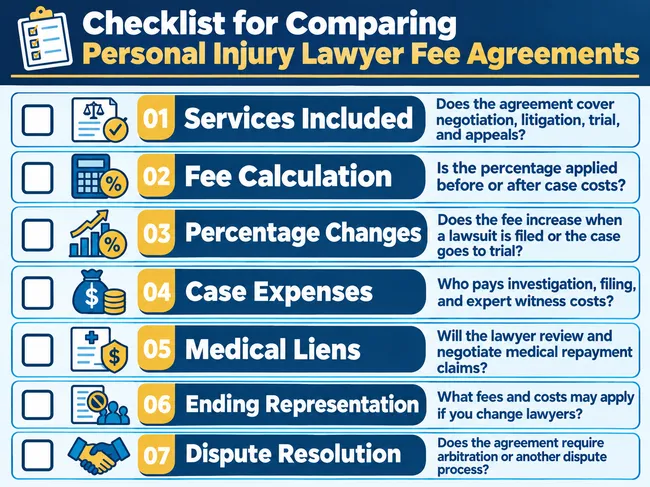
Before choosing between the firms, compare these terms:
- Services covered, including investigation, negotiations, lawsuits, trials, and appeals.
- Whether fees are calculated before or after case costs.
- When the fee percentage may increase.
- Who pays case expenses, including if there is no recovery.
- Whether medical bill reviews and lien negotiations are included.
- What happens to fees, expenses, and case files if you change lawyers.
California requires written contingency fee agreements to disclose specified terms, including the agreed fee rate and how costs affect the attorney’s fee and the client’s recovery (California Business and Professions Code § 6147). Knowing how much personal injury lawyers charge and how gross and net recovery calculations work can also help you assess the financial differences between the two proposals.
Key Facts About Comparing California Personal Injury Fee Agreements
- Written agreements are required. Contingency fee agreements in California generally must be in writing and signed by both the attorney and the client. The attorney must provide a duplicate signed copy when the agreement is made (BPC § 6147).
- Fees are generally negotiable. California does not set fixed percentages for ordinary personal injury claims. Special rules apply to medical malpractice, workers’ compensation, and minors’ settlements (BPC §§ 6146–6147; Labor Code § 4906; CRC 7.955).
- Services may differ. One proposal may cover only certain stages of a claim, while another may address litigation, trial, or related matters. Ask each firm to confirm its scope of work.
- Costs and fees are different. Attorney’s fees pay for legal services. Case costs may include filing fees, medical records, expert witnesses, and depositions. Your agreement determines how these expenses apply.
- Medical reimbursement claims matter. Health insurers, medical providers, or other entities may have repayment rights that affect the amount distributed to you.
- Changing attorneys may involve additional fee issues. A former attorney may seek payment for the reasonable value of services performed. The amount and payment arrangements depend on the circumstances.
Key Factors to Compare in Two Injury Lawyer Fee Proposals
The key factors to compare are the services each lawyer provides, fee calculations, percentage changes, case expenses, medical reimbursement assistance, termination terms, and dispute resolution procedures. Understanding the basics of contingency fee agreements can help you compare the specific terms and responsibilities outlined in each proposal.
1. Services Included in the Attorney’s Fee
Compare which legal services each firm’s quoted fee covers, including:
- Accident investigation and evidence collection.
- Identification of potentially responsible parties.
- Communication and negotiations with insurance companies.
- Lawsuit filing and discovery (the formal exchange of evidence).
- Representation during mediation, settlement conferences, and trial.
- Appeals and post-trial matters, if applicable.
Check whether the fee also covers MedPay, uninsured/underinsured motorist (UM/UIM), and property damage claims. Ask whether different rates or separate fees apply, particularly for UM/UIM arbitration.
California requires contingency fee agreements to disclose potential additional compensation for related matters outside their scope (BPC § 6147(a)(3)). Confirm which services require separate agreements or charges.
Also, ask who will handle your case. If lawyers from different firms divide the fee, California generally requires a written disclosure and your written consent. The arrangement cannot increase your total fee solely because the lawyers share it (California Rules of Professional Conduct, Rule 1.5.1).
2. Gross Versus Net Fee Calculation
How each firm calculates its fee can affect how much money you receive from a settlement or court award. Some agreements calculate the attorney’s percentage using the full recovery, while others deduct certain case costs first.
- Gross Recovery: The total settlement or award before attorney’s fees, case costs, and other deductions.
- Net Recovery: The amount remaining after applicable deductions. For fee calculations, the agreement should clarify which costs are deducted before the attorney’s percentage is applied.
California generally requires written contingency fee agreements to explain how case costs affect the attorney’s fee and the amount the client receives (BPC § 6147).
To compare the proposals, ask both firms to show how they would calculate their fees using the same hypothetical settlement amount and case expenses. This comparison can help you understand the differences without predicting your actual recovery.
3. Stage-Based Percentage Changes
Some personal injury lawyers charge different contingency fee percentages depending on the stage of your case. For example, the attorney may increase the fee percentage when they file a lawsuit or take the case to trial.
Check both agreements to see when any higher rate takes effect. A case may still settle after a lawsuit is filed, so the timing of the increase can affect how much you receive.
California generally requires written contingency fee agreements to state the agreed fee rate, including any applicable stage-based rates (BPC § 6147).
4. Case Costs and Financial Responsibility
Case costs are expenses related to pursuing your personal injury claim, separate from the attorney’s fees. These expenses can affect how much compensation you receive. These include:
- Medical record fees.
- Court filing fees.
- Expert witness fees.
- Investigation expenses.
- Deposition transcripts.
For example, car accident lawyers may incur expenses when obtaining crash reports, investigating collisions, or consulting accident reconstruction experts. Some attorneys advance these costs and seek reimbursement later, while others may require you to pay certain expenses during the case.
Ask whether either agreement requires your approval before the firm incurs significant expenses, such as expert witness fees. You can also compare how each firm documents costs and whether it provides itemized expense information before deducting amounts from your recovery.
Your agreement should explain who pays these expenses, whether additional charges apply, and what happens if you receive no compensation.
5. Medical Bills, Liens, and Reimbursement Claims
Medical bills and repayment obligations can reduce the amount you receive from a personal injury settlement. A medical lien may give a healthcare provider the right to payment from your recovery. For example, California’s Hospital Lien Act limits hospital liens to what can be paid from 50% of the recovery after prior liens (Civil Code § 3045.4). Health insurers and certain benefit programs may also have reimbursement rights.
When comparing fee agreements, check whether each lawyer will:
- Review outstanding medical bills and repayment claims.
- Identify valid liens and reimbursement obligations.
- Negotiate reductions when appropriate.
- Explain whether these services involve additional fees.
Not every unpaid medical bill creates a valid lien, and reductions are not guaranteed. The amount you must repay depends on the applicable law and agreements.
6. Termination and Switching Personal Injury Lawyers
You generally have the right to change personal injury lawyers in California, even after signing a fee agreement. However, your former attorney may seek payment for the reasonable value of work already performed, known as quantum meruit. In a contingency case, payment generally depends on a recovery or another applicable contractual condition (Fracasse v. Brent (1972) 6 Cal.3d 784).
Before signing, compare how each agreement addresses:
- Attorney’s Fees: Whether the former lawyer may seek compensation for completed work.
- Outstanding Expenses: Whether you must repay costs already incurred.
- Attorney Liens: Whether the lawyer may claim payment from a future recovery.
- Case File Transfers: How your documents and records will be provided when representation ends. California generally requires attorneys to promptly release client materials and property upon request, even if fees remain unpaid, subject to applicable legal restrictions (California Rules of Professional Conduct, Rule 1.16(e)(1)).
Changing lawyers does not automatically mean paying two full contingency fees. However, the financial consequences depend on the agreements and applicable law.
7. Arbitration and Dispute Resolution Terms
Some personal injury fee agreements include provisions explaining how disputes between the attorney and client will be resolved. These terms may address arbitration, mediation, or litigation, including fees or other disputes.
When comparing agreements, check whether either requires arbitration, limits available dispute resolution procedures, or includes additional expenses.
California’s Mandatory Fee Arbitration Program generally allows clients to request arbitration of attorney-fee disputes, even if their agreement contains another arbitration provision. This right is subject to applicable deadlines and waiver rules. Compare how each agreement addresses dispute resolution, and ask the firm to explain any unclear provisions before signing.
Side-by-Side Fee Agreement Comparison Worksheet
Use this worksheet to compare two fee proposals from California injury attorneys before signing. Fill in the details from each written agreement and ask the firms to clarify anything you do not understand.
| Term to Compare | Proposal A | Proposal B | Questions to Ask if Unclear |
|---|---|---|---|
| Services Included in the Attorney’s Fee | ______ | ______ |
|
| Gross Versus Net Fee Calculation | ______ | ______ |
|
| Stage-Based Percentage Changes | ______ | ______ |
|
| Case Costs and Financial Responsibility | ______ | ______ |
|
| Medical Bills, Liens, and Reimbursement Claims | ______ | ______ |
|
| Termination and Switching Personal Injury Lawyers | ______ | ______ |
|
| Arbitration and Dispute Resolution Terms | ______ | ______ |
|
Keep copies of both proposals and any written explanations.
Red Flags to Watch for Before Signing a Personal Injury Fee Agreement
Some fee agreements may contain unclear terms, unexpected charges, or conditions that need further explanation. These issues do not automatically mean a lawyer has violated the law, but they are worth reviewing before you sign.
The following table outlines common warning signs and why they matter:
| Red Flag | Why It Matters |
|---|---|
| Missing Written Terms | California generally requires written, signed contingency fee agreements that disclose the agreed rate, how costs affect recovery, and that the fee is not set by law but is negotiable, except where special statutory fee limits apply. An agreement that does not meet BPC § 6147 may be voidable at the client’s option, although the attorney may still recover a reasonable fee. |
| Unclear Expense Language | You may not know which case expenses you must pay or whether you will owe costs if your claim is unsuccessful. |
| Unexpected Upfront Charges | A firm may advertise no upfront attorney’s fees but later request payment. Ask whether the charge covers legal services, case expenses, or something else. Upfront charges are not automatically unlawful. |
| Pressure to Sign Immediately | You may feel rushed into accepting terms you do not fully understand. You can ask for time to review the agreement, while keeping legal deadlines in mind. |
| Guaranteed Settlement Amounts | A lawyer’s promise of a specific result may be misleading. California prohibits false or misleading communications about legal services (California Rules of Professional Conduct, Rule 7.1). |
If you notice any of these warning signs, ask the firm to explain the terms in writing before signing. You may also seek an independent legal opinion if you still have concerns.
Frequently Asked Questions About Comparing Personal Injury Lawyer Fee Agreements
Can I Negotiate the Percentage in a Personal Injury Fee Agreement?
Fees are generally negotiable. California does not set a fixed contingency fee percentage for ordinary personal injury claims. The agreed fee must be stated in the written agreement (BPC § 6147). You can ask either lawyer whether their proposed terms are negotiable. They may accept, decline, or offer a different arrangement.
How Do I Know Which Fee Proposal Will Leave Me With More Monetary Recovery?
You cannot determine the final amount based on the fee percentage alone. The recovery, applicable rate, costs, medical reimbursement obligations, and other deductions all matter. Ask both personal injury lawyers to provide an illustrative calculation using identical hypothetical figures. The illustration can show how their contractual methods differ.
Does My Attorney Have to Get My Approval Before Accepting a Settlement?
Yes, the decision to accept or reject a settlement belongs to the client. An attorney must follow the applicable rules concerning client authority and communication (California Rules of Professional Conduct, Rules 1.2, 1.4, and 1.4.1). You may ask your attorney to explain an offer, anticipated deductions, and unresolved expenses before deciding whether to accept it.
What Happens If a Fee Agreement Does Not Meet California’s Requirements?
A contingency agreement that fails to comply with BPC § 6147 may be voidable at the client’s option. The attorney may still be entitled to reasonable compensation for services performed. The consequences depend on the particular deficiency and circumstances. An independent attorney can assess whether the agreement complies with California law.
Does the Fee Agreement Cover Claims Against Government Entities?
It depends on the services covered by your agreement. Ask both lawyers whether their proposed fees cover preparing and submitting government claims, meeting applicable deadlines, and pursuing a lawsuit if necessary. Confirm whether any of these services require additional fees or a separate agreement.
Should I Choose the Lawyer With the Lower Percentage?
Not necessarily. A lower percentage is one consideration, but it does not establish the full cost or scope of representation. Compare the written services, fee calculation, expenses, medical reimbursement assistance, and termination provisions. Neither a lower nor a higher advertised rate guarantees a better financial or legal outcome.
Understand Your Fee Agreement With Arash Law
Arash Law can explain its written fee agreement before you decide whether to hire us. Our personal injury lawyers can discuss the proposed percentage, services included, case expenses, medical reimbursement issues, and other terms so you understand your potential financial obligations.
If you are comparing two personal injury lawyer proposals, use the worksheet above to identify questions about our agreement. We can clarify our proposed terms and explain how they may apply to your case.
Arash Law has recovered over $1 billion for injured Californians. We offer free case evaluations and handle personal injury cases on a contingency fee basis. You pay no attorney’s fees unless we recover compensation for you. Our written fee agreement explains the applicable fees, case expenses, and payment responsibilities.
Call Arash Law at (888) 488-1391, 24 hours a day, seven days a week.
Sources
- State Bar of California. What to Expect Regarding Fees and Billing. https://www.calbar.ca.gov/public/legal-resources/working-attorney/what-expect-regarding-fees-and-billing
- California Legislative Information. Business and Professions Code § 6147 — Contingency Fee Contracts. https://leginfo.legislature.ca.gov/faces/codes_displaySection.xhtml?lawCode=BPC§ionNum=6147.
- State Bar of California. California Rules of Professional Conduct, Rule 1.2 — Scope of Representation and Allocation of Authority. https://www.calbar.ca.gov/legal-professionals/rules/rules-professional-conduct/current-rules-professional-conduct/chapter-1-lawyer-client-relationship
- State Bar of California. California Rules of Professional Conduct, Rule 1.4 — Communication With Clients. https://www.calbar.ca.gov/legal-professionals/rules/rules-professional-conduct/current-rules-professional-conduct/chapter-1-lawyer-client-relationship
- California Supreme Court. Fracasse v. Brent (1972) 6 Cal.3d 784. The court addressed a discharged contingency-fee attorney’s right to reasonable compensation for services performed. https://scocal.stanford.edu/opinion/fracasse-v-brent-27665/
- California Legislative Information. Government Code § 911.2 — Time for Presenting Government Claims. https://leginfo.legislature.ca.gov/faces/codes_displaySection.xhtml?lawCode=GOV§ionNum=911.2
- California Legislative Information. Civil Code § 3045.4 — Hospital Lien Limits. https://leginfo.legislature.ca.gov/faces/codes_displaySection.xhtml?lawCode=CIV§ionNum=3045.4
- State Bar of California. Rule 1.5.1, Fee Divisions Among Lawyers. https://www.calbar.ca.gov/legal-professionals/rules/rules-professional-conduct/current-rules-professional-conduct/chapter-1-lawyer-client-relationship
- State Bar of California. Frequently Asked Questions: Fee Disputes. https://www.calbar.ca.gov/public/concerns-about-attorney/resolving-fee-disputes-your-attorney/frequently-asked-questions-fee-disputes
Disclaimer
This article is for general educational purposes only and does not constitute legal advice. Reading this information does not create an attorney-client relationship. Every case is different, and the applicable laws and fee agreement terms may vary. Consult a licensed California attorney about your specific circumstances before signing a fee agreement. Arash Law: (888) 488-1391.