TL;DR: Organizers, venue owners, and contractors can be responsible for injuries at Coachella. Liability depends on control and negligence. Victims can file claims under California’s general injury laws, with deadlines varying depending on whether the defendant is a public entity or a private defendant.
Highlights:
- Injuries can result from unsafe conditions, like poor crowd management or faulty equipment.
- Liability often depends on who controlled the area where the injury occurred.
- Multiple parties, including organizers, security, and vendors, can share responsibility.
- Coachella ticket waivers do not automatically shield organizers from all lawsuits.
- Claims may be complicated by disputed fault or involvement of public entities.
- Be aware of the deadlines for filing claims, which may vary for public entities.
Tip: Gather clear evidence and report the incident right away to support your claim.
Table of Contents
Injuries at Coachella can give rise to claims against multiple parties. Liability depends on who controlled the area, what they knew or should have known, and whether they took reasonable steps to ensure safety.
California Civil Code Section 1714 establishes this general negligence rule. If someone gets injured at Coachella, the resulting premises liability case will focus on whether the entities in charge of the festival acted reasonably to prevent harm.
Coachella is a large music festival held at the Empire Polo Club and organized by Goldenvoice. As a result, different parts of the event may be controlled by different people and companies. That is why claims for a parking injury, a crowd crush near a stage, a vendor-related injury, and an off-site road injury may point to different defendants.
Why Coachella Injury Claims Can Get Complicated
Coachella injury claims can get complicated because several parties often share control over different parts of the property. Coachella is one of the largest music festivals in the country. Goldenvoice, a subsidiary of AEG Presents, organizes the event at the Empire Polo Club in Indio, California. The festival spans multiple stages, walkways, vendor areas, campgrounds, parking zones, and entry points.
That size matters in injury cases. With around 125,000 people attending each day, long lines and crowded walkways can create safety risks. The desert heat adds to these dangers. Liability for an injury depends on a few key factors. It matters where the injury occurred, who was in charge of the area, and whether they took reasonable safety measures to address any hazards.
Who Can Be Responsible For Injuries At Coachella In California?
More than one party can be responsible for a Coachella injury. In California, the key question is usually control. Who was responsible for the venue, equipment, staff, or activity that caused the injury? Did that person or company act reasonably to keep staff and festivalgoers safe?
Parties that may be responsible for an injury at Coachella include:
- Festival Organizers: If they fail to manage crowd flow, maintain safe walkways, coordinate emergency response, or address known hazards, they may face liability.
- Venue Owner or Property Controller: A property owner or occupier can be liable for dangerous conditions on the premises.
- Security Companies: Security contractors may be responsible if poor screening, slow response times, poor crowd control, or weak staffing contributed to the injury.
- Vendors and Contractors: Food sellers, ride operators, staging crews, lighting teams, and other contractors may be liable if their own negligence caused harm.
- Other Attendees: Another guest may be liable for assault, reckless conduct, or other negligent behavior.
- Public Entities: If the injury involves public roads, traffic control, police activity, or public property, a city, county, or other public entity may be involved.
Who Controls What At Coachella? A Practical Liability Map
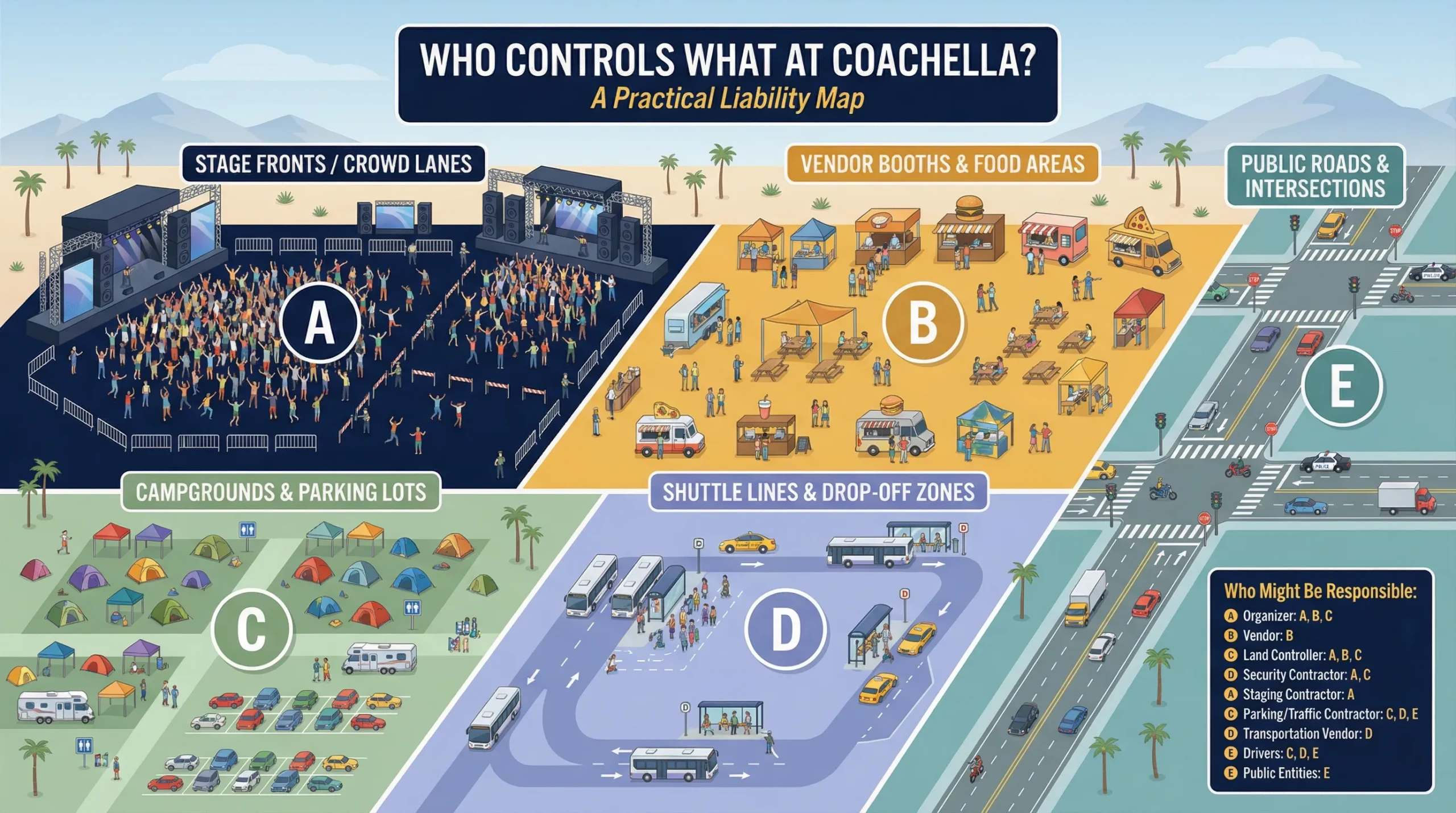
Liability gets clearer when you match the injury to the area and who controlled it. That practical control question is central in California premises cases.
- Stage Fronts, Crowd Lanes, Barricades, and Festival Walkways: Often point toward the organizer, land controller, security contractor, or staging contractor.
- Vendor Booths and Food Areas: Often point toward the vendor first. However, organizers or land controllers may also matter if they knew about the hazard and failed to act.
- Campgrounds and Parking Areas: May be the responsibility of the organizer, land controller, security vendor, parking contractor, or a negligent driver.
- Shuttle Lines, Drop-Off Zones, and Rideshare Pickup Areas: May be controlled by transportation vendors, traffic contractors, or drivers.
- Public Roads and Intersections Outside the Grounds: May involve private drivers, rideshare drivers, contractors handling traffic flow, or public entities, depending on the exact location and who controls it.
What California Laws Apply To Coachella Injury Claims?
California does not have a special law just for Coachella. Most cases follow general injury rules. The law basically asks: who was in control? Did they act reasonably? Finally, did their actions cause the injury?
Here are the main rules that matter:
- Civil Code Section 1714: This is the basic rule. It says people and businesses must act with reasonable care to prevent harm to others. If they act carelessly and someone gets hurt, they can be held responsible.
- California Civil Jury Instructions (CACI) No. 1000: This helps explain how property-related cases work. It looks at who controlled the area, whether there was a dangerous condition, and whether that condition caused the injury. At Coachella, this usually comes down to who was in charge of the space where the accident happened.
- Code of Civil Procedure Section 335.1: This is the general deadline. In most cases, you have 2 years to file a lawsuit. If you miss it, you usually lose your right to recover compensation.
- Government Code Section 911.2: This applies if a government agency may be involved, such as a city or county. In those cases, you may need to file a claim within 6 months, which is much shorter than the normal deadline.
Taken together, these laws explain who may be liable, what the injured person needs to show, and when the case must be filed.
Do Coachella Tickets Waive Your Right To Sue?
Coachella tickets come with terms. By buying one, a festivalgoer assumes a risk of potential injury at the music festival. In California, waiver language and assumption-of-risk defenses can limit some ordinary negligence claims. However, they do not stop every lawsuit.
California cases recognize express assumption of risk. That means a person can agree in advance to accept known risks. However, California law also limits the scope of a release.
Civil Code section 1668 bars contracts that try to exempt fraud, willful injury, or violations of law, and the California Supreme Court has held that releases of future gross negligence are unenforceable as a matter of public policy.
That means a Coachella ticket is not a universal shield. The result can depend on:
- The exact language.
- The type of risk.
- Whether the harm came from an inherent festival risk.
- Whether the conduct went beyond ordinary negligence.
Common Coachella Injury Scenarios And Who Is Usually Liable
The likely defendant depends on how the injury happened. The more clearly you can tie the injury to control, notice, and unreasonable conduct, the stronger the liability analysis becomes.
- Slip-and-Fall Hazards: These can create liability if they make a walkway, restroom area, vendor lane, campground path, or transition area unsafe, and the party controlling the venue or activity fails to fix them or warn people about them. These cases often turn on notice, maintenance, lighting, cords, debris, uneven ground, spills, or poor crowd routing.
- Crowd Surges and Trampling: Organizers or security may fail to manage crowd density, barricades, ingress and egress, choke points, communication, or emergency response. These claims often focus on whether the risk was foreseeable and whether the crowd plan was reasonable.
- Assaults or Altercations: Security failures may result in reasonably foreseeable and preventable criminal conduct. In California, negligent security analysis weighs foreseeability against the burden and effectiveness of security measures.
- Faulty Equipment, Staging, or Pyrotechnics: This can create liability when stage equipment, lighting, rigging, power systems, or pyrotechnics are set up, operated, or supervised carelessly. Depending on the facts, liability may rest with the organizer, contractor, staging company, or equipment manufacturer.
- Parking, Shuttle, and Road Injuries: Poor traffic management, unsafe crossings, negligent driving, or inadequate access controls can result in injuries in parking lanes, drop-off areas, pedestrian routes, or nearby roads. For example, in 2025, some campers reported being stuck for hours without water or restrooms. This incident highlights how off-stage logistics can pose safety issues as well.
-
Heat, Dust, and Illness-Related Claims: Heat, dust, or illness do not automatically create liability. A claim usually depends on whether someone failed to take reasonable safety steps, such as providing access to water, issuing warnings, ensuring sanitation, providing medical aid, or implementing reasonable crowd management under known conditions.
The South Coast Air Quality Management District (AQMD) issued a windblown dust advisory for the Coachella Valley on April 9, 2026, warning that unhealthy air quality was expected at times.
Negligent Security At Festivals: What “Foreseeability” Means
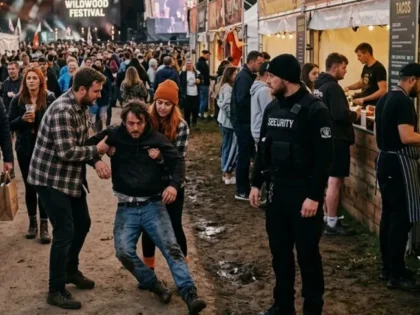
Negligent security claims often turn on foreseeability, or whether the danger was something the people in charge should have seen coming. A property owner, organizer, or security company affiliated with Coachella may have failed to address risks that they knew, or should have known about. Examples include assault and crowd violence. In this scenario, they could be legally liable.
In other words, foreseeability helps show liability. If the risks were predictable, the people in control may have had a duty to address them. That could mean adding security staff, improving lighting, screening people more carefully, monitoring choke points, responding faster, or communicating better during emergencies.
When they fail to take those kinds of reasonable precautions, and someone gets hurt, that failure can help prove they were negligent. In cases like these, injury attorneys often look closely at prior incidents, staffing levels, security planning, and how quickly the response team acted.
At a festival, facts that may show foreseeability include:
- The size and type of the crowd
- Alcohol or drug use
- Choke points or overcrowded areas
- Poor lighting
- Weak entry screening
- Prior fights or similar incidents
- Inadequate staffing
- Slow radio communication
- Delayed security response
The stronger the evidence that the danger was predictable, the stronger the argument that the people in charge may be liable for the injury.
Comparative Fault In California: Your Recovery Can Be Reduced
Even if someone else was negligent, your own conduct can still matter. California follows pure comparative negligence. That means you can still file an injury claim, even if you’re up to 99% at fault. However, a court can reduce your compensation by your share of fault.
At Coachella, defendants may argue you partly caused your own injury by:
- Ignoring barriers.
- Entering a restricted area.
- Pushing through a crowd.
- Climbing on unstable structures.
- Running while intoxicated.
- Refusing to comply with clear safety instructions.
These arguments do not automatically end a case. However, they can reduce damages if the evidence supports them.
What Do Victims Need To Prove In A Coachella Injury Claim?
To pursue compensation in a Coachella injury claim, the injured person must prove negligence. That means showing another party failed to use reasonable care. That failure then caused real harm.
Victims usually need to prove the following:
- Duty of Care: The other party had a legal duty to act with reasonable care. At Coachella, this duty might fall on organizers, property owners, security firms, vendors, or contractors. It all depends on who controls a specific area or activity.
- Breach of Duty: The party failed to act reasonably under the circumstances. For example, organizers might have left a barricade in a walkway, failed to control a dangerous crowd surge, ignored poor lighting, or failed to respond to a known safety risk.
- Causation: The unsafe act or condition was a substantial factor in causing the injury. In simple terms, the harm must be tied to the other party’s failure to use reasonable care.
- Damages: The injury led to actual losses. These may include:
- Medical bills, such as for hospital stays and chiropractic care.
- Lost wages, as well as reduced earning capacity, if the injury led to disability.
- Pain and suffering caused by the injury.
- Loss of consortium, if the injury impacted a spousal relationship.
A strong claim relies on clear evidence. Proof can include photos, videos, witness statements, incident reports, and medical records.
Steps To Take After Getting Injured At Coachella
What you do after getting injured at Coachella can affect both your recovery and your ability to bring a claim later. The goal is to protect your health first. From here, preserve as much evidence as possible before the scene changes.
- Get Medical Care Right Away: Your health comes first. Even if the injury seems minor, get checked by medical staff or go to a doctor as soon as possible. Some injuries, such as head trauma, internal injuries, heat illness, or soft tissue damage, may not fully show symptoms right away. Prompt treatment also creates medical records that can connect the injury to the incident.
- Report the Incident: Tell festival staff, security, or law enforcement, depending on what happened. Ask whether they will prepare an incident report and, if possible, request a copy. Reporting the injury early can help create a record of where and when it happened.
- Take Photos and Videos: If you can do so safely, photograph the area, the hazard, your injuries, and anything else that may help explain what happened. This may include barricades, spills, broken flooring, crowd conditions, poor lighting, or the lack of security in the area. Conditions at a festival can change quickly, so early photos matter.
- Get Witness Information: If anyone saw what happened, ask for their name and contact information. Witnesses can help support your version of events, especially if the other side later disputes what happened.
- Save Important Items: Keep your ticket, wristband, receipts, medical paperwork, and any damaged personal property. Do not throw away clothing, shoes, or broken items that may help show how the injury happened.
- Be Careful With Statements: Do not give detailed recorded statements to insurers or other representatives before you fully understand your injuries and the facts. It is better to stick to the basics until you have had time to review what happened.
- Write Everything Down: As soon as you can, make notes about the exact location, time, conditions, and sequence of events. Include details like crowd size, lighting, weather, staff response, and anything said by witnesses or security. Small details are often forgotten quickly.
These steps can help preserve the evidence needed to prove duty, breach, causation, and damages.
Notable Coachella Safety Incidents And The Legal Takeaway
Reported incidents at Coachella show the kinds of problems that can lead to claims. The legal answer still depends on control, notice, and reasonable safety steps.
- 2025 Pyrotechnics Incident: People reported a firework during Green Day’s set that caused a palm tree to catch fire. If a pyrotechnic malfunction injures someone, the legal focus is on who designed, operated, approved, or supervised the effect.
- 2024 Performer Fall: Entertainment Weekly reported Nelly Furtado fell during a Coachella performance. Incidents like this can raise questions about stage layout, maintenance, and contractor safety.
- 2019 Stagehand Death: Pitchfork reported a stagehand died after a fall during setup. Worker injuries may involve staging contractors, rigging practices, or workplace safety failures rather than attendee premises claims.
- 2016 Pedestrian Death Near the Festival: CBS Los Angeles reported an 18-year-old attendee was struck while crossing Avenue 52 near the festival. Off-site injuries can shift liability to drivers, traffic planners, contractors, or public entities, depending on the location and the level of control involved.
Deadlines: The 2-Year Rule And The Shorter Government Claim Deadline
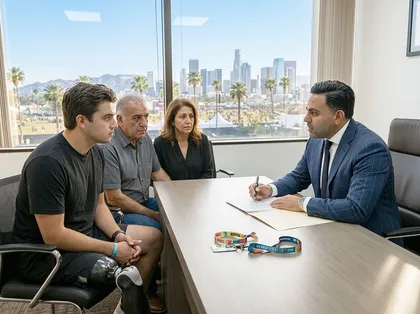
Most California personal injury and wrongful death lawsuits must be filed within 2 years. That rule comes from Code of Civil Procedure section 335.1.
However, do not assume every Coachella-related case gets 2 years. If a public entity is involved, like a city or county, you generally must file a personal injury or death claim within 6 months. This rule is based on Government Code section 911.2. That shorter deadline can matter in cases involving roads, intersections, traffic control, pedestrian routing, police activity, or other public-property issues around the festival.
Waiting too long can render an otherwise valid claim invalid. Because these timing rules can get confusing fast, some injured people reach the point where they think, “I need a personal injury lawyer.”
A firm like Arash Law can review the facts and identify which deadline applies. It can also help protect the right to seek compensation before time runs out.
Frequently Asked Questions About Injuries Sustained At Coachella
If you got injured at Coachella, you likely have questions about your rights, liability, and what to do next. Here are some common questions people ask:
How Much Is A Coachella Injury Claim Worth?
There is no fixed payout for a Coachella injury case. Value usually depends on these questions:
- How badly were you hurt?
- Is the liability clear?
- Do you share fault?
- How much did the injury change your daily life?
If the case involves disputed fault, waiver defenses, or multiple defendants, the value analysis gets more complicated.
What If A Loved One Died After A Coachella Incident?
If negligence caused a death connected to Coachella, the surviving family members may have a wrongful death claim. The damages can involve funeral expenses, lost financial support, and the loss of care, guidance, or companionship. California’s general two-year deadline also applies to actions for death caused by the wrongful act or neglect of another.
Can I Still File A Claim If I Was Partly At Fault?
Yes. California follows a pure comparative negligence rule. That means you may still recover compensation even if you share some responsibility. Your recovery will be reduced based on your percentage of fault.
Do Lawyers Only Get Paid If They Win?
In most personal injury cases, yes. Many attorneys work on a contingency fee basis. That means you do not pay upfront fees. Instead, the lawyer is paid a percentage of the recovery if the case is successful. If there is no recovery, you generally do not owe attorney’s fees.
Who Is Responsible If I Get Injured In A Crowded Area?
Liability usually depends on who controls that area and whether they acted reasonably. This may include the event organizer, security companies, or contractors responsible for crowd control. In some cases, multiple parties may share responsibility.
What If My Injury Happened Outside The Festival Grounds?
It depends on where and how the injury occurred. Suppose you were injured on a nearby public road, in a parking area, or near a traffic control point. A driver, contractor, or even a public entity may be involved. These cases may also have different deadlines, so timing can be important.
Injured At Coachella? Seek Help From Arash Law
A Coachella injury case can involve multiple defendants, waiver arguments, disputed fault, private contractors, and sometimes public-entity deadlines. Due to these complexities, you may be seeking free advice from a California premises liability attorney to figure out your next steps.
Arash Law can review where the injury occurred, identify who controlled the area, help preserve evidence, and explain which deadlines may apply. If the injury occurred due to unsafe conditions, poor security, faulty equipment, or road-related issues near the festival, seeking legal guidance early can help protect the claim.
Call AK Law at (888) 488-1391 to discuss your case and uncover your next steps.