TL;DR: Though the exact number of accidents caused by emergency vehicles is unknown, FARS data notes that crashes involving them caused 225 fatalities in 2024. These accidents often harm drivers, passengers, and pedestrians, involve high speeds and large vehicles, and require evidence to determine liability.
Highlights:
- Emergency vehicle crashes often happen during responses to urgent calls.
- Factors such as congested roads, extreme weather, and wildfires increase the risk of crashes.
- Large fire trucks and ambulances cause more severe damage in collisions.
- Distracted and reckless drivers contribute to emergency vehicle accidents in California.
- Claims against police or fire departments must meet the 6-month CTCA filing deadline.
- Comparative negligence may reduce recovery if the victim shares some fault.
Tip: Preserve traffic camera footage, witness info, and medical records to support fault determination.
Table of Contents
There is no exact figure for how many accidents are caused by emergency vehicles. While emergency vehicles are involved in a small percentage of traffic accidents, available statistics generally do not identify whether the emergency vehicle was responsible for causing the crash.
The most relevant data available comes from the National Highway Traffic Safety Administration (NHTSA) Fatality Analysis Reporting System (FARS). It reports that 225 people died in crashes involving emergency vehicles in 2024. These deaths involved police vehicles, ambulances, and fire trucks.
Though this data doesn’t explicitly state how many emergency vehicles cause traffic accidents or how many accidents they are involved in overall, it can help explain the scope and nature of these incidents. In the process, it can reveal specific trends, including which roads, vehicles, and victim groups face the greatest risk.
What The Data Says About Crashes Involving Emergency Vehicles
Determining how many crashes emergency vehicles actually cause remains difficult because most databases track vehicle involvement rather than fault. The latest NHTSA data is national in scope. It specifically covers the number of crashes involving emergency vehicles that resulted in fatalities. FARS breaks down the 225 deaths mentioned above as follows:
- Police Vehicles: 150 deaths.
- Ambulances: 47 deaths.
- Fire Trucks: 28 deaths.
Though this data doesn’t explicitly state how many accidents are caused by emergency vehicles, it may point to specific trends:
- More than half of the 225 deaths (56%) were occupants of non-emergency vehicles. That may imply that emergency vehicles were involved in several of these accidents.
- Pedestrians, the most vulnerable road users, accounted for 24% of the total fatalities. These may indicate that crashes involving emergency vehicles can be severe.
Why Do Emergency Responder Crashes Happen?
Emergency vehicles face real danger every time they respond to a call. Higher speeds, reckless drivers, crowded California roads, and pressure to arrive at the scene all raise crash risks. A detailed investigation may be required to know whether an emergency vehicle driver, road conditions, or both played a role in a crash.
Several factors explain why emergency vehicles crash in California:
- Higher Speeds: Responders drive fast to reach calls. At high speed, stopping takes longer, and reaction time shrinks.
- Size Differences: Fire engines and other large emergency vehicles can weigh tens of thousands of pounds when loaded. A vehicle that heavy causes far more damage on impact than a standard passenger car.
- Reckless Drivers: Other drivers speed, run red lights, and weave through traffic. Emergency vehicles share those same roads.
- Distracted Driving: Phones and in-car screens pull attention away from the road. A driver who misses a siren or flashing light may not move in time.
- Crowded Roads: More delivery vehicles and commercial trucks now share California roads. More traffic means more chances for a crash.
- Extreme Weather & Wildfire Evacuations: Wildfires push large numbers of drivers onto roads all at once. Flooding and heat add more danger. Responders must travel through it all.
These conditions are not just safety hazards. They are also what courts consider when deciding whether a responder drove with reasonable care. Motor vehicle accident attorneys rely on evidence, such as traffic camera footage, black box data, and witness statements, to determine who may be at fault in these types of incidents.
When Are Emergency Vehicles Liable For Causing Accidents?
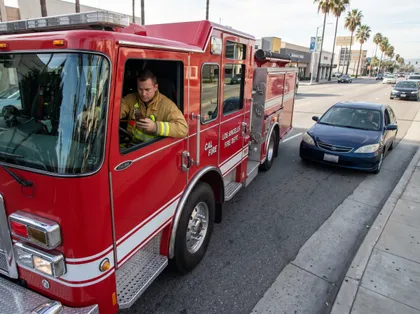
California law gives emergency vehicles special rights on the road. Responders can speed and run red lights when answering an emergency call. However, those rights are not unlimited. If they drive recklessly, they can be held liable for any harm they cause.
There are a few California Vehicle Code (CVC) statutes that define what those rights are and where they end:
- CVC 165 (Definition): An authorized emergency vehicle includes police cars, fire engines, and publicly owned ambulances. It also covers certain federal vehicles and private ambulances that hold a California Highway Patrol (CHP) permit.
- CVC 21055 (Traffic Exemptions): These vehicles can disregard red lights, speed limits, and other traffic rules. This exemption only applies when they respond to an emergency with both a siren and a steady-burning red light.
- CVC 21056 (Due Regard Standard): Even with sirens and warning lights on, an emergency vehicle driver must use due regard for safety. A responder who drives carelessly can still be held responsible for a crash.
- CVC 21806 (Duty to Yield of Other Drivers): When an emergency vehicle approaches with its siren and red light on, you must pull to the right curb and stop. You must stay stopped until it passes.
Responders have real legal exemptions, but not a blank check. If a driver ignores safety and injures someone, that reckless conduct can expose the agency to legal liability. These incidents can affect different people. Many of them may be eligible to pursue compensation for their losses through a personal injury claim:
- Occupants of other vehicles.
- Emergency vehicle passengers, if driver negligence is proven.
- Motorcyclists, bicyclists, or scooter riders.
- Pedestrians.
- Property owners whose structures or buildings were damaged.
- Eligible surviving family members filing a claim for the wrongful death of a loved one.
As these cases can be complex, some victims seek free advice from a motor vehicle accident lawyer to determine their legal options when an emergency vehicle is involved.
Rules That Apply To Accident Claims Against Emergency Vehicles
If a police car, fire truck, or ambulance hit you, special rules may apply when seeking compensation for your injuries. These cases usually involve a city, county, state, or federal government agency. Pursuing a claim against a public entity is not like filing a standard car accident claim. Additionally, other factors, such as shared fault, may also apply.
- Deadline: Claims against a police or fire department fall under the California Tort Claims Act (CTCA). Under it, you must file a written claim with the responsible government agency within six months of the crash. Missing that window generally ends your right to sue.
- Shared Liability: California also follows a pure comparative negligence rule. If you were partly at fault for the crash, your share of fault reduces your potential compensation. For example, if a court finds you were 20% at fault, you can only recover up to 80% of your losses.
Seeking medical care from a doctor after the accident creates a record connecting your injuries to the crash. Medical records show what you suffered and when the harm occurred. If there are recommended treatments, such as physical therapy or chiropractic care, it’s important to follow them, as they provide additional evidence of your injuries and recovery process.
If you find yourself thinking, “I need a personal injury lawyer,” trust that instinct. An attorney can identify the appropriate agency to file with, manage the 6-month deadline, and build an evidence-based claim. Do not wait until the deadline is near to get legal help. Critical evidence may already be gone by then.
Frequently Asked Questions About Crashes Caused By Emergency Vehicles
Pursuing compensation from an emergency vehicle driver isn’t the same as filing a claim against another car driver. The rules are different when a government agency is involved. These answers address the questions people most often ask after this type of crash in California.
Can An Emergency Vehicle Be At Fault If Their Lights Were On?
Yes. Lights and sirens give a driver certain legal rights. For example, under the Move Over Law and other provisions of the CVC, other road users must yield to them while their lights and sirens are on. However, these laws do not provide total protection. If the driver acted recklessly, such as racing through a red light without checking for other cars, the agency can still be legally responsible for your injuries.
What Happens If A Police Car Hits Me While Not Responding To An Emergency?
If the police car was not on an active call, it must follow the same traffic laws as any other driver. Normal fault rules apply. The public agency they work for may face liability if the officer caused the crash.
Do Lawyers Only Get Paid If They Win?
Yes, some of them do, because of the contingency-fee arrangement. Under this fee structure, you pay no fees upfront. Your lawyer only gets paid attorney’s fees if they can get compensation on your behalf.
How Long Do I Have To File A Claim Against The Police Department?
The California Tort Claims Act (CTCA) governs claims against police departments. You generally have six months from the date of the crash to file. Missing that deadline usually disqualifies you from filing a lawsuit later.
Where Can I Find Experienced Motor Vehicle Accident Attorneys In California?
You can search for them online or ask family and friends for referrals. Many personal injury law firms in California, including Arash Law, offer free initial consultations. Consider booking these meetings to ask whether their motor vehicle accident attorneys have experience handling claims arising from crashes involving emergency vehicles.
Accident With An Emergency Vehicle? Arash Law Offers Legal Support
A crash with a government vehicle is not like a typical car accident. Public agencies run ambulances, fire trucks, and police cars. When you file a claim against one of them, different rules apply. The deadlines are shorter, and the process has more steps than a standard injury case.
California law allows injured people to seek compensation depending on the facts of their case. What you can recover depends on how the crash happened and which agency was involved.
Our motor vehicle accident attorneys at AK Law can handle government entity claims and guide you through the process. We offer a free initial consultation to review your case and your options. Call (888) 488-1391 to get started.