TL;DR: Head injuries occur in about 38.6% of motorcycle crash victims, and severity drops sharply with helmet use (54.4% vs. 30.4%). Injuries range from concussions to hematomas, often with delayed symptoms. California’s comparative negligence rule may reduce, but not eliminate, your claim if unhelmeted. Strict deadlines apply, so seek immediate medical care and legal guidance.
Key Facts About Motorcycle Head Injury Claims In California
- An official collision report can provide important evidence of a crash that CHP or a local law enforcement agency may investigate, depending on the crash location.
- Video evidence may not be kept indefinitely. Retention periods vary among businesses, agencies, and camera systems. Identifying possible footage early can help preserve evidence from the motorcycle crash.
- California Vehicle Code (CVC) § 27803 says all riders and passengers must wear a helmet that meets federal safety standards. In California, if someone doesn’t wear a helmet, their head injury damages might be lower due to the pure comparative negligence rule.
- Filing deadlines can be as short as 6 months under Government Code § 911.2 if a public entity shares fault. For claims against State of California entities such as Caltrans, the claim is typically presented to the DGS/ORIM Government Claims Program; local public entities (cities, counties, transit agencies) have their own claims processes.
- Lane splitting is legal in California under CVC § 21658.1; see the FAQ below for how it may affect fault in your case.
Table of Contents

Head injuries are common among motorcyclists who suffer injuries in crashes. A large U.S. study found head injuries in 38.6% of motorcycle drivers injured in traffic crashes. Motorcyclists are also overrepresented in fatal crashes. In 2024, motorcyclists represented 16.2% of traffic fatalities.
Helmet use is a key factor in these rates. Motorcycles also lack a door frame and structural cage between the rider and the road, and most do not have integrated airbags.
To protect your rights, understand head injuries. Know what they look like, why symptoms may appear days later, and what California law allows for recovery.
Statistics About Head Injuries In Motorcycle Accidents
In traffic accidents, head injuries are common among motorcyclists, particularly those not wearing helmets. A 2024 study examined 315,258 injured motorcycle drivers using 2007–2017 data from the U.S. National Trauma Data Bank. Head injuries showed up in 121,640 patients (38.6%). Moreover, helmet use and non-use affected the rate of head injuries:
| Rider Group | Number of Riders in the Study | Riders w/ Head Injuries | Head Injury Rate |
|---|---|---|---|
| Helmeted | 207,928 | 63,278 | 30.4% |
| Non-helmeted | 107,330 | 58,362 | 54.4% |
Severe head injuries also affected 18.5% of the entire group, and they were far more common without a helmet: 13.3% among helmeted riders versus 28.5% for non-helmeted riders. These figures describe injured drivers treated at trauma centers, not every motorcycle crash.
Federal data also shows how many traffic crashes affect motorcyclists. Despite accounting for just 3% of registered vehicles and 0.6% of all miles traveled in the U.S., motorcyclists accounted for 16.2% of traffic fatalities and 3.6% of injuries in 2024, according to the National Safety Council.
In California, 583 motorcyclist deaths occurred in 2023, according to the California Office of Traffic Safety. It also reported that motorcyclist fatalities from not wearing a helmet dropped by about 23.3% from the previous year. That figure counts fatalities, not how many riders suffered a head injury specifically.
“Head injury” covers a spectrum of conditions, from mild concussion to catastrophic diffuse brain damage. Each condition affects the brain and body differently and often carries lasting consequences.
What Types Of Head Trauma Do Motorcyclists Typically Suffer?
Motorcycle accidents can cause several forms of traumatic brain injury, including concussions, brain contusions, diffuse axonal injuries, and hematomas. A rider may suffer one of these or several at once after hitting an uneven pavement, a vehicle, or another object.
Common forms of motorcycle-related TBI include:
- Concussion: A blow or sudden jolt can disrupt normal brain function. A concussion is a mild TBI, but its symptoms may last for weeks or months.
- Brain Contusion: A strong impact can bruise brain tissue, causing bleeding or swelling. Severe contusions may require surgery or other medical treatment.
- Diffuse Axonal Injury (DAI): A violent movement can cause the brain to shift inside the skull. This movement can damage nerve fibers throughout the brain. DAI can cause severe and lasting brain damage.
- Hematoma: A hematoma occurs when blood collects inside the skull after an injury. The buildup can increase pressure on the brain. Doctors classify hematomas by where the bleeding occurs, such as epidural, subdural, or intracerebral.
Motorcycle crashes can also cause facial injuries such as:
- Jaw fractures
- Eye socket fractures
- Dental injuries
- Permanent scars.
Helmet design may affect this risk. One systematic review found fewer facial fractures and TBIs among riders who wore full-face helmets.
One critical clinical distinction: facial fractures show up immediately on CT imaging, but many brain injuries appear deceptively mild on early scans yet mask progressive swelling or bleeding that becomes life-threatening over the following hours or days. This is why the timing of your medical records matters as much as the records themselves.
Why Do Motorcycle Head Injury Symptoms Often Have A Delayed Onset?
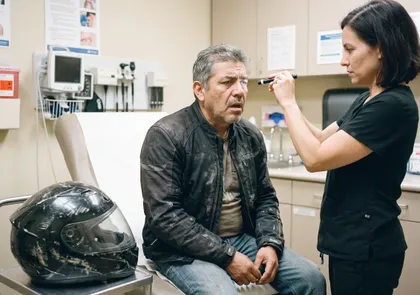
Some symptoms of head injuries from motorcycle accidents appear right away, while others become noticeable hours or days after the crash. Such delays can happen with concussions and other brain injuries. A rider can feel fine at the scene and still be developing a serious TBI.
Possible delayed symptoms include:
- Persistent Headaches: Pain that returns or intensifies in the days following the crash, often worse with activity or light.
- Memory Lapses: You may have trouble remembering what happened before or after the crash. Short-term memory problems may also continue afterward.
- Sudden Mood Swings: A head injury may cause unusual irritability, depression, or sudden changes in mood. These symptoms may appear days or weeks after the crash.
- Dizziness: You may feel dizzy, unsteady, or as if the room is spinning. These problems may last for a while and then go away after the crash.
Some symptoms require emergency care. These include worsening headaches, repeated vomiting, seizures, slurred speech, weakness, or confusion. After a possible head injury, seek prompt medical care even if you initially feel fine. That visit builds something insurers cannot easily tear down: a contemporaneous medical timeline.
Insurers may use gaps in post-crash medical care to argue that a rider’s TBI symptoms arose from something other than the collision. When no medical records exist from the days immediately following the crash, adjusters gain a powerful tool to challenge causation. Closing that evidentiary gap starts with getting evaluated the same day. Knowing what to do after a motorcycle accident is the first step toward protecting that timeline.
How Does California’s Helmet Law Affect Your Head Injury Claim?
Not wearing a helmet in California can reduce the head-injury portion of your damages award under comparative fault rules, but it does not eliminate your right to sue. California Vehicle Code § 27803 requires every motorcycle rider and passenger to wear a safety helmet meeting federal standards. Helmet non-use opens a specific legal argument that defendants and their insurers routinely make, but your right to sue is grounded in the other party’s negligence, not your own gear choices.
California applies pure comparative negligence, as the California Supreme Court established in Li v. Yellow Cab Co., 13 Cal. 3d 804 (1975). Under that doctrine, a defendant can argue that your head injuries were worsened by your choice not to wear a helmet. Whether and how a jury apportions fault depends on the medical evidence and expert testimony; it is a matter of litigation, not a fixed rule.
Medical data help explain why insurers raise this argument. In the same national study mentioned in earlier sections, severe head injuries affected 13.3% of helmeted riders compared with 28.5% of unhelmeted riders. An attorney can evaluate how helmet use may affect your specific claim.
Even after a comparative fault reduction, the remaining award can be substantial. California follows pure comparative negligence. So even if you are 80% at fault, you may still recover 20% of your damages.
The helmet argument is one of several comparative fault strategies insurers use against riders.
Lane splitting, speed, and road familiarity are other common comparative fault arguments. Having a motorcycle accident attorney who understands how California courts actually apply these arguments, not just what the statutes say, is the practical difference between an early low settlement and a fair recovery.
What Evidence Matters Most In A California Motorcycle Head Injury Claim?
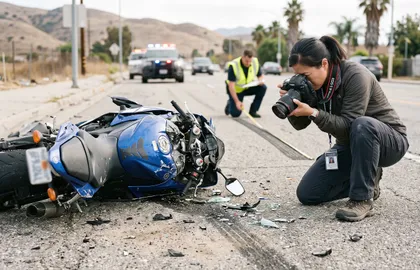
Important evidence in a California motorcycle head injury claim can include the collision report, medical records, imaging, the helmet, witness information, and scene photos. Some evidence is more time-sensitive than others since video and road conditions can change quickly. Medical records help connect the crash to the rider’s head injury and document how symptoms developed.
Some of the most important pieces of evidence in motorcycle head injury cases include:
- Official Collision Report: CHP or a local law enforcement agency may investigate the motorcycle crash, depending on where it happened. The report can include road conditions, helmet use, speed estimates, and the parties involved.
- Medical Records and Imaging: Emergency room admission notes, CT scans, MRI results, and neurology consult records document the nature, severity, and timing of the head injury. Prompt evaluation establishes a timeline linking the injury directly to the crash.
- The Helmet as Physical Evidence: Keep the motorcycle helmet in its post-crash condition. Damage may help experts evaluate the location or force of a head impact. Avoid repairing or discarding it before the claim is reviewed.
- Scene Photographs and Surveillance Footage: Road conditions and physical evidence can change after a crash. Video retention periods vary by system and organization, so possible footage should be identified and requested promptly.
- Insurance Information: California Vehicle Code § 16025 requires drivers to exchange identifying and insurance information after a crash. Available liability coverage can be investigated as the claim develops, and the rider’s own UM or UIM coverage may also become relevant.
Arash Law sends preservation letters as soon as a client retains the firm, ensuring the helmet is secured before it can be discarded, repaired, or lost, a step that has protected critical causation evidence in the firm’s motorcycle head injury cases.
Injured in a California motorcycle crash? Arash Law’s attorneys work to preserve your evidence and build your case from day one. Call (888) 488-1391 for a free case evaluation, available 24 hours a day.
What Compensation Is Available For Motorcycle Head Injuries Under California Law?
A motorcycle head injury can create both economic and non-economic losses. Serious brain injuries may require long-term rehabilitation and affect a rider’s ability to work. The damages available depend on the injury, evidence, liability, and the facts of the case.
Economic damages are verifiable, documentable costs:
- Emergency room charges, surgical costs, CT and MRI imaging, and ICU or hospital stays following the crash.
- Ongoing cognitive rehabilitation, including speech therapy, memory retraining, and occupational therapy.
- Long-term in-home care or home modification costs for riders left with lasting disability.
- Lost wages and lost earning capacity for riders who can no longer work in their prior occupation or at all.
Non-economic damages address the personal losses that numbers cannot fully capture:
- Chronic pain from the injury and from the medical interventions required to treat it.
- Loss of hobbies, activities, and relationships that the rider can no longer participate in.
- Anxiety, depression, post-traumatic stress, and other psychological consequences of the crash.
- Permanent facial disfigurement from head and facial trauma.
The damages available in any specific case depend entirely on the facts and evidence; there is no standard formula. What Arash Law’s attorneys bring to this analysis is direct experience with the long-arc costs of TBI claims: the rehabilitation timelines, the expert witnesses needed to project future medical needs, and the litigation strategies that prevent insurers from undervaluing a permanent brain injury.
Arash Law Results In Serious Injury Cases
Arash Law has recovered over $1 billion for injured clients across California. The following representative results illustrate the types of outcomes the firm has achieved in serious-injury cases, including those involving brain injury.
$10,000,000 — Recovery: Our client sustained severe injuries after being struck by a speeding vehicle. Arash Law obtained a $10 million recovery and coordinated extensive medical treatment to support the client’s long-term recovery.
$1,450,000 — Settlement: A motorcyclist struck a stretch of uneven pavement at a construction site, resulting in fractured ribs and a head injury. The contractor and the city denied responsibility until the trial began, ultimately agreeing to settle after the first day of the proceedings.
Past results do not guarantee future outcomes. Every case is different, and results depend on the specific facts and evidence involved.
Frequently Asked Questions About Motorcycle Head Injuries In California
After a crash, questions about deadlines, fault, and money can feel overwhelming. These answers address the California-specific concerns riders and their families bring to Arash Law after a crash.
How Long Do I Have To File A Motorcycle Head Injury Lawsuit In California?
California Code of Civil Procedure § 335.1 generally gives you two years from the crash date to file a personal injury lawsuit. If a public entity may share fault, Government Code § 911.2 generally requires an administrative claim within six months of the crash.
The agency then has 45 days to respond. If it sends a formal written rejection, you generally have six months from that notice to file suit. If 45 days pass without a formal response, the claim is deemed rejected, and you generally have 2 years from the crash date instead.
Missing either deadline can bar recovery, so consult an attorney early.
Does Lane Splitting Affect Who Is At Fault For A Motorcycle Crash?
Lane splitting is legal in California under Vehicle Code § 21658.1, and CHP advises riders to do it safely and prudently. Lane splitting alone does not make a rider responsible for a crash. However, insurers may still argue that the manner of lane splitting was unsafe, which can affect comparative fault. Documenting speed, traffic, and road conditions helps counter that argument.
Can A Passenger File A Claim For A Head Injury In A Motorcycle Accident?
Yes. A passenger injured in a motorcycle crash can seek compensation from the at-fault driver who caused the collision or from the motorcycle operator if that rider was negligent — meaning the rider failed to use reasonable care. In some crashes, multiple parties share fault, and a passenger may have claims against more than one of them.
Does Arash Law Charge Upfront Fees?
No. Arash Law works on a contingency basis; no attorney fees are owed unless a recovery is made. There are no upfront costs to get started. Contingency fees are negotiable between the attorney and client and are set in the written agreement.
Should I Accept The First Settlement Offer After A Head Injury?
It’s not recommended. An early settlement offer may not reflect the full long-term costs of a brain injury, especially while a rider’s prognosis is still developing. Future rehabilitation, lost earning capacity, and ongoing symptoms can add up over time. Have an attorney evaluate any offer before accepting it.
Can I Sue For Wrongful Death If A Family Member Died From A Motorcycle Head Injury?
California Code of Civil Procedure § 377.60 identifies who may bring a wrongful death claim, including a surviving spouse, domestic partner, children, and certain other heirs or dependents. Recoverable losses may include financial support the person would have provided and compensation for the loss of companionship, as governed by CCP § 377.61.
What Happens If I Wasn’t Wearing A Helmet During The Crash?
Failure to wear a helmet does not eliminate your right to file a claim. A defendant may argue that not wearing a helmet worsened your head injuries, which could reduce your damages under California’s comparative negligence rule. How that argument plays out depends on the medical evidence and expert testimony. An attorney can evaluate how it may affect your specific claim.
Talk To Arash Law About Your California Motorcycle Head Injury Claim
If you or someone you love sustained a head injury in a California motorcycle crash, the attorneys at Arash Law are ready to help. Arash Law has recovered over $1 billion for injured clients across California, handling motorcycle accident cases on a contingency fee basis. You don’t pay the attorney’s fees unless the team secures compensation for you.
Call Arash Law at (888) 488-1391 for a free case evaluation, available 24 hours a day. You can also reach Arash Law online to schedule your consultation at no cost. The earlier you call, the sooner Arash Law can send preservation letters, secure your medical records, and build the evidentiary timeline that protects your claim.
Arash Law. Make ‘em pay. Call AK.
Sources
UC Berkeley Safe Transportation Research and Education Center (SafeTREC). “2025 SafeTREC Traffic Safety Facts: Motorcycle Safety.” Published 2025, using 2023 event-year data. safetrec.berkeley.edu
Brockhus, L.A. et al. “Injury Patterns and Outcomes in Motorcycle Driver Crashes in the United States: The Effect of Helmet Use.” Injury. 2024;55(3):111196.
California Office of Traffic Safety (OTS). California Traffic Safety Quick Stats, updated July 2025. ots.ca.gov Insurance Institute for Highway Safety (IIHS). “Motorcycles.” iihs.org
California Office of Traffic Safety (OTS). California Traffic Safety Scorecard — 2023 statewide fatality data. ots.ca.gov
California Legislative Information. California Code of Civil Procedure §§ 335.1, 377.60, 377.61; Government Code § 911.2; California Vehicle Code §§ 16025, 21658.1, 27803. leginfo.legislature.ca.gov
California Department of Insurance. Bulletin 2023-1: SB 1107 minimum auto liability insurance limits ($30,000/$60,000/$15,000, effective January 1, 2025). insurance.ca.gov
California Department of General Services / Office of Risk and Insurance Management (DGS/ORIM). Government Claims Program — filing pathway for claims involving public entity liability. dgs.ca.gov
Disclaimer
Past results do not guarantee future outcomes. Every case is different. The information on this page is for general educational purposes and does not constitute legal advice. No attorney-client relationship is formed by reading or relying on this content. If you were injured, consult a licensed California personal injury attorney about your specific situation. Arash Law: (888) 488-1391.