TL;DR: You may be able to bring a claim against a California government agency if a dangerous condition on public property caused your injuries. To have a valid case, you must prove specific facts required by California law, including that the agency owned or controlled the property and had notice of the danger, like potholes or broken signals. To do this, you must prove that the agency owned the road, the defect posed a serious risk, it caused your injury, and the agency knew about it or should have discovered it through routine inspections.
Highlights:
- File a written administrative claim with the correct government agency within six months of your accident.
- Before repairs begin, document the road hazard immediately by taking photos and videos from multiple angles.
- Prove the government agency knew about the defect or should have discovered it through routine inspections.
- Identify which agency is responsible for maintaining the road: Caltrans for freeways, cities for city streets, and counties for unincorporated areas.
- Obtain a police report naming the specific road defect and seek medical care so a doctor can document how your injuries occurred.
- Gather public works logs and inspection records to show the agency had notice of the hazard.
Tip: Stick to facts at the scene and avoid guessing details, as your early statements may affect a government claim.
Table of Contents
If a dangerous road condition caused your accident, you may have the right to seek compensation in California. To make a valid claim, you need to show that a government agency was responsible for maintaining the road, that the hazard caused your injuries, and that the agency knew or should have known about the issue.
Claims against public agencies are subject to strict rules and deadlines. Failing to meet a requirement can prevent you from moving forward with your claim, so it’s essential to act quickly and understand your legal options.
Can You Sue For Injuries Caused By Road Hazards In California?
Yes, you can file a lawsuit for injuries caused by road hazards in California. However, suing a government agency is not the same as suing a private driver. Claims against public entities often require more evidence because you must prove additional legal elements that do not apply in a typical car accident case. Strict rules and deadlines also apply.
One of the biggest challenges in these cases is the legal doctrine of sovereign immunity. In general, government agencies cannot be held responsible for injuries unless a law allows them to be. Because of these protections, claims against government agencies often require additional legal steps and proof.
The California Government Claims Act sets out the rules for when cities, counties, state agencies, and other public entities may be sued. One instance in which a lawsuit is possible is when dangerous conditions on public property cause injuries and losses. You must prove specific facts about what the government knew and whether it acted.
How To Prove A Dangerous Road Condition Claim
To prove a dangerous road condition claim, you must show that a hazardous condition existed. A public entity knew or should have known about it, but failed to address it promptly. As a result, you sustained injuries and losses. Evidence such as photos, witness statements, inspection records, and accident reports can help support your claim.
To have a valid dangerous road condition claim, you generally must prove:
- The government agency owned or controlled the property.
- A dangerous condition existed on the property.
- The dangerous condition caused your injuries.
- The risk of injury was reasonably foreseeable.
- A public employee created the dangerous condition, or the agency knew or should have known about it and failed to take reasonable steps to address it.
Notice is often one of the most difficult elements to prove in a claim arising from dangerous road conditions. California law recognizes two types of notice:
- Actual Notice: The agency actually knew about the dangerous condition before the accident. This knowledge may come from inspections, complaints, reports, repair requests, or other reliable information. For example, public works records showing an open repair ticket for a broken traffic signal may help establish actual notice.
- Constructive Notice: The dangerous condition was evident for a long time. The agency should have noticed it during routine inspections. For example, a stop sign that has been down for weeks can show constructive notice, as it should have been seen and repaired.
Defects that meet this standard include severe potholes, missing or blocked road signs, blocked traffic signals, and broken storm drains that leave standing water on the road. Poor drainage can create dangerous driving conditions by allowing water to collect on the roadway. In some cases, standing water may contribute to crashes.
Government agencies may use a defense called design immunity. Under the California Government Code, this defense can protect an agency when a road was built in accordance with an approved design. However, the protection may not apply if conditions changed over time and the agency knew the design had become dangerous. Whether design immunity applies depends on the facts of the case.
To demonstrate the control and notice elements, you need to know exactly which agency owns and maintains the road where you were hurt. Pinpointing the right agency is the first step toward building a strong case.
Who Is Responsible For Road Maintenance And Repairs?
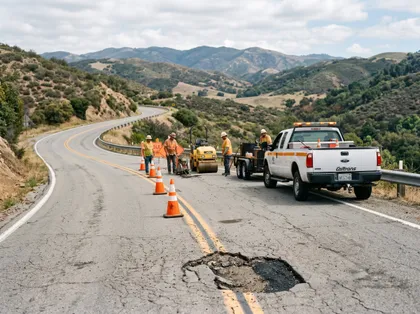
Who is legally responsible for a road defect depends on who owns or controls that stretch of road. Each type of owner has its own procedural rules. The deadlines to file a claim also differ. Finding the right party is essential because the rules and deadlines for your claim will depend on who that party is.
The road where you were hurt will usually fall into one of these categories:
- Caltrans: Maintains most state highways and freeways in California.
- City: Usually maintains streets within city limits.
- County: Usually maintains roads in unincorporated areas outside city limits.
A dangerous road conditions attorney can help you find out which public entity has control over the road where your accident occurred. They can also assess whether a third party may be responsible. That’s because not all road hazards involve a public agency. For instance:
- If your accident happened on a private road, for example, the property owner may be responsible. State law requires them to maintain safe environments for lawful visitors and passersby. If they had actual or constructive notice of the roadway defect but failed to fix it, you may have a valid claim against them.
- If a roadwork construction crew failed to use proper warning signs, barriers, or traffic controls, and that specific oversight contributed to the accident, the contractor may be liable for the resulting injuries.
The Strict Six-Month Government Claim Deadline
If a dangerous road caused your injuries, California law generally requires you to file a government claim within six months. Under the California Government Claims Act, you must submit a written claim to the correct public agency before you can file a lawsuit. If you miss the six-month deadline, your claim may be barred.
Once the agency receives your claim, it generally has 45 days to respond. If the agency sends a written denial, you usually have six months from the date of that notice to file a lawsuit. If the agency does not provide written notice of its decision, California law generally gives you up to two years from the date of the injury to file suit.
California law allows late-claim applications in some situations, such as when the injured person was a minor or lacked legal capacity. However, approval is not automatic. Because road hazards can be repaired or changed over time, it is important to document the condition and act quickly to protect your claim.
Steps To Protect Your Roadway Defect Claim
There are several steps you can take to protect your claim, starting at the accident scene and continuing afterward. Road conditions can change or be repaired over time, making it harder to document the hazard. Taking photos and videos as soon as possible can help preserve important evidence and strengthen your claim.
Take these steps as soon as you are able:
- Report the Crash to the Authorities: A police report can provide helpful information about the accident scene. However, photographs, witness statements, and maintenance records may also be important when proving that a roadway condition contributed to the crash. Officers may document the scene and create an official report that can help support your claim.
- Get Medical Care: Go to an emergency room, an urgent care clinic, or a doctor or chiropractor as soon as possible. Describe how your injuries occurred so your provider can document the cause accurately.
- Document the Hazard: If you are physically able, photograph and video the defect from multiple angles before leaving the scene. Capture the pothole, missing guardrail, or any other road hazard.
- Stay Off Social Media: It is generally advisable to avoid posting about the accident or your injuries on social media, as such posts can become evidence in your case. Social media posts may be reviewed and used as evidence during a claim or lawsuit.
If you could not act at the scene, you still have options today. Get medical care if you have not already done so. If you’re thinking, “I need a personal injury lawyer,” consider acting on that instinct and getting legal representation. An accident attorney can help you understand your rights, gather time-sensitive evidence, and speak to insurance adjusters and government representatives on your behalf.
Recoverable Damages And How Fault Is Shared
If a dangerous road condition caused your injuries, you may be able to recover compensation for the losses you experienced due to your injuries. California law allows injured parties to seek two main types of damages after a road hazard crash:
- Economic Damages: These are losses you can prove with bills or pay stubs. They include emergency care, surgery, physical therapy, rehab, and wages you lost while hurt. They also cover future lost income if your injuries are long-term.
- Non-Economic Damages: These include pain and suffering, emotional distress, and loss of enjoyment of life. California generally does not place a statutory cap on pain-and-suffering damages in roadway defect injury cases involving public entities. Some other types of cases may have different rules.
One important limit applies when your claim is against a public agency. In traffic accident lawsuits against private entities, courts may award punitive or exemplary damages if there is clear and convincing evidence of oppression, malice, or fraud. These damages aim to punish the at-fault party rather than compensate you for your losses.
Under the California Government Code, you cannot seek punitive damages from public entities. You can only pursue compensation for real losses, such as those covered by economic and non-economic damages.
Another rule may limit how much of your total damages you can actually recover. California follows a pure comparative negligence system. Under it, you may still pursue a claim, even if you were partly at fault for the accident. However, a court will assign a percentage of fault to each party and reduce your compensation by your share of the blame.
For example, if you’re 20% at fault because you were speeding on a road with a defect, your recovery will be reduced by 20%.
Frequently Asked Questions About Roadway Defect Claims

Road defect claims in California are subject to strict rules and deadlines. These cases raise specific questions due to the potential involvement of a public entity. Some victims even search for free advice from dangerous road condition attorneys before deciding on their next steps. The answers below provide general guidance on the most common questions victims raise.
Will My Insurance Cover Pothole Damage?
Yes, your insurance may cover pothole damage if you have collision coverage. Collision and comprehensive coverage can help pay for vehicle repairs, subject to your policy terms and deductible. Your insurance company may then try to recover its costs from the party responsible for the road hazard. If you were injured, MedPay coverage may also help pay for medical expenses if your own auto policy includes it.
How Can I Prove The City Knew About The Pothole Before My Accident?
You may be able to prove the city knew about the pothole by using inspection records, maintenance logs, repair requests, or prior complaints about the same location. These records can help show that the city knew, or should have known, about the hazard before the accident. Proving this notice is often an important part of a roadway defect claim.
Can I Sue If Foliage Or A Tree Branch Was Blocking The Stop Sign?
Possibly. If overgrown plants or tree branches blocked a stop sign and contributed to your accident, you may have a claim. A blocked traffic sign may qualify as a dangerous condition of public property under California law. To hold a public agency responsible, you generally must show that it knew or should have known about the obstruction and failed to take reasonable steps to address it. In some cases, a private property owner may also share responsibility.
What If The Accident Happened In A Construction Zone?
You may have a claim if unsafe conditions in a construction zone contributed to the accident. A contractor may be liable if it failed to use proper warning signs, barriers, or traffic controls, or if it left the road in a dangerous condition. Depending on the circumstances, subcontractors and the public agency overseeing the project may also share responsibility. Determining liability often requires reviewing construction records, contracts, and other evidence.
What If I Was Injured On A Public Sidewalk?
You may have a claim if a dangerous condition on a public sidewalk caused your injury. If the sidewalk was owned or maintained by a public entity, your case will generally follow the same government claims process as a roadway defect claim.
What If I Missed The Six-Month Government Claim Deadline?
You may still have options if you missed the six-month deadline. California law allows some people to apply for permission to file a late claim. Common reasons include being a minor, lacking legal capacity, or having another valid excuse for the delay. These requests are subject to strict rules and deadlines, and approval is not guaranteed.
Do Lawyers Only Get Paid If They Win A Roadway Defect Case?
Yes, if they work on a contingency fee basis. That means you only pay the attorney’s fees if they recover money for you through a settlement or court award. If there is no recovery, you usually do not owe legal fees. However, fee arrangements can vary, so it is important to review the agreement with your lawyer before hiring them.
Contact Arash Law To Learn If You Have A Valid Roadway Defect Case
Arash Law handles government road defect claims for injured Californians. These cases carry a strict six-month deadline from the date of your accident. They also involve immunity defenses, which are legal rules that allow government agencies to avoid paying for your injuries.
AK Law has helped injured Californians pursue claims against government agencies for years. Our attorneys know how to build a strong case, challenge the agency’s defenses, and meet every deadline. If we take your case, we can handle these legal complexities so you can focus on your recovery.
If a road defect hurt you, call us at (888) 488-1391 for a free initial consultation.