TL;DR: Consult a personal injury lawyer to seek compensation after an apartment stairway fall, and a tenant lawyer for legal help involving repairs, rent disputes, or eviction defense. Confirm each lawyer’s scope, fees, and costs. Preserve photos, repair requests, medical records, and housing notices. Injury lawsuits generally have a two-year deadline; property damage lawsuits generally have a three-year deadline; claims against California public entities generally require a government claim within six months.
You may need a personal injury lawyer after an apartment stairway fall to seek compensation for your injuries, a tenant lawyer to address unsafe housing conditions, or both if you have injury and housing concerns.
A personal injury lawyer can investigate liability and pursue compensation for medical expenses, lost income, and pain and suffering.
You may need a tenant lawyer if you need dangerous stairs repaired or help with housing disputes. They can address repair obligations, rent disputes, lease issues, and eviction defense.
You may need both if you suffered injuries and also face unresolved housing problems. Some firms handle both areas; others handle only one. Before hiring a lawyer, ask whether the representation covers your injury claim, housing concerns, or both, and confirm that scope in writing.
Key Facts About Apartment Stairway Fall Claims in California
- Property owners must use reasonable care. California Civil Code § 1714 establishes ordinary-care duties that can support injury claims when negligent property maintenance causes harm.
- California habitability standards include stairways and railings. Civil Code § 1941.1(a)(8) identifies stairways and railings maintained in good repair as required rental-housing conditions.
- Written repair requests help document unsafe conditions. California’s Attorney General recommends reporting unsafe housing conditions in writing and keeping copies of repair requests.
- Personal injury lawsuits generally have a two-year deadline. CCP § 335.1 generally allows two years from the injury to sue a private landlord, subject to applicable exceptions.
- Public-entity injury claims generally require earlier action. Government Code § 911.2 generally requires that an administrative claim be presented to the responsible California public entity within six months, subject to exceptions.
- Unsafe housing conditions can also affect eviction defenses. California courts explain that a landlord’s failure to repair serious housing problems may provide a defense to an eviction action, depending on the circumstances.
Table of Contents

I Was Hurt On An Apartment Stairway And Also Need A Dangerous Condition Fixed. Should I Speak With A Personal Injury Lawyer, A Tenant Lawyer, Or Both?
Speak with both types of lawyers if you want compensation for your injuries and help getting dangerous stairs repaired. A personal injury lawyer handles the injury claim. A tenant lawyer can assess repair remedies and any related housing concerns. Some firms handle both areas, so confirm which services each prospective engagement covers.
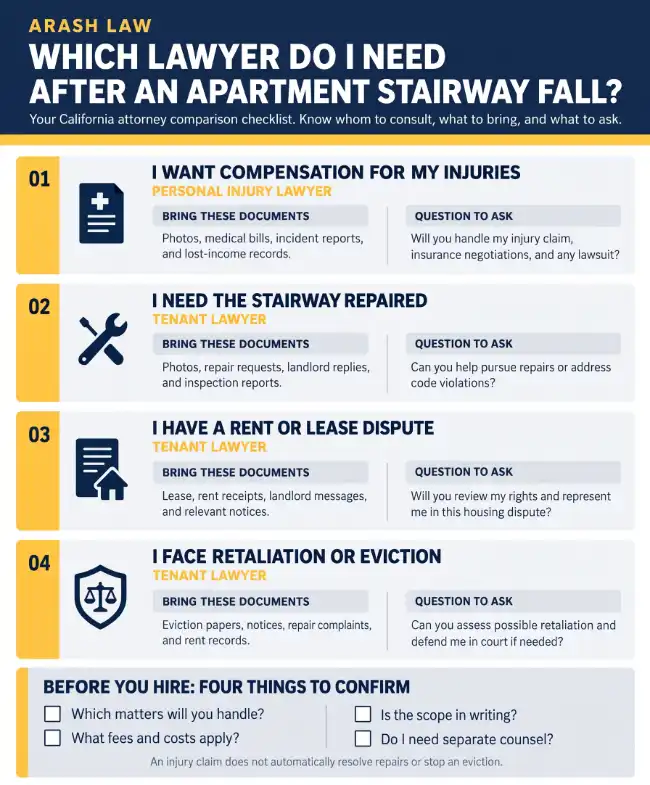
The right lawyer depends on what you want to accomplish. Use this table to identify the legal help you may need, the documents to prepare, and the questions to ask before hiring an attorney.
Here’s a quick guide on which type of lawyer you may need:
Before hiring, ask whether the lawyer handles all your concerns or only specific claims. Confirm the scope of representation, fees, and costs in writing. If the lawyer does not handle both injury and housing matters, ask whether you should consult separate counsel.
What Records Help a Lawyer Assess Responsibility and the Services You Need?
Photos, repair requests, medical records, and housing documents help lawyers assess responsibility and identify the services you need. Some support both injury and repair concerns; others specifically address only compensation or housing disputes. Bring the records you have, even if your file is incomplete.
Photos, Videos, and Incident Details
Preserve images of the steps, lighting, handrails, and surrounding area. Note the fall’s date, time, exact location, and what happened. Include any incident report, witness contact information, and camera locations.
- A personal injury lawyer uses these materials to investigate how the condition caused your fall.
- A tenant lawyer can use current images to document an unresolved hazard and support a repair request.
Repair Requests and Landlord Responses
Save emails, texts, maintenance submissions, and management responses. Separate complaints made before the fall from requests submitted afterward, and keep dates and recipient information.
- An injury lawyer assesses whether the landlord knew about the hazard before you fell.
- A tenant lawyer reviews the repair history, the landlord’s response, and available options to address the ongoing condition.
Medical Records and Income Documentation
Gather treatment records, medical bills, work restrictions, pay stubs, and documentation of missed work.
- A personal injury lawyer uses these records to assess your injuries, treatment needs, and financial losses.
- If your injuries also affect your ability to access your apartment, a tenant lawyer can assess whether disability-related housing accommodations warrant further review.
Inspection Reports and Code Enforcement Records
 Keep inspection reports, violation notices, repair orders, and complaint confirmations. If you lack the documents, provide the agency’s name and any complaint number.
- An injury lawyer looks for findings about the hazard and evidence of prior notice.
- A tenant lawyer assesses outstanding repair requirements and the status of enforcement.
Lease and Property Management Documents
Provide your lease, building rules, maintenance instructions, and notices identifying the owner or management company.
- A personal injury lawyer can use these documents to investigate who controlled or maintained the stairway.
- A tenant lawyer reviews rental obligations and determines whether your concerns involve repair enforcement, lease rights, or another housing issue.
Rent Records, Landlord Notices, and Court Papers
If housing disputes arise, save rent receipts, landlord messages, rent increase notices, termination notices, and eviction papers.
- A tenant lawyer uses these records to evaluate payment disputes, possible retaliation, or eviction defenses. Show any time-sensitive notices promptly.
- An injury lawyer should also be familiar with related proceedings so both lawyers can coordinate within their agreed-upon responsibilities.
How Are Legal Fees Handled for Stairway Fall Cases?
In personal injury cases, many lawyers, including those at Arash Law, work on a contingency fee basis. That means the attorney’s fees will be a percentage of what they recover for you.
California Business and Professions Code § 6147 requires a written contingency agreement signed by both the attorney and the client. The attorney must provide the client a duplicate signed copy when they enter the agreement. The written agreement must specify the fee percentage, how case costs and expenses are handled, and other required disclosures. If there is no recovery, you owe no attorney’s fee under a compliant contingency arrangement.
What Arash Law Has Recovered in Premises Liability and Fall Cases
Arash Law has secured significant settlements and judgments for clients seriously injured in fall-related and premises liability cases across California. These case results illustrate some of the many types of personal injury cases the firm handles. It also shows the level of resources the firm brings to complex injury claims.
$3,000,000 — Wrongful Death/Premises Liability Case: A farm employee fell on steep stairs without railings and passed away two days later due to bleeding in her brain. Our attorneys used proof of earlier complaints to resolve the case.
$1,012,804.97 — Premises Liability Case: Our client suffered multiple injuries when a deteriorated staircase collapsed at a home under construction. Our attorneys documented his losses and obtained a court judgment in his favor.
Past results do not guarantee future outcomes. Every case is different, and results depend on the specific facts and evidence involved.
Get a Free Case Evaluation from Arash Law’s Injury Lawyers
Arash Law handles personal injury claims, including those involving unsafe apartment conditions. Repair enforcement, lease disputes, landlord retaliation, and eviction defense involve distinct legal issues that may require the services of a tenant attorney.
If you were injured in a fall in an apartment stairway in California, our landlord liability lawyers can evaluate whether the landlord’s negligence gives rise to a personal injury claim.
There is no fee to speak with us; just call (888) 488-1391 to schedule your free case evaluation.
Frequently Asked Questions About Stairway Accidents and Legal Representation in California
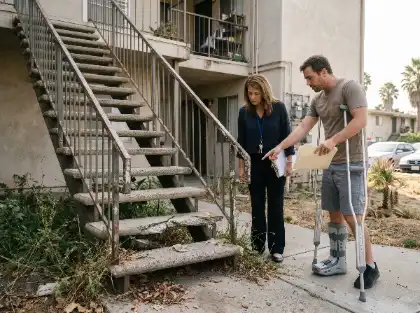
Can an Injury Claim Force My Landlord to Fix the Broken Stairway?
A personal injury settlement does not automatically require your landlord to repair the stairway. It generally resolves your compensation claim against the responsible party. However, a settlement can include an enforceable repair obligation if the parties agree to that term. Ask your lawyers whether the agreement addresses both compensation and repairs.
To compel repairs, you can file a complaint with your local building and safety or code enforcement office, for example, by contacting your city’s Department of Building and Safety. A tenant lawyer can also seek repairs by invoking California’s habitability statutes. These are separate legal strategies from those used in a personal injury claim.
Does My Landlord Paying My Medical Bills Stop an Eviction?
No. A landlord’s payment of some or all of your medical bills does not affect a pending or threatened eviction. These are two separate legal matters governed by different bodies of law, and one does not pause or resolve the other.
If you are facing eviction while recovering from a stairway fall, you likely need two types of legal help: a tenant lawyer handling the eviction proceeding, and a stairway accident lawyer handling the compensation claim.
What if I Was Visiting a Friend’s Apartment and Fell on the Stairway?
You do not need to be a tenant to have a valid premises liability claim. Property owners in California owe a duty of care, a legal obligation to keep their property reasonably safe, to guests and visitors, not only to tenants.
If a defective stairway caused your fall, the landlord may be liable for your injuries, regardless of whether you lived there or were visiting. This is a personal injury matter usually handled by an injury attorney, not a tenant lawyer.
Can I Withhold Rent Because I Got Hurt on the Stairs?
Getting hurt on the stairs does not automatically entitle you to withhold rent. A serious, unresolved housing defect could support rent withholding under California law, but specific requirements apply. Improperly withholding rent can expose you to eviction. Consult a tenant lawyer before stopping payments.
How Long Do I Have to File a Stairway Injury Lawsuit in California?
You generally have two years from the injury date to file a California stairway injury lawsuit against a private party (CCP § 335.1).
If a California public entity is responsible, you generally must first present a government claim within six months. A compliant written rejection generally starts a separate six-month lawsuit deadline. Minors and other exceptions can affect timing.
Ask a personal injury lawyer to confirm your deadlines; repair requests and insurance negotiations generally do not extend them.
What Is the Difference Between a Premises Liability Claim and a Negligence Claim After a Stairway Fall?
Premises liability is a type of negligence claim involving unsafe property conditions. After a stairway fall, the focus is on whether someone who owned or controlled the stairs failed to exercise reasonable care, causing your injuries. General negligence can also involve conduct such as a worker leaving an obstruction on the steps. The claims can overlap, and an injury lawyer can determine which parties and legal theories fit your case.
Talk to Arash Law About Your California Stairway Fall Claim
If you were hurt in an apartment stairway fall, Arash Law can evaluate your personal injury claim. Our attorneys investigate responsibility, preserve evidence, and pursue compensation for medical bills, lost income, and pain and suffering.
We handle personal injury cases on a contingency fee basis. You pay no attorney’s fees unless we secure compensation for you.
Call (888) 488-1391 today to schedule your free case evaluation.
Sources
- California Code of Civil Procedure § 335.1: Generally establishes a two-year filing deadline for personal injury lawsuits. https://leginfo.legislature.ca.gov/faces/codes_displaySection.xhtml?lawCode=CCP§ionNum=335.1.
- California Code of Civil Procedure § 352: Addresses tolling for minors and certain other circumstances, including exceptions for claims against public entities. https://leginfo.legislature.ca.gov/faces/codes_displaySection.xhtml?lawCode=CCP§ionNum=352.
- California Civil Code § 1714: Establishes the general duty of ordinary care, including in the management of property. https://leginfo.legislature.ca.gov/faces/codes_displaySection.xhtml?lawCode=CIV§ionNum=1714.
- California Civil Code § 1941: Addresses a landlord’s obligation to provide and maintain habitable rental premises. https://leginfo.legislature.ca.gov/faces/codes_displaySection.xhtml?lawCode=CIV§ionNum=1941.
- California Civil Code § 1941.1: Identifies habitability standards, including floors, stairways, and railings maintained in good repair. https://leginfo.legislature.ca.gov/faces/codes_displaySection.xhtml?lawCode=CIV§ionNum=1941.1.
- Judicial Council of California — Civil Jury Instructions, 2026 Edition, CACI Nos. 1000 and 1006: Premises liability elements and a landlord’s duties concerning unsafe conditions on rental property. https://courts.ca.gov/system/files/file/judicial_council_of_california_civil_jury_instructions_2026.pdf
- California Government Code § 911.2: Generally requires presentation of a personal injury claim against a California public entity within six months after accrual. https://leginfo.legislature.ca.gov/faces/codes_displaySection.xhtml?lawCode=GOV§ionNum=911.2.
- California Government Code § 945.4: Generally requires completion of the government claim process before suing a public entity for money or damages. https://leginfo.legislature.ca.gov/faces/codes_displaySection.xhtml?lawCode=GOV§ionNum=945.4.
- California Government Code § 945.6: Establishes lawsuit deadlines following government claims. https://leginfo.legislature.ca.gov/faces/codes_displaySection.xhtml?lawCode=GOV§ionNum=945.6.
- California Business and Professions Code § 6147: Specifies requirements for contingency fee agreements, including signatures, fee rates, and disclosures concerning costs. https://leginfo.legislature.ca.gov/faces/codes_displaySection.xhtml?lawCode=BPC§ionNum=6147.
- California Department of Justice — Landlord-Tenant Issues: Explains repair requests, habitability, code enforcement options, retaliation protections, and disability-related housing accommodations. https://oag.ca.gov/tenants
- California Department of Real Estate — California Tenants, 2026 Edition: Explains rental repair remedies, rent withholding requirements, and associated eviction risks. https://www.dre.ca.gov/publications/ResourceGuidebook/2026_Landlord_Tenant_Guide.pdf
- State Bar of California — Working With an Attorney: Provides guidance on confirming legal services, fees, and the scope of representation. https://www.calbar.ca.gov/public/legal-resources/working-attorney
- Arash Law — Case Results: Documents the inadequate-lighting fall, fatal staircase fall, and collapsed-staircase results discussed in this article. https://arashlaw.com/case-results/
Disclaimer
The information on this page is for general educational purposes and does not constitute legal advice. No attorney-client relationship is formed by reading or relying on this content. If you were injured, consult a licensed California personal injury attorney about your specific situation. Arash Law: (888) 488-1391.