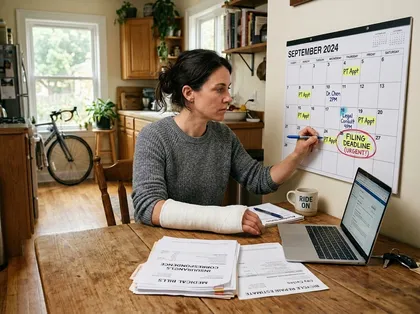
TL;DR: In California, the deadline for a bike accident claim depends on who caused the incident. If a public entity may be responsible, you usually must present a government claim within six months after the incident. If a personal injury lawsuit is required, you usually have two years from the date of a bicycle accident. Missing a deadline may bar you from seeking medical bills, lost wages, pain and suffering, and other damages.
Highlights:
- Calculate your exact filing deadline based on who caused the crash.
- If a public entity may be involved, file the government claim within 6 months.
- After a written government denial, calendar the lawsuit deadline – 6 months from notice.
- If the injured cyclist is under 18, track deadlines from age 18.
- Send written requests for dashcam or surveillance footage right away.
- Get prompt medical care and avoid treatment gaps in your medical and chiropractic records
- For hit-and-run, report within 24 hours and notify the insurer within 30 days.
Tip: Keep a dated folder of photos, contact information, symptoms, bills, and every letter or email from insurers or agencies.
Table of Contents
If you are wondering how long you have to file a bike accident claim in California, the state does not set a universal deadline. There are different time limits depending on the circumstances of the accident. Insurance, government, and UM claims may have different or shorter deadlines.
However, you should report the accident and submit your claim as soon as possible, because the applicable insurance policy may require prompt notice. The policy may contain additional notice, proof-of-loss, or arbitration requirements.
The deadline for filing a claim differs from that for filing a lawsuit. In bicycle accident cases where a personal injury lawsuit must be filed, the time limit is two years. Filing or negotiating a claim usually does not pause those two years.
The Two-Year Statute Of Limitations For California Bicycle Accidents
Under the Code of Civil Procedure (CCP) § 335.1, you usually have two years to file a lawsuit after a bicycle accident. This deadline is known as the statute of limitations.
In most bike crash cases, the clock starts on the accident date, not when you finish treatment. This deadline applies whether a careless driver caused the crash, another cyclist did, or a pedestrian was involved.
If you fail to file within this window and no exception applies, the defendant can ask the court to dismiss your case, which may cause you to lose the right to recover compensation. In most cases, this is the rule that governs your personal injury claim.
When the victim seeks compensation to repair or replace their bicycle and gear, and is not filing a claim for physical injuries, California allows a longer window. They have three years from the date of the accident to file a property damage lawsuit.
Tracking legal deadlines while recovering from a bicycle crash is difficult. Medical appointments, lost income, and physical pain demand most of your attention. It’s easy to assume you have more time than you actually do. The two-year window is a starting point, not a fixed rule. Depending on who caused the crash, your actual deadline could be much shorter. With this time pressure, seeking free advice from a bicycle accident lawyer can be beneficial.
A Short Deadline Applies For Accidents Involving Government Entities
The standard two-year window may not apply if a public entity or public employee in California is responsible. Under Government Code § 911.2, you must present an administrative claim against a public entity within six months of the accident. An administrative claim is a formal written notice you submit directly to the government agency before you can sue.
A government entity can be liable in more situations than you might think. If a public bus or city vehicle hit you, or if you crashed because of an unrepaired pothole on a city-maintained road, a public agency may be responsible for your injuries, depending on the facts.
Usually, the agency has 45 days to act on your claim. However, this period may be extended by written agreement.
If the public entity sends a compliant rejection notice, you usually have six months from the date it delivers or mails the denial to file a lawsuit. But the rejection notice must comply with Government Code § 913. If the agency does not send a compliant rejection notice, you generally have two years from the date the claim accrues to sue.

Exceptions That Pause The Clock
Not every injured cyclist has the same two-year deadline. California law allows certain circumstances to “toll,” or pause, the filing deadline. Tolling is a legal term for pausing the clock. When it applies, the countdown stops until a specific event occurs.
Tolling protects people who, through no fault of their own, cannot yet pursue a legal claim.
Injured Minors
If the injured cyclist was under 18, the two-year deadline usually does not start on the accident date. For many standard injury claims, the clock starts on the cyclist’s 18th birthday. This rule gives them until age 20 to file a lawsuit.
A minor’s standard personal injury lawsuit deadline may be tolled, but minority generally does not pause the six-month deadline for presenting a claim to a public entity. If that deadline is missed, an application for permission to present a late claim generally must be submitted within a reasonable time, within one year. California counts the period of minority when calculating that one-year limit.
Defendant’s Absence Or Incapacity
A qualifying legal incapacity may also toll the deadline, but the severity of an injury alone does not extend the filing period. A person who lacked the required legal capacity at the time of the accident may receive additional time to file under CCP § 352.
A brain injury or other condition meeting that legal standard depends on specific facts. It usually needs both medical and legal evaluations. This tolling rule usually doesn’t apply to claims against public entities. Those claims follow the government-claim deadlines mentioned earlier.
If a bicycle accident victim was imprisoned when the claim arose, CCP § 352.1 may toll the statute of limitations for up to two years or until your release, whichever occurs first. This tolling generally does not apply to claims subject to California’s government-claim requirements.
The Delayed Discovery Rule
In narrow cases, the two-year deadline may not start until you knew, or should have known, that you suffered injuries due to someone’s wrongful conduct. This rule is called the delayed discovery rule, and whether it applies depends on the specific facts of your case.
This is different from simply not realizing how bad your injury would turn out to be. If you know you’re hurt and who caused it, this rule usually won’t give you extra time. Even if the injury gets worse than you expected, it doesn’t change things.
Relying on this rule is risky, even when it applies. Insurers may challenge delayed claims. They may cite gaps in your medical records or argue that the crash did not cause your injury. Even if the delayed discovery rule applies, those gaps can still weaken your claim.
Arash Law’s bicycle accident lawyers can help you meet every reporting deadline. Knowing which deadlines apply to your case and acting on them is what determines whether your claim moves forward.
Why Waiting Until The Deadline Can Ruin Your Case
California’s two-year filing deadline gives you time on paper. In practice, the evidence that supports your claim can disappear in days. The longer you wait, the harder it becomes to prove what happened.
Key evidence can become harder to find right after the crash:
- Surveillance and Dash Camera Footage: Businesses and drivers may quickly delete or overwrite footage. Retention times vary by system, storage, and settings.
- Witness Memories: People who witnessed the crash may forget key details over time. Witnesses may also move, change phone numbers, or become harder to reach. The defense may challenge their accounts more easily as time passes.
- Road and Scene Conditions: Skid marks fade, debris gets cleared, and road conditions change. Physical evidence that could help prove fault may not last.
- Medical Causation: Medical causation means showing that the crash caused your injuries, not something else. If you delay seeing a doctor or chiropractor, the defense can argue your injuries came from another source. Gaps in your medical records can give them that opening.
What Should You Do Immediately After A Bicycle Accident?
Besides the deadlines for filing a claim, your safety comes first after a bicycle accident. Knowing what to do after a bicycle-car accident can help protect your claim.
When you can do so safely, take these steps:
- Move out of traffic and remain at the scene.
- Exchange names, contact information, driver’s license details, license plate numbers, and insurance information with every involved driver.
- Ask witnesses for their names, phone numbers, and email addresses.
- Photograph the vehicles, bicycles, injuries, debris, skid marks, traffic signs, road defects, bike lanes, lighting, and the surrounding area.
- Avoid admitting fault, apologizing for causing the crash, or guessing about what happened.
- Ask the responding agency for the report or incident number, and for instructions on obtaining a copy.
- Preserve your bicycle, helmet, clothing, lights, electronics, and damaged equipment without repairing or discarding them.
- Seek medical evaluation promptly. Some head, neck, back, and soft-tissue injuries may not be immediately apparent. Keep copies of your medical documents and bills.
You should also notify the appropriate insurance companies promptly, but use care when discussing fault, injuries, or a settlement before the full facts and medical consequences are known.
When a motor vehicle is involved, its driver generally must file a DMV SR-1 report within 10 days if anyone is injured or killed, or property damage exceeds $1,000. This report is separate from any police or insurance report.
Frequently Asked Questions About Bike Accident Claims
A bicycle accident can turn your life upside down instantly. While you focus on healing, legal deadlines continue to run in the background. Knowing how these timelines work is one of the most important steps you can take to protect your right to compensation. The following are some common questions about bike accident claims.
What Is The Difference Between An Insurance Claim And A Court Lawsuit?
An insurance claim is an informal negotiation process conducted directly with an insurance carrier to settle financial damages. A lawsuit is a formal legal proceeding filed in a civil court when negotiations stall or when the statute of limitations approaches. Filing an insurance claim does not stop the legal countdown for filing a lawsuit.
What Happens If I Miss The Statute Of Limitations Deadline?
If you miss the statute of limitations, the court may dismiss your case if no exception applies. A strong injury claim may still fail if you miss the deadline. Once the deadline passes, the defendant can ask the court to dismiss the lawsuit. You may lose the right to recover medical bills, lost wages, pain and suffering, and other damages.
Are The Deadlines Different If A Family Member Died In A Bicycle Accident?
Yes. You usually must file a wrongful death lawsuit within two years from the date of death, not the accident date. If the death occurred on a different day from the crash, that distinction matters for calculating your deadline. If a public entity or an employee may be responsible, the family must usually also present a government claim within six months.
What If The Driver Who Caused The Crash Was Uninsured?
You may need to turn to your own Uninsured Motorist (UM) coverage. UM claims have separate policy and statutory requirements. In California, the insured victim generally must sue the uninsured driver, reach an agreement on the amount due under the policy, or formally commence arbitration within 2 years of the accident.
Hit-and-run claims may also require prompt notice to the police and the insurer. California law generally requires a police report within 24 hours and a sworn statement to the insurer within 30 days.
What Does A Personal Injury Lawyer Actually Do For My Claim?
A personal injury lawyer manages every aspect of your case: investigating the accident, preserving critical video and physical evidence, handling all communications with insurance adjusters, consulting medical experts to value future care, and filing formal lawsuits before deadlines expire.
Hurt In A Bike Accident? Arash Law Can Support You
At Arash Law firm, we have handled serious injury cases for bicyclists and motorcyclists across California. These cases often involve disputed fault, severe injuries, and drivers or other parties who deny blame. As an example, here is a case our lawyers handled.
- A young boy suffered a traumatic brain injury after a pickup truck struck him while he rode his bike.
- The defense tried to shift the blame to the child, but our team focused on the driver’s behavior.
- Our lawyers used discovery and depositions to get the driver to admit he was distracted, and we recovered $3,500,000 for our client.
Each case depends on its own facts, evidence, injuries, and insurance coverage. Past results do not promise the same result in a future case.
A bike accident can leave you hurt, stressed, and unsure what to do next. Our bicycle accident lawyers can explain your rights, review your deadlines, and help you protect key evidence before it disappears. California’s filing deadlines are strict, and missing them can hurt your right to file if no exception applies.
Arash Law, also known as AK Law, handles bicycle accident cases on a contingency fee basis. Do lawyers only get paid if they win? With us, the answer is yes. You owe no attorney fees unless your lawyer recovers compensation for you. Your fee agreement should explain any case costs.
Contact us today for a consultation before your deadline runs out. Call at (888) 488-1391 to speak with our team.