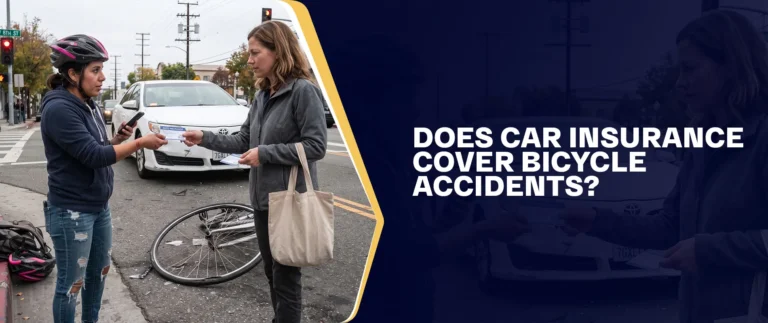
TL;DR: Report a bike crash involving injury or death to law enforcement within 24 hours. If a motor vehicle is involved, the driver must file an SR-1 within 10 days when someone is injured or killed, or the damage exceeds $1,000. Failure to file may suspend the motorist’s license. Prompt reporting may also preserve uninsured-motorist coverage after an unidentified hit-and-run.
Highlights:
- Confirm that an officer filed a collision report, and ask for the report number.
- Ask the officer to document your statement and visible injuries before leaving.
- Submit a written supplemental statement if the CHP report is incomplete or wrong.
- Get medical care immediately, even if you feel fine, since adrenaline can mask serious injuries.
- Photograph injuries, bike damage, vehicle damage, skid marks, and road conditions.
- Save your helmet, clothing, and damaged bike parts as-is (do not repair or wash) to preserve evidence.
- Collect witness names and phone numbers before they leave the scene.
- Stick to the facts when speaking with law enforcement and insurance companies.
- Send your insurer a sworn statement within 30 days for hit-and-run UM claims.
Tip: When a hit-and-run occurs, call 911 right away to establish an official record that you were the victim, and note any vehicle details witnesses provide.
Table of Contents
A bicycle accident resulting in injuries or a fatality triggers a specific duty. Every driver involved must file a written report with the California Highway Patrol (CHP) or local police within 24 hours. If the crash caused injury, death, or more than $1,000 in property damage, the motor vehicle driver must also submit an SR-1 form to the California Department of Motor Vehicles (DMV) within 10 days.
Both reports create an official record that can help support a compensation claim. Missing either deadline can weaken a case before it even begins. California law sets out the requirements for the written report. Understanding how to report a bike accident can help build an injury claim.
How To Report A Bicycle Accident In California
After a bicycle accident in California, report the crash promptly, especially when someone is injured, a motor vehicle is involved, or the driver leaves the scene. Keep in mind that speaking with the police, ensuring a written report is filed, submitting a DMV form, and notifying an insurer are separate steps. Taking care of one does not automatically complete the others.
Contact The Correct Law Enforcement Agency
In the event of a crash on a city street, contact the local police department. The CHP generally investigates crashes on freeways and unincorporated roads. Responsibility for a state route within city limits may vary. Still, an injury or fatality report arising within a city may be submitted to either CHP or the city police department. An agency not responsible for the investigation must forward the report to the appropriate agency.
Calling 911 or speaking with an officer at the scene creates an initial record of the crash. Provide as much information as possible, including:
- The date, time, and exact location.
- The driver’s name, license plate, vehicle description, and insurance information.
- Names and contact information for witnesses.
- A description of the collision and any suspected traffic violation.
- Photographs, videos, dashcam footage, and nearby surveillance cameras.
- Your injuries and damage to the bicycle, helmet, phone, clothing, or other property.
For a hit-and-run, give police every available detail about the fleeing vehicle, including its color, make, model, license plate characters, identifying damage, and direction of travel. If the driver refuses to provide information or tries to leave, avoid arguing or putting yourself in further danger. Record identifying details when it is safe to do so.
Ask for the incident number, the responding officer’s name, and instructions for obtaining the completed report. Once the report is available, request a copy from the agency that investigated the crash. You may need the report number, crash date, location, and names of the people involved. Review the report for errors involving contact information, witness details, injury descriptions, statements, vehicle information, and diagrams.
If the police or CHP report omits important details or contains errors, contact the agency that handled the crash. Ask how to request a correction or add a statement. You can submit photos, witness information, medical records, or other proof, but the agency may still keep the officer’s original conclusions.
For non-emergencies and accident reporting, you can reach the CHP at 1-800-TELL-CHP (1-800-835-5247).
Make Sure An Injury Accident Is Reported Within 24 Hours
California Vehicle Code § 20008 requires the operator of a vehicle involved in an injury or fatality crash to make or cause a written report within 24 hours. A cyclist riding on a highway is generally subject to the accident-reporting duties that apply to vehicle drivers under Division 10 of the Vehicle Code.
Calling 911 or speaking with an officer does not always mean a written collision report was completed. If officers respond, ask whether they will prepare the required report and whether you need to do anything else. If no officer comes to the scene, contact the local police department or CHP promptly and ask how to submit the report.
Report The Accident To The Appropriate Insurer
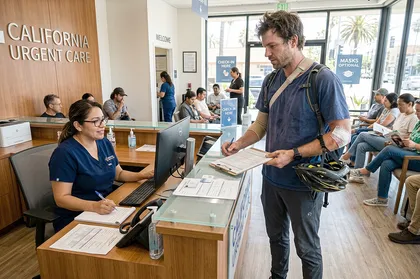
A police report or SR-1 does not open an insurance claim. The accident must be reported separately to any insurer whose coverage may apply.
This may include:
- The at-fault party’s liability insurer.
- Your own auto insurer for uninsured-motorist or underinsured-motorist coverage.
- Your own medical payments (MedPay) coverage, if available.
- Another applicable policy covering a household member or involved vehicle.
When reporting the accident, provide the crash date, location, police report number, driver information, witness details, and a general description of your injuries and property damage. Ask for the claim number and the adjuster’s contact information, and keep copies of all correspondence.
You can give the basic facts without accepting blame or estimating the full extent of your injuries. Some injuries take time to appear. Avoid guessing or agreeing to a recorded statement from the other driver’s insurer before you understand your rights.
For a bodily-injury uninsured-motorist claim involving an unidentified hit-and-run driver, California generally requires physical contact, a law-enforcement report within 24 hours, and a sworn statement to the insurer within 30 days. The cyclist must also qualify as an insured under the applicable policy.
Determine Whether A DMV SR-1 Is Required
A police report and a DMV accident report are different documents. When a motor vehicle is involved, the motorist must submit an SR-1 to the California DMV within 10 days if anyone:
- Was injured or killed, even if the injury appeared minor.
- Has suffered more than $1,000 in property damage.
A bicycle-only collision generally does not require an SR-1, as the rule applies only to drivers of motor vehicles. The motorist’s insurance agent, broker, attorney, or another representative may file the form on the motorist’s behalf. The DMV uses the SR-1 to record the crash and check insurance requirements, not to decide who caused it.
Which Report Applies?
- Injury or Fatality Crash: Make sure law enforcement completes a written report within 24 hours.
- Bike-Versus-Motor-Vehicle Crash: The motorist may also need to file an SR-1 with the DMV.
- Bicycle-Only Crash: An SR-1 usually is not required, but a police report may still be useful if someone was injured, property was damaged, or another cyclist left the scene.
- Hit-and-Run: Report the crash to police right away and notify your insurer if your uninsured motorist coverage may apply.
- Property-Damage-Only Crash: The motorist must file an SR-1 if one person’s property damage exceeds $1,000. Police reporting may also be required depending on the circumstances.
How The Accident Report Affects Liability And Your Claim
An accident or police report serves as the foundational evidence for an insurance claim. It can establish an official record of the crash and influence how insurers evaluate liability. A California accident report can help document:
- When and where the bicycle crash occurred
- Who was involved
- Witness information
- Physical evidence
- Statements collected during the investigation
The report does not make the final decision about fault. However, insurance companies may use it when reviewing the claim. They may also look at whether you were in a bike lane, how soon the crash was reported, and what each person did before the crash.
California follows a pure comparative negligence rule. The California Supreme Court established this standard in Li v. Yellow Cab Co. (1975). Under this rule, you can still recover even if you were partly to blame, but your percentage of fault reduces your available compensation. A clear police report can create a third-party record before an insurer can push a different version of events.
Immediate Steps To Protect Your Health And Legal Rights
The steps you take after a bike crash can affect both your health and your legal case. Getting medical care, documenting the scene, and sticking to the facts can help protect you in both ways. Understanding what to do after a bicycle-car accident can help in pursuing compensation for the resulting injuries and damages.
- Get medical care right away. Go to an emergency room or an urgent care center, even if you feel fine. Adrenaline can hide pain, and injuries like concussions may not show symptoms for hours or days.
- Document the scene. If you can, take photos of your injuries, your bicycle, and the vehicle involved. Also, photograph skid marks and the road around you. Photos preserve details that memory cannot.
- Collect witness information. Ask anyone who saw the crash for their name and phone number. Witnesses can be decisive when a driver disputes what happened.
- Stick to the Facts: Give police and insurers an accurate account of what you clearly remember. Do not admit fault or guess about speed, distance, or how the crash happened. Tell the officer about all pain and symptoms you notice, but do not exaggerate or minimize them. You generally do not have to give a recorded statement to the other driver’s insurer before speaking with an attorney.
- Keep a journal. Write down everything you remember about the bike crash, including the time, location, road conditions, and the sequence of events. Log every medical visit and symptom. If the driver left without stopping, your notes and the police report may be the only records of what happened, so document as much detail as you can.
- Contact a bike accident attorney. Experienced bicycle accident lawyers can identify which reports and insurance notices apply to your crash. They can help obtain the police report, request corrections or submit supporting information when errors are present, and communicate with insurance companies on your behalf.
At Arash Law, we have years of experience advocating for the rights of cyclists and other road users injured by others’ negligence.
- $3,500,000: We secured a $3.5 million settlement for a 6-year-old boy who suffered a traumatic brain injury after being hit by a truck. The driver admitted to being distracted, shifting the blame away from the child.
- $10,000,000: We were able to help our client recover $10 million after being severely injured by a speeding vehicle. We ensured he received top-quality medical care to support a successful recovery.
- $5,000,000: Despite initial evidence suggesting our client was at fault, we proved the truck driver made a dangerous turn that contributed to the accident. This resulted in a $5 million recovery for our client.
Disclaimer: The results described above are not guarantees or predictions of future outcomes in similar cases. Each case varies based on its unique facts and circumstances.
You should also watch the filing deadlines. California generally gives you two years from the crash date to file a personal injury lawsuit. If the victim is a minor, the two-year time limit is paused until they turn 18.
A shorter deadline may apply if a city, county, public bus, government worker, or unsafe public road was involved. In many government claims, you must file a separate claim within six months. Missing the correct deadline may prevent you from seeking compensation.
Frequently Asked Questions
After a crash, many cyclists are left with questions that the basics don’t cover. What if the driver ran? What if you weren’t wearing a helmet? Getting free advice from a bicycle accident lawyer can help you understand where you stand. The questions below address the situations that injured riders most often ask about.
Who Pays For Damages In A Hit-and-Run Bicycle Accident?
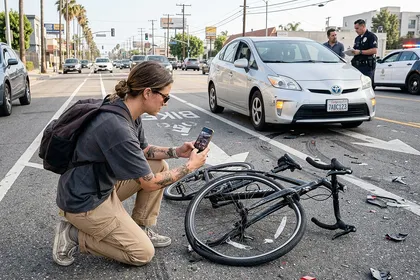
If police identify the hit-and-run driver, that driver’s liability insurance may pay for your covered losses, up to the policy limits. If the driver is not found or has no insurance, your own uninsured-motorist coverage may apply if you qualify under the policy.
Even though you were riding a bicycle, uninsured motorist (UM) coverage may still protect you if a motor vehicle hits you. UM coverage is part of an auto insurance policy and may help pay for injuries when the at-fault driver has no insurance or cannot be identified. For a claim involving an unidentified driver, California generally requires:
- Physical contact.
- A police report within 24 hours.
- A sworn statement to the insurer within 30 days.
Missing these steps may affect coverage. Submit the required documents as soon as possible, even if your injuries and losses are still being evaluated.
Can I Still Claim Compensation If I Wasn’t Wearing A Helmet?
Yes. You may still recover compensation even if you were not wearing a helmet. If you suffered a head injury, the other side may argue that a helmet would have reduced the harm. Any reduction would depend on proof that not wearing a helmet actually worsens your injuries. You may still recover for injuries that a helmet would not have prevented.
What Happens If The Police Report Says I Was At Fault?
You may still challenge the report and seek compensation. A police report does not determine fault. Witness statements, photos, video, vehicle damage, and other evidence may support a different conclusion.
Even if you share some fault, California law may still allow you to recover compensation. Your percentage of responsibility would generally reduce your payment.
Contact Arash Law For Help With Your Bicycle Accident Claim
A bicycle crash can leave you with medical bills, lost wages, and serious unanswered questions about your options. If you reach out, we can discuss your situation and explain what compensation may be available to you.
Victims often wonder, “Do lawyers only get paid if they win?” In most personal injury cases, the answer is yes. Many injury attorneys, including those who work at Arash Law, operate on a contingency fee basis. This means you pay no attorney’s fees unless we recover compensation for you. Our bicycle accident lawyers at AK Law can help investigate your case, preserve key evidence, and work to meet filing deadlines.
Call us at (888) 488-1391 to schedule your free initial consultation.