TL;DR: If you were stopped or driving safely and another vehicle pushed you into the car ahead, the rear driver may be liable for both impacts. However, if you hit the front car first and then the other driver rear-ends you, you may share responsibility. California uses comparative fault, so several drivers can be assigned shares of fault when their actions contributed to the crash.
If another driver rear-ended you and pushed you into the car ahead, the rear driver may be responsible for both collisions. You are not automatically at fault simply because your vehicle made contact with the car in front of you.
The answer changes if you hit the front car before the rear impact. In that situation, you may be responsible for the first collision. The rear driver may still be responsible for the second impact and any additional harm it caused.
Fault can also be divided among several drivers. Your following distance, the rear driver’s speed, the front driver’s actions, and the order of impacts can all affect liability.
Key Facts About Fault in Rear-End Collisions Involving 3 Cars in California
- The rear driver can be responsible for both impacts. California Vehicle Code (CVC) § 21703 requires drivers to maintain a reasonable and prudent following distance.
- The middle driver can also share fault. California’s pure comparative fault rule allocates responsibility based on each person’s contribution to the crash.
- The front driver can sometimes share responsibility. Civil Code § 1714 applies if their lack of ordinary care contributes to an accident, like making an unsafe lane change.
- Several insurance policies may become involved. Auto liability coverage and uninsured and underinsured motorist coverage may apply under California Insurance Code § 11580.2.
- A separate DMV report may be required. CVC § 16000 generally requires an SR-1 within 10 days after a qualifying collision.
Table of Contents

Who is Responsible for a Multi-Vehicle Rear-End Collision?
In a three-car rear-end collision, the rear driver, middle driver, lead driver, or more than one of them may be responsible. Liability depends on whose negligence caused each impact.
- The rear driver may be responsible for both collisions if they hit the middle vehicle, causing it to collide with the lead vehicle. For example, if you were stopped behind another car at a safe distance and the rear impact forced you forward, the rear driver may be liable for injuries and damage caused by both impacts.
- The middle driver may be responsible for the first collision if they rear-ended the lead vehicle before being struck from behind. The rear driver may still be responsible for the second collision and any additional injuries or damage they caused.
- The lead driver may share responsibility if their own negligent driving contributed to the crash. This might include an unsafe lane change, cutting into traffic without enough space, or deliberately brake-checking another driver. Simply stopping suddenly for traffic, a signal, or a roadway hazard does not by itself establish fault.
- The middle and rear drivers may share responsibility if both contributed to the chain reaction. For example, the middle driver may have followed the lead vehicle too closely, while the rear driver either followed too closely or failed to stop in time.
- Several drivers may be responsible for a larger pileup. One driver may cause the first collision, while other drivers who fail to stop cause additional impacts. Each driver can be held responsible for the harm their negligence caused.
Based on these principles, if you’re the middle driver, you’re not automatically liable just because your vehicle hit the car in front. If you were stopped and the rear driver pushed you into the car ahead, the rear driver may be responsible for both impacts. If you struck the front car before being rear-ended, you may share responsibility. These principles also apply when someone rear-ends a car and pushes it into yours.
If you share some fault, your insurer may also be involved in covering the damages. California’s pure comparative fault rule allows responsibility to be divided according to each driver’s percentage of fault. This means more than one driver can be at fault.
If you are found partly responsible, your compensation may be reduced by your percentage of fault. For example, if your proven damages are $300,000 and you are found 20 percent at fault, your recovery may be reduced by 20 percent. The other driver’s responsibility does not disappear simply because you also share some fault.
How to Determine Responsibility in a Chain-Reaction Crash?
Responsibility in a chain-reaction crash depends on who caused each impact and whether another driver’s actions also contributed. Investigators do not simply blame the last car or the middle car. They look at the order of the collisions and what each driver was doing beforehand.
Fault can be apportioned if several drivers were following too closely, speeding, or otherwise driving without reasonable care. California law provides several rules for making that determination:
- Following Distance: Vehicle Code § 21703 requires drivers to leave a reasonable and prudent distance based on speed, traffic, and roadway conditions.
- Unsafe Speed: Vehicle Code § 22350 requires drivers to travel at a speed that is safe for current conditions. A driver can violate this rule even while driving below the posted limit.
- Ordinary Care: Civil Code § 1714 generally holds people responsible for injuries caused by their failure to use ordinary care.
- Traffic Law Violations: Evidence Code § 669 can create a rebuttable presumption of negligence when a violation causes the type of harm the law was designed to prevent.
- Sudden Emergency: CACI No. 452 may apply when a driver faces an emergency that they did not cause and responds as a reasonably careful person would.
In a three-car rear-end crash, the key questions are therefore which impact occurred first, what caused the crash, and whether each driver’s conduct contributed to the subsequent collisions.
How Damages May Be Divided Among Drivers
When more than one driver is at fault, California law treats different types of damages differently. Under Civil Code § 1431.2, each at-fault person is generally responsible only for their own share of non-economic damages, such as pain and suffering. For economic damages, such as medical bills and lost wages, at-fault parties may be “jointly and severally” liable.
This means an injured person may be able to collect the full amount of economic damages from any one at-fault party, who may then seek repayment from the others. This rule can make a real difference in multi-car crashes, especially if one driver has little or no insurance.
What Compensation May Be Available?
If another driver was at fault, you may be able to seek compensation, known as “damages,” for your losses.” The amount of any recovery depends on the facts, the evidence, the available insurance coverage, and your share of fault, if any.
These damages may be recoverable:
- Economic Damages: Past and future medical expenses, chiropractic care, lost wages, reduced earning capacity, vehicle repair or replacement, rental car costs, and the cost of needed household help.
- Non-Economic Damages: Pain and suffering, emotional distress, loss of enjoyment of life.
Under California’s Proposition 213 (Civil Code § 3333.4), a driver who did not have the required auto insurance at the time of the crash generally cannot recover non-economic damages, even if another driver was entirely at fault. Economic damages may still be recoverable. Limited exceptions apply, including when the at-fault driver is convicted of DUI in connection with the crash.
What Evidence Can Show Which Impact Happened First?
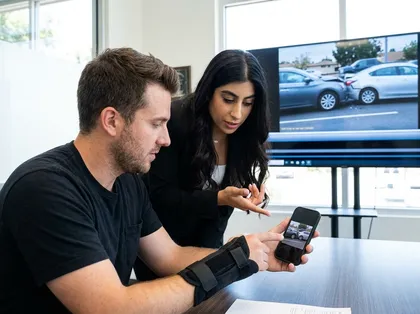
Evidence showing the order of impacts can be crucial when the middle and rear drivers disagree about what happened. When there’s a dispute over liability, it’s important to preserve evidence from the vehicle. This should happen before the vehicle is repaired, sold, or disposed of.
The following evidence can help show whether the middle vehicle struck the car ahead on its own or was pushed forward by the rear impact:
- Dashcam Footage: Videos may show that your vehicle was already stopped before the rear impact.
- Surveillance or Traffic-Camera Footage: Nearby cameras may capture the sequence from another angle.
- Damage to All Vehicles: Front and rear crush patterns can help explain how the force moved through the vehicles.
- Witness Statements: An independent witness may remember which collision happened first.
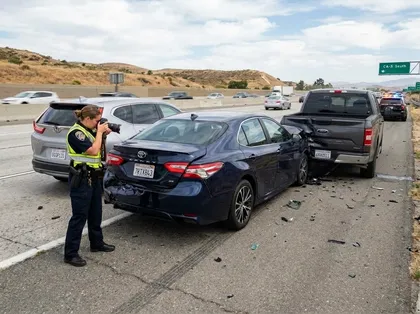
- Police or California Highway Patrol (CHP) Reports: Reports can document statements, vehicle positions, roadway evidence, and observations.
- Scene Photographs: Images may show vehicle positions, skid marks, debris, lanes, and surrounding conditions.
- Vehicle Inspection Records: Physical inspections can help compare damage across all involved vehicles.
- Event Data Recorder (EDR) Information: Some vehicles, such as commercial trucks, record technical crash information that may help reconstruct the events. Event Data Recorders do not contain the same information in every vehicle.
A driver’s statement that “you hit the car in front” tells only part of the story. The important question is whether you struck that vehicle under your own momentum or because another vehicle propelled you forward.
An experienced rear-end accident lawyer can send preservation demands for EDR data and surveillance footage before either is permanently erased or overwritten.
Steps to Take After a Chain-Reaction Crash
Focus on your health, document the scene, and preserve evidence showing the impact sequence.
- Get medical care when needed. Report your symptoms and explain how the collision occurred.
- Call 911. If the crash happened within city limits, the city police department typically responds and prepares the official collision report. The CHP generally handles crashes on state highways, freeways, and roads in unincorporated county areas.
- Photograph every vehicle. Capture the front, rear, and sides of each vehicle when possible.
- Photograph the scene. Include vehicle positions, lanes, traffic signals, skid marks, and other relevant conditions.
- Identify witnesses. Get contact information from people who saw the initial impact.
- Preserve video and vehicle data. Save dashcam recordings and identify nearby cameras that may have captured the crash.
- Report the crash when required. California generally requires an SR-1 form to be filed within 10 days when someone is injured or killed or when any one person’s property damage exceeds $1,000.
The SR-1 must be filed with the California Department of Motor Vehicles (DMV). This report is separate from a police, CHP, or insurance report.
Which Insurance Policy May Pay After a Chain-Reaction Crash?
More than one insurance policy may apply because multiple vehicles and claims are. If the rear driver caused both impacts, that driver’s auto liability insurer may face claims by the owners or occupants of the middle and lead vehicles.
Several injured people may seek payment from the same policy. For standard California auto policies, the current minimum liability limits, effective January 1, 2025, are:
- $30,000 for bodily injury or death per person.
- $60,000 total for bodily injury or death per accident (when multiple people are injured).
- $15,000 for property damage per accident.
Your own liability insurer should also receive notice when the driver in front claims that you caused the collision. The insurer can investigate the claim and defend you under the policy terms. A claim against your insurance does not establish that you were legally responsible.
Here are some of your own coverage options that may help:
- Collision coverage can pay for covered damage to your vehicle, subject to your deductible and policy terms.
- Medical payments coverage can pay qualifying medical expenses if you purchased it.
- Uninsured motorist coverage may apply to qualifying bodily injuries caused by an uninsured driver. It may also apply when the driver who caused the crash flees the scene.
- Underinsured motorist coverage may apply when an at-fault driver’s available bodily injury coverage is insufficient. California Insurance Code § 11580.2 generally requires UM bodily injury protection in covered auto policies unless it is properly rejected or reduced in writing.
How Long Do I Have to File an Injury Claim?
Different deadlines apply to injury lawsuits, property damage, government claims, and DMV reporting. A government claim may arise if a public vehicle or the condition of public property contributed to the crash. Missing any of these deadlines may jeopardize a claim.
| Type | General California Time Limit | Authority |
|---|---|---|
| Personal injury lawsuit | Two years | CCP § 335.1 |
| Property damage lawsuit | Three years | CCP § 338(c)(1) |
| Claim against a public entity | Six months to present the claim | Gov. Code § 911.2 |
| DMV SR-1 report | 10 days after a qualifying crash | CVC § 16000 |
California generally pauses the two-year personal injury lawsuit deadline while the injured person is under 18. That usually gives them until age 20 to file. This pause does not apply to claims against public entities. A government claim must generally be presented within six months, even if the injured person is a minor.
Presenting a government claim is a step before filing a lawsuit. If the public entity sends a written rejection that complies with Government Code § 913, you generally have six months from the date the notice is personally delivered or mailed to file suit. When a compliant written notice isn’t sent, a different deadline generally applies. If the six-month deadline was missed, a late-claim application may be available within one year.
Working with experienced rear-end accident attorneys can help determine the applicable deadline for your case.
Arash Law Can Handle Disputed Fault in Multi-Vehicle Crashes
When drivers and insurers disagree about who caused a chain-reaction crash, Arash Law focuses on reconstructing the sequence of impacts and identifying what each driver did before the collision.
In a disputed-fault case, Arash Law may:
- Compare each driver’s account with the physical evidence.
- Identify traffic-law violations, such as following too closely or driving too fast for conditions.
- Challenge an insurer’s attempt to assign fault that is not supported by the evidence.
- Determine whether more than one driver shares responsibility under California’s comparative fault rule.
- Review all potentially available liability, UM/UIM, collision, and other insurance coverage.
- Document the injuries and losses caused by each impact when the crash involved more than one collision.
- File a lawsuit and use discovery, depositions, and expert analysis when the parties cannot resolve fault through the claims process.
Arash Law has already handled rear-end cases where liability, injury severity, or causation was disputed. For example, we achieved a $1.3 million recovery in a rear-end case involving lumbar disc injuries where the defense described the crash as a low-speed fender-bender.
Call (888) 488-1391 for a free case evaluation. Our car accident lawyers can review your case and determine if you have a viable claim.
Past results do not guarantee future outcomes. Every case depends on its own facts, evidence, injuries, insurance, and applicable law.
Frequently Asked Questions About Multi-Car Rear-End Accidents in California
Can the Driver in Front Make a Claim Against Me Even if I Was Pushed?
Yes. The front driver can present a claim against you or your insurer, but making a claim does not establish liability.
Your insurer can investigate whether you caused the collision with the vehicle ahead or whether the rear driver pushed you into the lead vehicle. Video, witnesses, vehicle damage, and other evidence may help resolve the dispute.
Does the Police Report Completely Decide Who Is at Fault?
No. A police report is an important document, but it is not a legal ruling on liability. Officers typically arrive after the crash has occurred and record initial statements from drivers who may be in shock, injured, or uncertain about what happened. Reports can contain errors, reflect incomplete information, or miss physical evidence that later emerges. A report’s conclusions do not bind a court or insurer.
An attorney can challenge the report using dashcam footage, witness accounts, EDR data, and traffic camera recordings. If the report contains factual errors, you or your attorney can request a correction from the investigating agency or file a supplemental statement through the proper channel.
Can I File an Injury Claim if My Car Has Minor Damage?
Yes. Minor visible vehicle damage does not automatically prevent an injury claim. You still need evidence showing that you suffered an injury and that the collision caused or contributed to it. Medical records, symptoms, treatment, and crash evidence can help address that issue.
How Much Does it Cost to Hire a Rear-End Accident Attorney?
Many California personal injury attorneys, including those at Arash Law, use contingency fee agreements. We handle personal injury cases on a contingency fee basis, so clients do not owe attorneys’ fees unless we recover compensation on their behalf. The written agreement explains the attorney’s fees and other case-related costs.
Speak with Arash Law About Your California Rear-End Crash Claim
A three-car crash can produce several competing versions of the same event. The key question is not simply whether your vehicle touched the car ahead. The evidence must show why that contact happened.
If another driver pushed you into the car ahead, the fact that your vehicle made contact does not automatically make you responsible. Arash Law can investigate the cause of each impact, preserve available evidence, identify applicable coverage, and address disputed fault.
We represent injured people in motor vehicle claims throughout California, including cases involving disputed fault or multiple insurance carriers. Call (888) 488-1391 for a free case evaluation.
Arash Law: Make Them Pay, Call AK.
Sources
- California Vehicle Code § 21703. Following Distance. California Legislative Information. https://leginfo.legislature.ca.gov/faces/codes_displaySection.xhtml?lawCode=VEH§ionNum=21703
- California Vehicle Code § 22350. Basic Speed Law. California Legislative Information. https://leginfo.legislature.ca.gov/faces/codes_displaySection.xhtml?lawCode=VEH§ionNum=22350
- California Evidence Code § 669. Presumption of Negligence. California Legislative Information. https://leginfo.legislature.ca.gov/faces/codes_displaySection.xhtml?lawCode=EVID§ionNum=669
- California Civil Code § 1714. Responsibility for Lack of Ordinary Care. California Legislative Information. https://leginfo.legislature.ca.gov/faces/codes_displaySection.xhtml?lawCode=CIV§ionNum=1714
- Li v. Yellow Cab Co., 13 Cal.3d 804 (1975). Pure Comparative Negligence. California Supreme Court. https://scocal.stanford.edu/opinion/li-v-yellow-cab-co-30178
- CACI No. 452: Sudden Emergency. Judicial Council of California Civil Jury Instructions, 2026 Edition.
- https://courts.ca.gov/system/files/file/judicial_council_of_california_civil_jury_instructions_2026.pdf
- California Vehicle Code § 16000. Traffic Accident Reporting Requirements. California Legislative Information. https://leginfo.legislature.ca.gov/faces/codes_displaySection.xhtml?lawCode=VEH§ionNum=16000
- California Department of Motor Vehicles. Report of Traffic Accident Occurring in California, Form SR-1. https://www.dmv.ca.gov/portal/dmv-virtual-office/accident-reporting/
- California Department of Insurance: Automobile Insurance and Minimum Liability Limits. https://www.insurance.ca.gov/01-consumers/105-type/95-guides/01-auto/auto101.cfm
- California Insurance Code § 11580.2. Uninsured and Underinsured Motorist Coverage. California Legislative Information. https://leginfo.legislature.ca.gov/faces/codes_displaySection.xhtml?lawCode=INS§ionNum=11580.2
- Code of Civil Procedure § 335.1. Two-Year Statute of Limitations for Personal Injury. California Legislative Information. https://leginfo.legislature.ca.gov/faces/codes_displaySection.xhtml?lawCode=CCP§ionNum=335.1
- Code of Civil Procedure § 338. Three-Year Statute of Limitations for Property Damage. California Legislative Information. https://leginfo.legislature.ca.gov/faces/codes_displaySection.xhtml?lawCode=CCP§ionNum=338
- Government Code § 911.2. Six-Month Deadline for Government Tort Claims. California Legislative Information. https://leginfo.legislature.ca.gov/faces/codes_displaySection.xhtml?lawCode=GOV§ionNum=911.2
- Business and Professions Code § 6147. Contingency Fee Agreements. California Legislative Information. https://leginfo.legislature.ca.gov/faces/codes_displaySection.xhtml?lawCode=BPC§ionNum=6147
- National Highway Traffic Safety Administration. Event Data Recorders. https://www.nhtsa.gov/research-data/event-data-recorder
- Arash Law: Case Results. https://arashlaw.com/case-results/
Disclaimer
The information on this page is for general educational purposes and does not constitute legal advice. No attorney-client relationship is formed by reading or relying on this content. If you were injured, consult a licensed California personal injury attorney about your specific situation.